Crypto Lending Rebuilds From The Rubble, Reaching $25B In New Activity—Study

bitcoinistPublié le 2025-12-02Dernière mise à jour le 2025-12-02

Résumé

Reports have disclosed that centralized crypto lending climbed to roughly $25 billion in outstanding loans in the third quarter, a...

Trusted Editorial content, reviewed by leading industry experts and seasoned editors. Ad Disclosure

Reports have disclosed that centralized crypto lending climbed to roughly $25 billion in outstanding loans in the third quarter, a figure that signals renewed activity among centralized platforms. Activity has picked up this year, and some firms that survived the recent shake-out are growing their loan books again.

CeFi Surges

According to Galaxy Research, the broader crypto lending market totaled about $36.5 billion as of Q4 2024, down from a high of $64.4 billion in Q4 2021. That drop reflects the fallout from earlier platform failures and bankruptcies that cut into both supply and demand.

The makeup of the market has shifted. Based on reports, the largest centralized lenders — including Tether, Galaxy and Ledn — now account for a large share of CeFi loans. Those three together held close to $10 billion of CeFi outstanding loans, equal to roughly 88.6% of that segment by the end of last year. Tether alone represented the biggest single slice.
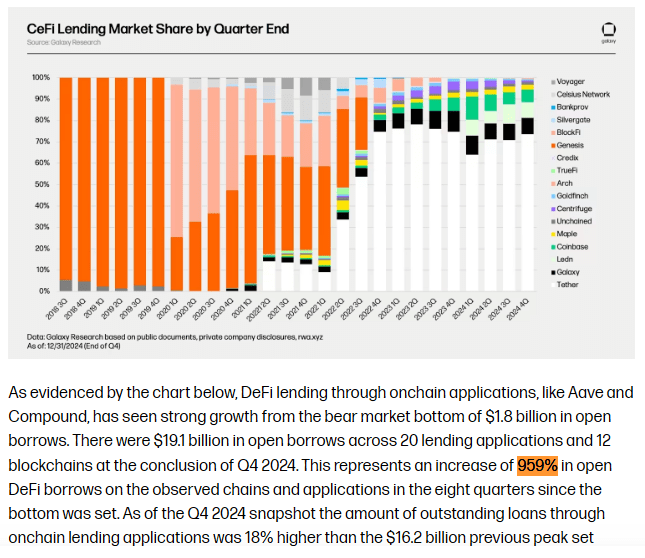
Source: Galaxy Research

DeFi Borrowing Sees A Strong Comeback

DeFi borrowing has recovered sharply from the lows of the 2022–2023 downturn. Open borrows on decentralized platforms climbed from about $1.8 billion in the trough to $19 billion by the end of 2024, an increase of 959% over the period. This shows many users moved back to on-chain solutions as centralized options contracted.
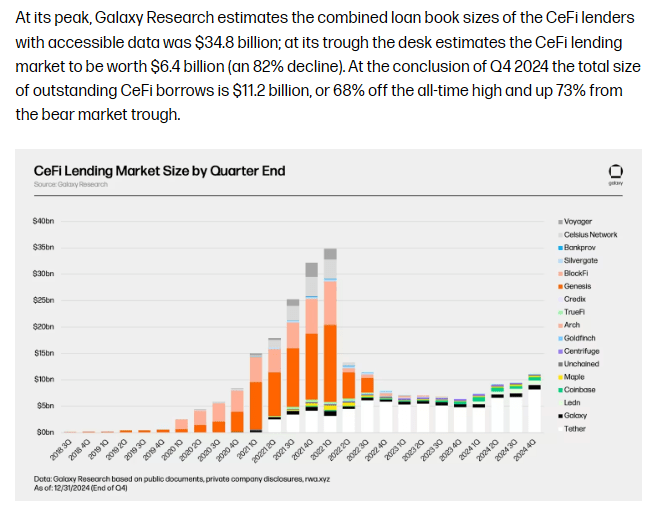
Source: Galaxy Research

Why Numbers Matter Now

Market watchers say the new totals matter because they reveal where activity lives today: more on chain, and concentrated among fewer centralized players. Some lenders appear to be operating with higher collateral levels and clearer reporting than some of the failed firms of past years. That has calmed some investors. Still, the total lending market is far below its 2021 size.

BTCUSD currently trading at $85,970. Chart: TradingView

Risks Remain

The concentration of CeFi loans in a handful of firms raises questions about single-point stress. If one large lender faces trouble, contagion could spread. Price swings in major cryptocurrencies also leave loans vulnerable to rapid liquidations. Regulators are watching the sector closely, and policy changes could reshape where and how loans are made.

What To Watch Next

Observers will be watching quarterly loan books, the pace of on-chain borrowing, and any signals of new capital flowing into lending desks. The market is rebuilding, but it is rebuilding in a changed form — smaller than the peak in 2021 and more split between centralized players and DeFi protocols.

Featured image from Unsplash, chart from TradingView

Editorial Process for bitcoinist is centered on delivering thoroughly researched, accurate, and unbiased content. We uphold strict sourcing standards, and each page undergoes diligent review by our team of top technology experts and seasoned editors. This process ensures the integrity, relevance, and value of our content for our readers.

Christian, a journalist and editor with leadership roles in Philippine and Canadian media, is fueled by his love for writing and cryptocurrency. Off-screen, he's a cook and cinephile who's constantly intrigued by the size of the universe.

Lectures associées

« Nous essayons de défendre le Bitcoin » : Pourquoi le BIP-110 perd le soutien de la communauté

La proposition d'amélioration Bitcoin BIP-110, un soft fork controversé, est à nouveau débattue. Adam Back, PDG de Blockstream, estime que les discussions sont alimentées par des idées fausses sur l'architecture de Bitcoin. Il reconnaît que les partisans du BIP-110 sont souvent de nouveaux venus bien intentionnés, mais il craint qu'ils ne se désillusionnent en ne comprenant pas pourquoi Bitcoin a rejeté cette proposition. Implémenté en décembre 2025, le BIP-110 visait à limiter les données arbitraires (comme les inscriptions Ordinals) pour prévenir le spam et préserver la fonction première de Bitcoin en tant que système de paiement pair-à-pair. Back admet le problème du spam mais affirme que Bitcoin le gère déjà via des mécanismes de marché (frais, incitations des mineurs, consensus décentralisé) plutôt que par des règles restrictives. Il argue également que le BIP-110 va à l'encontre de la nature sans permission de Bitcoin. Selon lui, une bifurcation basée sur cette proposition aurait peu de chances de succès, par manque de soutien communautaire et parce qu'elle contredit les principes fondamentaux du réseau. Michael Saylor rejoint ces critiques. Le soutien au BIP-110 reste faible, avec seulement 10 blocs sur 2 016 ayant appuyé une mise à niveau temporaire début juillet. Parallèlement, l'activité Ordinals a chuté à des niveaux historiquement bas, avec moins de 10 000 inscriptions quotidiennes. Le prix du Bitcoin a, quant à lui, baissé de 45% sur un an.

ambcryptoIl y a 5 h

« Nous essayons de défendre le Bitcoin » : Pourquoi le BIP-110 perd le soutien de la communauté

ambcryptoIl y a 5 h

Trading

Spot
活动图片