Coinbase Wallet Rebalancing Creates False $68B LTH Distribution Signal – Details

bitcoinistPublié le 2025-11-28Dernière mise à jour le 2025-11-28

Résumé

The crypto market is facing a wave of misinterpretation as Coinbase’s large-scale wallet rebalancing, which began on November 22, 2025,...

Trusted Editorial content, reviewed by leading industry experts and seasoned editors. Ad Disclosure

The crypto market is facing a wave of misinterpretation as Coinbase’s large-scale wallet rebalancing, which began on November 22, 2025, continues to distort major on-chain indicators. Many dashboards now display what appears to be an unprecedented $68 billion Long-Term Holder (LTH) “sell” spike — but according to analysts, this is not real distribution. Instead, it’s the direct result of Coinbase transferring coins internally as part of its routine wallet restructuring process.

This distinction is critical. Several prominent analysts and market commentators have highlighted massive outflows, huge shifts in LTH supply, and unusual wallet movements, yet many have failed to mention the underlying cause: Coinbase’s internal reshuffling. Without this context, market participants might wrongly conclude that long-term holders are panic-selling at scale, reinforcing fear during an already fragile market environment.

These rebalancing events have happened before, but the size of Coinbase’s holdings means even normal internal operations can trigger dramatic spikes in on-chain metrics such as LTH Net Position Change, Exchange Netflow, and Spent Output Age Bands.

Coinbase Internal Transfers Distorted Key On-Chain Metrics

According to detailed analysis by Axel Adler, Coinbase’s internal migration of approximately 800,000 BTC created one of the largest distortions in on-chain data ever recorded — without a single coin being sold.

The exchange executed 286 transactions totaling 798,636 BTC, moving funds from legacy P2PKH (Pay-to-Public-Key-Hash) addresses to modern P2WPKH (SegWit) addresses. This technical reorganization produced an artificial $68 billion “realized profit” spike, misleading many market observers into interpreting it as massive long-term holder distribution.
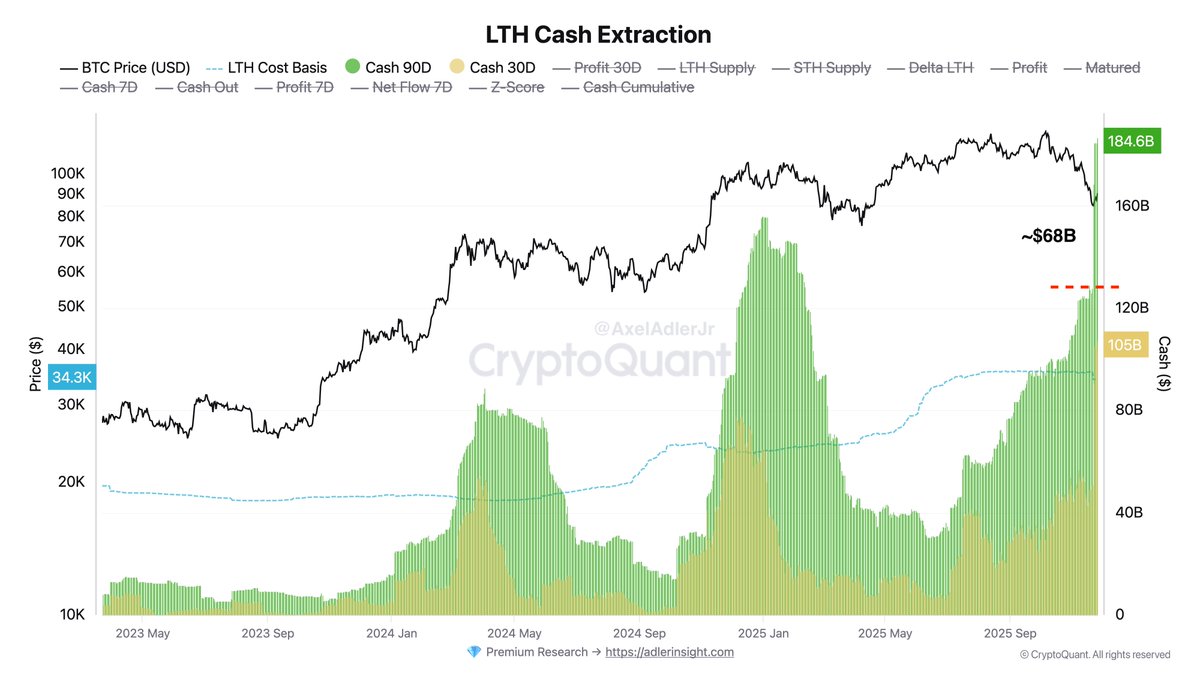
LTH Cash Extraction Chart | Source: Axel Adler

This large UTXO migration disrupted several major on-chain indicators. LTH and STH Supply metrics were temporarily skewed, showing a sharp drop in Long-Term Holder supply and a rise in Short-Term Holder supply — a pattern typically associated with heavy “smart money” selling. In reality, no distribution occurred; Coinbase simply restructured its internal wallets.

The distortion also affected LTH Realized Profit/Loss models, which reflected tens of billions in phantom gains, and HODL Waves, where UTXO ages were “reset,” suggesting long-term holders had suddenly spent old coins. Even Coin Days Destroyed (CDD) showed a significant spike, mimicking an “old coin awakening,” though the activity was entirely internal.

These disruptions highlight how exchange operations can temporarily break the reliability of on-chain metrics, requiring careful interpretation from analysts and investors.

Total Market Rebounds but Remains Under Critical Pressure

The Total Crypto Market Cap chart shows a sharp rebound after tagging the $2.88T zone, a level that aligns closely with the 100-week moving average (green), acting as a key structural support in previous cycles. This bounce has pushed total valuation back above the $3T mark, but the broader trend remains fragile after weeks of heavy selling across majors like BTC and ETH.
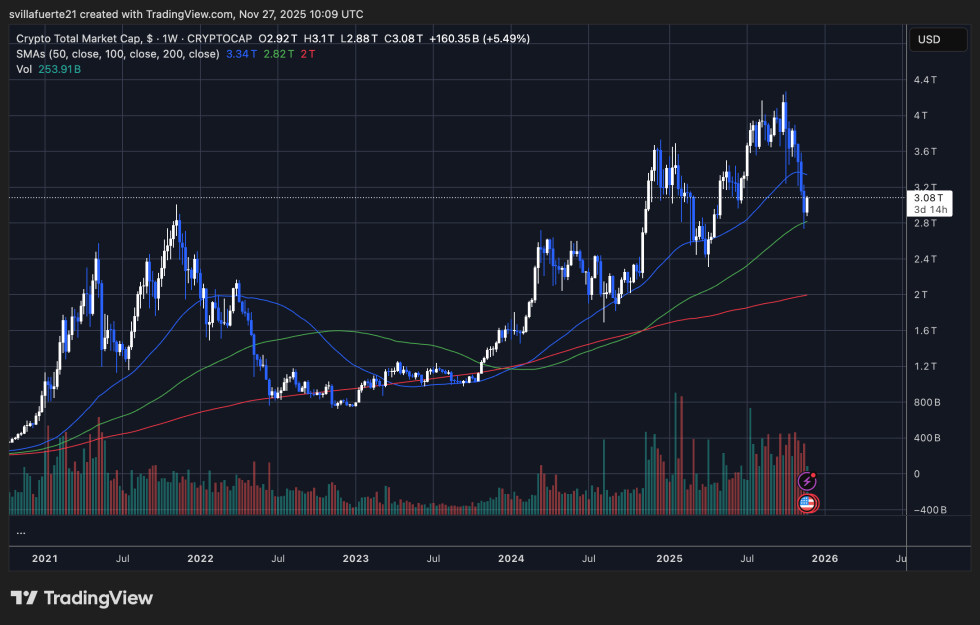
Total Crypto Market Cap | Source: TOTAL chart on TradingView

Price structure highlights a clear breakdown from the $3.6T–$3.8T consolidation zone, followed by a fast, impulsive decline—mirroring the speed of corrections seen during 2021 and mid-2022. Despite the latest recovery candle, the market remains below the 50-week moving average (blue), signaling that buyers must regain momentum quickly to avoid deeper downside toward the 200-week moving average near $2T.

Volume has surged on recent sell-offs, showing widespread forced selling and capitulation behavior—a pattern consistent with cycle mid-reset phases. The rebound, however, shows reduced sell volume, suggesting exhaustion from bearish participants. To confirm strength, total market cap must reclaim the $3.25T–$3.3T area, which currently acts as the first major resistance.

Failure to break above this zone risks further consolidation or a retest of the $2.8T support. For now, the market shows early signs of stabilization, but broader recovery depends on Bitcoin’s ability to sustain its own rebound and restore confidence across altcoins.

Featured image from ChatGPT, chart from TradingView.com

Editorial Process for bitcoinist is centered on delivering thoroughly researched, accurate, and unbiased content. We uphold strict sourcing standards, and each page undergoes diligent review by our team of top technology experts and seasoned editors. This process ensures the integrity, relevance, and value of our content for our readers.

Sebastian's journey into the world of crypto began four years ago, driven by a fascination with the potential of blockchain technology to revolutionize financial systems. His initial exploration focused on understanding the intricacies of various crypto projects, particularly those focused on building innovative financial solutions. Through countless hours of research and learning, Sebastian developed a deep understanding of the underlying technologies, market dynamics, and potential applications of cryptocurrencies. As his knowledge grew, Sebastian felt compelled to share his insights with others. He began actively contributing to online discussions on platforms like X and LinkedIn, focusing on fintech and crypto-related content. His goal was to expose valuable trends and insights to a wider audience, fostering a deeper understanding of the rapidly evolving crypto landscape. Sebastian's contributions quickly gained recognition, and he became a trusted voice in the online crypto community. To further enhance his expertise, Sebastian pursued a UC Berkeley Fintech: Frameworks, Applications, and Strategies certification. This rigorous program equipped him with valuable skills and knowledge regarding Financial Technology, bridging the gap between traditional finance (TradFi) and decentralized finance (DeFi). The certification deepened his understanding of the broader financial landscape and its intersection with blockchain technology. Sebastian's passion for finance and writing is evident in his work. He enjoys delving into financial research, analyzing market trends, and exploring the latest developments in the crypto space. In his spare time, Sebastian can often be found immersed in charts, studying 10-K forms, or engaging in thought-provoking discussions about the future of finance. Sebastian's journey as a crypto analyst and investor has been marked by a relentless pursuit of knowledge and a dedication to sharing his insights. His ability to navigate the complex world of crypto, combined with his passion for financial research and communication, makes him a valuable asset to the industry. As the crypto landscape continues to evolve, Sebastian remains at the forefront, providing valuable insights and contributing to the growth of this revolutionary technology.

Lectures associées

Évalué à 10 milliards de dollars, Nvidia mise gros ! Prime Intellect est en train de se débarrasser de son étiquette Web3 ?

Prime Intellect, une infrastructure d'IA décentralisée, a annoncé un tour de table de série A de 130 millions de dollars, portant sa valorisation à 10 milliards. Le tour est dirigé par Radical Ventures et implique les bras de capital-risque de Nvidia, Intel et Dell. La société, fondée en 2024, déclare un chiffre d'affaires annualisé (ARR) dépassant 100 millions de dollars et plus de 6000 clients entreprises. Initialement présentée avec un angle Web3 et des références à une future tokenisation, la plateforme a depuis nettoyé sa documentation de ces éléments, se repositionnant comme une entreprise d'infrastructure IA pure. Son produit phare, Prime Intellect Lab, permet aux entreprises d'entraîner et d'optimiser leurs propres modèles d'agents IA sans gérer de clusters GPU coûteux. La société a démontré sa technologie en entraînant des modèles de grande échelle (comme INTELLECT-3, un modèle MoE de 1060 milliards de paramètres) sur des GPU distribués géographiquement. Ses partenariats techniques avec Nvidia (utilisation de Dynamo pour l'inférence, tests sur Vera CPU) et d'autres géants du matériel visent à optimiser les coûts et les performances. Un cas d'usage notable est celui de la fintech Ramp, qui a utilisé la plateforme pour entraîner un agent spécialisé, obtenant de meilleurs résultats que certains grands modèles pour sa tâche spécifique. Si le chiffre d'ARR doit être interprété avec prudence (c'est une projection, non un revenu réalisé), il reflète la croissance rapide d'un modèle économique basé sur la location de puissance de calcul GPU, les services d'entraînement et d'inférence.

Foresight NewsIl y a 2 mins

Évalué à 10 milliards de dollars, Nvidia mise gros ! Prime Intellect est en train de se débarrasser de son étiquette Web3 ?

Foresight NewsIl y a 2 mins

Robinhood Chain fait sensation, pourquoi quelques projets DeFi bénéficient-ils des retombées ?

L'essor récent de Robinhood Chain, un réseau Layer 2 basé sur Arbitrum Orbit, profite particulièrement à plusieurs protocoles DeFi majeurs. Bien que son lancement ait été initialement porté par le meme coin CASHCAT, la chaîne montre désormais des signes de croissance soutenue, avec un TVL ayant doublé pour atteindre 96 millions de dollars et un volume DEX dépassant 5 milliards de dollars sur 24 heures. Cette dynamique bénéficie directement à plusieurs projets : * **Lighter (LIT)** : Sélectionné comme plateforme de perpétuels par défaut du Robinhood Wallet, il pourrait voir ses revenus et le brûlage de ses jetons augmenter. * **Arbitrum (ARB)** : Robinhood Chain, construite sur sa stack Orbit, reverse 10% de ses revenus nets à l'écosystème Arbitrum, validant le potentiel de ce modèle. * **Morpho (MORPHO)** : Accueille la majorité du TVL de la chaîne via le produit Robinhood Earn, qui oriente les dépôts vers ses vaults, agissant comme un catalyseur majeur. * **Uniswap (UNI)** : DEX principal de la chaîne, il a déjà généré environ 1 milliard de dollars de volume, générant des frais qui pourraient mener à un brûlage de jetons UNI. Ainsi, au-delà de la spéculation sur les memes, ces jetons offrent une exposition à la croissance fondamentale et infrastructurelle de Robinhood Chain, basée sur des utilités concrètes comme le trading, le prêt et les revenus protocolaires.

marsbitIl y a 29 mins

Robinhood Chain fait sensation, pourquoi quelques projets DeFi bénéficient-ils des retombées ?

marsbitIl y a 29 mins

Déblocage de 20 %, pression de 125 millions de dollars : PUMP va-t-il tenir ?

Malgré un marché des Meme en retrait par rapport à son apogée, Pump.fun reste l'un des protocoles Web3 les plus rentables, générant 28,4 millions de dollars de revenus sur 30 jours. Cependant, son jeton natif, PUMP, a été confronté à un test majeur avec le premier déblocage de jetons pour l'équipe et les investisseurs : 82,5 milliards de jetons (soit 20,23% de l'offre en circulation), d'une valeur d'environ 125 millions de dollars. Cette pression de vente potentielle est significative, alors que le volume quotidien de PUMP n'est que de 28 millions de dollars. Le protocole utilise une partie de ses revenus pour racheter et brûler des PUMP, créant un mécanisme d'achat. Cependant, l'intensité de ce rachat a diminué, passant de 100% à 50% des frais nets en avril, les fonds restants étant alloués aux opérations de l'entreprise. Les rachats mensuels ont ainsi fortement baissé, de 55,3 millions de dollars à leur pic à seulement 9,2 millions en juin. Malgré la pression actuelle du déblocage et la réduction des rachats, PUMP présente des caractéristiques intéressantes. La capitalisation de PUMP (environ 6,1 milliards de dollars) est relativement modeste comparée à ses revenus élevés et à la valorisation d'autres acteurs comme Hyperliquid. Son modèle économique est résilient car il ne dépend pas d'un seul Meme, mais profite de l'activité continue de création et d'échange de jetons. L'enjeu à court terme est la capacité du marché à absorber les jetons débloqués. À long terme, la pérennité de PUMP dépendra de la capacité de Pump.fun à maintenir ses revenus. Dans un marché baissier, il reste un actif rare : un jeton lié à une plateforme réellement lucrative et utilisée, avec une valorisation encore raisonnable, ce qui pourrait en faire une opportunité d'investissement progressif.

Odaily星球日报Il y a 44 mins

Déblocage de 20 %, pression de 125 millions de dollars : PUMP va-t-il tenir ?

Odaily星球日报Il y a 44 mins

Trading

Spot
活动图片