Solana Price Consolidates as Best Wallet Presale Surges Past $17M

bitcoinistPublié le 2025-11-14Dernière mise à jour le 2025-11-14

Résumé

Quick Facts: ➡️ Market focus is shifting from single Layer-1s like Solana to cross-chain wallet infrastructure that simplifies access and...

Trusted Editorial content, reviewed by leading industry experts and seasoned editors. Ad Disclosure

Quick Facts:

  • ➡️ Market focus is shifting from single Layer-1s like Solana to cross-chain wallet infrastructure that simplifies access and trading.
  • ➡️ Best Wallet leverage’s Fireblocks’ MPC-CMP technology to offer institutional-grade, non-custodial security in a mobile-first crypto wallet, aiming for a 40% market share.
  • ➡️ The $BEST token presale has gained significant momentum, raising over $17M by offering holders reduced fees, APY staking, and early access to vetted presales.

Solana price action is giving traders mixed signals.

After hitting $171 earlier this week, $SOL has pulled back to around $141.80, a 17% drop that has investors watching for the next move. It could be a positive one, though, as $SOL ETFs have logged their thirteenth day of consecutive inflows, showing sentiment is still bullish.
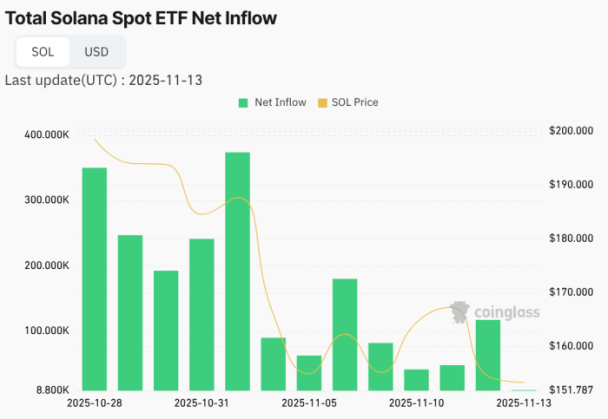
Solana ETF inflow for the past 13 days.
Source: Coinglass

The consolidation phase coincides with broader market uncertainty, but it’s creating opportunities in adjacent sectors.

Utility tokens tied to infrastructure projects are gaining traction while Layer-1s cool off. The crypto wallet space, which supports thousands of assets across dozens of chains, is emerging as a focal point for smart money.

That shift matters when you consider how fragmented the wallet experience remains for most users.

While Solana price prediction debates dominate X, builders are focusing on wallet infrastructure that works across ecosystems. For retail investors and whales alike, the next narrative may center on platforms that simplify access rather than single-chain bets.

Best Wallet is capitalizing on that simplicity, making trading easier by bringing all your tools and swaps to one simple interface. Plus, by holding its native token $BEST, you’ll receive extra perks too.

First Fully Integrated Fireblocks Wallet Targets 40% Market Share

The Best Wallet platform utilizes Fireblocks’ MPC-CMP technology in this mobile-first wallet, combining institutional-grade protection with consumer accessibility.

💡 The market needed this. Legacy solutions serve millions but lack the advanced features traders expect in 2025. Custodial wallets, courtesy of centralized exchanges, offer convenience but strip users of custody.

Best Wallet bridges both worlds through non-custodial architecture, with plans to support over 60 chains, including Ethereum, Solana, and Bitcoin. And it has big plans, aiming to capture 40% of the global crypto wallet market share by the end of next year.

Multi-chain wallet feature explanation.

Among the Best Wallet features that will help get it there is its Upcoming Tokens portal. This gives holders of its native Best Wallet Token ($BEST) early access to vetted presales, streamlining a process that typically requires navigating dozens of sketchy websites.

Token holders also unlock reduced fees across the ecosystem and dynamic APY staking rewards through an aggregator that scans multiple protocols. This combination of security, access, and incentives is why the presale has momentum.

Best DEX Aggregator Bringing Together 330 DEXs

Best Wallet’s trading infrastructure leverages Rubic’s aggregation technology, routing swaps across 330 decentralized exchanges and 30 cross-chain bridges. You get optimal rates without manually checking liquidity across networks.
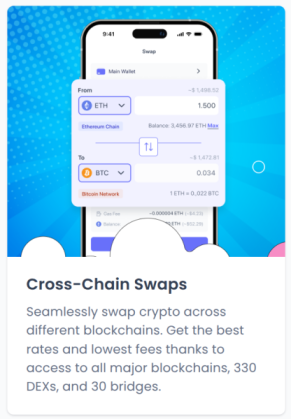
Cross chain swaps showing 330 DEX capability.

That capability matters as the Solana price fluctuates against Ethereum and other assets. You need seamless cross-chain execution, especially when arbitrage windows close in seconds. Best Wallet eliminates the friction of managing multiple interfaces and bridge protocols.

The mobile-first design prioritizes speed. Swap confirmations happen in under 10 seconds on most chains, with real-time gas fee optimization preventing overpayment during network congestion.

Holding Best Wallet Token ($BEST) means fee reductions, governance rights, and higher staking rewards – aligning long-term holder incentives with platform growth. This isn’t an altcoin with vague promises about community or vibes. It’s infrastructure with measurable benefits that activate post-launch.

📚 For the full low-down on the benefits of holding $BEST, check out our comprehensive Best Wallet Token review.

Whale Buys Signal Confidence Ahead of $BEST Listing

Smart money is positioning early. On-chain data shows whale buys of $70.2K and $50.9K, among many others. The presale raised over $5M in its first month, a pace that accelerated as features went live in beta testing. As of now, the project has raised over $17M.

🚨 However, the Best Wallet Token presale is drawing to a close – it ends November 28.

Right now, you can buy $BEST for $0.025945 and stake it for 77% APY. Take a look at our step-by-step guide to buying $BEST to find out how.

Our $BEST price prediction sees the token potentially reaching $0.62 by the end of 2026. That, by the way, would be an ROI of over 2,280% if you bought in at today’s price.

The integration of AI-powered portfolio analytics and derivatives trading tools positions the platform for 2026’s expected retail wave. If Bitcoin and Solana price predictions materialize around new all-time highs, onboarding infrastructure becomes critical.

New users won’t tolerate clunky multi-step processes or seed phrase anxiety. Best Wallet’s KYC-free, non-custodial approach with institutional security standards addresses both concerns. And $BEST is the secret sauce that could help this crypto wallet dominate the global market.

Disclaimer: Remember, this is not intended as financial advice, and you should always do your own research before making any investment.

Authored by Ben Wallis, Bitcoinist https://bitcoinist.com/solana-price-consolidates-companies-buy-for-13-days-best-time-to-buy-$best/

Editorial Process for bitcoinist is centered on delivering thoroughly researched, accurate, and unbiased content. We uphold strict sourcing standards, and each page undergoes diligent review by our team of top technology experts and seasoned editors. This process ensures the integrity, relevance, and value of our content for our readers.

Ben is a freelance writer specializing in crypto developments (mainly altcoins) and the intricate ways global economics shape the digital asset space. His B.Ed. in Education provides a unique foundation for his writing, enabling him to distill complex crypto concepts and market shifts into clear, digestible insights. This skill is key to helping readers adapt and apply their understanding to the ever-evolving world of crypto investment. Passionate about making crypto accessible, Ben crafts content designed to educate a broad audience, from current market events to the essential foundational knowledge that underpins them. His goal is to empower readers through understanding. When he’s not immersed in crypto analysis and breaking down complex topics, Ben is an avid Pokémon fan and enjoys all things Disney.

Lectures associées

Chacun est une MicroStrategy : Quand JPMorgan commence à accepter le BTC en garantie, allez-vous encore vendre vos cryptos ?

L'annonce que des géants bancaires comme JPMorgan, Citigroup et Bank of America acceptent désormais le Bitcoin comme collatéral pour accorder des prêts en dollars marque un tournant historique. Cette décision élève le Bitcoin au statut de "collatéral de premier ordre", similaire à l'or ou aux obligations d'État. Cette évolution permet aux détenteurs de Bitcoin d'accéder à des liquidités sans vendre leurs actifs, évitant ainsi les impôts sur les plus-values et conservant leur exposition à la hausse. La stratégie "Buy, Borrow, Die" (Acheter, Emprunter, Conserver), auparavant réservée aux très riches, se démocratise. Ce mouvement déclenche un "moteur de crédit" : la hausse du prix augmente la valeur du collatéral, permettant des emprunts plus importants et potentiellement plus d'achats de BTC. Cela représente une expansion de crédit bien plus puissante que les simples afflux d'ETF. L'implication des banques suggère un assouplissement réglementaire pratique, notamment vis-à-vis de la règle contraignante SAB 121 de la SEC, et un transfert de pouvoir des exchanges crypto vers la finance traditionnelle. Cependant, ce système introduit le risque de crises de la dette traditionnelle. Les liquidations forcées lors de corrections brutales pourraient être plus sévères et systémiques. Pour les investisseurs, l'ère de la "pensée dette" : accumuler des actifs pour construire un historique de crédit et utiliser des prêts à faible taux pour les dépenses, tout en maintenant un ratio prêt/valeur (LTV) prudent (<30-40%) pour éviter le risque de liquidation. Le retour de la finance centralisée (CeFi) via des institutions régulées est une tendance clé à surveiller.

marsbitIl y a 12 mins

Chacun est une MicroStrategy : Quand JPMorgan commence à accepter le BTC en garantie, allez-vous encore vendre vos cryptos ?

marsbitIl y a 12 mins

Le "Bear Flag" du Bitcoin vise 67 000 $, la demande de BTC au comptant diminue

Selon une analyse technique, le Bitcoin (BTC) affiche un modèle de drapeau baissier ("bear flag") sur les graphiques quotidiens, suggérant un objectif potentiel à la baisse autour de 67 000 dollars, soit une baisse d'environ 25 % par rapport aux niveaux actuels. Ce scénario se déclencherait si le prix venait à clôturer en dessous du seuil du drapeau à 90 000 dollars. Les analystes pointent du doigt deux facteurs principaux freinant une hausse au-dessus de la résistance clé des 93 000 dollars : un net ralentissement de la demande sur le marché au comptant et des sorties de fonds persistantes des ETF spot Bitcoin. L'indicateur de volume cumulé (CVD) pour le BTC est fortement négatif, indiquant une pression vendeuse accrue et un affaiblissement de la conviction des acheteurs. La semaine dernière, les ETF spot Bitcoin ont enregistré des sorties nettes significatives, culminant à 60 millions de dollars pour la seule journée de lundi, marquant un revirement par rapport aux entrées de fonds précédentes. Cette prudence des investisseurs, combinée à des incertitudes macroéconomiques et à des événements de liquidation, limite le potentiel de hausse à court terme. Certains traders anticipent un test préalable des résistance à 92 000 dollars, voire 98 000 dollars, avant une éventuelle descente. D'autres analystes estiment qu'un creux pourrait se former entre 74 000 et 77 000 dollars, suivi d'un rebond vigoureux.

cointelegraph_中文Il y a 20 mins

Le "Bear Flag" du Bitcoin vise 67 000 $, la demande de BTC au comptant diminue

cointelegraph_中文Il y a 20 mins

Trading

Spot
Futures
活动图片