Hoskinson Says Cardano Will Anchor The Human Internet In The AI Age

bitcoinistPublié le 2025-10-14Dernière mise à jour le 2025-10-14

Résumé

Cardano founder Charles Hoskinson used an October 13 livestream to sketch an expansive, two-track future for the web, arguing that...

Trusted Editorial content, reviewed by leading industry experts and seasoned editors. Ad Disclosure

Cardano founder Charles Hoskinson used an October 13 livestream to sketch an expansive, two-track future for the web, arguing that accelerating AI automation will force a structural split between a bot-dominated “slop land” and an invitation-only “human internet” whose trust rails run on decentralized identity, NFTs and on-chain incentive systems. In that architecture, he said, Cardano’s stack—spanning DIDs, the Midnight data-protection network, and a planned decentralized social platform—would serve as foundational infrastructure.

Opening with a diagnosis that “the internet is dying,” Hoskinson framed the problem as a runaway rise in automated accounts and AI-generated media that he believes has already tipped major platforms away from authentic human interaction. “The majority of internet users today are bots,” he claimed, citing “credible 2025 research” that allegedly pegs the share of botlike X accounts at 45%–64%.

“Over the next five years, the slop will get so bad that there’s going to be a better than 75% chance that what you see is a bot.” His contention is that this trajectory effectively nullifies social discourse: “We are no longer interacting with humans… The probability that it’s actually Bob and not Robo Bob is going to approach zero by 2030.”

Cardano’s Role In Rebuilding The Human Internet

Hoskinson’s proposed remedy centers on cryptographic identity and attestations. He placed decentralized identifiers (DIDs) at the core, coupled with “proof-of-humanity” methods that bind a persistent identifier to a verified person without leaking private data. “What [DIDs] allow you to do is assign to a person an ID and then you can prove properties about that person,” he said, adding that humanity checks could draw on a variety of approaches—from existing “Proof of Humanity”-style mechanisms to more novel biometric signals. He even referenced experiments related to his Quantum Hosky gaming venture, suggesting “your brain actually has a unique fingerprint… and you can use your brain for proof of human.”

Once identity is anchored, the Cardano founder argued, content itself must carry provenance. He envisions authenticity NFTs attached to media artifacts, cryptographically signed by a DID that has passed a humanity test. “When you look at content you will have a marketplace for non-slop… ‘Verified made by human,’ a proof of humanity,” he said. That, in turn, would allow clients to filter feeds to human-originated material and restore high-signal social spaces.

The architectural consequence, in Hoskinson’s view, is a bifurcated web: one substrate optimized for autonomous agents and AI-to-AI commerce, and a separate, admission-controlled human layer. “We’re basically going to create an invitation-only second internet… the only place humans are allowed to go,” he said. Agents would still traverse the open web to execute tasks on a user’s behalf—shopping, research, negotiations—while the human layer preserves identity, privacy and discourse.

Blockchains, he argued, are indispensable to both halves. For the human layer, the chain becomes “the ledger for humanity… the place where the DIDs live… where the NFT[s] verifying [genuine] content are.” For the agentic layer, it provides coordination of model licensing, personalization data, and payments among swarms of bots. He described a coming marketplace of pre-parameterized, task-specific agents—“Uncle Bob’s magic hatbot” as a toy example—bought, tuned and composed much like today’s app economy, but transacted as digital goods on an “AI ledger.” “What if that marketplace lives on an AI ledger?” he asked. “This will be the next-gen browser as the interface.”

Privacy-preserving data sharing, Hoskinson said, is where Cardano’s Midnight fits. Framing it as a way to “share without sharing,” he positioned Midnight as a substrate that lets users lend the semantic value of their personal data to agents (for example, preferences that improve recommendations) while keeping raw information shielded. “That’s why we got Midnight,” he said.

Hoskinson Plans A Decentralized Social Platform

Beyond identity and provenance, the Cardano founder called for new truth-seeking primitives built into social applications: prediction markets, “veracity bonds” and what he termed an “epistemic funnel.” In his telling, users and institutions that assert facts could post economic stakes that are slashed if claims later prove false, while consumers would run claims through layered tests—automated AI checks, authenticity NFTs, reputational vouching—before conferring belief. “I think all the media has to be here,” he said, arguing that economic consequences would curb low-quality publishing. “There are lots of money to be made in building these applications that enforce epistemic hygiene.”

On the business side, he forecast an AdTech realignment as human attention slips and agents transact directly with paywalled content on a micro-licensing basis. “Humans aren’t there to watch [ads]… a whole multi-trillion-dollar industry is going to be disrupted,” he said, predicting protocols where agents “check out” articles or datasets for cents and negotiate usage and summarization rights through machine-readable contracts. He referenced emergent “402/ATA”-style access standards and “X.42”-type protocols in that context, while stressing the need for a neutral settlement layer.

While much of the AMA surveyed the broader industry, Hoskinson repeatedly returned to Cardano’s roadmap and adjacent efforts. He suggested the ecosystem would move “after we get done with Midnight and get that out by RealFi and Quantum Hosky” to “some form of decentralized social network,” integrating proof-of-humanity credentials, authenticated content, and truth-market mechanisms. He also highlighted Lace as the prospective on-ramp: “We have the perfect interface for it… Lace is a great on and off ramp because it has the money there. It’s built right into the browser… and Lace is just about to go into mobile.”

The normative thread running through the session was a rejection of price fixation and a call to re-center crypto on coordination and civilizational resilience. “If you think it’s just token go up, token go down… you’re a useless person,” he said bluntly. He portrayed the industry’s purpose as “to liberate humanity’s economic, political, and social systems,” adding that blockchains “create a shared space for a synthetic objective reality… immutable, timestamped and auditable,” that lets societies bind rights and rules to accelerating technologies.

At press time, Cardano (ADA) traded at $0.69.
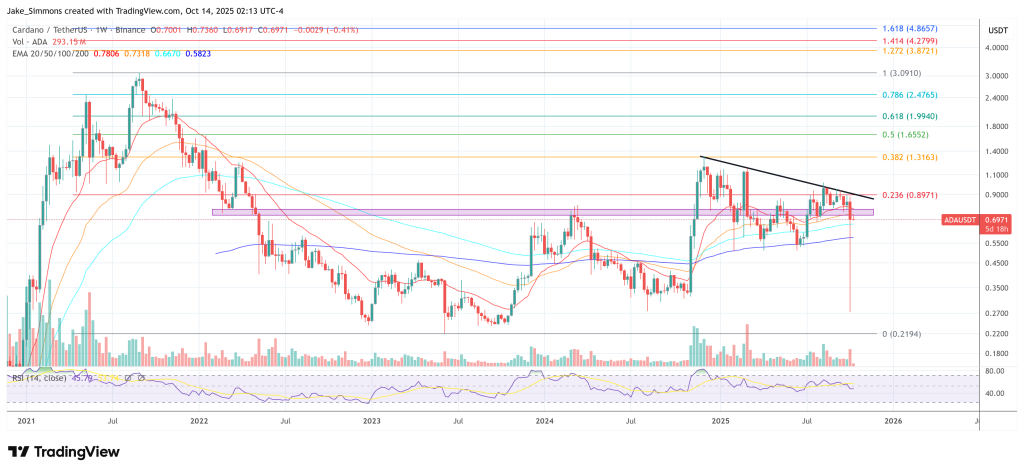
Cardano price
Cardano is now below the red resistance band again, 1-day chart | Source: ADAUSDT on TradingView.com
Featured image created with DALL.E, chart from TradingView.com
Editorial Process for bitcoinist is centered on delivering thoroughly researched, accurate, and unbiased content. We uphold strict sourcing standards, and each page undergoes diligent review by our team of top technology experts and seasoned editors. This process ensures the integrity, relevance, and value of our content for our readers.

Jake Simmons has been a Bitcoin enthusiast since 2016. Ever since he heard about Bitcoin, he has been studying the topic every day and trying to share his knowledge with others. His goal is to contribute to Bitcoin's financial revolution, which will replace the fiat money system. Besides BTC and crypto, Jake studied Business Informatics at a university. After graduation in 2017, he has been working in the blockchain and crypto sector. You can follow Jake on Twitter at @realJakeSimmons.

Cryptos en tendance

Lectures associées

Le Bitcoin, Ethereum et Solana grimpent alors qu'un autre milliard de dollars de positions courtes a été liquidé

Le Bitcoin a franchi les 76 000 $ lors des négociations européennes de vendredi matin, enregistrant une hausse de plus de 9 % sur 24 heures et de 21 % sur la semaine. Cette forte progression s'est accompagnée de nouvelles liquidations massives de positions courtes. Environ 1,2 milliard de dollars de positions courtes ont été liquidées sur 24 heures, portant le total à plus de 4 milliards de dollars sur deux jours, dont une liquidation record de 3 milliards de dollars jeudi. Ces liquidations, qui se produisent lorsque le marché évolue à l'encontre des traders qui ont emprunté pour parier sur une baisse des prix, ont créé un effet cascade en forçant des rachats et en faisant monter les cours. Cette dynamique technique distingue le rallye actuel, largement alimenté par ce mécanisme, d'une hausse fondée sur la demande fondamentale. D'autres crypto-monnaies ont également progressé : Ethereum a augmenté de près de 5 % pour atteindre 2 350 $, Solana de plus de 5 % à près de 90 $, et Dogecoin de près de 9 %. Hyperliquid (HYPE), en tête des principales bourses cette semaine, a gagné plus de 4 %. Le rallye a été déclenché mercredi par l'annonce du Trésor américain de doubler le rachat d'obligations à long terme, assouplissant ainsi les conditions du marché. Le Bitcoin a ensuite franchi une résistance clé vers 66 600 $. Un soutien politique supplémentaire est venu de Washington, où le président Donald Trump a appelé le Congrès à faire avancer la loi sur la clarté du marché des actifs numériques. Malgré la forte hausse, la capitalisation boursière du Bitcoin, à 1 500 milliards de dollars, reste inférieure d'environ 40 % à son sommet historique d'octobre dernier.

cryptonews.ruIl y a 8 mins

Le Bitcoin, Ethereum et Solana grimpent alors qu'un autre milliard de dollars de positions courtes a été liquidé

cryptonews.ruIl y a 8 mins

Un tribunal de Hong Kong confirme une peine de 56 mois de prison pour fraude alors que l'intérêt pour les cryptomonnaies s'accroît

La Cour d'appel de Hong Kong a confirmé la condamnation à 56 mois de prison d'un recruteur pour une organisation criminelle dans une affaire de fraude. Les pertes mondiales liées à ce schéma pourraient atteindre 442 milliards de dollars d'ici 2025, selon Interpol. Les fonds illicites sont de plus en plus dirigés vers des plateformes de cryptomonnaies et des stablecoins. L'affaire implique Ma Che-hou, 32 ans, reconnu coupable de conspiration pour fraude et blanchiment d'argent en 2021-2022. Il a trompé cinq hommes avec de fausses offres d'emploi, les conduisant à être détenus en Asie du Sud-Est, où certains ont été torturés. Le tribunal a considéré ces faits de traite d'êtres humains comme une circonstance aggravante, appliquant une peine de base de sept ans réduite pour aveux. Le rapport 2026 de l'ONUDC décrit un réseau criminel en Asie du Sud-Est utilisant des modèles similaires au franchisage pour diverses activités illégales. Les flux de cryptomonnaies liés à ces services frauduleux ont augmenté de 85% en 2025, les stablecoins comme l'USDT étant privilégiés pour leur stabilité et facilité de conversion. Les autorités intensifient la répression. Le DOJ américain a saisi pour 701,9 millions de dollars de cryptomonnaies en avril 2026 et fermé 503 sites frauduleux. Dans une autre affaire majeure, environ 15 milliards de dollars en Bitcoin ont été confisqués. Le GAFI place désormais la lutte contre la fraude au cœur de sa feuille de route, estimant les pertes mondiales à près de 500 milliards de dollars pour 2024-2025. Il appelle à un renforcement des contrôles des transactions par les entreprises de crypto, notamment sur les comptes écrans et les transferts transfrontaliers rapides, et à une meilleure formation des autorités pour traquer et saisir les actifs criminels en cryptomonnaies.

cryptonews.ruIl y a 15 mins

Un tribunal de Hong Kong confirme une peine de 56 mois de prison pour fraude alors que l'intérêt pour les cryptomonnaies s'accroît

cryptonews.ruIl y a 15 mins

Trading

Spot

Articles tendance

Comment acheter ADA

Bienvenue sur HTX.com ! Nous vous permettons d'acheter Cardano (ADA) de manière simple et pratique. Suivez notre guide étape par étape pour commencer votre parcours crypto.Étape 1 : Création de votre compte HTXUtilisez votre adresse e-mail ou votre numéro de téléphone pour ouvrir un compte sur HTX gratuitement. L'inscription se fait en toute simplicité et débloque toutes les fonctionnalités.Créer mon compteÉtape 2 : Choix du mode de paiement (rubrique Acheter des cryptosCarte de crédit/débit : utilisez votre carte Visa ou Mastercard pour acheter instantanément Cardano (ADA).Solde :utilisez les fonds du solde de votre compte HTX pour trader en toute simplicité.Prestataire tiers :pour accroître la commodité d'utilisation, nous avons ajouté des modes de paiement populaires tels que Google Pay et Apple Pay.P2P :tradez directement avec d'autres utilisateurs sur HTX.OTC (de gré à gré) : nous offrons des services personnalisés et des taux de change compétitifs aux traders.Étape 3 : stockage de vos Cardano (ADA)Après avoir acheté vos Cardano (ADA), stockez-les sur votre compte HTX. Vous pouvez également les envoyer ailleurs via un transfert sur la blockchain ou les utiliser pour trader d'autres cryptos.Étape 4 : tradez des Cardano (ADA)Tradez facilement Cardano (ADA) sur le marché Spot de HTX. Il vous suffit d'accéder à votre compte, de sélectionner la paire de trading, d'exécuter vos trades et de les suivre en temps réel. Nous offrons une expérience conviviale aux débutants comme aux traders chevronnés.

1.4k vues totalesPublié le 2024.12.10Mis à jour le 2026.06.02

Comment acheter ADA

Discussions

Bienvenue dans la Communauté HTX. Ici, vous pouvez vous tenir informé(e) des derniers développements de la plateforme et accéder à des analyses de marché professionnelles. Les opinions des utilisateurs sur le prix de ADA (ADA) sont présentées ci-dessous.

活动图片