Global Watchdog FSB To Address Stablecoin-Related Risks With Surveillance Overhaul – Report

bitcoinistPublié le 2025-10-14Dernière mise à jour le 2025-10-14

Résumé

Financial Stability Board (FSB), an international body that monitors and makes recommendations about the global financial system, has reportedly vowed...

Trusted Editorial content, reviewed by leading industry experts and seasoned editors. Ad Disclosure

Financial Stability Board (FSB), an international body that monitors and makes recommendations about the global financial system, has reportedly vowed to address the evolving threats from private finance and the growing use of stablecoins.

Global Watchdog Plans Surveillance Overhaul

On Monday, Bank of England (BoE) Governor and FSB Chairman Andrew Bailey promised to increase the global watchdog’s policy response to the emerging risks related to the private finance sector and stablecoins.

According to Bloomberg, Bailey pledged to overhaul the FSB’s surveillance in a letter delivered ahead of this week’s Group of 20 (G20) meetings, seeking to make it “more flexible and quicker to recognise, and respond to, emerging vulnerabilities.”

“Whether it is the rise of private finance, the implications of geopolitical tensions, or the increasing role of stablecoins for payment and settlement purposes, our ability to detect and address emerging risks is critical,” he wrote in the letter.

In June, the Financial Action Task Force (FATF) raised concerns about the “increasing risks” associated with the adoption of stablecoins, noting that the growing use of these digital assets by illicit parties poses a challenge to global financial security.

The FATF emphasized that mass adoption of stablecoins could increase these risks given the “inconsistent application” of its standards across various jurisdictions. Similarly, Bailey considers there is potential for “regulatory arbitrage” due to gaps in addressing financial stability risks and the low number of finalized regulatory frameworks for global stablecoin arrangements.

He affirmed that the FSB will have “open and frank discussions among members” about the next steps for the international watchdog, and will “increase outreach to the private sector to benefit from their expertise and perspectives on risks and vulnerabilities.”

The FSB chair also warned that the global deregulatory trend has “raised concerns that reform efforts may be weakening.” Notably, Bailey has previously shared a skeptical perspective on the sector, cautioning that stablecoins threaten to destabilize the public’s trust in money.

However, he has recently shared a seemingly softer approach, affirming that it would be “wrong to be against stablecoins as a matter of principle,” which could suggest a shift from his highly criticized approach.

Stablecoin Regulation Faces Challenges

Amid stablecoin’s growing momentum, driven by the US regulatory efforts, Europe’s top financial stability watchdog is reportedly pushing for stricter regulations for the sector, which could impact how issuers like Circle and Paxos operate across borders.

As reported by Bitcoinist, the European Central Bank (ECB) has called for a ban on multi-issuance stablecoins in the bloc and other jurisdictions, following a recently passed recommendation by the European Systemic Risk Board (ESRB) to ban jointly issued stablecoins.

Despite being supported by a high-powered board of central bank governors and European Union (EU) officials, the ESRB guidance is not legally binding. However, it will likely pressure authorities to “implement the restrictions or explain how financial stability can be preserved in their absence.”

Meanwhile, the EU is reportedly planning to shift oversight power of key financial market areas, like crypto, from national authorities to a centralized supervisory authority, aiming to boost the bloc’s capital markets and address the continued fragmentation in markets.

The Chair of the European Securities and Markets Authority (ESMA), Verena Ross, affirmed that the European Commission is preparing new rules that would shift the supervision of stock exchanges, crypto companies, and clearing houses from local authorities to ESMA to “create more of a single market for capital in Europe.”

Nonetheless, smaller EU nations, such as Luxembourg, Ireland, and Malta, have criticized the proposal, arguing that a single financial regulator would become a “monster” and questioning the watchdog’s ability to oversee the rapidly growing crypto market.
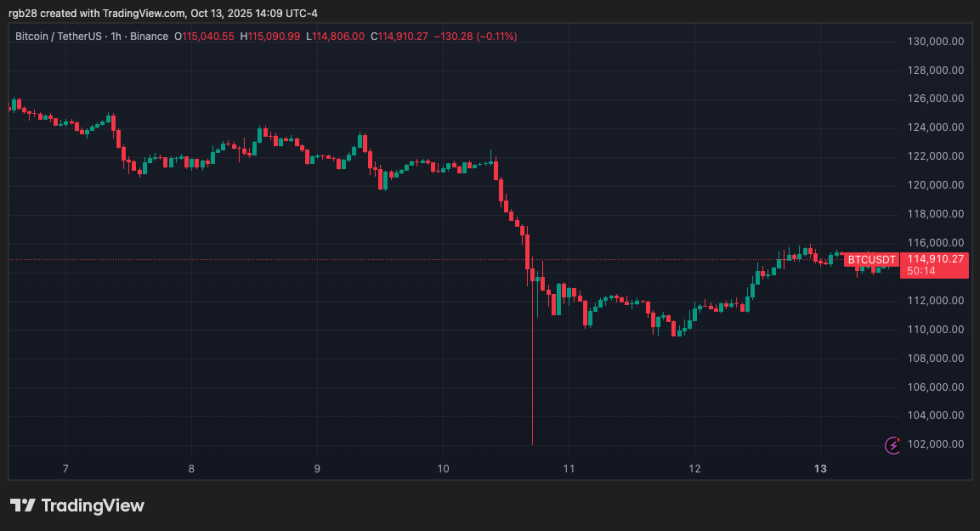
stablecoin, btc, btcusdt, bitcoin

Bitcoin (BTC) trades at $114,910 in the one-week chart. Source: BTCUSDT on TradingView
Featured Image from Unsplash.com, Chart from TradingView.com
Editorial Process for bitcoinist is centered on delivering thoroughly researched, accurate, and unbiased content. We uphold strict sourcing standards, and each page undergoes diligent review by our team of top technology experts and seasoned editors. This process ensures the integrity, relevance, and value of our content for our readers.

Rubmar is a crypto enthusiast who likes learning and improving constantly. She enjoys reporting on the latest news and developments in the crypto industry. Rubmar also enjoys scrapbooking, crafting, simulation games, and watching football.

Lectures associées

Le Bitcoin, Ethereum et Solana grimpent alors qu'un autre milliard de dollars de positions courtes a été liquidé

Le Bitcoin a franchi les 76 000 $ lors des négociations européennes de vendredi matin, enregistrant une hausse de plus de 9 % sur 24 heures et de 21 % sur la semaine. Cette forte progression s'est accompagnée de nouvelles liquidations massives de positions courtes. Environ 1,2 milliard de dollars de positions courtes ont été liquidées sur 24 heures, portant le total à plus de 4 milliards de dollars sur deux jours, dont une liquidation record de 3 milliards de dollars jeudi. Ces liquidations, qui se produisent lorsque le marché évolue à l'encontre des traders qui ont emprunté pour parier sur une baisse des prix, ont créé un effet cascade en forçant des rachats et en faisant monter les cours. Cette dynamique technique distingue le rallye actuel, largement alimenté par ce mécanisme, d'une hausse fondée sur la demande fondamentale. D'autres crypto-monnaies ont également progressé : Ethereum a augmenté de près de 5 % pour atteindre 2 350 $, Solana de plus de 5 % à près de 90 $, et Dogecoin de près de 9 %. Hyperliquid (HYPE), en tête des principales bourses cette semaine, a gagné plus de 4 %. Le rallye a été déclenché mercredi par l'annonce du Trésor américain de doubler le rachat d'obligations à long terme, assouplissant ainsi les conditions du marché. Le Bitcoin a ensuite franchi une résistance clé vers 66 600 $. Un soutien politique supplémentaire est venu de Washington, où le président Donald Trump a appelé le Congrès à faire avancer la loi sur la clarté du marché des actifs numériques. Malgré la forte hausse, la capitalisation boursière du Bitcoin, à 1 500 milliards de dollars, reste inférieure d'environ 40 % à son sommet historique d'octobre dernier.

cryptonews.ruIl y a 32 mins

Le Bitcoin, Ethereum et Solana grimpent alors qu'un autre milliard de dollars de positions courtes a été liquidé

cryptonews.ruIl y a 32 mins

Un tribunal de Hong Kong confirme une peine de 56 mois de prison pour fraude alors que l'intérêt pour les cryptomonnaies s'accroît

La Cour d'appel de Hong Kong a confirmé la condamnation à 56 mois de prison d'un recruteur pour une organisation criminelle dans une affaire de fraude. Les pertes mondiales liées à ce schéma pourraient atteindre 442 milliards de dollars d'ici 2025, selon Interpol. Les fonds illicites sont de plus en plus dirigés vers des plateformes de cryptomonnaies et des stablecoins. L'affaire implique Ma Che-hou, 32 ans, reconnu coupable de conspiration pour fraude et blanchiment d'argent en 2021-2022. Il a trompé cinq hommes avec de fausses offres d'emploi, les conduisant à être détenus en Asie du Sud-Est, où certains ont été torturés. Le tribunal a considéré ces faits de traite d'êtres humains comme une circonstance aggravante, appliquant une peine de base de sept ans réduite pour aveux. Le rapport 2026 de l'ONUDC décrit un réseau criminel en Asie du Sud-Est utilisant des modèles similaires au franchisage pour diverses activités illégales. Les flux de cryptomonnaies liés à ces services frauduleux ont augmenté de 85% en 2025, les stablecoins comme l'USDT étant privilégiés pour leur stabilité et facilité de conversion. Les autorités intensifient la répression. Le DOJ américain a saisi pour 701,9 millions de dollars de cryptomonnaies en avril 2026 et fermé 503 sites frauduleux. Dans une autre affaire majeure, environ 15 milliards de dollars en Bitcoin ont été confisqués. Le GAFI place désormais la lutte contre la fraude au cœur de sa feuille de route, estimant les pertes mondiales à près de 500 milliards de dollars pour 2024-2025. Il appelle à un renforcement des contrôles des transactions par les entreprises de crypto, notamment sur les comptes écrans et les transferts transfrontaliers rapides, et à une meilleure formation des autorités pour traquer et saisir les actifs criminels en cryptomonnaies.

cryptonews.ruIl y a 39 mins

Un tribunal de Hong Kong confirme une peine de 56 mois de prison pour fraude alors que l'intérêt pour les cryptomonnaies s'accroît

cryptonews.ruIl y a 39 mins

Trading

Spot
活动图片