EU Plans Transfer Of Crypto, Stocks Oversight Power To Address Market Fragmentation – ESMA Chair

bitcoinistPublié le 2025-10-07Dernière mise à jour le 2025-10-07

Résumé

The European Union (EU) is reportedly planning to shift oversight power of key financial market areas, including crypto, from national...

Trusted Editorial content, reviewed by leading industry experts and seasoned editors. Ad Disclosure

The European Union (EU) is reportedly planning to shift oversight power of key financial market areas, including crypto, from national authorities to a centralized supervisory authority to help boost the bloc’s capital markets and harmonize regulation.

EU Eyes Centralized Crypto Market Oversight

On Monday, Verena Ross, chair of the European Securities and Markets Authority (ESMA), affirmed that the regulation of stock exchanges, crypto companies, and clearing houses in the EU will likely be transferred to the bloc’s market watchdog.

Ross told the Financial Times that the European Commission is preparing new rules that would shift the supervision of several areas of EU financial markets from national authorities to ESMA, to push for “a capital market in Europe that is more integrated and globally competitive.”

Last month, the EU commissioner for financial services, Maria Luís Albuquerque, shared they were “considering a proposal to transfer supervisory powers to Esma for the most significant cross-border entities,” including crypto companies.

“All of this would imply changes to the governance and decision-making processes of Esma, and we have various models to consider based on other existing models of centralised supervision,” said Albuquerque.

The change aims to address the continued fragmentation in markets to “create more of a single market for capital in Europe,” the ESMA chair stated, arguing that “while we are doing a lot of work to try to make sure the implementation of MiCA is aligned, it clearly takes a lot of effort from us and the national supervisors to achieve that.”

“It also means that people had to build up specific new resources and expertise 27 times in different national supervisors, which could have been done more efficiently once at a European level,” she added.

Single Supervisor Proposal Faces Backlash

Notably, the EU first proposed making ESMA the main supervisory agency of Crypto Asset Service Providers (CASP) during the development of its Markets in Crypto-Assets Regulation (MiCA).

The plan received backlash from smaller EU nations, such as Luxembourg, Ireland, and Malta, which criticized the watchdog’s ability to oversee the fast-growing crypto market and feared it could undermine their flourishing financial sectors.

As a result, the supervision of these markets was left in the hands of the 27 national authorities, which Ross considers has created inefficiencies. She explained that the Paris-based authority has “tried for quite some time with the capital markets union and other initiatives to build a more effective capital market,” but “the reality has been that it is not easy to do given we have very different market structures.”

In July, ESMA raised concerns about Malta’s process for approving pan-EU licenses for crypto companies, arguing that “some risk areas were not adequately assessed during the authorisation process.”

As reported by Bitcoinist, the bloc watchdog’s Peer Review Committee (PRC) conducted a review of Malta’s Financial Services Authority (MFSA) CASP authorization process, finding the national regulator only “partially met expectations,” despite having adequate staffing and technical infrastructure.

At the time, ESMA stressed that the concerns extended beyond Malta and urged all EU competent authorities to align their oversight mechanisms to ensure consistency under MiCA’s regulatory regime.

Last year, former European Central Bank President Mario Draghi identified transforming ESMA into a single common regulator for all the bloc’s securities markets, similar to the US Securities and Exchange Commission (SEC), as a “key pillar” to boost European capital markets.

Since then, the European watchdog has been granted greater powers. The regulator will oversee new providers of consolidated tapes for equity and bond prices, and agencies that provide environmental, social, and governance ratings starting in 2026.

However, Claude Marx, Director General of Luxembourg’s financial watchdog, considers that a single financial regulator would turn into a “monster.” “It is a fantasy that the European Commission wants to push a single supervisor,” Marx stated in June.

“The European Commission has always stated they do not have an idée fixe to have a European SEC,” he argued, adding that there remain several barriers to providing financial services across European borders.
crypto, bitcoin, btc, btcusdt

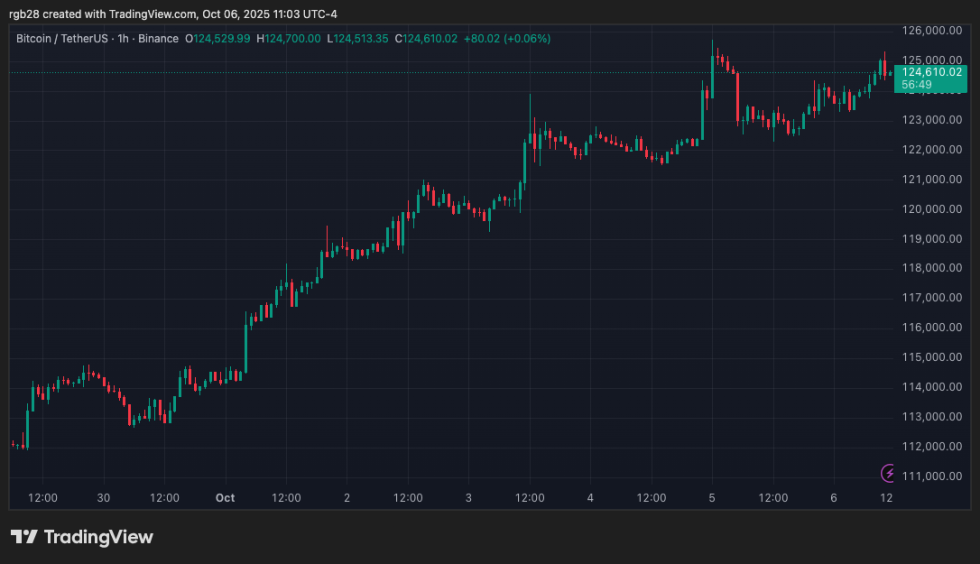
Bitcoin (BTC) trades at $124,610 in the one-week chart. Source: BTCUSDT on TradingView
Featured Image from Unsplash.com, Chart from TradingView.com
Editorial Process for bitcoinist is centered on delivering thoroughly researched, accurate, and unbiased content. We uphold strict sourcing standards, and each page undergoes diligent review by our team of top technology experts and seasoned editors. This process ensures the integrity, relevance, and value of our content for our readers.

Rubmar is a crypto enthusiast who likes learning and improving constantly. She enjoys reporting on the latest news and developments in the crypto industry. Rubmar also enjoys scrapbooking, crafting, simulation games, and watching football.

Lectures associées

ChatGPT pourrait bientôt disparaître

OpenAI vient d'annoncer lors de sa conférence *Intelligence at Work* l'intégration prochaine de Codex, son application dédiée aux tâches productives, directement dans l'application ChatGPT. Cette fusion, qui interviendra dans les prochaines semaines, marque une étape clé dans la transformation de ChatGPT d'un outil de conversation en une « super-application » ou plateforme agentique unifiée. Cette décision s'appuie sur le succès rapide de Codex, qui compte désormais 5 millions d'utilisateurs actifs hebdomadaires, avec une croissance trois fois plus rapide chez les professionnels non-développeurs. Financièrement, les produits entreprise comme Codex représentent déjà 40% des revenus d'OpenAI. La stratégie est claire : évoluer du « chat » vers l'« exécution ». L'objectif ultime est de combiner ChatGPT (compréhension), Codex (exécution via des agents) et le navigateur Atlas (accès web) en une seule interface permettant d'accomplir des tâches complexes sur simple instruction verbale. Pour renforcer Codex, OpenAI a dévoilé trois grandes mises à jour : des *plugins* d'agents pour six rôles métiers intégrant des outils comme Salesforce ou Figa, la fonction *Annotations* pour modifier du contenu directement dans son contexte original, et *Sites* pour générer des applications web partageables depuis n'importe quel projet. L'article souligne que cette course a été largement motivée par le succès du concurrent Claude Code d'Anthropic, qui a forcé OpenAI à rattraper son retard dans le domaine de la programmation assistée par IA. Si Claude Code reste souvent perçu comme plus performant, Codex le concurrence sur le prix et les limites d'utilisation. En interne, cette fusion ressemble moins à ChatGPT absorbant Codex qu'à l'inverse : l'équipe et la vision produit de Codex prennent le lead sur l'avenir de la plateforme. Le nom ChatGPT, actif de marque immense, restera probablement, mais son essence évoluera fondamentalement vers un assistant exécutant capable de travailler en autonomie.

marsbitIl y a 15 mins

ChatGPT pourrait bientôt disparaître

marsbitIl y a 15 mins

WWDC26 : Un nouveau Siri en vedette, iOS 27 se contente d’améliorations mineures

Apple a confirmé que le WWDC26 débutera le 8 juin à 10h (heure locale), soit le 9 juin à 1h du matin (heure de Pékin). Le grand enjeu de cette édition sera de voir si Apple peut répondre à une question fondamentale : dans un monde où l'IA imprègne tous les appareils, l'écosystème Apple restera-t-il la meilleure plateforme de calcul ? Le point central des rumeurs concerne une refonte majeure de Siri, désormais pilotée par le modèle Gemini, qui devrait devenir l'élément principal de la conférence. Cette nouvelle Siri, intégrée plus profondément aux systèmes, serait accessible via une bulle depuis la Dynamic Island et une entrée système unifiée "Search or Ask" en glissant du haut de l'écran. Concernant les systèmes d'exploitation, les mises à jour semblent se concentrer sur des améliorations de stabilité, de performances et des ajustements pratiques plutôt que sur des transformations radicales. * **iOS 27** : L'accent serait mis sur l'optimisation des fondations. L'application Appareil photo pourrait gagner en contrôles manuels et l'application Photos en outils de retouche basés sur l'IA. Le système pourrait aussi préparer l'arrivée future d'un iPhone à écran pliable. * **iPadOS 27** : Les améliorations devraient viser à combler l'écart entre la puissance matérielle et les limites logicielles, avec un système de fenêtres (Stage Manager) plus stable et une gestion des fichiers améliorée. * **macOS 27** : Ce système pourrait devenir le terrain d'essai central pour Apple Intelligence, mieux adapté aux flux de travail complexes. Il abandonnerait le support des Mac à puces Intel et apporterait des ajustements de design et des optimisations. Le défi pour Apple sera de démontrer que son IA, au-delà de fonctions dispersées, peut s'intégrer de manière cohérente et utile dans l'expérience utilisateur quotidienne, tout en préservant ses principes de confidentialité. Le WWDC26 révélera si la société peut rattraper son retard perçu et redéfinir l'entrée dans l'ère de l'IA générative.

marsbitIl y a 41 mins

WWDC26 : Un nouveau Siri en vedette, iOS 27 se contente d’améliorations mineures

marsbitIl y a 41 mins

Trading

Spot
Futures
活动图片