DeepSeek Predicts SOL to Break $450 – $750 by Year-End, Snorter Token Stands to Benefit

bitcoinistPublié le 2025-10-01Dernière mise à jour le 2025-10-01

Résumé

Chinese AI tool DeepSeek has high hopes for Solana’s next growth spurt, citing several bullish catalysts: technological upgrades, a favorable...

Trusted Editorial content, reviewed by leading industry experts and seasoned editors. Ad Disclosure

Chinese AI tool DeepSeek has high hopes for Solana’s next growth spurt, citing several bullish catalysts: technological upgrades, a favorable macro environment, and ETF approvals.

Suppose these factors work as planned, the chatbot believes that $SOL could exceed $450 by this year’s end – a 108%+ increase compared to its current $220 price tag.

It even goes as far as to suggest that a $750 price point might not be out of the equation.

And when $SOL rises, it’s not just a win for the asset itself. Solana-based projects often experience increased user activity and deeper liquidity – especially those pushing boundaries, like Snorter Token’s upcoming trading bot.

Solana’s Growth to Explode Under Compute Limit Upgrade

DeepSeek scouts the web in real time, ingesting and analyzing vast amounts of publicly available data – its findings aren’t to be sneezed at.

The chatbot found that a key driver of Solana’s future will likely be its expanding ecosystem. As applications like DeFi protocols and NFT marketplaces scale, demand for $SOL – which is required for transaction fees and staking – is expected to surge.

Another major catalyst includes technological advancements on the Solana network. Under Jump Crypto, Firedancer developers are working on SIMD-0370 to eliminate Solana’s fixed compute limit.

In turn, it should slash transaction finality from roughly 12.8 seconds to just 150 milliseconds. This would significantly boost Solana’s efficiency as a leading blockchain for real-time apps.
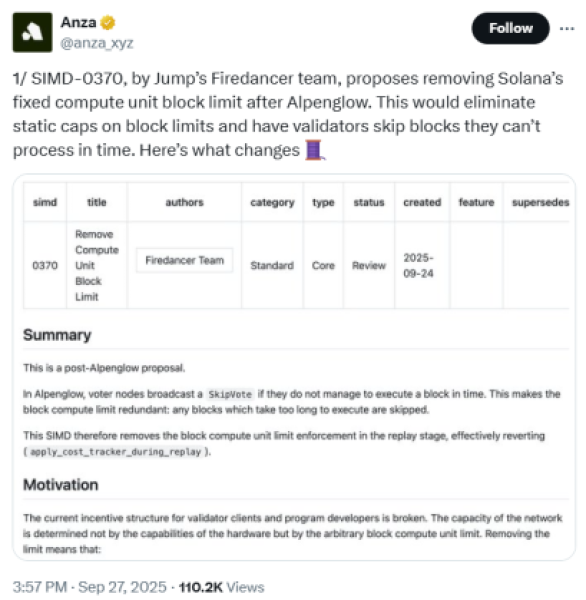
Anza announced Jump Crypto SIMD-0370 upgrade on X.
Source: X (Anza)

Macroeconomic conditions could also play a major role in $SOL’s success.

If 2025 brings lower interest rates and increased market liquidity, risk-on sentiment could return to financial markets. In such an environment, capital often flows into riskier assets like crypto, and which are better ones to invest in than the leaders: $BTC, $ETH, and $SOL?
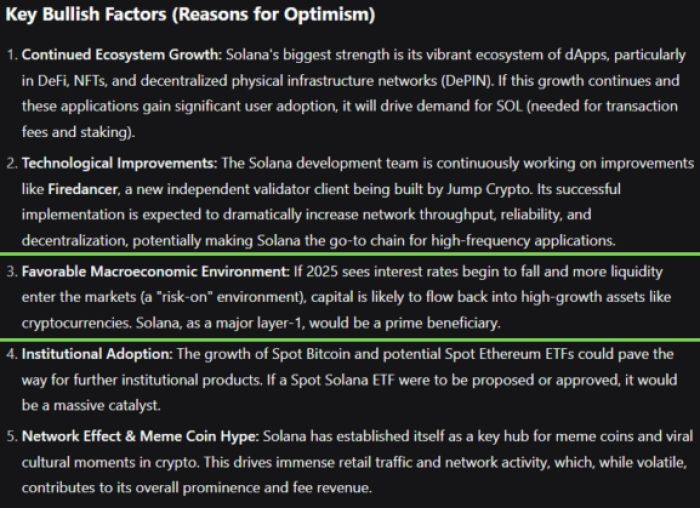
SOL bullish factors on DeepSeek.
Source: DeepSeek

Another area to watch? Solana ETFs, of course. The reason is that they’d unlock institutional capital, increase market liquidity, and cement $SOL’s status alongside $BTC and $ETH as a cornerstone asset in the digital economy.

Bloomberg analyst James Seyffart recently announced that significant movement is already underway on this front. Multiple issuers – Franklin, Fidelity, CoinShares, Direction, and Bitwise – have all submitted updated filings for $SOL ETFs.

With progress being made by the Securities and Exchange Commission (SEC), approvals may be just around the corner.
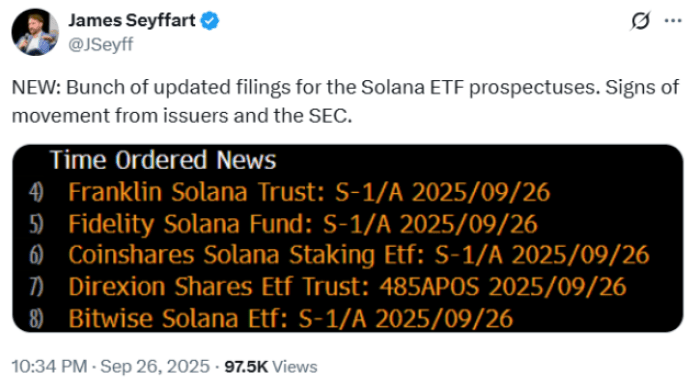
Bloomberg analyst announced SOL ETF filings on X.
Source: X (James Seyffart)

Finally, the network, driven by the best Solana meme coins and viral cultural moments like high-profile NFT mints (check out Mad Lads and Tensorians), continues to be a significant growth engine.

Together, these developments could propel not only $SOL but Solana-based projects like Snorter Token ($SNORT) to even rosier pursuits.

Snorter Bot to Go Live on Solana This Quarter

$SNORT would significantly benefit from a $SOL price rise as its flagship product – Snorter Bot – is set to go live on Solana this quarter.

The Telegram trading bot is designed to give traders a potent edge in the ultra-fast crypto market. By leveraging Solana’s high throughput, it promises to offer the lowest trading fees (at just 0.85%) and the fastest execution speeds.

When also taking into account Solana’s upcoming SIMD-0370 upgrade, its transaction fees might become even lower.

While it strategically picks Solana as its first network of choice, the bot’s also set to expand across Ethereum, BNB Chain, and other EVM-compatible chains. Doing so means that it’ll open the door to broader trading opportunities.

Whichever chain you favour, the bot will offer many ways to help you hunt down the next crypto to explode.

Take its copy trading tool, for instance. By copying the strategies of top-performing traders, you’ll be able to capitalize on market opportunities without deep crypto know-how.

To top it off, it promises to roll out automated sniping so that you can enter new token launches as soon as they go live.

Another boon is its upcoming set limit tool. You’ll be able to automatically buy and sell tokens at your preferred price tag, whether online or offline.
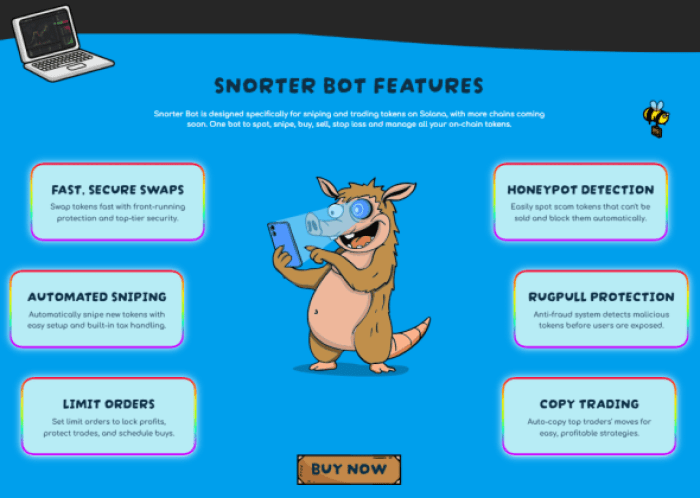
Top Snorter Token bot benefits.
Source: Snorter Token

And all will be achieved without compromising security. Snorter Bot will be MEV-protected and include built-in rug pull and honeypot detection alerts, so you don’t fall victim to scams.

Join the Snorter Token Presale for Possible 782% Returns

Behind it all is $SNORT, the ecosystem’s native token. It sets aside a substantial 25% of its total token supply for development, ensuring continuous innovation and growth.

By purchasing $SNORT, you not only contribute to its future trajectory, but are also granted perks. Think leaderboard rewards, staking yields up to 113% APY (if you join now), and DAO rights.

You can get involved by purchasing $SNORT on presale for as little as $0.1065, using either $SOL, $ETH, $USDT, $USDC, $BNB, or fiat.

Our Snorter Token price prediction anticipates it to close at around $0.94 this year. There might not be any better time to join the presale for potential returns exceeding 782%.

Join Snorter Token for possible 8x gains.

Disclaimer: This isn’t investment advice. DYOR and never invest more than you’re willing to lose. 

Authored by Leah Waters, Bitcoinist – https://bitcoinist.com/deepseek-sol-prediction-boosts-snorter-token

Editorial Process for bitcoinist is centered on delivering thoroughly researched, accurate, and unbiased content. We uphold strict sourcing standards, and each page undergoes diligent review by our team of top technology experts and seasoned editors. This process ensures the integrity, relevance, and value of our content for our readers.

Leah is a British journalist with a BA in Journalism, Media, and Communications and nearly a decade of content writing experience. Over the last four years, her focus has primarily been on Web3 technologies, driven by her genuine enthusiasm for decentralization and the latest technological advancements. She has contributed to leading crypto and NFT publications – Cointelegraph, Coinbound, Crypto News, NFT Plazas, Bitcolumnist, Techreport, and NFT Lately – which has elevated her to a senior role in crypto journalism. Whether crafting breaking news or in-depth reviews, she strives to engage her readers with the latest insights and information. Her articles often span the hottest cryptos, exchanges, and evolving regulations. As part of her ploy to attract crypto newbies into Web3, she explains even the most complex topics in an easily understandable and engaging way. Further underscoring her dynamic journalism background, she has written for various sectors, including software testing (TEST Magazine), travel (Travel Off Path), and music (Mixmag). When she's not deep into a crypto rabbit hole, she's probably island-hopping (with the Galapagos and Hainan being her go-to's). Or perhaps sketching chalk pencil drawings while listening to the Pixies, her all-time favorite band.

Lectures associées

Anthropic lance son IPO : miracle commercial ou bulle d'évaluation ?

Anthropic, l'une des principales entreprises d'IA, a déposé une demande d'introduction en bourse (IPO) secrète, visant une introduction dès octobre. Sa valorisation pré-IPO est estimée à 965 milliards de dollars, approchant le seuil des 1 000 milliards. Contrairement à la bulle Internet des années 2000, les investisseurs soulignent que sa valorisation repose sur des fondamentaux commerciaux solides et une croissance des revenus sans précédent. Le chiffre d'affaires annuel récurrent (ARR) d'Anthropic est passé de 1 milliard de dollars début 2025 à 47 milliards en mai 2026, avec un objectif de 100 milliards d'ici fin d'année. L'entreprise a atteint sa première rentabilité opérationnelle au deuxième trimestre 2026. Avec environ 3 000 employés, sa productivité par tête dépasse 10 millions de dollars. Sa clientèle comprend de grandes entreprises telles que Netflix, Spotify et Salesforce, et son produit Claude Code domine le marché de la programmation assistée par IA. L'auteur soutient que cette valorisation élevée reflète une transition économique plus profonde : le passage d'une économie basée sur le "carbone" (ressources humaines) à une économie mixte "carbone-silicium", où la puissance de calcul et l'intelligence artificielle deviennent des moteurs essentiels de productivité et de compétitivité. L'IPO d'Anthropic symboliserait donc l'ancrage de ce nouveau paradigme.

链捕手Il y a 1 h

Anthropic lance son IPO : miracle commercial ou bulle d'évaluation ?

链捕手Il y a 1 h

Near fait son retour sur la scène de l'IA : Transformation en blockchain publique après des difficultés de paie, les Agents et la confidentialité deviennent les nouvelles opportunités de croissance

Near, fondé en 2017 par Illia Polosukhin (co-auteur de l'article Transformer) et Alexander Skidanov, est né d'un problème pratique : une startup IA ne pouvait pas payer ses développeurs internationaux en raison des limites des systèmes de paiement transfrontalier. Cette contrainte a conduit à la création d'une blockchain performante. Après des débuts difficiles dans un paysage concurrentiel, Near a trouvé un nouvel élan en 2024, recentrant sa stratégie sur l'IA et l'abstraction inter-chaînes via son système "Near Intents". Ce mécanisme permet aux utilisateurs (ou aux agents IA) d'exprimer simplement leur intention de transaction (ex: échanger du BTC contre de l'ETH sur une autre chaîne), tandis qu'un réseau de "solveurs" calcule et exécute le meilleur parcours. Cette innovation a généré plus de 200 milliards de dollars de volume transfrontalier et plus de 33 millions de dollars de frais. Parallèlement, Near a introduit des "Intentions Confidentielles" pour les échanges privés, répondant à la demande croissante de confidentialité en DeFi. Ces transactions, qui masquent les montants et les directions avant règlement, représentent déjà plus de 40% du volume récent sur le réseau, attirant les gros investisseurs mais soulevant aussi des questions potentielles de régulation. Ainsi, Near revient à ses racines liées à l'IA, en combinant abstraction des chaînes, intents et confidentialité pour se positionner dans l'économie des agents intelligents et construire un nouvel écosystème.

marsbitIl y a 3 h

Near fait son retour sur la scène de l'IA : Transformation en blockchain publique après des difficultés de paie, les Agents et la confidentialité deviennent les nouvelles opportunités de croissance

marsbitIl y a 3 h

Des "CROPS" d'Ethereum à l'IA : ce que Vitalik souligne sans cesse, ces "variables lentes", qu'est-ce que c'est ?

Ces dernières semaines, Vitalik Buterin a introduit et mis en avant le concept de **CROPS**. Il s'agit d'un cadre de valeurs fondamentales pour Ethereum, défini dans un document de l'Ethereum Foundation (EF Mandate), qui guide le développement à long terme du protocole. CROPS est l'acronyme de : * **C**ensorship Resistance (Résistance à la censure) * **C**apture Resistance (Résistance à la capture) * **O**pen Source (Open source) * **P**rivacy (Vie privée) * **S**ecurity (Sécurité) Pour Ethereum, il ne s'agit pas seulement d'être rapide et peu coûteux, mais de fournir une infrastructure où les utilisateurs peuvent détenir des actifs, interagir et se coordonner sans dépendre d'une plateforme unique, sans céder le contrôle final et sans être arbitrairement bloqués. L'intérêt de CROPS s'amplifie avec l'essor de l'**IA**, en particulier des agents autonomes. Ces derniers risquent de devenir le principal intermédiaire pour les opérations numériques des utilisateurs, y compris la gestion d'actifs sur la blockchain. Si ces agents fonctionnent dans des "boîtes noires" centralisées, ils pourraient compromettre la vie privée, la sécurité et le contrôle des utilisateurs. C'est pourquoi Vitalik évoque désormais la convergence entre le **"CROPS Ethereum access layer"** et le **"CROPS AI"**. L'objectif est de développer des outils où l'accès aux données de la blockchain (via des RPC) et l'utilisation de modèles d'IA (comme les LLM) puissent se faire de manière **privée, vérifiable et décentralisée**. Des technologies comme les preuves à connaissance nulle (ZK) pourraient permettre d'utiliser des services distants sans révéler ses informations personnelles ou ses intentions. En résumé, CROPS n'est pas un simple slogan mais un principe directeur crucial. Il pose une question essentielle pour l'ère de l'IA : alors que les systèmes numériques deviennent plus puissants et autonomes, **les utilisateurs peuvent-ils conserver la souveraineté sur leurs actifs, leurs données et leurs actions ?** La réponse, pour Ethereum et l'écosystème Web3, passe par la construction d'infrastructures et d'expériences utilisateur alignées sur ces valeurs de résistance, d'ouverture, de vie privée et de sécurité.

marsbitIl y a 3 h

Des "CROPS" d'Ethereum à l'IA : ce que Vitalik souligne sans cesse, ces "variables lentes", qu'est-ce que c'est ?

marsbitIl y a 3 h

Trading

Spot
Futures
活动图片