Best Crypto to Buy Now Before Tether Goes Public in Potential $500B Raise

bitcoinistPublié le 2025-09-24Dernière mise à jour le 2025-09-24

Résumé

Crypto heavyweight Tether is reportedly in early-stage discussions to raise between $15-20B in a private equity round, offering about 3%...

Trusted Editorial content, reviewed by leading industry experts and seasoned editors. Ad Disclosure

Crypto heavyweight Tether is reportedly in early-stage discussions to raise between $15-20B in a private equity round, offering about 3% of its equity.

If successful, the deal could peg the company’s valuation at nearly $500B, placing it among the world’s most valuable private firms alongside names like OpenAI and SpaceX, and joining elite company at a stroke.

This would likely raise crypto adoption and investor interest in the industry, creating hype.

It should be high time you paid attention to the best cryptos to buy (like Bitcoin Hyper) if you don’t want to miss this speeding train.

Fundraise Reveals the Scale of Tether’s Ambition

Tether’s deal would involve new equity issuance, rather than existing shareholders selling down their stakes, according to the source.

Cantor Fitzgerald is reported to be the lead advisor; the company owns roughly a 5% stake in Tether already, a share worth $25B if Tether’s IPO achieved the upper range of its valuation.

That’s speculative, of course – the final terms and valuation of the IPO may differ substantially.

Still, the proposed terms indicate just how ambitious Tether’s plans are. Tether issues the $USDT stablecoin, the largest such crypto, with a circulating supply of $173B. That supply has increased steadily over the past year, as demand for stablecoins has grown.
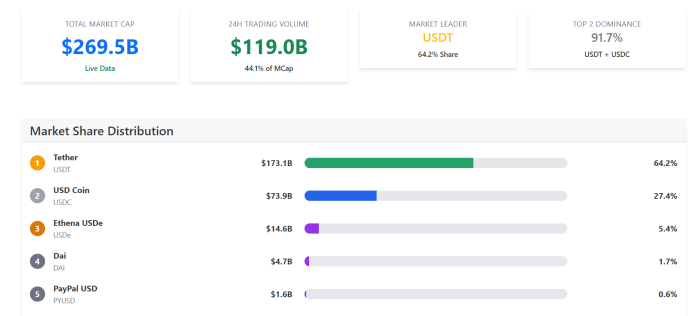
Stablecoin market overview.


More growth means more profits in Tether’s case; the company reported exceptionally strong profitability of $4.9B in Q2 2025 alone. That financial strength gives Tether a powerful base for any IPO plans.

U.S. Push and Regulatory Context

Part of those plans include a move into the U.S. market. Tether appointed Bo Hines, a former U.S. crypto policy official, as strategic adviser, and plans to launch a U.S.-oriented $USAT stablecoin.
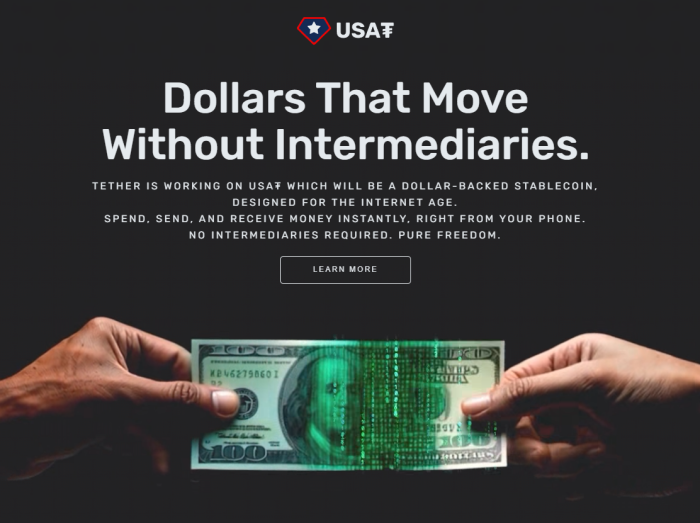
USAT presentation page.

Why now? Regulatory headwinds that historically restrained its U.S. operations largely vanished earlier this year with the passing of the GENIUS stablecoin act.

That has created an opportunity for Tether – currently headquartered in South America – to expand and cater its operations to the US market.

Despite the hype, there are several uncertainties. The deal is still preliminary, so the valuation, stake dilution, and raise amount could all shift materially.

There’s also a bigger question; with Tether already highly profitable, why go public at all? Possible reasons include accelerating U.S. expansion, regulatory compliance, product diversification, or building reserves, but investors will want transparency over how the funds are deployed.

Regardless of how this plays out, even rumors of Tether’s move are enough to surge investors’ interest. Here are three of the best cryptos under $1 that could explode soon.

1. Bitcoin Hyper ($HYPER) – Faster, Cheaper, Better Bitcoin Layer 2

Bitcoin’s big, bad, and beautiful, with a $2.2T+ market cap and constant predictions of $150K, $200K, or even $1.5M.

But it’s also slow, with an average of 7 TPS, and has a low throughput; add a lot of traffic, and congestion can cause transaction speeds to drop and fees to jump. That’s where Bitcoin Hyper ($HYPER) comes in.

Leveraging a Canonical Bridge on the Solana Virtual Machine, Bitcoin Hyper introduces a Layer 2 that allows investors to bridge Bitcoin and create wrapped Bitcoin.

On the Hyper Layer 2, that wrapped Bitcoin can be swapped, traded, and deployed across the full range of decentralised finance in a way Bitcoin couldn’t be before now.

dApps, smart contracts, DAOs, NFT marketplaces, even GameFi applications: they could all come alive on Bitcoin through Bitcoin Hyper’s L2.
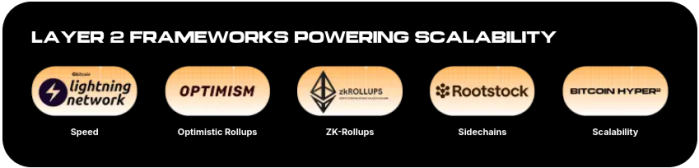
Bitcoin Hyper framework scalability and comparison.

The Bitcoin Hyper presale just passed $18M raised in the presale and shows no sign of slowing down.The token price is now set at $0.012975 but it won’t stay this cheap for too long. Our Bitcoin Hyper price prediction estimates a 2,366% increase by the end of the year.

Learn how to buy $HYPER, and check out our complete guide on what Bitcoin Hyper is and how it works.

Visit the $HYPER presale page to join before the next price increase.

2. Snorter Token ($SNORT) – Buy. Sell. Snipe. Win.

The best meme coins never see the light of day. They trade underground, rising and fading away again, but not before savvy investors make millions. The hardest part of trading them is finding them, and that’s where the Snorter Bot changes the game.

Snorter Bot and the Snorter Token ($SNORT) provide a cutting-edge meme coin trading tool.
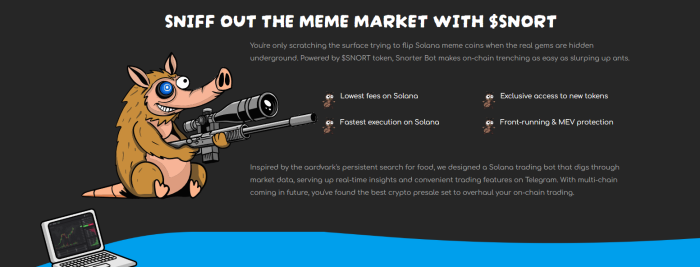
Snorter Token utility as shown on the presale page.

Native to Telegram and focused on Solana meme coins, Snorter sniffs out the best small-cap gems and gives traders all the tools they need to make winning plays. Those include:

  • Automated sniping
  • Rugpull protection
  • Copy trading
  • Honeypot detection
  • Limit orders

What is Snorter Token? It’s the tool that powers the best crypto trading bot. With over $4M raised, the presale continues to power forward towards the TGE.

Buy $SNORt at just $0.1053 before the presale ends in less than 26 days.

3. Aster ($ASTER) – 2,500% Gains for Up-and-Coming DeFi Platform

Back by CZ and benefiting from a wave of incoming TVL, Aster (the platform) has been on a roll recently. But $ASTER, the native utility token, has done even better.

In a single month since launch, $ASTER’s price increased over 2,500%.
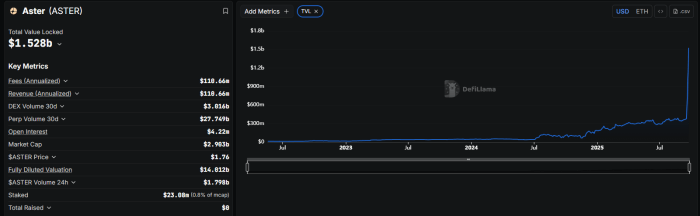
Aster TVL growth showing an abrupt climb recently.

That makes $ASTER one of the best plays of the resurgent DeFi scene. The platform, a decentralized perpetual contracts tool, has even drawn interest away from longstanding competitors in the field like Hyperliquid.

While $ASTER isn’t likely to grow at this rate forever, it’s already a proven contender.

Tether’s influence extends beyond its crypto business, holding tens of billions in U.S. Treasury bills, making it one of the largest non-sovereign purchasers of U.S. Treasuries.

Tether’s move might prompt re-assessments of how stablecoin issuers are valued compared to more traditional financial firms – and open the door for projects like $HYPER and $SNORT to skyrocket.

Recap: Bitcoin Hyper ($HYPER) is a utility-heavy altcoin focused on upscaling Bitcoin to modern demands, while Snorter Token ($SNORT) gives you the fastest and cheapest trading bot on Solana. And Aster ($ASTER) is a top DeFi buy right now.

Authored by Bogdan Patru, Bitcoinist – https://bitcoinist.com/best-crypto-to-buy-now-before-tether-goes-public

Editorial Process for bitcoinist is centered on delivering thoroughly researched, accurate, and unbiased content. We uphold strict sourcing standards, and each page undergoes diligent review by our team of top technology experts and seasoned editors. This process ensures the integrity, relevance, and value of our content for our readers.

As a crypto writer, Bogdan’s responsibilities are split between researching and writing articles and entertaining the team with his humor bordering on the politically incorrect, an aspiring Bill Burr, if you will. Thanks to his 12+ years of writing experience in just as many fields, including tech, cybersecurity, modelling, fitness, crypto, and other topics-that-shall-not-be-named, he's become a genuine asset to the team. While his position as a senior writer at PrivacyAffairs thought him valuable lessons about the power of self-management, his entire writing career was and is an exercise in self-improvement. Now, he's ready to sink his teeth into crypto and teach people how to take control of their own money on the blockchain. With fiat as an eternally devaluing currency, Bitcoin and altcoins seem like the best-fitting alternative for Bogdan. Bogdan’s biggest professional accomplishment, aside from securing a position as a main writer for Bitcoinist, was his 5-year run as a writing manager at Blackwood Productions, where he coordinated a team of four writers. During that time, he learned the value of teamwork and that of creating a working environment that breeds efficiency, positivity, and friendship.

Lectures associées

Pourquoi le Trésor américain intensifie ses rachats de dette à long terme, et pourquoi l'or et le Bitcoin montent-ils ?

Le Trésor américain a annoncé un doublement du programme de rachat de ses obligations à long terme à partir du 9 septembre, une mesure visant à soutenir la liquidité du marché. Cette décision, intervenue dans un contexte de hausse continue des rendements obligataires et d'affaiblissement du dollar, a ravivé les craintes d'une dépréciation de la devise américaine, servant de catalyseur principal à une forte hausse du bitcoin et de l'or. Le bitcoin a connu une progression particulièrement marquée, avec des gains quotidiens d'environ 6% pendant trois séances consécutives. L'or a également bénéficié de la faiblesse du dollar, franchissant sa moyenne mobile sur 200 jours. Les analystes expliquent que l'annonce du Trésor a relancé le "trade de dépréciation monétaire", poussant les investisseurs vers des actifs considérés comme des valeurs refuges face à l'érosion anticipée du pouvoir d'achat du dollar. Cependant, le marché obligataire est resté sceptique, les rendements des obligations à 10 et 30 ans étant rapidement revenus à leurs niveaux d'avant l'annonce. Cette réaction met en doute l'efficacité réelle de l'opération pour soulager la pression sur les taux à long terme. Des facteurs supplémentaires, comme une réunion à la Maison Blanche sur la régulation des cryptomonnaies et des rachats forcés de positions vendeuses sur le bitcoin, ont aussi contribué à la hausse. En définitive, bien que l'intervention du Trésor ait provoqué un mouvement de fuite vers les actifs tangibles, elle ne semble pas avoir modifié les dynamiques fondamentales du marché obligataire, où persistent les inquiétudes concernant le déficit budgétaire, l'inflation et le fardeau de la dette publique américaine.

华尔街日报Il y a 2 h

Pourquoi le Trésor américain intensifie ses rachats de dette à long terme, et pourquoi l'or et le Bitcoin montent-ils ?

华尔街日报Il y a 2 h

Le mystérieux grand modèle « Ox Alpha » fait le buzz, gratuit pour un temps limité

Le monde des grands modèles de langage (LLM) est en effervescence avec l'apparition d'Ox Alpha, un modèle anonyme surnommé « Niu Lai » par les internautes chinois. Proposé gratuitement et temporairement sur OpenRouter, il dispose d'un contexte de 1 million de tokens et prend en charge texte, images et vidéos. Son évaluation sur des tâches d'ingénierie logicielle réelles (benchmark DeepSWE) montre des performances impressionnantes, avec un taux de réussite initial de 80% sur un sous-ensemble de tests, rivalisant ainsi avec les meilleurs modèles de codage actuels. Bien que d'autres tests aient rapporté un score d'environ 63%, son fort potentiel est établi. Son origine fait l'objet de vives spéculations. Plusieurs indices techniques pointent vers une version non publiée de GLM-5.3 (probablement GLM-5.3 Flash ou sa variante multimodale) développée par Zhipu AI : alignement parfait du comptage de tokens visuels et textuels avec GLM-5V-Turbo/GLM-5.3, comportements de refus et style de réponse similaires. L'entreprise n'a cependant pas confirmé. Parallèlement, un autre modèle anonyme nommé « korrine » apparaît sur Code Arena, suscitant des hypothèses le liant à Kimi, Qwen ou MiMo. Cette tendance au test anonyme (« sous couverture ») permet aux développeurs d'évaluer objectivement les capacités des modèles, sans biais de marque, et de les soumettre à des tests de stress en conditions réelles avant un lancement officiel, tout en générant du buzz marketing. La performance d'Ox Alpha, s'il s'agit bien d'un modèle « Flash » (version allégée), laisse entrevoir un potentiel encore plus élevé pour les versions complètes à venir.

marsbitIl y a 3 h

Le mystérieux grand modèle « Ox Alpha » fait le buzz, gratuit pour un temps limité

marsbitIl y a 3 h

Bitwise CIO Matt : Si vous avez actuellement une configuration crypto de 0 %, cela équivaut à être activement baissier sur le marché

Matt Hougan, CIO de Bitwise, analyse la dynamique actuelle du marché cryptographique malgré une baisse de 50% depuis les sommets. Il souligne l'engagement persistant de Wall Street, citant le lancement de fonds tokenisés par BlackRock malgré les retards réglementaires comme le CLARITY Act. Hougan estime que ce projet de loi restera dans un état d'incertitude, mais que l'industrie avancera sans lui, soutenue par les grandes institutions financières. Il observe un changement de comportement du Bitcoin, désormais résistant aux mauvaises nouvelles, signe pour lui de la fin d'un marché baissier. Concernant l'investissement, il explique que le DCA (moyenne par coût) est une assurance comportementale, mais qu'une entrée immédiate est justifiée pour les rendements absolus, anticipant une reprise. Hougan note que les grandes plateformes de gestion de patrimoine (Wells Fargo, UBS) considèrent désormais la crypto comme une classe d'actifs à part entière, se focalisant sur le long terme. Il met en avant les opportunités de la gestion d'actifs on-chain et du thème de la tokenisation d'actifs réels (RWA), bénéfiques pour Ethereum, Solana et Chainlink. Son conseil principal : une allocation de 5% en crypto est un "repas gratuit", améliorant significativement les rendements sans augmenter la volatilité globale du portefeuille. À l'inverse, une allocation de 0% n'est pas une position neutre, mais un pari actif très baissier sur l'avenir de cette classe d'actifs.

marsbitIl y a 3 h

Bitwise CIO Matt : Si vous avez actuellement une configuration crypto de 0 %, cela équivaut à être activement baissier sur le marché

marsbitIl y a 3 h

À l'instant, le premier match de tennis humain-machine au monde s'est déroulé, un robot a effectué un sauvetage limite, laissant Zheng Jie stupéfaite

Le premier match de tennis humain-robot au monde a eu lieu lors des deuxièmes Jeux mondiaux des robots humanoïdes, diffusé en direct par la télévision centrale de Chine. Le robot humanoïde "Galaxy Star仔" de Galaxy General Robotics a affronté la championne de tennis Zheng Jie en simple, après avoir participé à un double mixte. Le robot a démontré des capacités remarquables : déplacement agile, échanges fluides, service à plus de 100 km/h, et récupération de balles difficiles. Il a même réussi à se relever rapidement après une chute. Cette performance représente un point de rupture dans l'intelligence incarnée, testant en temps réel les limites de la perception, de la prise de décision, du contrôle moteur et de l'adaptation dans un environnement physique dynamique et imprévisible, bien plus complexe que les jeux de stratégie comme les échecs ou le Go. Cette réussite s'appuie sur le modèle d'intelligence incarnée "Galaxy AstraBrain", qui intègre dans une même architecture les fonctions de décision de haut niveau ("cerveau") et de contrôle moteur fin ("cervelet"), éliminant ainsi les délais de communication. Le robot a été entraîné en deux étapes : d'abord par apprentissage à partir de données imparfaites de joueurs humains, puis par un entraînement intensif en simulation où plusieurs agents s'affrontaient, permettant l'émergence autonome de compétences comme le sauvetage extrême ou la technique pour se relever. Cet événement "AstraTennis" marque le passage de l'IA d'un monde numérique à la maîtrise du monde physique, symbolisant les avancées de la Chine dans l'ère de la symbiose carbone-silicium.

marsbitIl y a 4 h

À l'instant, le premier match de tennis humain-machine au monde s'est déroulé, un robot a effectué un sauvetage limite, laissant Zheng Jie stupéfaite

marsbitIl y a 4 h

Soudain, DeepSeek annonce des tarifs creux le week-end, travailler le samedi et dimanche deviendrait plus avantageux ?

DeepSeek a annoncé une modification de sa tarification par période de pointe et creuse pour ses API, effective à partir du 23 août. Désormais, les week-ends (samedi et dimanche) seront entièrement facturés au tarif creux, sans distinction d'heure. Cette décision, généralement bien accueillie par les développeurs qui peuvent ainsi réduire leurs coûts en exécutant des tâches batch le week-end, suscite également des inquiétudes parmi les salariés. En effet, certaines industries, comme celle des mini-séries, ont déjà commencé à ajuster les horaires de travail pour profiter des périodes de calcul AI moins chères. Des cas sont rapportés où des entreprises modifient les plannings, voire imposent du travail le week-end, pour optimiser les dépenses en tokens. Les raisons de ce changement tarifaire font débat. Une hypothèse avance que les prix de pointe correspondent aux périodes d'entraînement des modèles par DeepSeek, libérant la capacité de calcul le week-end. D'autres remettent en cause cette logique, arguant que l'entraînement des modèles est hautement automatisé. Alors que la nouvelle grille tarifaire est en vigueur, la question des impacts à long terme sur l'organisation du travail et des potentielles économies réelles, compte tenu des coûts de coordination supplémentaires, reste ouverte.

marsbitIl y a 4 h

Soudain, DeepSeek annonce des tarifs creux le week-end, travailler le samedi et dimanche deviendrait plus avantageux ?

marsbitIl y a 4 h

Trading

Spot
活动图片