SEC Eyes More Crypto Clarity: ‘Innovation Exemption’ Could Come By Year-End – Chair Atkins

bitcoinistPublié le 2025-09-24Dernière mise à jour le 2025-09-24

Résumé

In a recent interview, the Securities and Exchange Commission (SEC) Chairman discussed the importance of establishing a crypto market structure...

Trusted Editorial content, reviewed by leading industry experts and seasoned editors. Ad Disclosure

In a recent interview, the Securities and Exchange Commission (SEC) Chairman discussed the importance of establishing a crypto market structure legislation and the regulatory agency’s effort to implement a rule exception for digital asset firms in the coming months.

SEC To Offer More Crypto Clarity By Year-End

On Tuesday, SEC Chairman Paul Atkins joined FOX Business to discuss the US Congress’s crypto legislation and the agency’s measures to make the industry “stand on firm ground” and provide the long-awaited regulatory clarity to advance the digital assets sector in America.

Atkins stated that the Commission is “trying to get the marketplace some kind of stable platform upon which they can introduce new products,” citing the recently approved new generic listing standards for spot crypto exchange-traded funds (ETFs) as one big step toward their goals.

The SEC Chief affirmed that “a lot is going on” for the agency, including working on rulemaking and setting an innovation exemption for crypto firms by the end of 2025. Following the successful “Crypto Week” in July, he revealed that the Commission was exploring some regulatory changes to boost innovation.

As reported by Bitcoinist, the Chairman shared that the agency was considering an innovation exemption that would “permit novel ways of trading and more narrowly tailored forms of relief to facilitate the building of other components of a tokenized securities ecosystem.”

The rule exemption would allow crypto firms to quickly launch products without having to comply with “burdensome prescriptive regulatory requirements that hinder productive economic activity.”

Instead, crypto firms would “be able to comply with certain principles-based conditions designed to achieve the core policy aims of the federal securities laws,” Atkins detailed in a late July speech.

CFTC, SEC To Work ‘Hand in Glove’

During the interview, the SEC Chairman also discussed the regulator’s ongoing collaboration with the Commodity Futures Trading Commission (CFTC) and the potential consolidation of the two agencies, with Atkins as the leader.

It’s worth noting that the CFTC is currently in leadership limbo as the confirmation process of President Trump’s nominee for Chairman, Brian Quintenz, has stalled following a request from the White House.

The regulatory agency, intended to be a five-person, bipartisan commission, is down to only acting Chair Caroline Pham, who is also expected to depart from the agency once a permanent chief is appointed.

“I have my hands full right now,” Atkins said, shutting down the idea. “We are working hand in glove right now with the CFTC, so harmonization is what I envision. People have been discussing this issue for a long time, and I think we’re at a point now, especially when we look at the changes in the digital asset area, that it’s incumbent on the two agencies to work hand in glove.”

What we have to really focus on is that over the years, there’s been (…) jockeying for position, and we don’t need regulatory turf battles. The field is littered with bodies of would-be products (…) that over the years have been torpedoed by the lack of certainty as between what falls within the SEC’s realm and what’s the CFTC’s realm.

Speaking about crypto market structure legislation, the regulator highlighted the importance of the bill. He explained that with the enactment of the GENIUS Act for stablecoin regulations, the market structure must be a priority “so that there’s certainty in the marketplace and direction to the SEC and CFTC to work together.”

Ultimately, he anticipated that the two regulatory agencies would work on joint rulemaking to “try to future-proof these rules and the relationships from some rogue regulations in the future.”
crypto, bitcoin, btc, btcusdt

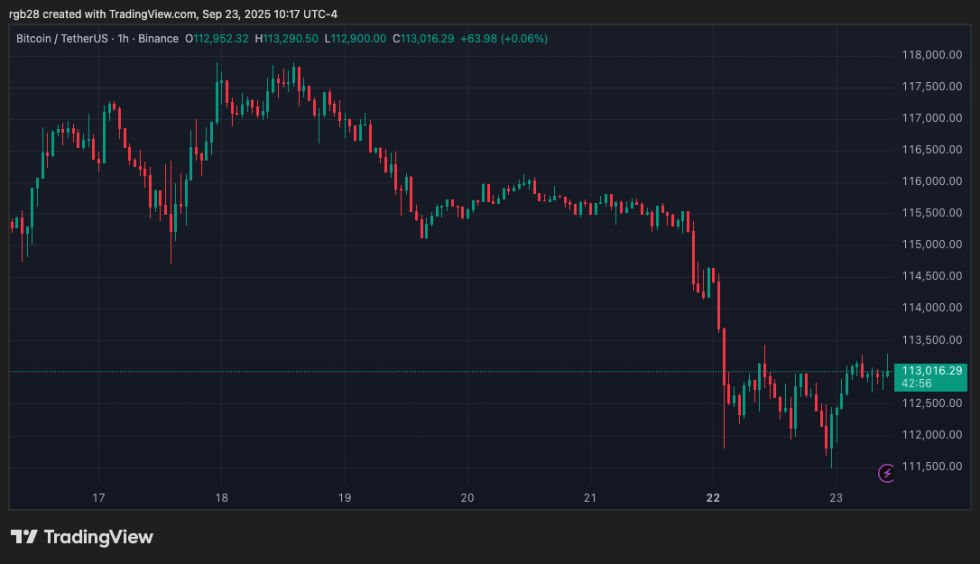
Bitcoin (BTC) trades at $113,016 in the one-week chart. Source: BTCUSDT on TradingView
Featured Image from NBC News, Chart from TradingView.com
Editorial Process for bitcoinist is centered on delivering thoroughly researched, accurate, and unbiased content. We uphold strict sourcing standards, and each page undergoes diligent review by our team of top technology experts and seasoned editors. This process ensures the integrity, relevance, and value of our content for our readers.

Rubmar is a crypto enthusiast who likes learning and improving constantly. She enjoys reporting on the latest news and developments in the crypto industry. Rubmar also enjoys scrapbooking, crafting, simulation games, and watching football.

Lectures associées

Analyse de rapport : Le secteur des semi-conducteurs a bondi de 155 %, Bernstein estime que NVDA et AVGO sont "absurdement bon marché"

Résumé : Le cabinet Bernstein a publié son analyse trimestrielle du secteur des semi-conducteurs. Le point central est que l'IA est désormais le principal moteur de croissance, portant l'indice SOX à une hausse de 155% sur un an. La hausse est jugée fondamentalement saine. Bernstein souligne une divergence forte au sein du secteur. Malgré des valorisations globalement élevées pour le secteur (P/E de 34,1x), l'analyste estime que les leaders clés de la chaîne d'approvisionnement en IA, NVIDIA (NVDA) et Broadcom (AVGO), sont "absurdement bon marché". Cela s'explique par leurs perspectives de croissance à long terme (p.ex. Blackwell pour NVDA) et leurs positions dominantes. Les deux sociétés sont notées « Surperformance ». Le cabinet a amélioré sa recommandation sur AMD à "Surperformance", citant des opportunités à la fois dans l'IA/GPU et dans les CPU. En revanche, il reste prudent sur Qualcomm (QCOM, "Égalité avec le marché"), en raison des pressions sur le marché des smartphones. Les équipementiers semi-conducteurs restent favorisés. Pour les semi-conducteurs analogiques, la valorisation est jugée élevée malgré la reprise. Bernstein met en garde contre deux risques principaux : un niveau de participation historiquement élevé des investisseurs dans le secteur et une montée des niveaux d'inventaire qui pourrait peser sur les prix si la demande faiblissait. L'analyse conclut qu'en dépit de la solide demande d'IA, la sélectivité est désormais cruciale.

marsbitIl y a 45 mins

Analyse de rapport : Le secteur des semi-conducteurs a bondi de 155 %, Bernstein estime que NVDA et AVGO sont "absurdement bon marché"

marsbitIl y a 45 mins

Entretien long avec le PDG d'Anthropic : Quand l'IA devient une super-arme, comment trouver l'équilibre entre commerce et sécurité ?

Dario Amodei, PDG d'Anthropic, discute de l'équilibre entre innovation commerciale et responsabilité sécuritaire dans le développement de l'IA. Il évoque son départ d'OpenAI dû à des divergences de valeurs et un manque de confiance, et défend la stratégie d'Anthropic axée sur les applications entreprises pour aligner modèle économique et éthique. Il aborde les risques sociétaux, notamment la suppression potentielle de nombreux emplois de cols blancs, tout en proposant des solutions pour une transition positive. Amodei insiste sur la nécessité d'une coopération entre acteurs de confiance pour établir des normes de sécurité élevées, citant sa collaboration avec Google. Concernant la sécurité nationale, il justifie les contrats avec le Département de la Défense américain par la nécessité de contrer des adversaires, mais en fixant des limites strictes contre la surveillance de masse ou les armes autonomes. Il explique également la non-publication du modèle "Mythos", jugé trop puissant et risqué, en attendant des mécanismes de défense adaptés. Enfin, il rejette l'idée d'un "moment" singulier d'auto-amélioration de l'IA, décrivant plutôt une accélération exponentielle graduelle. Il conclut sur la nécessité d'une gouvernance équilibrée, évitant à la fois le contrôle exclusif par des entreprises privées ou par les gouvernements.

marsbitIl y a 56 mins

Entretien long avec le PDG d'Anthropic : Quand l'IA devient une super-arme, comment trouver l'équilibre entre commerce et sécurité ?

marsbitIl y a 56 mins

Émetteur de DRAM ETF : Samsung, SK Hynix et Micron franchissent tous le cap du trillion de dollars, l'ère de l'IA pour les puces mémoire ne fait que commencer

Les trois géants des semi-conducteurs mémoire (Samsung, SK Hynix, Micron) ont vu leur capitalisation boursière dépasser 1 000 milliards de dollars, suscitant des interrogations sur la durabilité de cette croissance. Un récent article de Morningstar met en garde contre les cycles historiques de surproduction et la nature « commoditisée » de la mémoire, suggérant que l'enthousiasme pourrait être déconnecté des fondamentaux. Cependant, l'article de Roundhill Investments (gérant du DRAM ETF) défend une thèse différente, arguant que l'ère de l'IA change structurellement l'industrie. La demande n'est plus tirée par l'électronique grand public, mais par les infrastructures d'IA, notamment par la mémoire HBM (High Bandwidth Memory). La fabrication du HBM présente des barrières technologiques extrêmes, contrôlée quasi exclusivement par les trois leaders, ce qui limite fortement l'entrée de nouveaux acteurs et crée une pénurie durable. Les fondamentaux semblent solides : les bénéfices combinés des trois sociétés pourraient atteindre 704 milliards de dollars d'ici 2027, avec des marges à des niveaux records. Leurs valorisations, bien qu'en hausse, restent modérées par rapport aux projections de croissance des bénéfices. L'article conclut que le secteur, historiquement volatile, pourrait entrer dans une nouvelle ère de profitabilité soutenue grâce à l'IA, justifiant une réévaluation des modèles d'investissement traditionnels.

marsbitIl y a 1 h

Émetteur de DRAM ETF : Samsung, SK Hynix et Micron franchissent tous le cap du trillion de dollars, l'ère de l'IA pour les puces mémoire ne fait que commencer

marsbitIl y a 1 h

Trading

Spot
Futures
活动图片