Laos Eyes Bitcoin Mining To Tackle Mounting Debt

bitcoinistPublié le 2025-09-18Dernière mise à jour le 2025-09-18

Résumé

Laos is exploring a new way to service the debts from its decades-long hydropower build-out: turning excess electricity into Bitcoin....

Trusted Editorial content, reviewed by leading industry experts and seasoned editors. Ad Disclosure

Laos is exploring a new way to service the debts from its decades-long hydropower build-out: turning excess electricity into Bitcoin. In a report published on September 17, the South China Morning Post framed the pivot bluntly: “Saddled with debt and surplus electricity, the ‘battery of Southeast Asia’ is eyeing energy-intensive crypto mining to turn a profit.” The article situates the move within a dam-driven development model that has left Laos with power it cannot always sell and a mounting repayment schedule.

Why Laos Eyes Bitcoin Mining

The policy logic is straightforward. Bitcoin mining converts electrons into a globally liquid asset and can be sited directly at hydropower plants, mitigating transmission bottlenecks and absorbing seasonal surpluses. Laos has promoted electricity exports for years—SCMP notes power accounted for roughly a quarter of the country’s exports last year—yet export deals and grids do not always line up with generation, exacerbating revenue-timing mismatches against hard-currency debt obligations from dam construction.

According to SCMP “environmental campaigners view the turn to crypto as symptomatic of a flawed energy policy that has left Laos indebted and unable to offload its surplus power.” The Chinese news report cites Witoon Permpongsacharoen, director of the Mekong Energy and Ecology Network: “Laos allowing electricity to be used for cryptocurrency mining is clearly not something driven by internal conditions. It stems from the fact that Laos is heavily indebted and unable to pay off its debts.”

If implemented, this would not be Laos’s first embrace of digital-asset mining. In September 2021, the government launched a pilot program authorizing six firms to mine and trade Bitcoin and cryptocurrencies under regulated power-purchase terms, a move widely read as an attempt to capture miners displaced by China’s crackdown.

However, the stance has seesawed amid hydrological stress and grid constraints: in August 2023, the state utility Électricité du Laos (EDL) halted electricity supply to Bitcoin miners citing drought and power shortages; by May 2024, Reuters reported crypto data centers made up “over a third of the country’s power” consumption and contributed to outages, prompting authorities to stop approving new operations even as they weighed proposals to stabilize supply.

The fiscal backdrop helps explain the renewed interest. External public debt service is projected by the World Bank to average about $1.3 billion per year over 2025–2028—around 9% of GDP annually—keeping gross financing needs elevated as key hydropower assets are still ramping. Separate reporting this year underscored the strain: a Chinese dam operator initiated a $555 million arbitration against EDL for alleged unpaid dues, highlighting the financial pressures on the state power sector.

Yet the “surplus power” narrative is not uniform. Hydropower output is volatile, impacted by erratic rainfall and a warming climate, while export pipelines remain politically and commercially complex. Laos produces surplus electricity in the wet season but must import power from neighboring countries during the dry months. These structural frictions are precisely the niches where mobile, interruptible loads like Bitcoin mines can monetize stranded energy—until the water runs low.

Analysts who champion “wasted renewables” see a broader pattern. “Bhutan, Ethiopia, and now Laos use Bitcoin mining to monetize wasted renewable energy,” Bitcoin climate activist Daniel Batten wrote via X as coverage of the SCMP story circulated, casting the strategy as part of a 2025 “vibe shift.”

Bhutan has openly leaned into hydro-powered mining this year, calling bitcoin “a strategic battery” to arbitrage seasonal surpluses and fund development; Ethiopia’s power utility has said it generated about $55 million over 10 months by selling surplus hydro to miners. Laos’s plan would slot into that template, albeit with more fragile hydrology and balance-sheet constraints.

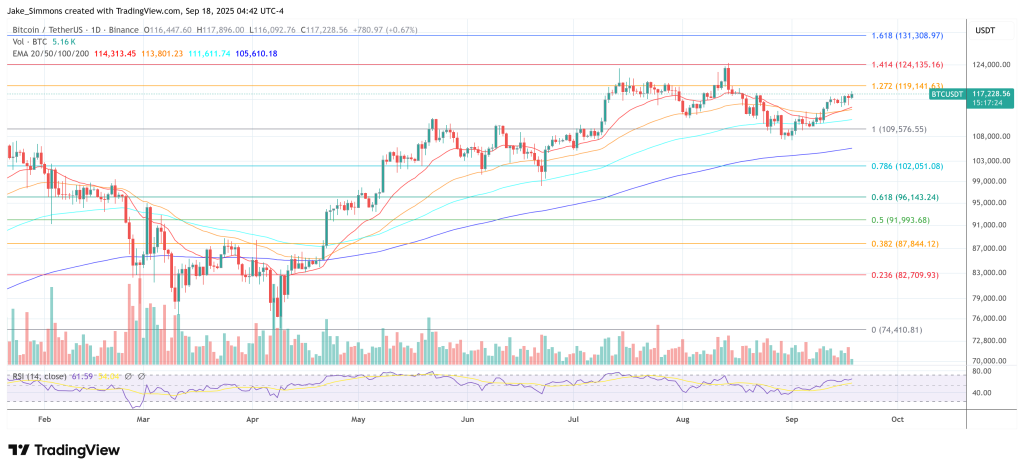
At press time, BTC traded at $117,228.
Bitcoin price
BTC is back above $117,000, 1-day chart | Source: BTCUSDT on TradingView.com
Featured image created with DALL.E, chart from TradingView.com
Editorial Process for bitcoinist is centered on delivering thoroughly researched, accurate, and unbiased content. We uphold strict sourcing standards, and each page undergoes diligent review by our team of top technology experts and seasoned editors. This process ensures the integrity, relevance, and value of our content for our readers.

Jake Simmons has been a Bitcoin enthusiast since 2016. Ever since he heard about Bitcoin, he has been studying the topic every day and trying to share his knowledge with others. His goal is to contribute to Bitcoin's financial revolution, which will replace the fiat money system. Besides BTC and crypto, Jake studied Business Informatics at a university. After graduation in 2017, he has been working in the blockchain and crypto sector. You can follow Jake on Twitter at @realJakeSimmons.

Lectures associées

Les détenteurs de portefeuilles matériels perdent de l'argent : les nuances du stockage à froid du Bitcoin en 2026

Fin 2026, une série d'incidents a secoué la confiance dans les portefeuilles matériels (cold wallets). L'attaque la plus grave a visé Coldcard de Coinkite, exploitant une vulnérabilité vieille de cinq ans dans son générateur de phrases de récupération (seed phrase). Une erreur de firmware avait réduit l'entropie cryptographique, facilitant une attaque par force brute et entraînant le vol de 1 778 à 2 417 BTC (115 à 153 millions de dollars). Les autres grands fabricants, Trezor et Ledger, ont rapidement assuré que leurs dispositifs, utilisant des générateurs de nombres aléatoires matériels sécurisés, n'étaient pas affectés par cette faille spécifique. Cependant, des incidents parallèles ont alimenté la méfiance : une fuite de données personnelles chez SafePal via un plugin tiers et une autre chez des clients de Trezor due au piratage de son opérateur logistique, ShipMonk. Ces événements soulignent plusieurs nuances cruciales : un portefeuille ne stocke pas les cryptomonnaies, mais les clés d'accès. Aucune méthode de stockage (papier, métal, matériel) n'est parfaite. Fait notable, après l'affaire Coldcard, certains utilisateurs ont transféré leurs actifs vers des plateformes centralisées (CEX), optant paradoxalement pour la garde sous tutelle plutôt que la sécurité autonome. Enfin, un défi majeur émerge : l'évolution de l'IA. Comme l'a noté un responsable de Ledger, elle amplifie à la fois les capacités des développeurs à renforcer la sécurité et celles des attaquants à découvrir des vulnérabilités. Ainsi, plutôt que de condamner toute une catégorie de produits, il faut analyser chaque cas. Les portefeuilles matériels, malgré leurs imperfections, restent pour beaucoup un compromis optimal entre sécurité et praticité dans l'écosystème cryptographique.

cryptonews.ruIl y a 21 mins

Les détenteurs de portefeuilles matériels perdent de l'argent : les nuances du stockage à froid du Bitcoin en 2026

cryptonews.ruIl y a 21 mins

La prévision de 100 000 dollars pour le bitcoin pourrait être sous-estimée après un « squeeze » à découvert record

Le rebond soudain du bitcoin a accru la probabilité que la prévision de 100 000 $ de Jeffrey Kendrick pour fin d'année soit trop conservatrice, selon une analyse de Standard Chartered. Kendrick, responsable de la recherche sur les actifs numériques, a qualifié la semaine dernière de plus important « short squeeze » (liquidation de positions courtes) de l'histoire du bitcoin, avec près de 1,44 milliard de dollars liquidés lors du rallye du 19-21 août. Ce phénomène, combiné à un retour des entrées nettes dans les ETF spot américains (environ 1,92 milliard de dollars sur cinq jours), pourrait accélérer la hausse. Le rallye a été alimenté par deux catalyseurs : l'annonce du Trésor américain d'augmenter ses rachats d'obligations et un événement à la Maison Blanche où le président Trump a poussé pour une régulation favorable aux cryptomonnaies. Le bitcoin a ainsi atteint 79 500 $ le 21 août, son plus haut niveau depuis mai. Kendrick estime qu'au-delà de son objectif de 100 000 $, un dépassement du record historique de 126 000 $ d'octobre 2025 est possible avant fin d'année, surtout après la date anniversaire de ce pic. Il note également que l'intérêt ouvert sur les marchés dérivés reste relativement bas, laissant de la place pour une reprise de l'activité. Standard Chartered maintient une prévision à long terme de 500 000 $ pour le bitcoin d'ici 2030.

cryptonews.ruIl y a 25 mins

La prévision de 100 000 dollars pour le bitcoin pourrait être sous-estimée après un « squeeze » à découvert record

cryptonews.ruIl y a 25 mins

Trading

Spot
活动图片