Survey Finds 54% of Firms Plan Stablecoin Adoption by 2026; Best Wallet Token Presale Nears $16M

bitcoinistPublié le 2025-09-17Dernière mise à jour le 2025-09-17

Résumé

Per an EY-Parthenon survey, 54% of business leaders who have yet to touch stablecoins plan to do so by 2026....

Trusted Editorial content, reviewed by leading industry experts and seasoned editors. Ad Disclosure

Per an EY-Parthenon survey, 54% of business leaders who have yet to touch stablecoins plan to do so by 2026.

Why the change of heart? Lower transaction costs and faster cross-border payments are the main reasons organizations are turning to stablecoins.

Since crypto wallets play a key role in enabling stablecoin transactions, choosing the right one matters. One option we like is Best Wallet, thanks to its ease of use and security.

Its native token, $BEST, also deserves a shout-out. It’s close to raising nearly $16M on presale, as it supports the wallet’s developments and grants holders low gas fees.

Only 13% of Firms Use Stablecoins, But 41% Report Big Savings

The report found that, right now, only around 13% of financial institutions and  international corporations use stablecoins. One of the main reasons for them not doing so boils down to regulatory uncertainty.
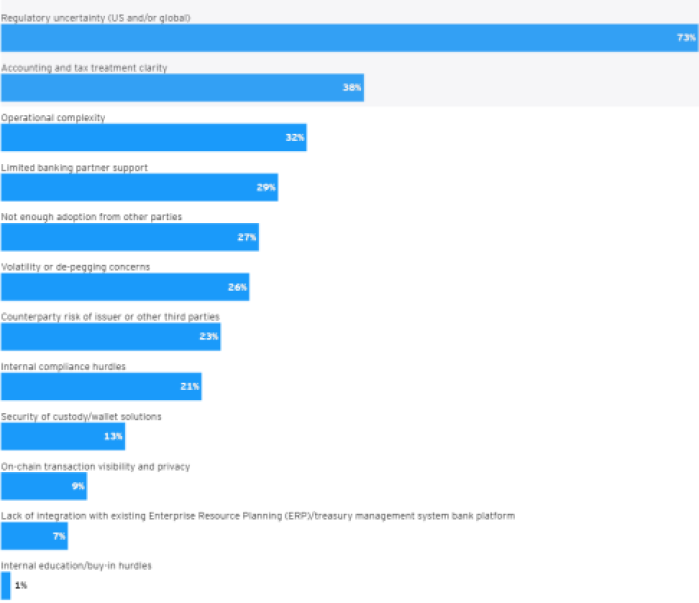
Graph showing reasons behind low stablecoin adoption.
Source: EY-Parthenon

Yet, this percentage is on the rise following the passage of the GENIUS Act on July 18. It gives institutions greater regulatory clarity and, thus, confidence to move forward with adopting these digital assets.

And it’s no wonder stablecoins are attracting attention. Among current users, 41% said they’ve saved over 10% in costs compared to traditional payment methods.

The top use case for stablecoins is cross-border supplier payments, which account for 62% of implementations.

The reason is that they’re 1:1 backed by reserve assets (often the US dollar) for stability. Yet, they have faster settlement times compared to traditional international transfers.

Out of the stablecoins available, US-dollar-pegged ones are the go-to choice. $USDC is the clear frontrunner with 77%, followed by $USDT at 59%.

If these stablecoins are top of your radar, Best Wallet is a great way to manage, buy, and sell them.

Store Top Stablecoins & Cryptos on Best Wallet

Available on Google Play and iOS, the Best Wallet app is a great way to manage, buy, sell, and swap various types of cryptos while out and about.

The mobile app already supports over 1K+ assets across top chains like Ethereum, BNB Chain, and Polygon. This includes top stablecoins like $USDC and $USDT, plus leading cryptos like $BTC, $ETH, and $BNB.

It takes pride in making crypto activities simple. Check out its built-in launchpad, for instance. It gives you access to the best crypto presales. And that’s not to mention its swap engine, which scans 330+ DEXs and 30 bridges to find you the best rates.
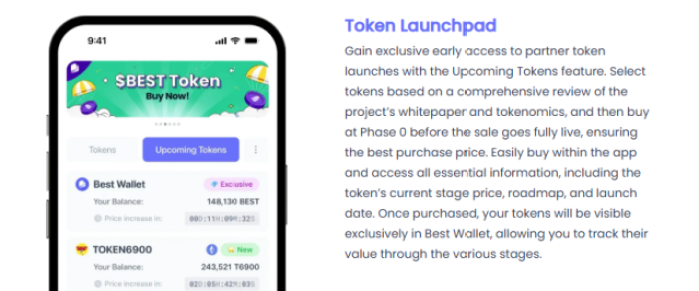
Best Wallet has its own crypto launchpad.
Source: Best Wallet

And all is achieved with security intact. Because Best Wallet’s non-custodial, it ensures that you, and only you, have access to your private keys.

Also helping prevent unauthorized access are extra layers of protection like 2FA, biometrics, and local encryption.

Even if you lose account access, you can rest easy knowing that you can restore your assets through encrypted cloud backups.

The app also has lots to look forward to in the pipeline, including an NFT gallery, intel market analytics, and a rewards hub.

$BEST will make this possible, as a quarter of its total token supply is set aside for product development.
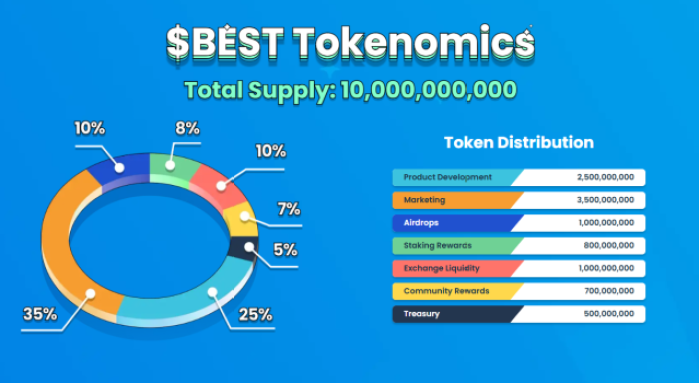
Best Wallet tokenomics.
Source: Best Wallet Token

Holding $BEST also grants governance rights, reduces gas fees, and offers staking rewards at an 83% APY.

So far, $BEST has raised over $15.9M on presale, backed by three major investors ($70.2K, $91.1K, and $59K).

You can buy $BBEST for as little as $0.025655. Following the upcoming app developments, the cost could increase to $0.072 this year, making now a great time to join before it possibly spikes by over 180%.

Want to learn more? Check out our Best Wallet guide.

Authored by Leah Waters, Bitcoinist – https://bitcoinist.com/stablecoin-adoption-rises-best-wallet-nears-16m

Editorial Process for bitcoinist is centered on delivering thoroughly researched, accurate, and unbiased content. We uphold strict sourcing standards, and each page undergoes diligent review by our team of top technology experts and seasoned editors. This process ensures the integrity, relevance, and value of our content for our readers.

Leah is a British journalist with a BA in Journalism, Media, and Communications and nearly a decade of content writing experience. Over the last four years, her focus has primarily been on Web3 technologies, driven by her genuine enthusiasm for decentralization and the latest technological advancements. She has contributed to leading crypto and NFT publications – Cointelegraph, Coinbound, Crypto News, NFT Plazas, Bitcolumnist, Techreport, and NFT Lately – which has elevated her to a senior role in crypto journalism. Whether crafting breaking news or in-depth reviews, she strives to engage her readers with the latest insights and information. Her articles often span the hottest cryptos, exchanges, and evolving regulations. As part of her ploy to attract crypto newbies into Web3, she explains even the most complex topics in an easily understandable and engaging way. Further underscoring her dynamic journalism background, she has written for various sectors, including software testing (TEST Magazine), travel (Travel Off Path), and music (Mixmag). When she's not deep into a crypto rabbit hole, she's probably island-hopping (with the Galapagos and Hainan being her go-to's). Or perhaps sketching chalk pencil drawings while listening to the Pixies, her all-time favorite band.

Lectures associées

Aave grimpe face au Bitcoin alors que le récit institutionnel de la DeFi se renforce

AAVE affiche une performance remarquable face à un marché crypto affaibli, résistant à la pression générale exercée par la faiblesse du Bitcoin. Ce mouvement est attribué au renforcement du récit de la finance décentralisée (DeFi) institutionnelle et des actifs du monde réel (RWA), relancé par l'attention récente de Standard Chartered sur le protocole. La banque a mis en avant le rôle d'AAVE en tant que marché de prêt décentralisé majeur et mature, traduisant son potentiel en termes de revenus, de demande de crédit et de marché adressable pour un public institutionnel. Cette résistance suggère que les traders pourraient commencer à différencier les infrastructures DeFi solides, dotées de cas d'utilisation crédibles, du reste du marché des altcoins. La persistance de cette force relative sera un test clé. Si elle se maintient malgré la volatilité, cela pourrait indiquer une rotation du capital vers des protocoles aux fondamentaux robustes, même dans un contexte de pression sur le Bitcoin. Cette évolution s'inscrit dans des tendances de fond du marché : une régulation plus précise, un rapprochement des produits institutionnels avec les rails financiers traditionnels et une réaction rapide des traders à la liquidité réduite. Ainsi, l'épisode Aave est moins un catalyseur de prix isolé qu'un indicateur de l'évolution des infrastructures, des flux de capitaux et de la prochaine étape d'adoption de la cryptomonnaie.

bitcoinistIl y a 14 mins

Aave grimpe face au Bitcoin alors que le récit institutionnel de la DeFi se renforce

bitcoinistIl y a 14 mins

Huang Renxun : Les prompts sont en train de devenir obsolètes, les loops sont le nouveau paradigme

Prompt passe, place aux loops. Tel est le nouveau paradigme souligné par des figures comme Jensen Huang. Le concept de "loop" (boucle) désigne la conception de systèmes où l'IA exécute des tâches de manière autonome : elle définit ses propres instructions, vérifie les résultats, et réitère jusqu'à réussite ou épuisement du budget, sans intervention humaine constante. Contrairement à un agent simple qui nécessite une instruction à chaque étape, un système avec loop fonctionne en continu. Des produits comme Claude Code et OpenAI Codex l'ont déjà implémenté via des fonctionnalités comme `/goal` ou des automations, où un modèle écrit le code et un autre, indépendant, le valide. Pour construire une loop efficace, il faut : 1) s'assurer que la tâche est répétitive, automatisable et dans les limites budgétaires ; 2) commencer par une loop simple avec un déclencheur, une compétence, un fichier d'état et un contrôle ; 3) séparer clairement l'écriture et la validation du code ; 4) éviter les pièges comme l'absence de conditions d'arrêt ou la gestion de tâches nécessitant un jugement humain. Cette évolution s'inscrit dans une progression : après l'ingénierie des prompts (2023-2024), puis du contexte (2024-2025) et du "harnais" (environnement d'exécution, 2025-2026), l'ingénierie des loops représente la dernière étape, où le contrôle humain passe de la micro-gestion à la conception de systèmes autonomes. Des travaux académiques comme ReAct (2022) ont jeté les bases de ce principe de boucle réflexive. Bien que prometteuse, cette approche nécessite prudence quant aux coûts et à la préservation d'une compréhension humaine des systèmes automatisés.

marsbitIl y a 1 h

Huang Renxun : Les prompts sont en train de devenir obsolètes, les loops sont le nouveau paradigme

marsbitIl y a 1 h

GPT conçoit GPT

OpenAI a dévoilé son premier puce, Jalapeño, destinée à l'inférence des grands modèles linguistiques. Ce mouvement ne vise pas principalement à concurrencer Nvidia, mais marque une étape stratégique où OpenAI cherche à maîtriser l'ensemble du processus de production de l'intelligence artificielle, des modèles aux puces, en passant par les centres de données et l'énergie. Alors que l'écart entre les modèles se réduit, le vrai fossé se creuse au niveau de la puissance de calcul, des coûts d'inférence et de l'efficacité système. Chaque jeton (Token) généré représente un coût, et OpenAI, avec ses produits à forte demande comme ChatGPT, supporte une « taxe de calcul » importante sur le matériel externe. Jalapeño est conçu pour réduire cette « taxe d'inférence » en optimisant les coûts opérationnels quotidiens. Un détail crucial est le cycle de conception de seulement neuf mois, accéléré par l'utilisation par OpenAI de ses propres modèles d'IA pour aider à concevoir et optimiser la puce. Cela crée un cycle vertueux : de meilleurs modèles conçoivent de meilleures puces, qui réduisent le coût d'exécution des modèles futurs, permettant plus d'utilisateurs et de données pour affiner les prochaines générations de puces. OpenAI ne cherche pas à devenir un fournisseur de matériel comme Nvidia. Son approche s'apparente plutôt à celle d'Apple : construire un écosystème fermé et intégré où les modèles, les produits (ChatGPT, API), les puces et les infrastructures sont optimisés conjointement pour contrôler l'ensemble de la chaîne de valeur de l'IA. À long terme, cela pourrait repositionner les entreprises de modèles en tant que joueurs majeurs de l'infrastructure IA, aux côtés des fournisseurs de matériel traditionnels.

marsbitIl y a 1 h

GPT conçoit GPT

marsbitIl y a 1 h

Trading

Spot
Futures
活动图片