Cardano Founder Blasts Ghost Chain Critics: ‘Cavalry Is Coming’

bitcoinistPublié le 2025-09-15Dernière mise à jour le 2025-09-15

Résumé

Broadcasting “from rough and rugged Wyoming” late on September 14, Cardano founder Charles Hoskinson delivered a forceful rebuttal to what...

Trusted Editorial content, reviewed by leading industry experts and seasoned editors. Ad Disclosure

Broadcasting “from rough and rugged Wyoming” late on September 14, Cardano founder Charles Hoskinson delivered a forceful rebuttal to what he called years of dismissive “ghost chain” narratives, arguing that the industry has “moved the goalposts” away from decentralization and toward VC-favored speed and token economics.

“It sucks to go to cryptocurrency Reddit and no matter what you say or do, you’re criticized and demeaned and attacked,” he said, after reading a community post lamenting the “overwhelming negative sentiment outside of our community.” Hoskinson’s message: Cardano will stick to its original brief—resilience, censorship resistance, and self-governance—and the payoff is near. “Keep the faith and don’t give up hope. The cavalry is coming. We are moving exactly as we need to,” he said.

Hoskinson Blasts Cardano Critics And ‘VC Chains’

The livestream’s central theme was a clash of first principles. Hoskinson traced early crypto’s mission to “disintermediation and decentralization,” saying the sector has since rewarded throughput and speculative manias—NFTs, GameFi, memecoins, and now RWAs—over credible neutrality. “The goalpost moved from disintermediation and decentralization to, well, let’s build high-performance systems and we don’t particularly care if those systems are resilient or decentralized,” he argued.

In his telling, Cardano’s refusal to compromise on those design goals explains both the network’s slower, research-driven cadence and its perceived under-appreciation in Web3 circles: “We’ve beat that drum and we’ve built protocol after protocol doing things the right way. Not the sexy way, not the VC-friendly way.”

Hoskinson framed the project’s past decade as an exercise in building durable primitives: the extended UTXO model for deterministic smart contracts; “liquid non-custodial staking”; the Ouroboros family of protocols; the Hard Fork Combinator for “telescoping” upgrades; end-to-end on-chain governance and treasury; and newer concepts such as isomorphic state channels, a partner-chains paradigm, and “Bitcoin DeFi” to align with what he called a principles-first ecosystem. “Every year, Cardano continues to get more decentralized, more resilient,” he said. “We’re able to take the best of all the ideas in the space, but never once have we compromised on who we are.”

On scalability, Hoskinson said Cardano is “on the dawn” of its next phase. He stated that “Leios is now in a SIP,” describing it as “the last stage before implementation” and “the foundation of a scalability agenda that is endless,” language he linked to a co-evolution with Hydra and advances in zero-knowledge cryptography. Taken together, he said, these efforts aim at “infinite scale just in time to absorb the needs of the economic, political and social systems abroad and at home.” He pointed to Hydra’s maturation—from a “toy” to demonstrations including a “vending machine” and tests he described as “a million transactions a second”—as a key pillar of the network’s L2 posture.

The founder set out a go-to-market plan that deliberately looks beyond crypto natives. “Less than 5% of the world is in the cryptocurrency space,” he said. “So why do we particularly care about a minority of a minority when there’s a big wide world out there?”

He urged “physicalizing Cardano,” citing Hydra-backed point-of-sale and ATM integrations, and stressed “rational privacy for all” through Midnight. He also cast Cardano as “the best place to launch a new blockchain,” linking that claim to the partner-chains initiative and what he called the “best AVS experience in the space.” Bitcoin remains the critical ally in this strategy, he said: “We have to partner with ecosystems that are principles first like Bitcoin… And we’re doing this with Bitcoin DeFi.”

Cavalry Coming?

Geographically, Hoskinson highlighted Argentina and Africa. He said Input Output maintains the “largest cryptocurrency office” in Buenos Aires and hosts biweekly events, adding that Cardano “continues to grow throughout Latin America.” In Africa, he said the long-trailed identity push is “almost ready to roll out,” with 2026 targeted to “turn on the ability to bring economic identity to the millions eventually billions who don’t have it.” Throughout, he contrasted these efforts with what he characterized as short-lived hype cycles: “To be truly a visionary, you have to accept that you have to go alone sometimes into the wilderness… And we’ve done that for 10 years.”

Governance milestones formed another through-line. Hoskinson declared the project’s “Voltaire” era “mission accomplished,” citing a community-elected constitutional committee, “hundreds of DReps,” a ratified on-chain constitution, and an annual budget. “We’re already talking about the next constitution and an incredible suite of governance tools,” he said, arguing that this collective machinery lets the ecosystem “speak with one voice,” ratify upgrades, and “converge to a budget” without compromising liveness or safety. “We are the only chain in the history of the cryptocurrency industry to do this,” he asserted.

The address included rare self-critique. Hoskinson said he wished Cardano had “moved faster in certain areas,” made “slightly different decisions about the ordering of the roadmap,” and staffed partnerships more aggressively. He nonetheless credited the privacy-focused Midnight initiative with “more than a hundred partnerships,” positioning it as a commercial bridge that “will bring hundreds more, if not thousands.”

He also revisited longstanding allegations from rival communities, saying he is “still inundated” with claims he “stole $600 million,” and added that a “128-page” forensic audit “gave complete exoneration,” a result he said received little attention from crypto media. “The asymmetries of information sting long, hard, and unfortunately take years or decades to undo,” he said.

Hoskinson closed by returning to community morale, urging Cardano’s governance participants to “forget the past and… look to the future,” redirecting energy toward entrepreneurs who can “bring in the countless millions to tens of millions to hundreds of millions of users.” The core bet, he said, is unchanged: that decentralization, credible governance, and research-led engineering will ultimately outlast every hype cycle.

“The next 24 to 36 months, Cardano will be in a position where it’s the fastest, most secure, and frankly speaking, best platform… to build anything at scale for anyone,” Hoskinson concluded, adding: “Cardano’s best days are ahead of it. I will always believe that. And that’s because Cardano has the best people.”

At press time, ADA traded at $0.89.
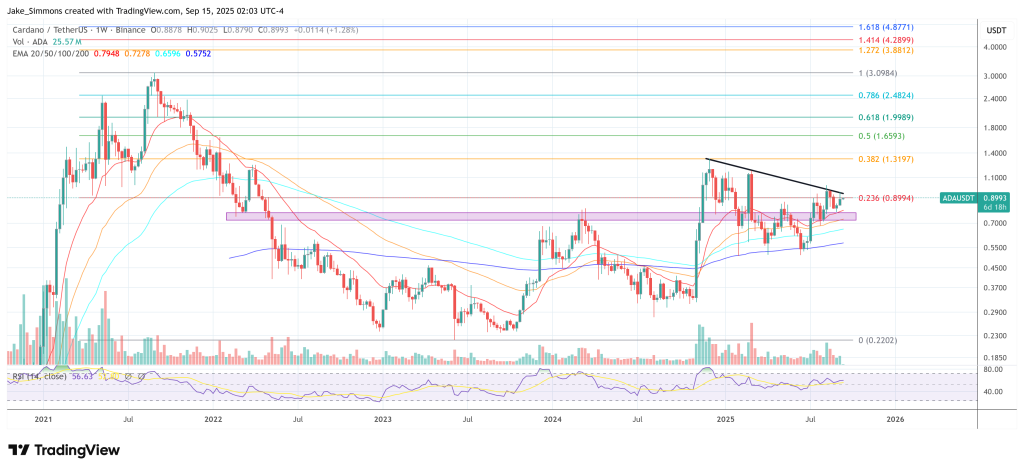
Cardano price
ADA bulls need to break the trendline, 1-week chart | Source: ADAUSDT on TradingView.com
Featured image created with DALL.E, chart from TradingView.com
Editorial Process for bitcoinist is centered on delivering thoroughly researched, accurate, and unbiased content. We uphold strict sourcing standards, and each page undergoes diligent review by our team of top technology experts and seasoned editors. This process ensures the integrity, relevance, and value of our content for our readers.

Jake Simmons has been a Bitcoin enthusiast since 2016. Ever since he heard about Bitcoin, he has been studying the topic every day and trying to share his knowledge with others. His goal is to contribute to Bitcoin's financial revolution, which will replace the fiat money system. Besides BTC and crypto, Jake studied Business Informatics at a university. After graduation in 2017, he has been working in the blockchain and crypto sector. You can follow Jake on Twitter at @realJakeSimmons.

Cryptos en tendance

Lectures associées

Emploi américain, PMI chinois et inflation en scène, la croissance mondiale peut-elle rester résiliente ?

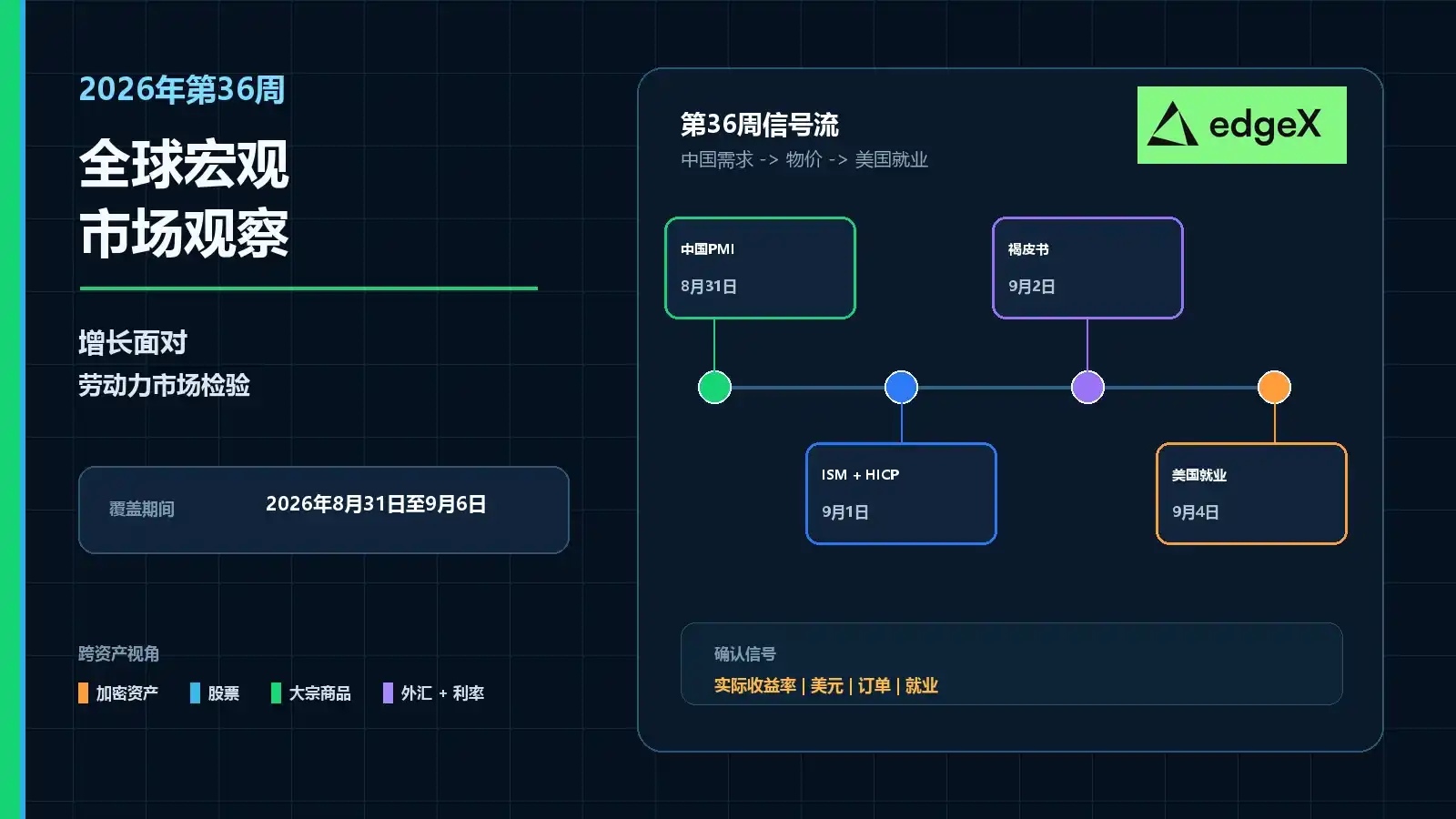
**Semaine 36 : PMI chinois, emploi américain et inflation européenne testent la résilience mondiale** La semaine du 31 août au 6 septembre sera cruciale pour évaluer la santé de l'économie mondiale, avec une série de données clés. Elle débute le 31 août par les indices PMI manufacturier et non-manufacturier chinois, offrant un premier signal sur la demande d'usine et de services après un mois de juillet sous la barre des 50. Le 1er septembre, les indices PMI manufacturier américain (ISM) et l'estimation flash de l'inflation de la zone euro apporteront des éléments sur la demande, les prix et les pressions salariales. Le rapport Beige de la Fed (2 septembre) complétera ce tableau avec des preuves régionales. Le point culminant sera le rapport sur l'emploi américain du 4 septembre (données d'août). Son impact sur les taux, le dollar et les actifs risqués dépendra largement des signaux précédents. La combinaison idéale pour les marchés serait une amélioration des PMI chinois, un emploi américain stable avec une inflation en repli, et un Beige montrant un ralentissement progressif de la demande. En revanche, des PMI chinois faibles, une inflation européenne tenace et un emploi américain décevant créeraient un scénario complexe, exerçant une pression sur les actifs cycliques. Pour les traders, il sera essentiel de surveiller la cohérence entre ces indicateurs plutôt que de réagir à un seul chiffre. La confirmation d'une reprise nécessitera une amélioration simultanée des commandes, de l'emploi et des prix modérés à l'échelle mondiale.

marsbitIl y a 10 mins

Emploi américain, PMI chinois et inflation en scène, la croissance mondiale peut-elle rester résiliente ?

marsbitIl y a 10 mins

Le mythe d'Olympus DAO renaît ? Une « banque centrale souveraine sur chaîne » écrite en 4000 lignes de code immuable

L'aperçu du projet The Standard Reserve, une "banque centrale souveraine en chaîne" composée de 4 000 lignes de code immuable, a émergé. Inspiré par Olympus DAO, il vise à automatiser les fonctions clés d'une banque centrale : émission de monnaie ($STANDARD, plafonnée à 1 milliard), régulation de l'offre et accumulation de réserves (or tokenisé). Son mécanisme central est une "politique monétaire réflexive" basée sur un seul signal : le flux net d'ETH dans le pool Uniswap v4 dédié. Un flux net positif (achats continus) déclenche une phase d'expansion, augmentant l'émission de $STANDARD et utilisant les frais pour acheter de l'or. Un flux nul ou négatif déclenche immédiatement une contraction, réduisant l'émission et utilisant les frais pour racheter et brûler des $STANDARD. Le système repose sur six entités principales : la monnaie $STANDARD, le pool de liquidités, la banque centrale (le code), les "Charters" (NFT liés à l'âme, agissant comme des licences de banquier), les "Branches" (sous-unités générant des revenus) et les coffres d'expansion/contraction. Pour participer, il faut acquérir un Charter (1000 gratuits à la genèse, puis enchères). Chaque Charter permet d'ouvrir des Branches (jusqu'à 10) qui perçoivent une part des nouveaux $STANDARD émis. Ouvrir plus de Branches nécessite de brûler des $STANDARD. Se retirer ("retire") permet de récupérer les $STANDARD accumulés mais implique des frais de sortie dynamiques (plus élevés si beaucoup sortent), une partie étant redistribuée aux autres. Les revenus du protocole (frais de transaction et enchères de Charters) sont alloués ainsi : 70% au coffre actif (expansion ou contraction), 15% aux liquidités permanentes du pool, 15% à l'équipe. En phase de contraction, les rachats sont limités pour éviter les manipulations. Le projet présente une mécanique ingénieuse liant incitations individuelles et stabilité systémique, mais des risques existent : anonymat de l'équipe, paramètres clés non définis (durée d'époque, taux d'émission de base, etc.) et sécurité du code non auditée. DYOR.

marsbitIl y a 11 mins

Le mythe d'Olympus DAO renaît ? Une « banque centrale souveraine sur chaîne » écrite en 4000 lignes de code immuable

marsbitIl y a 11 mins

Trading

Spot

Articles tendance

Comment acheter ADA

Bienvenue sur HTX.com ! Nous vous permettons d'acheter Cardano (ADA) de manière simple et pratique. Suivez notre guide étape par étape pour commencer votre parcours crypto.Étape 1 : Création de votre compte HTXUtilisez votre adresse e-mail ou votre numéro de téléphone pour ouvrir un compte sur HTX gratuitement. L'inscription se fait en toute simplicité et débloque toutes les fonctionnalités.Créer mon compteÉtape 2 : Choix du mode de paiement (rubrique Acheter des cryptosCarte de crédit/débit : utilisez votre carte Visa ou Mastercard pour acheter instantanément Cardano (ADA).Solde :utilisez les fonds du solde de votre compte HTX pour trader en toute simplicité.Prestataire tiers :pour accroître la commodité d'utilisation, nous avons ajouté des modes de paiement populaires tels que Google Pay et Apple Pay.P2P :tradez directement avec d'autres utilisateurs sur HTX.OTC (de gré à gré) : nous offrons des services personnalisés et des taux de change compétitifs aux traders.Étape 3 : stockage de vos Cardano (ADA)Après avoir acheté vos Cardano (ADA), stockez-les sur votre compte HTX. Vous pouvez également les envoyer ailleurs via un transfert sur la blockchain ou les utiliser pour trader d'autres cryptos.Étape 4 : tradez des Cardano (ADA)Tradez facilement Cardano (ADA) sur le marché Spot de HTX. Il vous suffit d'accéder à votre compte, de sélectionner la paire de trading, d'exécuter vos trades et de les suivre en temps réel. Nous offrons une expérience conviviale aux débutants comme aux traders chevronnés.

1.4k vues totalesPublié le 2024.12.10Mis à jour le 2026.06.02

Comment acheter ADA

Discussions

Bienvenue dans la Communauté HTX. Ici, vous pouvez vous tenir informé(e) des derniers développements de la plateforme et accéder à des analyses de marché professionnelles. Les opinions des utilisateurs sur le prix de ADA (ADA) sont présentées ci-dessous.

活动图片