Altcoin Season Index Sets New 2025 High, What This Means For The Crypto Market

bitcoinistPublié le 2025-09-15Dernière mise à jour le 2025-09-15

Résumé

The wait for the start of the altcoin season has been a long one, and even now, this market phenomenon...

Trusted Editorial content, reviewed by leading industry experts and seasoned editors. Ad Disclosure

The wait for the start of the altcoin season has been a long one, and even now, this market phenomenon remains elusive to investors. It was expected that after the Bitcoin price hit multiple new all-time highs over the last two years, altcoins would follow. Bitcoin continued to outperform the top altcoins by a large margin, and this blocked the way for the altcoin season to begin. However, with the market recovery, there is now a chance that the altcoin season might begin again.

Altcoin Season Index On The Rise

The Altcoin Season index takes into account the performance of the top 100 altcoins versus the performance of the Bitcoin price. This comparison is then charted and plotted over a 90-day period to show how these large-cap altcoins have performed against the pioneer cryptocurrency.

Depending on the number of altcoins that are outperforming Bitcoin in this 90-day period, the index deduces whether the market is headed into an altcoin season or not. Now, the higher the figure on the index, the higher the chances that an alt season might begin. When there are more than 75 altcoins outperforming the Bitcoin price in a 90-day period, then it is the needed signal that the alt season has begun.

In 2025, the Altcoin Season Index has trended low, mostly below the 50% mark. However, with the recent market recovery over the weekend, the index has now achieved its highest level this year, suggesting that an altcoin season is drawing closer.

According to data from the CoinMarketCap website, the Altcoin Season Index is sitting at a score of 67% at the time of this writing. With 75% being the target, it means that the market just needs another 8 of the top 100 altcoins to outperform Bitcoin to use in an alt season.
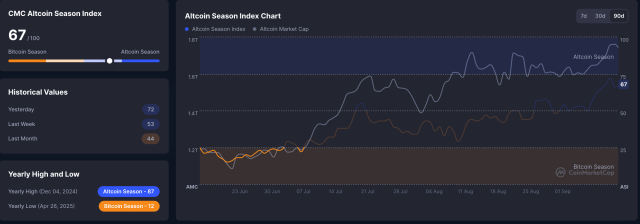
Altcoin season index
Source: Coinmarketcap

What To Expect

Previous market performances have shown altcoin seasons to be a period of explosive rallies for altcoins. The last alt season was categorized by notable rallies such as Dogecoin’s 36,000% rise and Shiba Inu’s legendary rally that saw it temporarily flip Dogecoin.

There was also the DeFi summer during this time that ushered the likes of Fantom, Polygon, and Uniswap into the limelight. Given this, it is expected that the next altcoin season will send existing altcoins flying while giving new narratives a chance to outperform as well.

Altcoin total market cap chart from TradingView.com
Altcoin market cap holds at $1.69 trillion | Source: Crypto Total Market Cap Excluding BTC on TradingView.com
Featured image from Dall.E, chart from TradingView.com
Editorial Process for bitcoinist is centered on delivering thoroughly researched, accurate, and unbiased content. We uphold strict sourcing standards, and each page undergoes diligent review by our team of top technology experts and seasoned editors. This process ensures the integrity, relevance, and value of our content for our readers.

Scott Matherson is a leading crypto writer at Bitcoinist, who possesses a sharp analytical mind and a deep understanding of the digital currency landscape. Scott has earned a reputation for delivering thought-provoking and well-researched articles that resonate with both newcomers and seasoned crypto enthusiasts. Outside of his writing, Scott is passionate about promoting crypto literacy and often works to educate the public on the potential of blockchain.

Lectures associées

Emploi américain, PMI chinois et inflation en scène, la croissance mondiale peut-elle rester résiliente ?

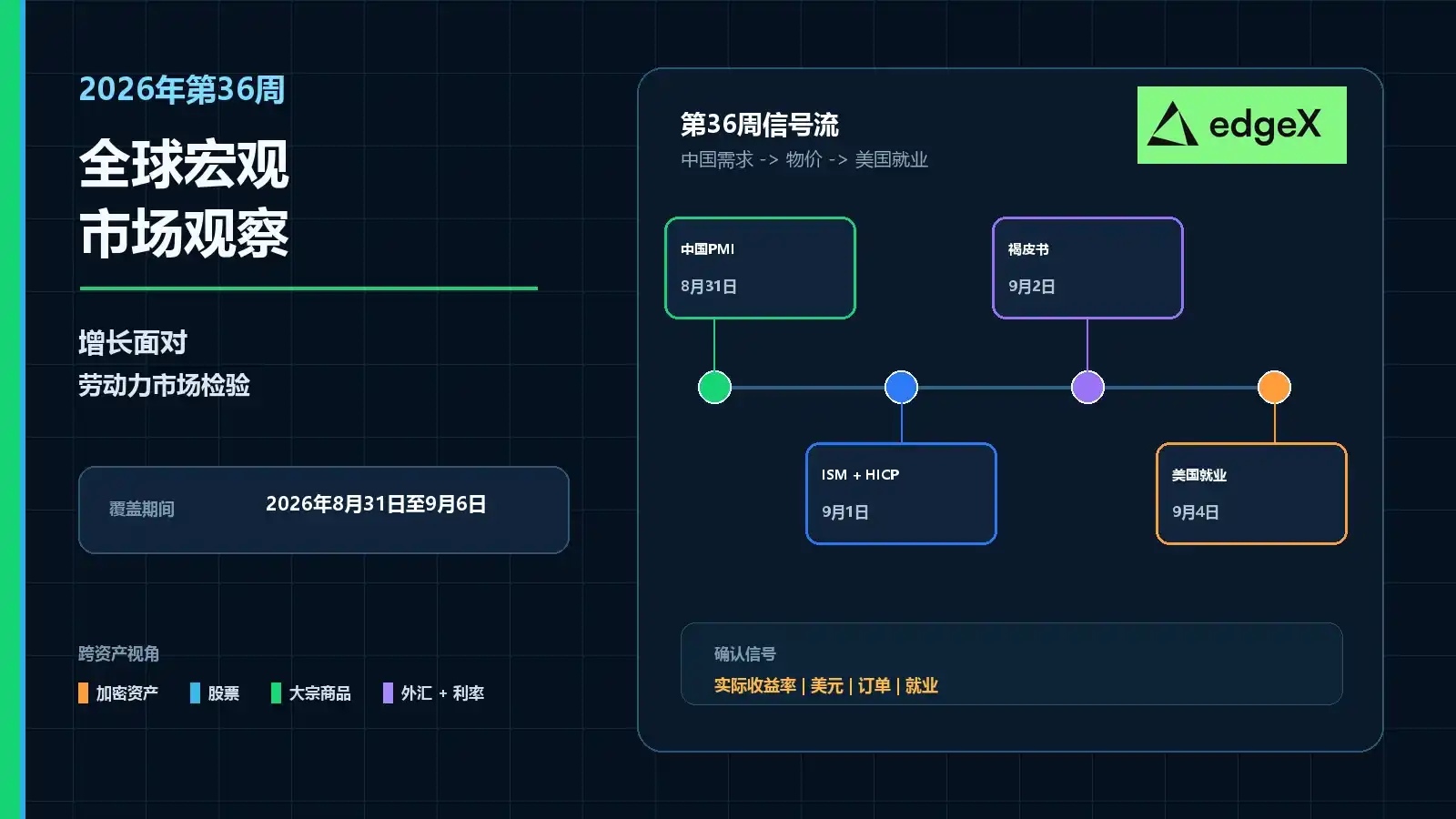
**Semaine 36 : PMI chinois, emploi américain et inflation européenne testent la résilience mondiale** La semaine du 31 août au 6 septembre sera cruciale pour évaluer la santé de l'économie mondiale, avec une série de données clés. Elle débute le 31 août par les indices PMI manufacturier et non-manufacturier chinois, offrant un premier signal sur la demande d'usine et de services après un mois de juillet sous la barre des 50. Le 1er septembre, les indices PMI manufacturier américain (ISM) et l'estimation flash de l'inflation de la zone euro apporteront des éléments sur la demande, les prix et les pressions salariales. Le rapport Beige de la Fed (2 septembre) complétera ce tableau avec des preuves régionales. Le point culminant sera le rapport sur l'emploi américain du 4 septembre (données d'août). Son impact sur les taux, le dollar et les actifs risqués dépendra largement des signaux précédents. La combinaison idéale pour les marchés serait une amélioration des PMI chinois, un emploi américain stable avec une inflation en repli, et un Beige montrant un ralentissement progressif de la demande. En revanche, des PMI chinois faibles, une inflation européenne tenace et un emploi américain décevant créeraient un scénario complexe, exerçant une pression sur les actifs cycliques. Pour les traders, il sera essentiel de surveiller la cohérence entre ces indicateurs plutôt que de réagir à un seul chiffre. La confirmation d'une reprise nécessitera une amélioration simultanée des commandes, de l'emploi et des prix modérés à l'échelle mondiale.

marsbitIl y a 9 mins

Emploi américain, PMI chinois et inflation en scène, la croissance mondiale peut-elle rester résiliente ?

marsbitIl y a 9 mins

Le mythe d'Olympus DAO renaît ? Une « banque centrale souveraine sur chaîne » écrite en 4000 lignes de code immuable

L'aperçu du projet The Standard Reserve, une "banque centrale souveraine en chaîne" composée de 4 000 lignes de code immuable, a émergé. Inspiré par Olympus DAO, il vise à automatiser les fonctions clés d'une banque centrale : émission de monnaie ($STANDARD, plafonnée à 1 milliard), régulation de l'offre et accumulation de réserves (or tokenisé). Son mécanisme central est une "politique monétaire réflexive" basée sur un seul signal : le flux net d'ETH dans le pool Uniswap v4 dédié. Un flux net positif (achats continus) déclenche une phase d'expansion, augmentant l'émission de $STANDARD et utilisant les frais pour acheter de l'or. Un flux nul ou négatif déclenche immédiatement une contraction, réduisant l'émission et utilisant les frais pour racheter et brûler des $STANDARD. Le système repose sur six entités principales : la monnaie $STANDARD, le pool de liquidités, la banque centrale (le code), les "Charters" (NFT liés à l'âme, agissant comme des licences de banquier), les "Branches" (sous-unités générant des revenus) et les coffres d'expansion/contraction. Pour participer, il faut acquérir un Charter (1000 gratuits à la genèse, puis enchères). Chaque Charter permet d'ouvrir des Branches (jusqu'à 10) qui perçoivent une part des nouveaux $STANDARD émis. Ouvrir plus de Branches nécessite de brûler des $STANDARD. Se retirer ("retire") permet de récupérer les $STANDARD accumulés mais implique des frais de sortie dynamiques (plus élevés si beaucoup sortent), une partie étant redistribuée aux autres. Les revenus du protocole (frais de transaction et enchères de Charters) sont alloués ainsi : 70% au coffre actif (expansion ou contraction), 15% aux liquidités permanentes du pool, 15% à l'équipe. En phase de contraction, les rachats sont limités pour éviter les manipulations. Le projet présente une mécanique ingénieuse liant incitations individuelles et stabilité systémique, mais des risques existent : anonymat de l'équipe, paramètres clés non définis (durée d'époque, taux d'émission de base, etc.) et sécurité du code non auditée. DYOR.

marsbitIl y a 10 mins

Le mythe d'Olympus DAO renaît ? Une « banque centrale souveraine sur chaîne » écrite en 4000 lignes de code immuable

marsbitIl y a 10 mins

Trading

Spot
活动图片