Charles Hoskinson says Cardano is now on a defined, accelerated path to its most ambitious performance leap yet. In an August 31 AMA, the Cardano founder highlighted an open-for-review Cardano Improvement Proposal (CIP) for Leios—a staged implementation plan that, in its first iteration, targets a 30× to 65× throughput increase while preserving Cardano’s determinism and UTXO model. “The throughput increases if Leios is implemented 30 to 65x,” Hoskinson said, adding that time-to-market is “about 1 to 1.5 years,” a compressed window he contrasted with a two-and-a-half to three-year timeline for a full, unsimplified build.
Cardano’s Biggest Scaling Milestone Yet
Hoskinson framed Leios as the anchor of a long-arc scaling agenda designed to push Cardano from consensus-bound ceilings toward network-bound ceilings. “The goal is to get a one-minus-delta protocol where you’re no longer consensus constrained but rather you’re network constrained,” he said. The initial design intentionally trims complexity relative to the research blueprint so client teams can co-develop and ship something “that massively improves the state of affairs” and can be upgraded iteratively thereafter.
The trade-offs of the first step are explicit. Hoskinson said transaction-inclusion latency would rise from roughly 20 seconds to around 40–60 seconds, a cost he presented as acceptable when measured against headline throughput gains and mitigable through parallel workstreams. “There’s always trade-offs in these things,” he noted, pointing to Hydra as one mitigation avenue today and to a joint evolution with Paris—Cardano’s fast-finality effort—for future confirmation times. He also emphasized that the hardware footprint remains modest: “Four-core machines,” he said, “which means that Raspberry Pis can run it,” alongside a cryptographic key-registration step.
As reported last week by Bitcoinist, the specification is not yet approved and is open for review by the broader ecosystem. It includes acceptance criteria, versioning and an implementation plan intended to align multiple independent node teams. “Next we need our partners like TXPipe and Blink Labs and all these others to read through it, comment on it… then the hope is to get to a final CIP and get it on the official implementation agenda,” he said. One outcome of implementation, he added, is a standardized test suite to ensure interoperability “between all of the different nodes… the Haskell node, the Rust [node], the Go node.”
The execution model is as noteworthy as the technical plan. Hoskinson said Input Output has already begun provisioning a ‘follow-the-sun’ development cadence so “development occurs 24 hours a day, 7 days a week,” with AI-assisted hand-offs to “massively improve developer velocity and also code quality.” That process focus is meant to compress the 12–18 month delivery window without sacrificing reliability.
Architecturally, Hoskinson positioned Leios as a drop-in operating mode that cooperates with the current Ouroboros stack rather than replacing it wholesale. “It knows how to plug into our goals with Paris for fast finality. It knows how to plug into fee markets. It knows how to plug into Chronos, which will come later for timekeeping. It knows how to plug into the partner-chains ecosystem. It knows how to plug into Hydra,” he said. Importantly, if the new mode encounters problems, the network can fail back to the existing consensus path, preserving liveness: “When Leios fails, it fails back to Praos… Praos becomes the emergency mode of the network and Leios becomes the operating mode of the network.”
Hoskinson stressed that Cardano’s core execution model remains intact. “What’s nice is we didn’t have to change UTXO. We didn’t have to change any of the fundamental assumptions of the system,” he said. “For the most part, all intents and purposes, transaction determinism is preserved.” By avoiding a wholesale ledger redesign, the team expects to minimize disruption for builders while still unlocking headroom for demand.
Beyond the first release, Hoskinson described a multi-year upgrade path already under prototyping, with a next wave “ready to go for 2027–2028.” That roadmap includes deeper overhauls to Cardano’s network stack, adding more flexibility and data-availability components. Each layer, he argued, ratchets Cardano closer to “unlimited scale.”
For now, the message is focus and speed. “This is the hardest thing we’ve ever done as an ecosystem,” Hoskinson said, “but it puts us in a really good position.” The priority is to finalize the specification with client teams and ship the first step on an aggressive clock. “We’ve never moved this fast in the history of Cardano,” he said. “We basically want to write code on the weekends… during the night… during the day.” And the end-state remains unambiguous: “We’re very convinced that the Leios program as it evolves over time will basically keep the Cardano network relevant forever.”
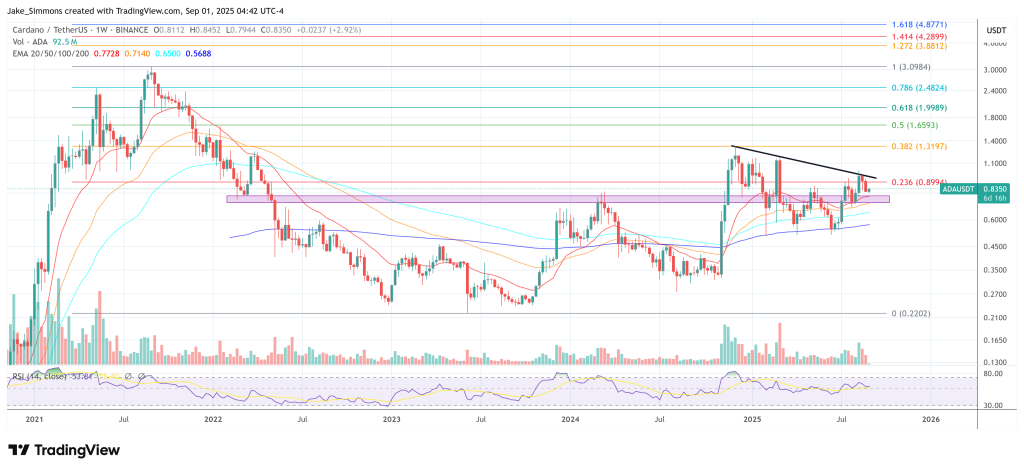
At press time, ADA traded at $0.83.

Related Posts