3 Scenarios To Watch Out As Dogecoin Price Plays Out Its Thin Cloud Behavior

bitcoinistPublié le 2026-04-15Dernière mise à jour le 2026-04-15

Résumé

Dogecoin's price is exhibiting a "Thin Cloud Behavior" on the 4-hour chart, indicating low volatility and a lack of directional commitment. A crypto analyst outlines three potential scenarios. The first is a bearish breakdown below the cloud's support at $0.092, which could trigger a sustained downtrend toward $0.09. The second is a bullish breakout above $0.094, turning the cloud green and signaling the start of a larger upward move. The third scenario is continued "chop," where the price moves sideways within the cloud, requiring investors to wait for clearer directional momentum. Until a definitive move occurs, the advice is to treat the market with caution.

The current Dogecoin performance trend has highlighted the appearance of a rather interesting behavioral pattern. This has to do with the zig-zag movement of the meme coin through the last few months, and depending on the direction of the next move, it could determine how the Dogecoin price could play out. Given this, a crypto analyst has given three different scenarios that could end up playing out for the digital asset soon.

Dogecoin Price Displays Kumo Cloud Behavior

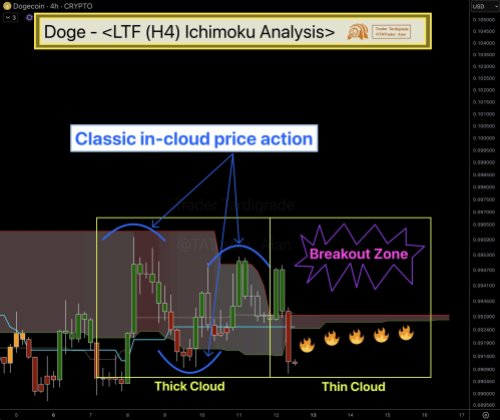
Crypto analyst Trader Tardigarde pointed out a rather ineresting formation on the Dogecoin price chart using the 4-Hour chart. According to the analysis, the current Dogecoin up and down movement suggests the appearance of a Thin Cloud Behavior.

As Trader Tardigrade explains, the Dogecoin price movements through this thin cloud suggests that the meme coin is not seeing a lot of movement. This means that there is nothing that is currently blocking the price from moving. But the interesting part of this is that the price is not blocked in either direction. Thus, Dogecoin could push in any direction from here.

As a result, there are three scenarios that could play out for the cryptocurrency at this point. The first of these is the bearish one that could lead to a sustained downtrend. The Thin Cloud current lies between $0.092 and just below $0.093. If the price breaks below the bottom, then it could trigger a breakdown.

This breakdown would lead to the cloud actually thickening, eliminating the thin cloud currently being seen. Additionally, it would push the price further down, possibly breaking below the $0.09 level once again. However, there is still the possibility of a bullish scenario.
Source: X

The second scenario highlighted by Trader Tardigrade is the the breakout, when the Dogecoin price successfully surges above the thin cloud. Such a move would put it in the breakout zone above $0.094, pushing the cloud from red to green. This would then be the first step before an even bigger move.

Last but not least is the third scenario, which the crypto analyst refers to as ‘Chop.’ In this case, the Dogecoin price would continue to revolve around the current thin cloud without any meaningful breakout in either direction. In this case, investors would have to wait for directional clarity to happen.

For now, the crypto analyst says that the Dogecoin price hasn’t committed to a single direction. And until it does, Trader Tardigrade says to “treat Kumo like air.” Thus, wait for the wind to change before taking a position.

DOGE bulls push for a recovery | Source: DOGEUSDT on Tradingview.com

Questions liées

QWhat is the 'Thin Cloud Behavior' mentioned in the Dogecoin price analysis?

AThe 'Thin Cloud Behavior' refers to a pattern on the price chart where Dogecoin is moving in a zig-zag pattern within a narrow range, indicating a lack of significant price movement and no major resistance or support blocking its price in either direction.

QAccording to Trader Tardigrade, what are the three possible scenarios for Dogecoin's price movement?

AThe three scenarios are: 1) A bearish breakdown below the cloud leading to a sustained downtrend, 2) A bullish breakout above the cloud triggering a potential upward move, and 3) A 'Chop' scenario where the price continues to move sideways around the current range without a clear direction.

QWhat price levels define the current Thin Cloud for Dogecoin?

AThe Thin Cloud currently lies between the price levels of $0.092 and just below $0.093.

QWhat would a bullish breakout for Dogecoin price look like according to the analysis?

AA bullish breakout would occur if the Dogecoin price successfully surges above the thin cloud, breaking past the $0.094 level. This would change the cloud from red to green and could be the first step before a larger upward move.

QWhat is the analyst's advice for traders until Dogecoin commits to a direction?

AThe analyst advises traders to 'treat Kumo like air,' meaning they should wait for the wind to change (wait for a clear directional move) before taking a position, as the price hasn't committed to a single direction yet.

Lectures associées

Intervention conjointe américano-japonaise : le début d'un nouvel « accord du Plaza » et du système de Bretton Woods 2.0, et la fin de l'ère du carry trade sur le yen

Intervention conjointe historique des États-Unis et du Japon pour soutenir le yen, marquant un tournant potentiel dans le carry trade sur yen et les flux de capitaux mondiaux. Les secrétaire au Trésor américain Bestent et le président Trump ont confirmé l'implication active des États-Unis, évoquant des achats coordonnés de 5 à 10 milliards de dollars de yens. Cette action a provoqué un rebond significatif du yen face au dollar. Les analystes y voient la fin possible d'une ère de financement mondial à bas coût via le yen, un pilier des marchés depuis les années 1980. La nécessité pour le Japon de vendre potentiellement des réserves de devises (comme les Treasuries américains) pour défendre sa monnaie pourrait faire remonter les rendements obligataires à long terme et restructurer la liquidité globale. Cette pression sur les crédits n'est pas uniquement liée à l'inflation, mais aussi au changement de rôle des géants technologiques, qui émettent désormais des obligations pour financer l'IA, et à un ajustement structurel mondial. Certains interprètent cette coordination comme le signe d'un nouvel ordre monétaire international naissant, un "Bretton Woods 2.0", où les politiques se recentreraient sur la croissance et la productivité. L'événement force les marchés à réévaluer les dépendances établies de longue date.

marsbitIl y a 2 mins

Intervention conjointe américano-japonaise : le début d'un nouvel « accord du Plaza » et du système de Bretton Woods 2.0, et la fin de l'ère du carry trade sur le yen

marsbitIl y a 2 mins

Des TPU aux agents auto-évolutifs : comment Jeff Dean envisage la prochaine étape de l'IA

Lors d’une intervention à la YC Startup School 2026, Jeff Dean a partagé sa vision de l’évolution de l’IA au-delà des simples modèles de grande taille. Il souligne que la prochaine étape ne consiste pas seulement à créer des modèles plus puissants, mais à les intégrer dans des systèmes capables de fonctionner de manière autonome, d’apprendre par essais et erreurs, et d’exécuter des tâches complexes sur de longues périodes. Dean insiste sur l’importance de l’ingénierie du contexte, des outils spécialisés et des boucles de rétroaction pour permettre aux agents IA d’agir efficacement, comme des ingénieurs juniors. Il met en lumière les défis techniques sous-jacents, tels que la latence, la consommation énergétique et le coût du déplacement des données, qui conditionnent la faisabilité des applications pratiques. Pour les startups, il conseille de se concentrer sur des problèmes où les modèles génériques actuels échouent (taux de succès proche de 0–1%), en exploitant des données propriétaires, des évaluateurs spécialisés ou des flux de travail métier. Il anticipe également une automatisation croissante de la recherche scientifique et du développement de l’IA elle-même, accélérant le cycle hypothèse-expérience-évaluation. Enfin, Dean rappelle que la clé reste de bien définir les problèmes, de remettre en cause les hypothèses établies et de privilégier les solutions qui auront un impact réel, tout en travaillant avec des équipes complémentaires et collaboratives.

marsbitIl y a 1 h

Des TPU aux agents auto-évolutifs : comment Jeff Dean envisage la prochaine étape de l'IA

marsbitIl y a 1 h

Trading

Spot
活动图片