Analyst Foresees BTC Breaking Past $150K – $HYPER Hits $8.3M Amid Scaling Demand

bitcoinistPublié le 2025-08-11Dernière mise à jour le 2025-08-11

Résumé

Macroeconomist Lyn Alden believes $BTC has what it takes to hit $150K or ‘much higher’ this cycle. But when $BTC...

Trusted Editorial content, reviewed by leading industry experts and seasoned editors. Ad Disclosure

Macroeconomist Lyn Alden believes $BTC has what it takes to hit $150K or ‘much higher’ this cycle.

But when $BTC attracts increased demand, there’s often a hitch: The Bitcoin network becomes congested, slowing transactions and driving up fees.

Fear not. Bitcoin Hyper is preparing to boost the network’s reliability this quarter. And the timing of the Bitcoin Layer 2 network’s launch, perhaps, couldn’t be any better.

Alden Predicts $BTC to Climb Like Big-Tech Giants

In a recent Cryptoslate interview, Alden explained how $BTC – currently valued at $121K – might experience a longer, less extreme cycle. One of which is similar to big-tech giants, as opposed to typical crypto volatility.

‘If you look at what used to be called FANG stocks, and now it’s the Mag7 stocks, basically large-cap U.S. tech stocks, they kept grinding up longer than people thought,’ she explained.

She added that they sometimes face corrections or choppy years, but resume climbing once momentum rebuilds. Then, that $BTC could follow the same path.

‘I think Bitcoin could resemble that model to some extent. Maybe it’s still more volatile than that, but I do think we should expect maybe longer and less extreme cycles on average,’ continued Alden.

Alden then dismissed concerns that Bitcoin treasury companies could trigger a market-wide collapse. As an example, she explained how Microstrategy (which holds 628,791 $BTC worth $74.21B) has relatively low leverage compared to its Bitcoin holdings.

Because the company buys $BTC through a mix of internal cash and external financing, it avoids aggressive debt positions that could cause a large-scale sell-off if prices fall sharply.

Still, she says we’ll like see many altcoin treasury companies fail, with even Bitcoin ones heading to a downturn due to poor management.

Such a warning stems from the fact that excessive leverage and poor management can force treasuries to liquidate holdings during downturns.

Nevertheless, if Alden’s outlook proves correct, $BTC could be set for a steadier, more sustained climb to rosy pursuits.

Suppose this environment surfaces, Bitcoin Hyper’s mission to keep the network efficient and affordable during peak demand could prove more essential than ever.

Bitcoin Hyper Layer 2 to Boost Bitcoin’s Programmability

The Bitcoin Hyper Layer 2 solution is being built to fix Bitcoin’s bottlenecks.

By processing transactions off-chain while securing them to Bitcoin’s mainchain, it’ll boast higher throughput and lower costs. Therefore, you’ll be able to send $BTC quickly and cheaply during heavy network load.

Powered by the Solana Virtual Machine (SVM), it’ll also bring smart contract capabilities to Bitcoin. By doing so, developers will be able to build DeFi protocols and dApps directly on the network.

It’ll leverage a Canonical Bridge to process transactions through the SVM. This way, it can mint equivalent wrapped $BTC on the Layer 2 network for use in DeFi and dApps. But don’t worry, you’ll still be able to redeem your $BTC on the mainnet whenever you wish.
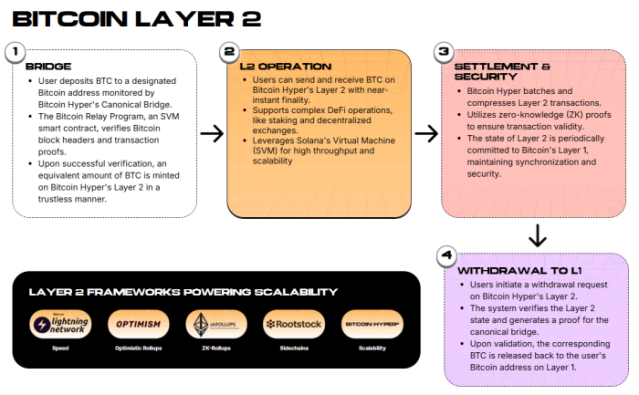
How the Bitcoin Hyper Layer 2 works
Source: Bitcoin Hyper

Additionally, Bitcoin Hyper will integrate Zero-Knowledge Proofs (ZKPs) to verify transactions quickly and securely without overloading Bitcoin’s base layer. This’ll make it suitable for high-volume payments, cross-border transfers, and on-chain applications.

Read more about what Bitcoin Hyper is and what it plans to do in our guide.

And then there’s the Layer 2 network’s native token, $HYPER, which offers additional perks: reduced transaction fees, governance rights, and staking rewards at a 130% APY.

Since its presale launch on May 16, 2025, $HYPER has already raised over $8.3M, backed by major whale buys independently investing $74.9K, $54.1K, and $53.9K.

Given this strong investor confidence, it’s no wonder that it’s poised to be the next crypto to explode.

Verdict – Alden’s $BTC Outlook Enhances Bitcoin’s Hyper’s Relevance

Alden’s outlook frames $BTC experiencing steady, sustained gains as opposed to volatile spikes and crashes.

Say her prediction proves correct, the Bitcoin network’s demand could remain high for an extended period. In turn, this would make scalability solutions increasingly important.

This is where Bitcoin Hyper shines bright. By combining off-chain transaction processing, Solana-level performance, and smart contract capabilities, it’s a clear answer to Bitcoin’s programmability challenges – especially if $BTC continues to rise, like Alden foresees.

To get the most out of the Layer 2, consider scooping up some $HYPER, available on presale for just $0.012625.

Once Bitcoin Hyper officially launches on mainnet, it’s anticipated to jump to $0.32 this year. So, why not purchase $HYPER now at $0.012625 for possible gains surpassing 2,400%?

This isn’t investment advice. Always DYOR and never invest more than you’d be sad to lose.

Editorial Process for bitcoinist is centered on delivering thoroughly researched, accurate, and unbiased content. We uphold strict sourcing standards, and each page undergoes diligent review by our team of top technology experts and seasoned editors. This process ensures the integrity, relevance, and value of our content for our readers.

Leah is a British journalist with a BA in Journalism, Media, and Communications and nearly a decade of content writing experience. Over the last four years, her focus has primarily been on Web3 technologies, driven by her genuine enthusiasm for decentralization and the latest technological advancements. She has contributed to leading crypto and NFT publications – Cointelegraph, Coinbound, Crypto News, NFT Plazas, Bitcolumnist, Techreport, and NFT Lately – which has elevated her to a senior role in crypto journalism. Whether crafting breaking news or in-depth reviews, she strives to engage her readers with the latest insights and information. Her articles often span the hottest cryptos, exchanges, and evolving regulations. As part of her ploy to attract crypto newbies into Web3, she explains even the most complex topics in an easily understandable and engaging way. Further underscoring her dynamic journalism background, she has written for various sectors, including software testing (TEST Magazine), travel (Travel Off Path), and music (Mixmag). When she's not deep into a crypto rabbit hole, she's probably island-hopping (with the Galapagos and Hainan being her go-to's). Or perhaps sketching chalk pencil drawings while listening to the Pixies, her all-time favorite band.

Lectures associées

L'ancienne équipe institutionnelle de la Fondation Ethereum lance Ethereum Institutional

L'ancienne équipe chargée des relations avec les entreprises au sein de la Fondation Ethereum lance Ethereum Institutional, une organisation à but non lucratif indépendante. Sa mission est d'accélérer l'adoption institutionnelle d'Ethereum, de ses réseaux de couche 2, de ses applications et de son écosystème élargi. Ethereum Institutional servira de point de contact neutre pour les institutions financières, leur offrant des conseils techniques, une veille écosystémique et un accompagnement. L'organisation met en avant la neutralité d'Ethereum comme un atout majeur, tout en soulignant le besoin d'une entité crédible et indépendante pour guider les acteurs traditionnels dans leurs décisions d'infrastructure liées à la tokenisation, aux stablecoins et à la finance sur chaîne. L'équipe fondatrice, qui avait développé la fonction "Entreprise" de la Fondation Ethereum, étend désormais ses activités de façon autonome autour de cinq axes : engagement institutionnel, renseignement institutionnel, marketing de l'écosystème Ethereum et de l'ETH, analyse des besoins du secteur, et organisation d'événements. Le lancement bénéficie du soutien de Bitmine, SharpLink et du co-fondateur d'Ethereum Joseph Lubin, parmi d'autres soutiens. Cette initiative fait suite à la récente restructuration de la Fondation Ethereum et à la création d'Ethlabs, reflétant une stratégie plus large de développement de l'écosystème via des organisations spécialisées et indépendantes.

ambcryptoIl y a 1 h

L'ancienne équipe institutionnelle de la Fondation Ethereum lance Ethereum Institutional

ambcryptoIl y a 1 h

« La plus grande mise à niveau depuis The Merge » ? Comment Glamsterdam va impacter Ethereum et les utilisateurs lambda ?

La prochaine mise à niveau majeure d'Ethereum, baptisée "Glamsterdam" (combinaison des mises à jour de consensus "Glas" et d'exécution "Amsterdam"), est prévue pour le second semestre 2026. Considérée comme la plus importante depuis "The Merge", elle vise à réformer en profondeur l'architecture du réseau principal (L1) pour en augmenter la capacité et l'efficacité, sans compromettre sa décentralisation. Trois changements principaux sont au cœur de cette mise à niveau : 1. **L'ePBS (Enshrined Proposer-Builder Separation)** : Intègre la séparation entre proposeurs et constructeurs de blocs directement dans le protocole, éliminant le besoin d'intermédiaires de confiance externes (Relays). Cela prolonge la fenêtre de traitement des blocs, permettant d'augmenter la limite de gaz (Gas Limit) et donc la taille des blocs. 2. **Les listes d'accès au niveau des blocs (Block-Level Access Lists - BALs)** : Fournissent une "carte" préalable des données d'état que les transactions d'un bloc vont lire ou modifier. Cela permet un traitement parallèle des transactions non conflictuelles et accélère la synchronisation des nœuds, ouvrant la voie à une exécution plus rapide. 3. **La reprix du gaz** : Introduit un modèle de tarification plus précis pour mieux refléter le coût réel des ressources, en distinguant le coût de calcul instantané du coût de stockage permanent des données d'état. Cela vise à contrôler l'expansion incontrôlée de l'état du réseau. **Impact pour les utilisateurs :** * **Frais de transaction** : Une capacité de bloc accrue devrait globalement réduire la congestion et stabiliser les frais, en particulier pour les transferts simples. Cependant, les opérations créant beaucoup de données d'état (comme le déploiement de contrats complexes) pourraient voir leurs coûts augmenter. * **Expérience utilisateur** : Les portefeuilles pourront estimer les frais de gaz avec plus de précision, réduisant les échecs de transaction. Les mouvements internes d'ETH seront plus faciles à tracer. * **Couche 2 (L2)** : La capacité accrue à traiter les "blobs" de données bénéficiera à long terme aux Rollups, pouvant stabiliser leurs coûts. * **Nœuds et décentralisation** : En optimisant les processus sous-jacents plutôt qu'en exigeant simplement plus de puissance de calcul, Glamsterdam cherche à augmenter le débit tout en préservant la possibilité pour des particuliers de faire tourner des nœuds. En résumé, Glamsterdam ne se contente pas d'augmenter la taille des blocs. Il restructure les fondations d'Ethereum pour permettre une future expansion durable du réseau principal, en équilibrant performances accrues et préservation des principes de décentralisation.

marsbitIl y a 3 h

« La plus grande mise à niveau depuis The Merge » ? Comment Glamsterdam va impacter Ethereum et les utilisateurs lambda ?

marsbitIl y a 3 h

Trading

Spot
活动图片