Shiba Inu Open Interest Crashes From $328 Million July Peak To $190 Million, What’s Going On?

bitcoinistPublié le 2025-08-05Dernière mise à jour le 2025-08-05

Résumé

Shiba Inu’s Open Interest (OI) has crashed from its July peak, sparking a bearish sentiment for the foremost meme coin....

Trusted Editorial content, reviewed by leading industry experts and seasoned editors. Ad Disclosure

Shiba Inu’s Open Interest (OI) has crashed from its July peak, sparking a bearish sentiment for the foremost meme coin. This development has coincided with the recent crypto market crash, as investors choose to wait on the sidelines amid market uncertainty. 

Shiba Inu’s Open Interest Crashes To $190 Million

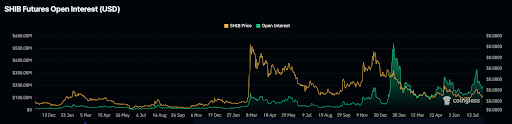
Coinglass data shows that Shiba Inu’s Open Interest is currently at $190 million, down significantly from its July peak of $328 million recorded on the 22nd of last month. Since then, the OI has declined daily, indicating a drop in interest in the meme coin among traders. Open Interest refers to the number of open positions on an asset at a particular time.

A plausible reason for the drop in Shiba Inu’s Open Interest is the crypto market correction, which has occurred over the last two weeks. SHIB has dropped from its local high of around $0.000016 as a result. Meanwhile, the meme coin is down over 8% in the last seven days. Notably, Shiba Inu had hit this local high on July 21, which highlights the correlation between price performance and this derivatives metric. 
Shiba Inu
Source: Chart from Coinglass

One reason for this market correction is the Trump tariffs, which are set to take effect from August 7. The U.S. president yesterday threatened to substantially raise tariffs on India from the current proposed 25%. This is a development that could further impact the markets, including crypto assets like Shiba Inu. The tariffs have a direct impact on the global economy and could negatively impact the flow of liquidity into these assets if they lead to inflation. 

Furthermore, the U.S. economy already looks to be in a fragile state, thanks to the July job report, which came in lower than expectations. A weak labor market could have several ripple effects, including a recession or stagflation, which is bearish for Shiba Inu and other assets. 

Some Positives For SHIB

The Shiba Inu long/short ratio is currently 1.09, which indicates that most traders are still bullish on the meme coin. This could help spark a market recovery, especially as the broader crypto market picks up. SHIB, alongside other crypto prices, has shown a resurgence on July 4, as the total crypto market surged as much as 2%. 

Thanks to this rebound, Shiba Inu’s derivatives trading volume surged as much as 20% to $161 million. Meanwhile, crypto analyst Javon Marks has again doubled down on his prediction that the foremost meme coin can record a 500% rally to reach $0.000081. This will bring SHIB close to its current all-time high (ATH) of $0.00008845. 

At the time of writing, the Shiba Inu price is trading at around $0.00001233, up in the last 24 hours, according to data from CoinMarketCap.

Shiba Inu
SHIB trading at $0.000012 on the 1D chart | Source: SHIBUSDT on Tradingview.com
Featured image from Getty Images, chart from Tradingview.com
Editorial Process for bitcoinist is centered on delivering thoroughly researched, accurate, and unbiased content. We uphold strict sourcing standards, and each page undergoes diligent review by our team of top technology experts and seasoned editors. This process ensures the integrity, relevance, and value of our content for our readers.

Scott Matherson is a leading crypto writer at Bitcoinist, who possesses a sharp analytical mind and a deep understanding of the digital currency landscape. Scott has earned a reputation for delivering thought-provoking and well-researched articles that resonate with both newcomers and seasoned crypto enthusiasts. Outside of his writing, Scott is passionate about promoting crypto literacy and often works to educate the public on the potential of blockchain.

Lectures associées

Ayant contribué à lancer l'USDC, pourquoi Coinbase soutient-il désormais son concurrent OUSD ?

La création de l'Open USD (OUSD), un stablecoin soutenu par une alliance de plus de 140 entreprises dont Coinbase, Visa et BlackRock, représente un défi majeur pour les modèles établis comme l'USDC de Circle. Ce nouveau projet propose une redistribution des revenus, attribuant la majeure partie des intérêts générés par les réserves aux plateformes de distribution plutôt qu'à l'émetteur. Le soutien de Coinbase, partenaire de distribution clé de l'USDC, est perçu comme une manœuvre stratégique avant la renégociation de son accord avec Circle en 2026. Cela illustre la demande croissante des canaux de distribution pour une plus grande part des profits. Le PDG de Circle, Jeremy Allaire, défend le modèle éprouvé de l'USDC, mettant en avant sa liquidité supérieure, son intégration écosystémique et la complexité opérationnelle d'un large consortium. Il souligne les coûts nécessaires à la conformité et à l'infrastructure, qui seraient mis à mal par une redistribution intégrale des revenus. Les analystes soulèvent des obstacles potentiels pour l'OUSD : la difficulté du démarrage à froid face à la liquidité dominante de l'USDC/USDT, la lenteur décisionnelle au sein d'un vaste consortium, et les risques réglementaires ou de gouvernance. En somme, l'émergence de l'OUSD marque un tournant dans la compétition des stablecoins, où la bataille pour le contrôle de la valeur et des revenus du réseau entre émetteurs et distributeurs devient centrale.

Foresight NewsIl y a 1 h

Ayant contribué à lancer l'USDC, pourquoi Coinbase soutient-il désormais son concurrent OUSD ?

Foresight NewsIl y a 1 h

Si Strategy a vraiment vendu 491 bitcoins, quel impact cela aura-t-il sur le marché ?

Le trader connu Lightcrypto affirme que Strategy, la plus grande société détentrice de Bitcoin, aurait vendu 491 BTC, pour une valeur d'environ 30 millions de dollars. Cette quantité est négligeable (0,058%) par rapport aux 847 000 BTC détenus par l'entreprise. L'importance réside dans le contexte : Strategy a récemment établi un cadre autorisant la vente de jusqu'à 12,5 milliards de dollars de BTC. L'objectif est de générer des liquidités pour renforcer ses réserves de dollars, payer les dividendes de ses actions privilégiées (STRC) et les intérêts de sa dette, ainsi que pour racheter des actions. Le prix des actions privilégiées STRC étant inférieur à leur valeur nominale, Strategy a dû augmenter leur dividende à 12%, ce qui représente un coût important. La vente de BTC, même minime, est donc perçue comme un moyen de gérer cette structure financière. À court terme, le marché a réagi positivement à la clarté apportée par ce cadre de vente planifié, offrant une visibilité sur la liquidité de l'entreprise. Cependant, à moyen terme, cela modifie la narration autour de Strategy, qui passe d'un "acheteur net perpétuel" de BTC à une entreprise devant parfois vendre pour gérer ses obligations. Pour le marché du Bitcoin, l'impact de 491 BTC est insignifiant en termes d'offre. Psychologiquement, cela brise toutefois l'image de Strategy comme acheteur inconditionnel en toutes circonstances. La vigilance portera désormais sur la possibilité de futures ventes, si la pression sur les flux de trésorerie persiste.

marsbitIl y a 1 h

Si Strategy a vraiment vendu 491 bitcoins, quel impact cela aura-t-il sur le marché ?

marsbitIl y a 1 h

Trading

Spot
活动图片