XRP Distribution Chart Reveals How Much Supply Ripple Still Holds In Escrow

bitcoinistPublié le 2025-08-04Dernière mise à jour le 2025-08-04

Résumé

A recently updated XRP distribution chart from SBI Holdings is giving the crypto community a much clearer view of how...

Trusted Editorial content, reviewed by leading industry experts and seasoned editors. Ad Disclosure

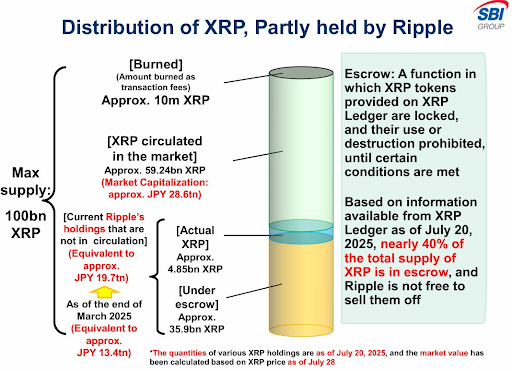
A recently updated XRP distribution chart from SBI Holdings is giving the crypto community a much clearer view of how Ripple manages its massive token reserves. At the center of the report is a detailed chart that actively breaks down the token’s total supply into circulating coins, Ripple-held reserves, and locked escrow.

Shared by XRP analyst Wrath of Kahneman on X (formerly Twitter), the infographic is quickly becoming one of the most reliable visual summaries of the cryptocurrency’s current supply status.

XRP Distribution Chart Reveals Ripple’s Escrow Strategy

According to the infographic, Ripple’s total supply of XRP stands at a maximum of 100 billion tokens. As of July 20, 2025, around 35.9 billion tokens remain in escrow, meaning the company has locked nearly 40% of the total supply under smart contract conditions. These escrowed tokens are not available to sell or transfer freely but are subject to pre-programmed release schedules, which guarantee that only a fixed amount is unlocked periodically.

Ripple may aim to prevent market flooding by spacing out token availability, potentially leading to sudden price drops. Wrath of Kahneman, who has been tracking the fintech company’s activities for years, called it “still the best infographic about total XRP circulation” when he shared the visual. 
Ripple reserves
Source: X

Beyond the 35.9 billion XRP in escrow, the chart shows that 59.24 billion tokens are already circulating in the market, available for trading across exchanges and used in Ripple’s payment systems. Meanwhile, approximately 10 million tokens have been permanently burned through transaction fees over time, effectively removing them from the supply for good.

Locked Holdings Signal Long-Term Supply Control

Ripple also holds an additional 4.85 billion XRP that are not in circulation and not part of the escrow. The company still controls these tokens but is currently holding them back from the open market. As of March 2025, the estimated value of these holdings was at JPY 13.4 trillion, with a later update raising the figure to as high as JPY 19.7 trillion.

The distribution chart update comes as Ripple expands further into global payments and begins exploring stablecoins, making it clear that most of its XRP supply is either locked in escrow or held back from circulation, with the rest already in public hands. With investor interest growing once again, precise data about how many tokens are available and how much is safely locked away is more valuable than ever.

By maintaining nearly 40% of its supply in escrow and implementing a slow, transparent release system, Ripple is showing a commitment to responsible supply control. This level of clarity could help the fintech company build trust and draw long-term investors while also signaling to holders that it isn’t likely to flood the market or disrupt the XRP price anytime soon.

XRP price chart from TradingView.com
Price struggles to hold $3 | Source: XRPUSDT on TradingView.com
Featured image from Unsplash, chart from TradingView.com
Editorial Process for bitcoinist is centered on delivering thoroughly researched, accurate, and unbiased content. We uphold strict sourcing standards, and each page undergoes diligent review by our team of top technology experts and seasoned editors. This process ensures the integrity, relevance, and value of our content for our readers.

My name is Sandra White. I am a graduate. I work for the news platforms NewsBTC and Bitcoinist, providing the latest updates on the world of cryptocurrencies. I love listening to music, learning new things, a family-oriented person, I dream of travelling around the world and getting a view of natures, the cultures, and how people live.

Lectures associées

Quand les géants américains « déserteraient » collectivement les modèles d'IA chinois

Le PDG de Coinbase, Brian Armstrong, a révélé que la plateforme a réduit de moitié ses dépenses en IA en adoptant les modèles chinois GLM-5.2 et Kimi 2.7, malgré une augmentation de l'utilisation. Cette économie repose sur trois stratégies clés : un système de routage automatique sélectionnant le modèle le plus adapté à chaque tâche, une optimisation du cache portant le taux de réussite de 5% à 60%, et l'ingénierie du contexte (Context Engineering) qui privilégie des informations précises pour l'IA. Cette tendance ne se limite pas à Coinbase. La start-up Lindy a également réalisé des économies significatives en remplaçant Claude par Deepseek, tandis qu'un test de Snowflake montre que GLM-5.2 offre des performances comparables à Claude Opus pour un coût bien inférieur (écart de 5 à 7 fois sur les sorties). Bien que les modèles chinois puissent parfois manquer de stabilité, le rapport qualité-prix convainc de plus en plus d'entreprises. Pour les utilisateurs, cela signifie qu'il est avantageux d'utiliser différents modèles selon les tâches, d'optimiser le cache et de privilégier des contextes courts et précis. Enfin, cette migration met en lumière une remise en question des modèles de tarification de l'IA. La concurrence accrue, avec notamment l'entrée en guerre des prix d'OpenAI et d'Anthropic, profite aux consommateurs en offrant plus de choix à des coûts réduits.

链捕手Il y a 7 mins

Quand les géants américains « déserteraient » collectivement les modèles d'IA chinois

链捕手Il y a 7 mins

Bitcoin envisage un bond macro vers 70 000 $ après une chute sous les 60 000 $ – Quel est l’avenir du BTC ?

Le prix du Bitcoin (BTC) est actuellement à 61 540,15 $, après une hausse de 2,01% en 24 heures, malgré une récente chute sous les 60 000 $. Les indicateurs techniques comme le RSI et le MACD montrent une certaine force des acheteurs, mais les signaux ne sont pas fermes. Les Bandes de Bollinger indiquent une volatilité à venir. Les données on-chain de CryptoQuant révèlent un marché en reset : l'exposition nette longue des gestionnaires d'actifs est à son plus bas depuis l'arrivée des ETF spot américains, bien qu'ils restent majoritairement longs. Les fonds à effet de levier ont réduit leurs positions courtes de 67,5% et l'open interest a chuté de 63,5%, signalant une réduction de l'effet de levier plutôt qu'une vente massive. Cette situation crée un vide de positionnement, similaire à novembre 2022 avant un rally de 30%, mais le contexte est différent avec les ETF spot. Les détenteurs à long terme (LTH) ont soutenu le prix en achetant lors des baisses, créant un plancher. Bien que le BTC soit au-dessus de sa moyenne mobile sur 7 jours, il reste sous sa moyenne sur 30 jours, indiquant que la tendance globale n'est pas encore pleinement haussière. Par ailleurs, d'importants transferts vers Coinbase Prime (potentiellement liés à Tim Draper et Clifton Collins) ont été observés, ce qui pourrait signifier une future offre sur le marché, mais pas nécessairement une vente immédiate. En résumé, malgré le rebond, le Bitcoin reste sous sa moyenne mobile à 30 jours. Les retraits des ETF et les ventes restent les principaux facteurs d'influence sur son prix. Certains analystes estiment que les métriques on-chain ne montrent pas encore les conditions de surachat extrême typiques des creux de cycle, suggérant un risque de baisse persistant.

ambcryptoIl y a 13 mins

Bitcoin envisage un bond macro vers 70 000 $ après une chute sous les 60 000 $ – Quel est l’avenir du BTC ?

ambcryptoIl y a 13 mins

Trading

Spot
活动图片