XRP Price Can Still Cross $3, But It Needs To Hold This Level Against Bears

bitcoinistPublié le 2025-07-03Dernière mise à jour le 2025-07-04

Résumé

XRP’s recent rally to $2.30 has been followed by a cooling-off period, with the price falling back to $2.18 after...

Trusted Editorial content, reviewed by leading industry experts and seasoned editors. Ad Disclosure

XRP’s recent rally to $2.30 has been followed by a cooling-off period, with the price falling back to $2.18 after slipping below the short-lived $2.25 support. Although this pullback might raise concern, it comes on the back of a week-long steady increase that took XRP from $1.93 early last week back to the $2.33 resistance level that has held firm in the past 30 days.

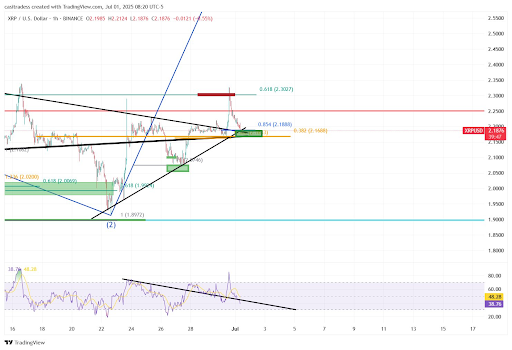
Crypto analyst CasiTrades shared an updated outlook with a chart to show how a test of the consolidation zone between $2.18 and $2.16 could determine whether XRP reclaims its bullish momentum to $3 or enters into a deeper reset.

$2.16–$2.18 Zone Determines XRP’s Direction

According to CasiTrades, who posted her technical analysis on the social media platform X, XRP’s recent retest around $2.16–$2.18 is not yet a breakdown, but it marks a defining moment. After reaching $2.30 resistance, the price wasn’t able to hold the $2.25 support level. Instead, it pulled back to retest. 

Notably, this zone was previously the top of a major consolidation structure, and holding above it would suggest that XRP is a simple backfill structure after a breakout.  This is a very common pattern where a crypto price rejects a key resistance, retests the initial breakout zone, and resumes the trend if momentum holds.
XRP
Source: CasiTrades on X

In the analyst’s view, the market needs to respect this range to confirm that XRP is still in breakout mode. The importance of this level is also echoed in the chart shared by the analyst, where a rising wedge intersects with the highlighted horizontal support at $2.1688 around the 0.382 Fibonacci retracement level. 

On the other hand, a failure to hold would shift the outlook drastically from a bullish perspective. As noted by the analyst, if the altcoin fails to hold above $2.16, it could initiate a pullback toward $1.90 and potentially invalidate the bullish setup that has been building over the past week.

RSI Divergence Points To Higher Chance Of Rebound

One of the early encouraging signs for XRP bulls is in the Relative Strength Index (RSI), which has been diverging from price. This is an excellent signal of seller exhaustion, which supports the analyst’s claim that the current move could be more of a cooldown than another crash to $1.90.

CasiTrades believes XRP would be ready for its next extension wave if bulls can defend the $2.16 to $2.18 range and reclaim $2.25. The price targets in view are $2.69 and $3.04, both based on Fibonacci levels. The first resistance level is at $2.3027 around the 0.618 Fibonacci extension. This price level is also a milestone for confirming the strength of the rally before a broader move to $3 and possibly above.

Interestingly, the altcoin’s price action in the past 12 hours has seen it already reclaiming bullish momentum after bouncing off an intraday low of $2.17. At the time of writing, XRP is trading at $2.27, up by 3.7% in the past 24 hours. This shows that buyers are already working to flip the $2.25 price level.

XRP
XRP trading at $02.28 on the 1D chart | Source: XRPUSDT on Tradingview.com
Featured image from Getty Images, chart from Tradingview.com
Editorial Process for bitcoinist is centered on delivering thoroughly researched, accurate, and unbiased content. We uphold strict sourcing standards, and each page undergoes diligent review by our team of top technology experts and seasoned editors. This process ensures the integrity, relevance, and value of our content for our readers.

Scott Matherson is a leading crypto writer at Bitcoinist, who possesses a sharp analytical mind and a deep understanding of the digital currency landscape. Scott has earned a reputation for delivering thought-provoking and well-researched articles that resonate with both newcomers and seasoned crypto enthusiasts. Outside of his writing, Scott is passionate about promoting crypto literacy and often works to educate the public on the potential of blockchain.

Lectures associées

IOSG : compte à rebours du Q-Day, l'informatique quantique mettra-t-elle fin aux cryptomonnaies ?

Le calcul quantique représente une menace existentielle pour la cryptographie sous-jacente aux blockchains, en particulier les algorithmes de chiffrement à clé publique comme ECDSA, vulnérables à l'algorithme de Shor. Le « Q-Day », moment où un ordinateur quantique corrigeant les erreurs (CRQC) pourrait casser ces systèmes, est estimé entre 2035 et 2045. Pour les blockchains, dont Bitcoin et Ethereum, le risque est accentué par la nature immuable et publique du grand livre : les actifs liés à des clés publiques déjà exposées sont les plus vulnérables. La migration vers une cryptographie post-quantique (PQC), avec des algorithmes standardisés par le NIST comme ML-KEM et ML-DSA, est impérative. Cependant, le défi est moins technique que socio-gouvernance. Pour Bitcoin, la migration progressive via un soft fork se heurte à l'inflation de la taille des signatures et au dilemme politique sur le sort des UTXO historiques inactifs. Pour Ethereum, la stratégie repose sur l'agilité cryptographique, l'abstraction de compte et des mises à niveau couches par couches (exécution, consensus, données). L'industrie dispose d'une fenêtre de 5 à 8 ans pour coordonner cette transition à l'échelle de l'écosystème. L'enjeu n'est pas l'effondrement soudain, mais une course contre la montre pour restructurer les fondations cryptographiques avant que la menace ne devienne économiquement viable, sous peine de réévaluation sévère par le marché.

marsbitIl y a 10 mins

IOSG : compte à rebours du Q-Day, l'informatique quantique mettra-t-elle fin aux cryptomonnaies ?

marsbitIl y a 10 mins

Tiger Research : Déplacer d'abord la tokenisation des RWA à l'étranger

Le marché des actifs réels tokenisés (RWA) connaît une croissance rapide, mais de nombreuses juridictions manquent encore de cadre réglementaire. Face à ce vide, les institutions financières ont trois options stratégiques : attendre une législation locale, utiliser des bac à sable réglementaires, ou se tourner vers les marchés étrangers déjà réglementés. L'expansion transfrontalière des RWA exige une préparation minutieuse dans six domaines clés : choix de la juridiction, licences, définition de l'actif, public d'investisseurs cible, modalités de règlement et exigences opérationnelles. L'objectif est d'acquérir une expérience opérationnelle concrète. Deux voies principales s'offrent aux institutions : la voie directe, en s'implantant dans des juridictions matures comme Hong Kong, Singapour ou les États-Unis où des plates-formes facilitent l'entrée sur le marché ; et la voie « native chaîne », utilisant des infrastructures en ligne intégrant la conformité (comme Ondo ou Plume) pour un déploiement plus rapide et une meilleure connexion à la liquidité DeFi, bien que la complexité structurelle soit accrue. Un cas pratique illustre le processus, qui peut prendre de six mois à un an, et couvre l'évaluation de la présence locale, le choix de la plate-forme, la conception du produit, la structure de garde et l'exécution. Le message central est que l'attente passive n'est pas une stratégie viable. Le marché évolue rapidement, et la capacité à agir dès maintenant pour tracer une voie réalisable et accumuler de l'expérience est plus cruciale que tout. L'essence d'une activité de tokenisation réside dans l'achèvement réussi du processus de vente, et non dans la seule conception technique.

marsbitIl y a 1 h

Tiger Research : Déplacer d'abord la tokenisation des RWA à l'étranger

marsbitIl y a 1 h

Trading

Spot
活动图片