Gov. Waller Says Fed May Cut Rates in July — Could This Trigger the Next Crypto to 1000x?

bitcoinistPublié le 2025-06-23Dernière mise à jour le 2025-06-23

Résumé

Despite holding interest rates steady between 4.25% and 4.5% since December 2024, the Fed may finally be ready to pivot....

Trusted Editorial content, reviewed by leading industry experts and seasoned editors. Ad Disclosure

Despite holding interest rates steady between 4.25% and 4.5% since December 2024, the Fed may finally be ready to pivot. Federal Reserve Governor Christopher Waller has hinted that the first rate cut could arrive as soon as July, signaling a potential shift in monetary policy.

Waller thinks that the effects of Trump’s tariffs are now fully factored in, meaning there shouldn’t be any further downside risk. He has urged the Fed to be more proactive and not wait for the labor market slump before cutting rates.

It’s worth noting that the Fed has kept the rate steady in its latest June 18 statement. However, as market expectations swell, we might see a rate cut sooner rather than later.

Read on as we dig into the rate cut situation and also recommend a few tokens that could be the next crypto to 1000x as a more lenient policy change fuels risk-on sentiment.

Opposing Views Within the Fed

Mary Daly, the San Francisco Fed president, portrayed a more conservative approach when talking about rate cuts.

Daly believes that the Fed should wait till this fall to make a decisive move. And in the meantime, the committee should collect more economic data on various possible outcomes, including labor market trends.

As per reports, 12 out of the 19 Fed meeting participants expect at least one rate cut this year.

If rate cuts kick in, which they should, borrowing costs will go down, fueling more investments in non-traditional and ‘risky’ assets like crypto.

To help you stay ahead of the curve, we’ve handpicked three top cryptos that we believe could be the perfect portfolio boosters.

1. Snorter Token ($SNORT) – The Next Crypto to 1000x, Powering the Snorter Bot

$SNORT is a new cryptocurrency that powers the Snorter Bot, a powerful trading bot built into Telegram, allowing users to snipe liquidity in new meme coins on Solana (support for other blockchains coming soon).

All you have to do is give Snorter Bot a token-launch address. Then, it will automatically set up a buy order, meaning you’ll be able to buy new meme coins as soon as liquidity appears.

In other words, Snorter will allow you to get in when the prices are at their lowest, i.e., before the tokens pump.
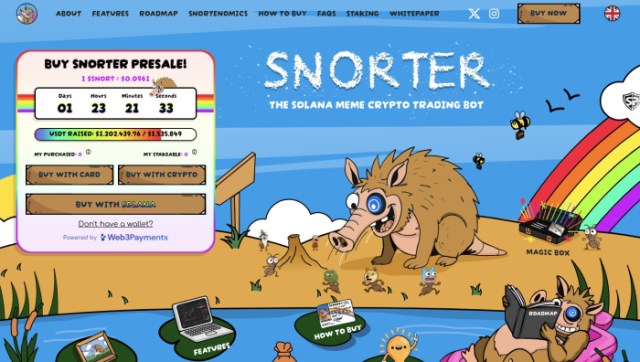
Snorter Token ($SNORT)

Snorter is also incredibly secure. It runs all trades through MEV-resistant relayers, protecting you against front-running and sandwich attacks, as well as rug pulls, honeypots, and scams.

Although Snorter Bot offers a very competitive 1.5% trading fee, you can bring this down to an industry-best 0.85% by becoming a $SNORT holder.

If you buy Snorter Token now, you can potentially make 3,200% in less than five years, seeing as $SNORT is predicted to reach $3.25 by 2030.

Speaking of buying $SNORT, each token is currently available for just $0.0959, and the project has, in total, raised over $1.2M in early investor funding.

2. Bitcoin Hyper ($HYPER) – Bitcoin Layer 2 for Fast & Low-Cost Transactions

Bitcoin Hyper ($HYPER) is another utility token that has the potential to become the next crypto to explode.

According to our research-backed $HYPER price prediction, the token can surge 12,400% and hit $1.25 by 2030.

Such brain-melting numbers are a direct reflection of Bitcoin Hyper’s mission. It aims to introduce low-cost, fast transactions and smart contract capabilities to the Bitcoin ecosystem.

Although Bitcoin is a force to reckon with as a store of value, it’s nowhere near as popular as Ethereum or Solana when it comes to dApps.

$HYPER will build a Bitcoin Layer 2 that will combine Bitcoin’s security with Solana’s scalability, low transaction fees, and programmability.

Bitcoin Hyper ($HYPER)

Using a Canonical Bridge, $HYPER users will be able to convert their original $BTC into wrapped $BTC, which can then be used to interact with dApps, trade on decentralized exchanges, and earn staking yields across the Bitcoin L2 ecosystem.

Once you’re done, raise a withdrawal request on Bitcoin Hyper’s Layer 2. It will verify the transaction and release your corresponding $BTC back to your Bitcoin address on Layer 1.

Note that Bitcoin Hyper is currently in presale (more than $1.5M raised), which is why it’s available for a low price of $0.012. For more information, check out our detailed Bitcoin Hyper buying guide.

3. Useless Coin ($USELESS) – Viral New Meme Crypto with 1000x Potential

Useless Coin ($USELESS) is the internet’s perfect revenge on utility-backed altcoins and the best meme coins.

It’s built to promote ‘nothingness,’ as if to convey that there’s beauty in being a token of no use except, well, satire and humor.

$USELESS doesn’t come with any governance mechanics or staking, with liquidity fees being the only way it ever generates any revenue.

Useless Coin ($USELESS)

Thanks to strong community backing, $USELESS has emerged as one of the top trending cryptos, having gained around 24% since its launch just over a week ago.

One $USELESS token is currently priced at $0.1015, but given its amusing take on the modern meme coin scene and strong community hype (trading volumes are up 44% in the last 24 hours), you can expect it to hit triple-digit gains in the next few weeks.

Final Thoughts

With the US expected to adopt a controlled, proactive approach to cutting interest rates, which could begin as early as July, Wall Street could take it as a green light to increase investments across all risk markets, including crypto and the best altcoins.

If you’re looking for explode-worthy cryptos, have a look at utility tokens like Snorter Token ($SNORT) and Bitcoin Hyper ($HYPER).

However, make sure you do your own research before investing. None of the above is financial advice, and there are no promises in crypto thanks to the market’s uncertainty.

Editorial Process for bitcoinist is centered on delivering thoroughly researched, accurate, and unbiased content. We uphold strict sourcing standards, and each page undergoes diligent review by our team of top technology experts and seasoned editors. This process ensures the integrity, relevance, and value of our content for our readers.

As a crypto writer, Bogdan’s responsibilities are split between researching and writing articles and entertaining the team with his humor bordering on the politically incorrect, an aspiring Bill Burr, if you will. Thanks to his 12+ years of writing experience in just as many fields, including tech, cybersecurity, modelling, fitness, crypto, and other topics-that-shall-not-be-named, he's become a genuine asset to the team. While his position as a senior writer at PrivacyAffairs thought him valuable lessons about the power of self-management, his entire writing career was and is an exercise in self-improvement. Now, he's ready to sink his teeth into crypto and teach people how to take control of their own money on the blockchain. With fiat as an eternally devaluing currency, Bitcoin and altcoins seem like the best-fitting alternative for Bogdan. Bogdan’s biggest professional accomplishment, aside from securing a position as a main writer for Bitcoinist, was his 5-year run as a writing manager at Blackwood Productions, where he coordinated a team of four writers. During that time, he learned the value of teamwork and that of creating a working environment that breeds efficiency, positivity, and friendship.

Lectures associées

Génération d'images par IA accélérée de 1000% sans entraînement, méthode : le « pipeline en trois étapes » le plus simple

Le modèle de génération d’images par IA MrFlow (Multi-Resolution Flow Matching), développé par une équipe de recherche de l’Université de Beihang, de NTU et de l’ETH, propose une accélération significative sans entraînement supplémentaire. Basé sur un pipeline en trois étapes simples, il permet de réduire le temps de génération d’images de haute résolution tout en préservant la qualité. L’approche repose sur trois phases : 1. Génération de structure à basse résolution (12 étapes) pour capturer la composition globale, les couleurs et la sémantique. 2. Sur-échantillonnage dans l’espace pixel à l’aide d’un modèle pré-entraîné comme Real-ESRGAN pour obtenir une image haute définition tout en conservant la clarté structurelle. 3. Raffinement haute résolution en une seule étape, après ajout d’un faible bruit, pour corriger les détails et assurer la cohérence sémantique avec l’invite. Cette méthode atteint une accélération de 10,35× sur des modèles comme Qwen-Image, réduisant le temps de génération de 49,32 s à 4,77 s, avec une perte de qualité inférieure à 1 %. Contrairement aux autres méthodes d’accélération sans entraînement, MrFlow évite les artefacts flous ou les déformations locales grâce au sur-échantillonnage en espace pixel. Elle est compatible avec plusieurs modèles avancés (FLUX.1-dev, SD3, etc.) et peut être combinée à des techniques de distillation pour une accélération supplémentaire. Le code est open source, incluant un plugin ComfyUI pour une utilisation facile.

marsbitIl y a 11 mins

Génération d'images par IA accélérée de 1000% sans entraînement, méthode : le « pipeline en trois étapes » le plus simple

marsbitIl y a 11 mins

Dollars en garantie : comment se forme le « deuxième étage du dollar » au-dessus des stablecoins ?

L'article examine la formation du "dollar collatéral", une couche secondaire de créances en dollars construite sur les stablecoins, et différencie ce mécanisme du système eurodollar traditionnel. L'auteur explique que les stablecoins représentent une créance en dollars tokenisée, mais ne reproduisent pas la capacité d'expansion du crédit des dépôts eurodollars. Alors que le système eurodollar crée de l'élasticité monétaire dès l'émission d'un dépôt bancaire, les stablecoins remplacent principalement certains soldes opérationnels. Leur véritable potentiel systémique émerge lorsqu'un intermédiaire financier utilise des stablecoins comme collatéral pour émettre une nouvelle créance en dollars (la "deuxième couche"), et qu'une troisième partie finance cette créance à une valeur proche du pair. L'article décrit les conditions nécessaires à cette transformation : un contrôle juridique et opérationnel solide sur les jetons, une décote rigoureuse couvrant les risques (émetteur, liquidité, rachat) et la pérennité du financement de la créance secondaire. La pression dans cette chaîne se propage différemment : la première vulnérabilité apparaît au niveau de la créance secondaire (via des appels de marge et une hausse des décotes), bien avant tout problème potentiel de rachat du stablecoin sous-jacent. En conclusion, le "dollar collatéral" n'est pas le stablecoin lui-même, mais la créance en dollars de seconde couche qui est acceptée et financée comme quasi-monnaie. Son élasticité dépend de la volonté des bilans de traiter cette créance comme un actif liquide, et non de la qualité des réserves du stablecoin.

marsbitIl y a 48 mins

Dollars en garantie : comment se forme le « deuxième étage du dollar » au-dessus des stablecoins ?

marsbitIl y a 48 mins

Trading

Spot
活动图片