XRP Ledger Chosen By Dubai To Power Real Estate Tokenization

bitcoinistPublié le 2025-05-26Dernière mise à jour le 2025-05-26

Résumé

Dubai’s Land Department (DLD) has switched on the Middle East’s first government-backed tokenization of property title deeds, selecting the open-source...

Trusted Editorial content, reviewed by leading industry experts and seasoned editors. Ad Disclosure

Dubai’s Land Department (DLD) has switched on the Middle East’s first government-backed tokenization of property title deeds, selecting the open-source XRP Ledger (XRPL) as the settlement layer for a pilot expected to reshape how domestic real-estate assets are bought, sold and financed. The live launch, developed under the DLD’s Real Estate Evolution Space Initiative (REES) and executed with tokenization specialist Ctrl Alt, synchronizes on-chain deed tokens with Dubai’s conventional land registry, creating a legally compliant bridge between the XRP Ledger and the emirate’s long-standing property system.

Dubai Turns To XRP Ledger

Ripple’s developer arm welcomed the choice. In a post on X, RippleX called the programme “a massive milestone for Dubai’s real estate market,” adding that the XRPL was picked “thanks to its decade-long reliability and stability in tokenizing and exchanging digital and real-world assets.”

Ctrl Alt’s infrastructure mints fractional title tokens, each representing a direct economic interest in a registered property. The company has integrated its stack directly with DLD databases so that any on-chain transfer instantly updates the government ledger, preserving legal finality while dispensing with paper conveyancing. Matt Ong, founder and chief executive of Ctrl Alt, said the team had “been working closely with the DLD … to bring real estate investment to a wider audience,” describing Dubai’s embrace of next-generation finance as “truly world-class.”

During the pilot phase, eligible UAE-ID holders can subscribe through PRYPCO Mint with a minimum ticket of AED 2,000 (about US$545). Transactions are settled in dirhams, not crypto, but ownership is recorded as bearer tokens on XRPL. The project targets cumulative fractional-deed issuance of roughly AED 60 billion ($16 billion) by 2033, equivalent to seven per cent of all property transactions forecast for that year, according to DLD projections.

For policymakers, the initiative advances two headline agendas: the Real Estate Sector Strategy 2033 and the broader Dubai Economic Agenda (D33), each of which mandates digital-first reforms to attract capital and sharpen regulatory competitiveness. Oversight is distributed: DLD governs the underlying physical asset, while the Virtual Assets Regulatory Authority (VARA) licenses Ctrl Alt as broker-dealer and issuer, ensuring that deed tokens meet the same provenance tests as the plots they represent.

XRPL’s selection gives the ledger its highest-profile government integration to date. Launched in 2012, the chain processes close to two million transactions per day, with finality in seconds and negligible network fees—features DLD cited as critical for scaling fractional real-estate markets without compromising retail-grade user experience.

Ctrl Alt arrives with a track record: as of 1 May 2025 the London- and Dubai-based firm had tokenized $295 million in alternative assets ranging from private credit to litigation finance. The real-estate deployment, however, places its infrastructure at the heart of an emirate whose property sector cleared more than $218 billion in deals last year, according to official statistics.

While authorities bill the sandbox as a gateway to broader participation, risk warnings accompany the launch. Ctrl Alt reminds prospective investors that “virtual assets may lose their value in full or in part, and are subject to extreme volatility,” and that fractional deed holders do not benefit from conventional investor-protection schemes.

If the pilot scales as planned, Dubai would become the world’s first jurisdiction to maintain mirror records of every property transfer on a public blockchain in real time—an architectural leap that could compress settlement cycles from weeks to minutes, widen access beyond high-net-worth buyers and generate transparent, machine-readable data streams for regulators and developers alike. For now, the ball is with early adopters: the PRYPCO Mint portal is live, the first apartments are tokenized, and every transaction settles irrevocably on XRPL’s consensus ledger—one more signal that the emirate intends to put real estate on-chain and on the map.

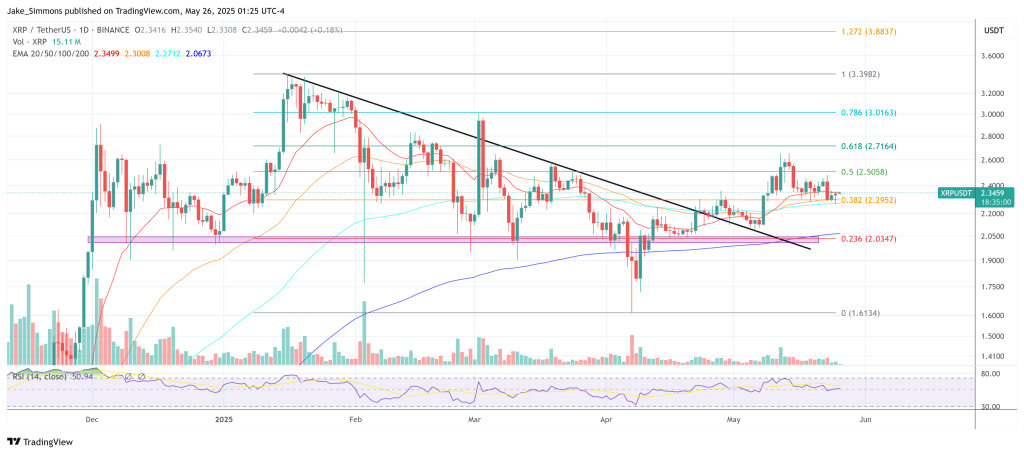
At press time, XRP traded at $2.34.
XRP price
XRP price, 1-day chart | Source: XRPUSDT on TradingView.com
Featured image created with DALL.E, chart from TradingView.com
Editorial Process for bitcoinist is centered on delivering thoroughly researched, accurate, and unbiased content. We uphold strict sourcing standards, and each page undergoes diligent review by our team of top technology experts and seasoned editors. This process ensures the integrity, relevance, and value of our content for our readers.

Jake Simmons has been a Bitcoin enthusiast since 2016. Ever since he heard about Bitcoin, he has been studying the topic every day and trying to share his knowledge with others. His goal is to contribute to Bitcoin's financial revolution, which will replace the fiat money system. Besides BTC and crypto, Jake studied Business Informatics at a university. After graduation in 2017, he has been working in the blockchain and crypto sector. You can follow Jake on Twitter at @realJakeSimmons.

Lectures associées

Le jeton IP chute de 98 %, la refonte de DATA est-elle un dernier baroud d'honneur ? Analyse de la transformation du protocole Story

**Points clés** Un rebranding n'est généralement pas un signal de reprise, mais plutôt l'aveu d'un échec stratégique. Si le produit, les utilisateurs et la liquidité ne reviennent pas après un changement de nom, le projet échoue souvent. Juger uniquement sur le prix est trompeur. Le succès véritable, comme le montre la transformation d'ETHLend en Aave, dépend d'une croissance réelle des utilisateurs et de la valeur totale verrouillée (TVL), que le prix suivra ensuite. La transition de Story Protocol de l'IP vers DATA est-elle une restructuration sérieuse ou une dernière tentative marketing ? L'exécution future le dira. **Réaction du marché** Le 25 juin, Story Protocol a annoncé sa transformation en DATA Foundation et le changement de son jeton IP vers DATA. Malgré des financements importants (a16z), le jeton IP a chuté d'environ 98 % depuis son pic. Après l'annonce, le prix a brièvement rebondi avant de retomber. Ce rebranding, coûteux et risqué, semble indiquer que le projet était dans une impasse. **Cas de rebranding échoués** Des projets comme MultiversX (ex-Elrond), Golem (GNT vers GLM), Cortex, Oasis et OMG Network ont changé de nom ou de narration sans améliorations substantielles en matière de développement produit, d'acquisition d'utilisateurs ou de liquidité. Leurs jetons ont significativement chuté ou les projets ont perdu en pertinence. **Au-delà du prix : les indicateurs clés** Certains projets, malgré la baisse des prix, montrent une exécution solide. Exemples : - Kaia (fusion KLAY/FNS) : partenariat avec des banques coréennes et une appli décentralisée avec des millions d'utilisateurs. - Polygon (MATIC vers POL) : développement continu d'infrastructures comme l'AggLayer. - Render et ASI : cas d'usage réels dans le calcul pour l'IA. Le succès exemplaire reste Aave (ex-ETHLend), où la croissance de la TVL et de la base utilisateurs a précédé et soutenu la valorisation. **Le cas de Story (IP) vers DATA** Le jeton IP a atteint son plus bas historique le 10 juin 2026 (0,275 $). L'annonce du rebranding quinze jours plus tard soulève des doutes sur une motivation défensive pour relancer le prix. Pour que cette transformation soit crédible, Story (DATA) devra démontrer : 1. Une force relative du jeton par rapport au marché. 2. Une amélioration de la liquidité et des volumes après le changement de jeton. 3. Une croissance réelle des utilisateurs et des revenus sur la chaîne grâce à la nouvelle narration sur les données d'IA. Un changement de direction est également notable : le fondateur Seung Yoon Lee passe à un rôle consultatif, remplacé au poste de CEO de la fondation DATA par l'ancien CPO Andrea Muttoni. Sans preuves tangibles d'exécution après la migration, ce rebranding risque de rejoindre la liste des échecs.

Foresight NewsIl y a 21 mins

Le jeton IP chute de 98 %, la refonte de DATA est-elle un dernier baroud d'honneur ? Analyse de la transformation du protocole Story

Foresight NewsIl y a 21 mins

Trading

Spot
活动图片