Best Altcoins to Watch as Banks Enter Crypto and DeFi Surges

bitcoinistPublié le 2025-05-24Dernière mise à jour le 2025-05-24

Résumé

The crypto space has never been more exciting, especially with news circulating about traditional financial giants like JPMorgan, Bank of...

Trusted Editorial content, reviewed by leading industry experts and seasoned editors. Ad Disclosure

The crypto space has never been more exciting, especially with news circulating about traditional financial giants like JPMorgan, Bank of America, Citi, and Wells Fargo possibly launching a joint stablecoin.

This could be a game-changer, but it’s not just stablecoins that deserve your attention.

Altcoins continue to be the driving force behind innovation in the blockchain and cryptocurrency world.
In fact, many of the best altcoins of 2025 are looking to capitalize on the growing interest in decentralized finance (DeFi), tokenized assets, and new technologies.

As big banks consider entering the crypto space, it’s important to look beyond the headlines and focus on the smaller, yet powerful projects making waves.

In this article, we’ll highlight three exciting new crypto projects that have the potential to change the game in the world of altcoins.

The Big Picture: Traditional Banks Eye Crypto, But Altcoins Lead the Way

The world of cryptocurrency is undergoing a major shift, with some of the biggest traditional financial institutions – JPMorgan, Bank of America, Citi, and Wells Fargo – reportedly considering a joint stablecoin launch.

This is a significant development, as these major players in banking have largely stayed on the sidelines, hesitant to fully embrace crypto.

Stablecoins, which are pegged to fiat currencies like the US dollar, offer a sense of stability in the otherwise volatile crypto market.
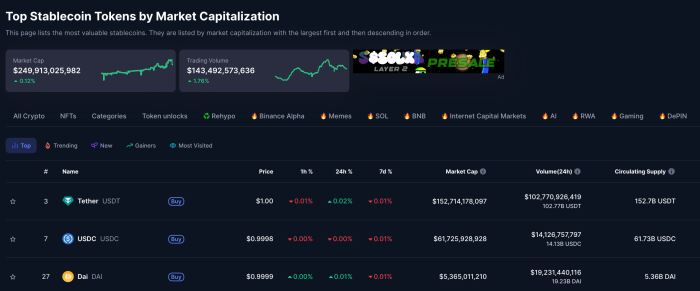
Top 3 stablecoins on CoinMarketCap.
Source: CoinMarketCap.

With these financial giants moving into the space, they may appeal to both retail and institutional investors seeking safer, less volatile options.

However, while stablecoins may offer short-term stability, the true innovation in blockchain lies within altcoins. These projects are pushing the boundaries of what decentralized finance can achieve, from tokenizing real-world assets to enabling decentralized exchanges.

Investors are flocking to protocols that offer speed, transparency, and liquidity, which are solving long-standing issues in traditional finance.

As financial institutions look to enter the crypto space, altcoins are already leading the charge, proving that the future of digital finance is decentralized.

1. Best Wallet Token ($BEST) – Unlocking Future Growth with Innovation and Security

Best Wallet Token ($BEST) is revolutionizing digital wallet management with a user-friendly platform that supports multiple cryptocurrencies, cross-chain transfers, and top-tier security powered by Fireblocks MPC-CMP technology.

Unlike traditional wallets, Best Wallet is designed for both newcomers and experienced investors, making crypto management easy and secure.

Priced at $0.025075, $BEST raised over $12.6M during its presale, signaling strong investor confidence.
As major financial institutions like JPMorgan, Bank of America, and Wells Fargo explore stablecoin initiatives, the decentralized wallet and token space is gaining traction.

how to buy $BEST presale.

With a forecasted price of $0.62 by 2026, $BEST could see a significant 2,372% increase from its current value.

If you staked $1,000 worth of $BEST today, at a 15% annual percentage yield (APY), you could accumulate additional tokens throughout the year.

By 2026, with $BEST priced at $0.62, your total investment could be worth $3,174 – a potential profit of $2,174.

Token buyers also enjoy reduced transaction fees, early access to new projects, and benefits in Best Wallet’s iGaming partnerships.

As Best Wallet continues to disrupt the market with innovative features, $BEST offers significant long-term growth potential — making it one of the most promising altcoins to watch in 2025.

2. SUBBD Token ($SUBBD) – Tokenizing Real-World Assets for Blockchain Innovation

SUBBD Token ($SUBBD) is transforming the creator economy by tokenizing real-world assets such as real estate and commodities, allowing people to buy, sell, and trade them as digital assets.

This approach makes traditionally illiquid markets more accessible and efficient, bridging the gap between blockchain and traditional finance.

Beyond tokenization, $SUBBD leverages AI to empower creators, offering tools to automate chat, editing, and monetization, helping them scale content with ease.

People can also generate AI-driven photos and videos, which are approved by creators, creating new revenue streams. With over 250M combined followers across its ecosystem, $SUBBD is poised to onboard a large user base to its platform.

The project raised nearly $500K during its presale, and you can buy $SUBBD right now for $0.055475.

As financial institutions explore stablecoin initiatives, the decentralized content and asset tokenization space is gaining significant momentum.

SUBBD token benefits

With staking rewards offering 20% APY during the presale, $SUBBD provides an attractive opportunity for early investors.

As the platform grows and blockchain adoption accelerates, $SUBBD is set to become a key player in both the crypto and creator economies.

3. NEAR Protocol ($NEAR) – A Blockchain Built for the Future

NEAR Protocol ($NEAR) is a blockchain platform designed to make decentralized apps (dApps) easier to build and use. Think of it like a super-fast highway for blockchain, where developers can quickly deploy apps without getting stuck in traffic.

One of $NEAR’s coolest features is its sharding technology, called Nightshade. It splits the blockchain into smaller parts (called shards), allowing the network to process a lot more transactions at once.

This makes NEAR Protocol faster and cheaper to use than many other blockchains, which tend to slow down when too many people use them.

But $NEAR isn’t just about speed. It also makes it easy for newcomers.

Instead of dealing with complicated crypto addresses, users get simple, human-readable account names. And developers can easily connect to other blockchains, like Ethereum, thanks to tools like the Aurora EVM.

Currently priced at $2.81, $NEAR has been gaining momentum with over 1K projects already running on its network. It’s quickly becoming one of the most reliable platforms in decentralized space.
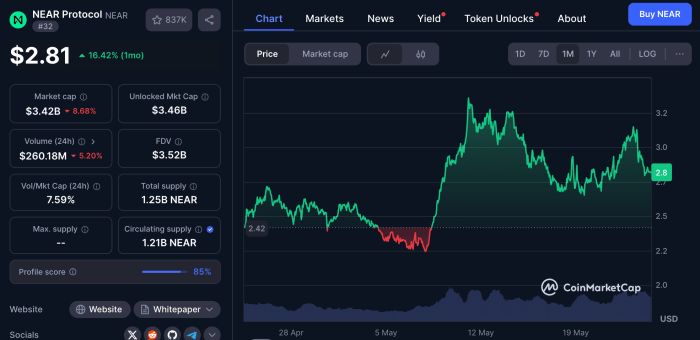
$NEAR pumping over the last month on CoinMarketCap.
Source: CoinMarketCap.

As traditional financial institutions like JPMorgan and Bank of America explore blockchain technology, $NEAR’s scalability and developer-friendly approach make it a key player in the future of decentralized finance.

The Next Generation of Altcoins

As traditional financial institutions start exploring the crypto space, innovative altcoins like Best Wallet Token, SUBBD Token, and NEAR Protocol are leading the charge in decentralized finance.

These projects are pushing the boundaries with secure wallets, tokenizing real-world assets, and bridging crypto with traditional markets. Keep an eye on them for future growth.

Before investing in crypto, always do your own research (DYOR). This article is for informational purposes only and shouldn’t be considered as financial advice.

Editorial Process for bitcoinist is centered on delivering thoroughly researched, accurate, and unbiased content. We uphold strict sourcing standards, and each page undergoes diligent review by our team of top technology experts and seasoned editors. This process ensures the integrity, relevance, and value of our content for our readers.

Lectures associées

Robinhood lance une chaîne et des "actions tokenisées", mais les "actions tokenisées" joliment emballées n'accordent toujours pas de droits de propriété

Robinhood a lancé sa propre chaîne Layer 2, "Robinhood Chain", basée sur Arbitrum. L'initiative inclut des "Stock Tokens", présentés comme des actions tokenisées, mais qui sont en réalité des titres de dette offrant une exposition économique aux actions sous-jacentes, sans conférer de droits de vote ou de propriété légale directe. Cette approche permet à Robinhood de proposer des produits financiers globaux et portables tout en conservant une structure juridique traditionnelle et régulée. La stratégie de Robinhood vise à étendre son écosystème financier (courtage, crypto-monnaies, portefeuille numérique, etc.) vers une "super-application" financière mondiale. Cependant, le succès dépendra de sa capacité à masquer la complexité juridique sous-jacente derrière une interface utilisateur simple. Les risques incluent des incompréhensions des clients sur la nature des produits, et un examen réglementaire accru si l'emballage est perçu comme trompeur. L'acquisition de Bitstamp et l'intégration de protocoles comme Lighter pour les contrats perpétuels renforcent sa position d'infrastructure, au-delà du simple revenu de trading. En somme, Robinhood Chain est une expérience ambitieuse pour relier la finance traditionnelle et décentralisée, mais son avenir est conditionné par l'acceptation des utilisateurs, des développeurs et des régulateurs.

marsbitIl y a 1 h

Robinhood lance une chaîne et des "actions tokenisées", mais les "actions tokenisées" joliment emballées n'accordent toujours pas de droits de propriété

marsbitIl y a 1 h

La ruse comptable de Strategy : la limite de vente de crypto-monnaies dépasse largement les 12,5 milliards de dollars

Strategy a récemment vendu 3 588 BTC (environ 216 millions de dollars) pour payer des dividendes et reconstituer sa réserve de dollars, sans que cette vente ne réduise la limite de 12,5 milliards de dollars prévue pour "construire" la réserve. Ceci révèle une subtilité comptable : l'entreprise distingue la "construction" et la "reconstitution" de la réserve, bien que les deux consistent à vendre des BTC pour obtenir des liquidités destinées aux obligations financières. Le plan de monétisation des BTC de Strategy prévoit en réalité trois cas de vente : construire une réserve (12,5 Md$ maximum), couvrir les coûts des actions privilégiées et de la dette (pas de plafond clair), et financer des rachats d'actions (jusqu'à 20 Md$). Le potentiel total de vente dépasse ainsi largement les 12,5 milliards de dollars. Strategy évolue d'une stratégie d'accumulation passive de Bitcoin vers une gestion active de son capital, utilisant le BTC comme un levier de bilan pour maintenir sa structure financière complexe. Cela crée des conflits d'intérêts, par exemple entre vendre des BTC (préserve la trésorerie mais érode le récit de détention à long terme) et soutenir les actions privilégiées. Les investisseurs doivent désormais décrypter minutieusement la communication de Strategy, car chaque terme ("construire", "reconstituter", etc.) a des implications spécifiques sur les futures ventes de BTC. L'entreprise s'est donné une plus grande flexibilité, mais son défi est de gérer activement les tensions entre ses différentes parties prenantes sans rompre l'équilibre de l'ensemble.

Odaily星球日报Il y a 1 h

La ruse comptable de Strategy : la limite de vente de crypto-monnaies dépasse largement les 12,5 milliards de dollars

Odaily星球日报Il y a 1 h

Le jeu des relations dans l'élite de la Silicon Valley : 50 millions pour ceux qui ont des relations, les véritables talents ne trouvent pas de financement ?

L'élite de la Silicon Valley est en train de passer d'une méritocratie à un jeu de relations. Aujourd'hui, l'accès au financement dépend moins du talent que du réseau et du pedigree. Les fondateurs issus de Stanford ou d'OpenAI lèvent des millions facilement, tandis que les véritables outsiders talentueux peinent à sécuriser des fonds. Cette évolution est alimentée par une pensée de groupe consensuelle, accentuée par l'IA qui déforme les attentes de croissance, la concentration des capitaux chez quelques grands fonds, et la professionnalisation de la VC qui privilégie les paris "sûrs". Les accélérateurs produisent des startups uniformes, et les grands fonds couronnent prématurément des équipes "sélectionnées" avec des guerres de trésorerie allant jusqu'à 50 millions de dollars. Cette pratique du "kingmaking" crée des effets pervers : pression pour une croissance à tout prix, comportements risqués et créativité comptable dans le reporting des revenus. Elle attire aussi des fondateurs plus intéressés par la vente de parts secondaires que par la construction d'une entreprise durable. Cependant, l'auteur prédit un retour à la moyenne. Historiquement, les entreprises les plus précieuses ne naissent pas des tendances à la mode. Il mise sur les outsiders déterminés, ignorés par le consensus, qui finiront par l'emporter. Ceux qui suivent le mouvement aveuglément seront, à terme, "massacrés".

marsbitIl y a 1 h

Le jeu des relations dans l'élite de la Silicon Valley : 50 millions pour ceux qui ont des relations, les véritables talents ne trouvent pas de financement ?

marsbitIl y a 1 h

Trading

Spot
活动图片