Bitcoin Price Volatility Far Lower Than During COVID-19 Crash — What This Means

bitcoinistPublié le 2025-04-12Dernière mise à jour le 2025-04-13

Résumé

Over the past few weeks, the cryptocurrency market has been overwhelmed by a high degree of uncertainty and volatility triggered...

Trusted Editorial content, reviewed by leading industry experts and seasoned editors. Ad Disclosure

Over the past few weeks, the cryptocurrency market has been overwhelmed by a high degree of uncertainty and volatility triggered by the constantly shifting global macroeconomics. This unsettled market condition saw the Bitcoin price dance between $74,000 and $83,000 in the space of a few days.

The price of BTC sank toward $74,000 at the start of the past week as crypto investors panicked after United States President Donald Trump announced new trade tariffs. On Thursday, April 10, the premier cryptocurrency reclaimed the $83,000 level after President Trump paused trade tariffs on all countries except China.

Is Bitcoin Now A ‘Mature Asset’?

The Bitcoin price has been quite reactive to virtually every piece of news in the global trade, demonstrating the highly volatile state of the cryptocurrency market. However, an on-chain analytics expert has explained that the volatility of the current Bitcoin market pales in comparison to past episodes.

In a new post on the social media platform X, CryptoQuant’s head of research, Julio Moreno, revealed that the Bitcoin price volatility in the ongoing global trade drama has been “so far lower” than that from other past events, such as the COVID-19 crash, Terra-Luna collapse, FTX downfall, and the Silicon Valley Bank (SVB) bank run.

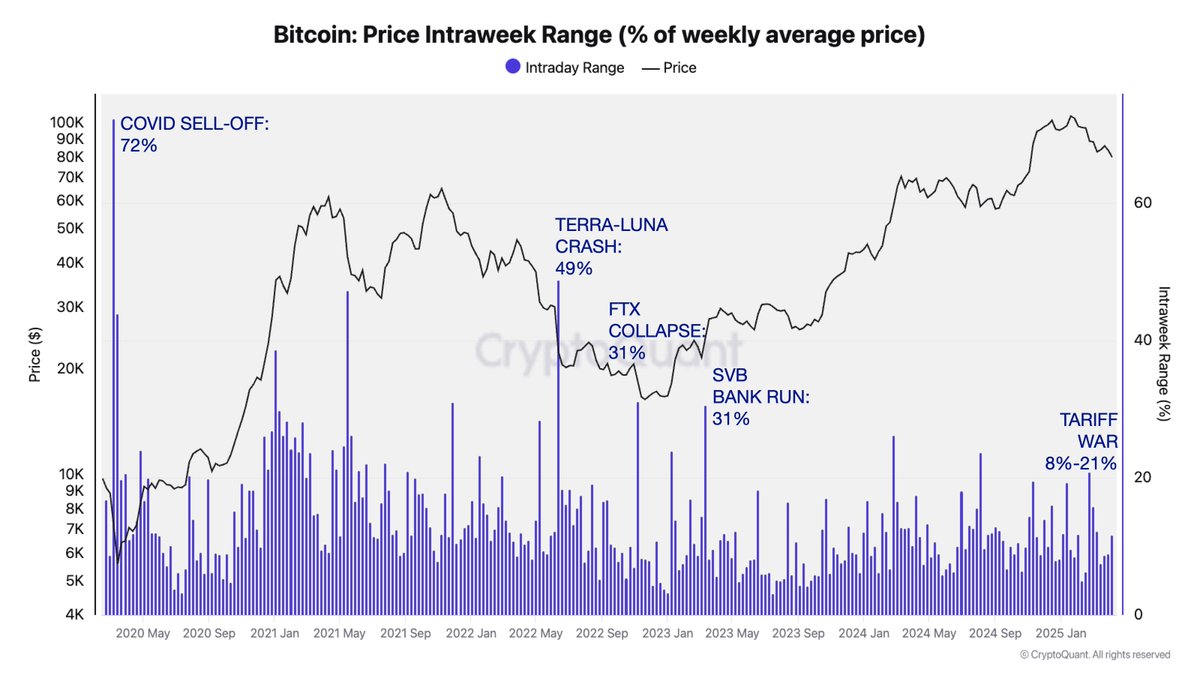
The relevant indicator here is the Price Intraweek Range metric, which estimates the percentage change in the average weekly price of Bitcoin. According to data from CryptoQuant, the Bitcoin Price Intraweek Range climbed to an all-time high of 72% during the COVID-19 market downturn in April 2020.
Bitcoin price

Source: @jjcmoreno on X

The chart above shows that the BTC Intraweek Range metric surged to 49% after the crash of the Terra Luna ecosystem in May 2022. Meanwhile, the indicator reached 31% following the collapse of the Sam-Bankman-Fried-led FTX exchange in late 2022 and the SVB bank run in early 2023.

With the escalating trade tensions between the United States and China, the Bitcoin Price Intraweek Range metric stands between 8% – 21%. This reduced volatility suggests that the premier cryptocurrency has matured as an asset, with deeper liquidity and a better market structure.

The relatively stable price action can be connected to the growing base of long-term holders and steady corporate adoption, as institutional players are beginning to view the world’s largest cryptocurrency less as a high-risk asset and more as a hedge against macroeconomic uncertainties.

Bitcoin Price At A Glance

As of this writing, the price of BTC stands at around $83,700, reflecting a 5% increase in the past 24 hours.

Bitcoin price

The price of BTC returns to above $83,000 on the daily timeframe | Source: BTCUSDT chart on TradingView

Featured image from iStock, chart from TradingView
Editorial Process for bitcoinist is centered on delivering thoroughly researched, accurate, and unbiased content. We uphold strict sourcing standards, and each page undergoes diligent review by our team of top technology experts and seasoned editors. This process ensures the integrity, relevance, and value of our content for our readers.

Opeyemi Sule is a passionate crypto enthusiast, a proficient content writer, and a journalist at Bitcoinist. Opeyemi creates unique pieces unraveling the complexities of blockchain technology and sharing insights on the latest trends in the world of cryptocurrencies. Opeyemi enjoys reading poetry, chatting about politics, and listening to music, in addition to his strong interest in cryptocurrency.

Lectures associées

Tiger Research : Déplacer d'abord la tokenisation des RWA à l'étranger

Le marché des actifs réels tokenisés (RWA) connaît une croissance rapide, mais de nombreuses juridictions manquent encore de cadre réglementaire. Face à ce vide, les institutions financières ont trois options stratégiques : attendre une législation locale, utiliser des bac à sable réglementaires, ou se tourner vers les marchés étrangers déjà réglementés. L'expansion transfrontalière des RWA exige une préparation minutieuse dans six domaines clés : choix de la juridiction, licences, définition de l'actif, public d'investisseurs cible, modalités de règlement et exigences opérationnelles. L'objectif est d'acquérir une expérience opérationnelle concrète. Deux voies principales s'offrent aux institutions : la voie directe, en s'implantant dans des juridictions matures comme Hong Kong, Singapour ou les États-Unis où des plates-formes facilitent l'entrée sur le marché ; et la voie « native chaîne », utilisant des infrastructures en ligne intégrant la conformité (comme Ondo ou Plume) pour un déploiement plus rapide et une meilleure connexion à la liquidité DeFi, bien que la complexité structurelle soit accrue. Un cas pratique illustre le processus, qui peut prendre de six mois à un an, et couvre l'évaluation de la présence locale, le choix de la plate-forme, la conception du produit, la structure de garde et l'exécution. Le message central est que l'attente passive n'est pas une stratégie viable. Le marché évolue rapidement, et la capacité à agir dès maintenant pour tracer une voie réalisable et accumuler de l'expérience est plus cruciale que tout. L'essence d'une activité de tokenisation réside dans l'achèvement réussi du processus de vente, et non dans la seule conception technique.

marsbitIl y a 11 mins

Tiger Research : Déplacer d'abord la tokenisation des RWA à l'étranger

marsbitIl y a 11 mins

Cinq ans de chute de 15 milliards de dollars, le leader du jeu blockchain YGG capitule

Yield Guild Games (YGG), ancien leader du jeu blockchain, annonce la fermeture de sa division d'édition de jeux, YGG Play, d'ici le 31 juillet. Cette décision, qualifiée de choix stratégique face à un environnement macroéconomique difficile et à une baisse de confiance des utilisateurs, entraîne le licenciement de 35 employés. Bien que YGG Play ait généré plus de 9 millions de dollars de revenus depuis 2025, prouvant la viabilité des jeux casual sur mobile pour les utilisateurs Web3, l'activité n'est plus jugée durable. Fondé en 2020, YGG avait connu son apogée en 2021, porté par le modèle "Play-to-Earn" (P2E) et le jeu Axie Infinity, atteignant une valorisation dépassant 10 milliards de dollars. Le bear market de 2022 a exposé la fragilité du modèle P2E, menant YGG à se diversifier vers l'édition avec YGG Play en 2025. Sa fermeture symbolise les profondes difficultés du secteur des jeux blockchain. Un rapport récent estime que 93% des quelque 3200 projets suivis sont "morts" ou inactifs, avec une chute moyenne de 95% des prix des jetons depuis les sommets de 2022. Le modèle économique initial, basé sur un cycle spéculatif nécessitant un afflux constant de nouveaux joueurs pour rémunérer les anciens, s'est révélé structurellement non viable. YGG annonce désormais un pivot complet vers l'économie des données d'IA.

Foresight NewsIl y a 31 mins

Cinq ans de chute de 15 milliards de dollars, le leader du jeu blockchain YGG capitule

Foresight NewsIl y a 31 mins

Trading

Spot
活动图片