Ripple CTO Details How RLUSD Might Trade At $1,200 On Debut

bitcoinistPublié le 2024-12-16Dernière mise à jour le 2024-12-16

Résumé

Ripple CTO David “JoelKatz” Schwartz has outlined how RLUSD—the upcoming stablecoin on the XRP Ledger—could initially trade at highly inflated...

Ripple CTO David “JoelKatz” Schwartz has outlined how RLUSD—the upcoming stablecoin on the XRP Ledger—could initially trade at highly inflated prices, possibly even $1,200, despite its intended $1 peg. Speaking via X, he highlighted early supply bottlenecks, speculative fervor, and the fundamental market mechanics of stablecoins as factors likely to drive any short-lived spike.

Why The Ripple Stablecoin RLUSD Could Hit $1,200

In a reply to community chatter around a screenshot that showed an RLUSD value of $1,200 on the Xaman wallet, Schwartz confirmed such a price is theoretically possible. He remarked that “as RLUSD goes live, there may be supply shortages in the very early days before the market stabilizes. There actually is someone willing to pay $1,200/RLUSD for a tiny fraction of one RLUSD. Tools will show you the highest price anyone is willing to pay, even if it’s just for a tiny bit. Maybe someone wants the ‘honor’ of buying the first bit of RLUSD on the DEX.”

However, he was quick to stress that “the price will come back to very close to $1 as soon as supply stabilizes,” suggesting that any eye-popping listing would be more of a novelty event than a real market assessment of RLUSD’s long-term value. “But rest assured, the price will come back to very close to $1 as soon as supply stabilizes. […] If you want to spend a lot of money to get a tiny bit of RLUSD before anyone else does, you can. But please don’t expect the price to stay over $1 once things stabilize, which I expect they will do very quickly.”

Part of the reason for these anomalies, according to the Ripple CTO, lies in the basic minting and burning mechanics that underpin stablecoins. Minting the Ripple stablecoin involves creating new units when demand rises, while burning is the process of removing units from circulation when demand falls. Both processes help maintain the $1 peg but can lag behind real-time trading. At launch, an imbalance between the number of tokens available (supply) and those seeking to buy them (demand) could generate extreme initial price distortions.

Schwartz’s remarks on social media echoed points he made at the Emergence conference in Prague. He discussed “weird failure scenarios” that might occur when a stablecoin first goes live, jokingly referring to the possibility that “people might spend extra just to own RLUSD first.”

A scenario he described was someone paying $3—rather than $1—just to say they are an original holder of the stablecoin. While that still pales in comparison to $1,200, the principle remains: such anomalies, he said, could lead some buyers to mistakenly believe that the Ripple stablecoin might be a speculative asset rather than a stablecoin.

“Obviously it’s going to come back down from $3 to $1 as soon as somebody mints enough of it,” the Ripple CTO noted, adding that this is where arbitragers play a pivotal role. When the price of a stablecoin floats significantly above or below its peg, traders seize on the mismatch, either selling at a premium or buying at a discount and redeeming at face value. This process locks the price back to its target.

Schwartz also cautioned, “please don’t FOMO into a stablecoin! This is not an opportunity to get rich.”
Ripple Software Engineer Neil Hartner recalled that GateHub USDC was “regularly over $2 per GateHub USD” during its initial automated market maker (AMM) phase, especially on weekends when GateHub’s own mint-and-burn processes were offline.

A vital takeaway here is that many stablecoins rely on an external entity or protocol for minting and redemption. When those processes aren’t operational 24/7—or when liquidity is restricted outside of business hours—prices can decouple from the $1 peg on specific exchanges or trading venues.

Hartner cited Circle’s USDC depegging incident in March 2023 as another cautionary parallel. “Price distortions can happen if minting and burning aren’t available 24/7. Same thing happened when USDC depegged over a weekend in March 2023 because markets panicked and Circle had limited liquidity operations outside business hours, Hartner wrote.

Community member Khaled Elawadi.XRP, questioned how halting minting or burning could logically distort a stablecoin’s price if redemptions for fiat ultimately remain $1. “Surely, there should be a fixed buy and sell price on the DEX and on the other listed exchanges?” he remarked.

In response, Hartner underscored that the peg is enforced not by a universal algorithmic price fix but by traders themselves. “You don’t cash out stablecoins from exchanges, you trade them for fiat with other traders,” he explained. If more stablecoins are being sold than there are buyers willing to pay $1, the price on that particular exchange can slip until market participants or liquidity providers step in.

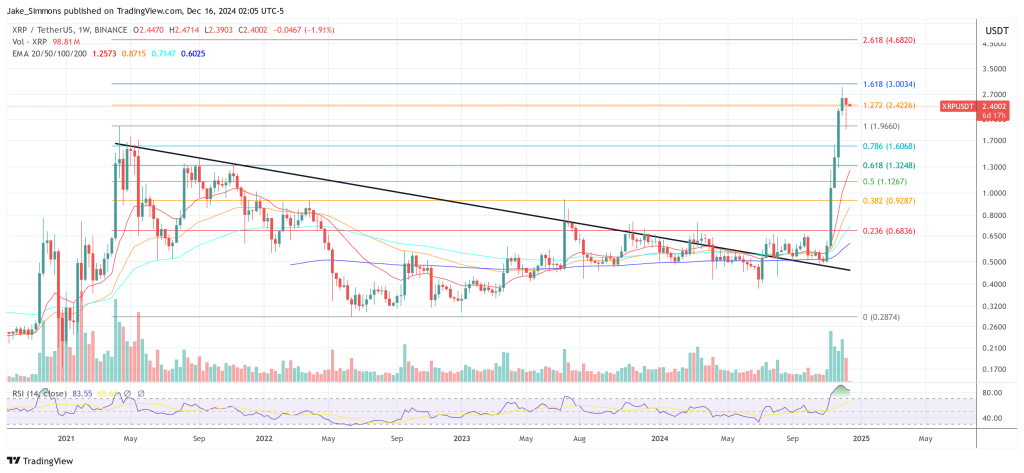
At press time, XRP traded at $2.40.
XRP price
XRP price, 1-week chart | Source: XRPUSDT on TradingView.com
Featured image from YouTube, chart from TradingView.com
Jake Simmons

Jake Simmons

Jake Simmons has been a Bitcoin enthusiast since 2016. Ever since he heard about Bitcoin, he has been studying the topic every day and trying to share his knowledge with others. His goal is to contribute to Bitcoin's financial revolution, which will replace the fiat money system. Besides BTC and crypto, Jake studied Business Informatics at a university. After graduation in 2017, he has been working in the blockchain and crypto sector. You can follow Jake on Twitter at @realJakeSimmons.

Lectures associées

6 questions pour comprendre les tendances commerciales de l'IA

L'économie de l'IA est entrée dans sa phase d'« été », caractérisée par une coexistence entre le récit et la livraison concrète, où la rentabilité devient cruciale. Cette analyse s'appuie sur un cadre à six dimensions, chacune notée 1 point sur 2, pour un total de 6 points, situant le secteur en plein été (5-7 points). Les six dimensions évaluées sont : 1. **Narration vs Livraison** : Passage des promesses à des offres payantes (ex. : abonnements Doubao, publicité OpenAI). 2. **Connectivité système** : Les produits IA sortent de leur isolement pour s'intégrer aux workflows. 3. **Capacité de livraison** : L'IA est utilisée à grande échelle pour des tâches productives (ex. : milliards d'appels quotidiens sur Doubao). 4. **Rationalisation du ROI** : Les coûts (calcul, électricité) imposent une tarification et un calcul du retour sur investissement. 5. **Phénomène sectoriel** : Fin de la gratuité généralisée, début des discussions sur la profitabilité. 6. **Environnement capitalistique** : Les investissements continuent, mais les valorisations dépendent désormais des revenus. Deux signes récents illustrent cette transition : * **Doubao lance des abonnements payants** en raison des coûts astronomiques liés à ses centaines de milliards de requêtes quotidiennes. * **OpenAI lance une plateforme publicitaire** pour monétiser son immense audience et couvrir ses lourdes pertes. Pour les entreprises, la période estivale est le moment d'agir. La feuille de route proposée est en trois étapes : 1. **Démarrer petit** : Identifier un point de douleur précis, obtenir un résultat financier clair (économie/recettes) en moins de 3 mois. 2. **Répliquer et institutionnaliser** : Capitaliser sur les succès initiaux, créer des plateformes de partage de compétences en IA et adapter la structure organisationnelle (formation, incitations). 3. **Refondre par l'IA** : Repenser fondamentalement les processus pour une collaboration parallèle entre humains et IA, visant une automatisation intelligente des flux de travail. En résumé, l'été de l'IA est une phase de validation commerciale où la valeur tangible prime. La stratégie gagnante consiste à prouver la valeur sur un point précis, à l'étendre, puis à réinventer les processus métier autour de l'intelligence artificielle.

marsbitIl y a 2 h

6 questions pour comprendre les tendances commerciales de l'IA

marsbitIl y a 2 h

Bit Digital a reconnu la valeur stratégique d'Ethereum avant que les institutions ne le comprennent

Bit Digital a reconnu très tôt la valeur stratégique d'Ethereum (ETH), bien avant que la plupart des institutions ne considèrent cet actif comme fondamental pour le secteur de la cryptographie. Alors que beaucoup traitaient encore l'ETH comme un actif secondaire, l'entreprise a positionné ses investissements autour de son potentiel à long terme en tant que pierre angulaire de la finance décentralisée, du jalonnement et des économies de jetons. Dans une publication récente, Bit Digital a expliqué avoir identifié Ethereum comme un actif essentiel pour son bilan plusieurs années avant que le consensus institutionnel ne reconnaisse son rôle d'infrastructure de règlement. La société fonde sa thèse sur la croissance continue de l'adoption et de l'utilité réelle d'ETH - notamment pour les règlements de stablecoins, la tokenisation et l'activité financière sur chaîne - tandis que son prix reste relativement comprimé. Par ailleurs, un signal fort émerge du marché des actifs réels tokenisés (RWA) : Ethereum s'impose comme la principale couche de règlement pour la majorité de ces actifs financiers. Cette préférence est motivée par la recherche de couches de règlement neutres, d'infrastructures crédibles et de composabilité entre applications. Enfin, les grands détenteurs d'ETH continuent d'accumuler pendant les périodes de faiblesse du marché. Les portefeuilles détenant au moins 100 000 ETH ont ainsi atteint un solde collectif d'environ 17,41 millions d'ETH, un plus haut sur neuf semaines. Ce comportement d'accumulation stratégique est souvent considéré comme un signe haussier à long terme.

bitcoinistIl y a 5 h

Bit Digital a reconnu la valeur stratégique d'Ethereum avant que les institutions ne le comprennent

bitcoinistIl y a 5 h

Les États-Unis autorisent pour la première fois les contrats perpétuels cryptographiques : qu'est-ce que cela signifie pour le marché ?

Le 29 mai, la CFTC américaine a publié une directive autorisant la négociation et la compensation 24h/24 et 7j/7 pour les produits dérivés liés aux actifs cryptographiques, ouvrant effectivement le marché américain jusque-là interdit aux contrats perpétuels cryptos. Cette décision historique permet aux plateformes et aux citoyens américains d'accéder à ce marché, qui représentait entre 60 et 90 billions de dollars de volume en 2025. Les principaux bénéficiaires immédiats sont Kalshi (dont le contrat perpétuel BTCPERP a été approuvé), Coinbase (devenue le premier FCM régulé par la CFTC pour offrir ces produits) et le CME (passant à une négociation 24/7 pour ses contrats Bitcoin). La directive de la CFTC est présentée comme une mesure spécifique aux actifs numériques, distinguant les cryptomonnaies des matières premières traditionnelles comme les produits agricoles. Les réactions de l'industrie sont majoritairement positives, saluant un accès élargi et une amélioration de l'efficacité du capital. Cependant, l'organisation de protection des consommateurs Better Markets critique vivement la décision, l'accusant de négliger la protection des investisseurs particuliers face aux risques complexes des contrats perpétuels et d'agir dans l'intérêt des entreprises qu'elle est censée réguler. D'autres acteurs comme Kraken ont annoncé leur intention de lancer des produits similaires sous peu, indiquant que le marché américain des dérivés cryptos est sur le point de connaître une phase de croissance significative.

marsbitIl y a 13 h

Les États-Unis autorisent pour la première fois les contrats perpétuels cryptographiques : qu'est-ce que cela signifie pour le marché ?

marsbitIl y a 13 h

Trading

Spot
Futures
活动图片