$2.5 Billion Liquidated: Crypto Market Cursed with Following Declines but Not Rallies

Odaily星球日报Publié le 2026-02-01Dernière mise à jour le 2026-02-01

Résumé

A massive crypto market crash on January 31 led to $2.522 billion in liquidations, with Bitcoin falling below $78,000 (a 7.6% drop) and Ethereum plunging over 12% to under $2,400, erasing gains from mid-2025. Solana also dropped sharply, falling below $100. The sell-off was triggered by broader financial turmoil, beginning with escalating geopolitical tensions and accelerated by a severe crash in precious metals. Gold and silver saw dramatic drops—15.7% and 37%, respectively—after reports suggested former Fed official Kevin Warsh, perceived as hawkish, might be nominated as the next Fed chair. This sparked a repricing of expectations around U.S. monetary policy and a stronger dollar. The crypto market, positioned at the bottom of the risk asset hierarchy, suffered disproportionately—falling more sharply than traditional markets during downturns without matching their rallies. Major players were heavily impacted: trader Garrett Bullish saw over $700 million liquidated in a single position on Hyperliquid, while institutional entity Trend Research faces nearly $500 million in unrealized losses on its Ethereum holdings. Despite Bitcoin’s price relative to gold hitting historic lows—a signal some interpret as a potential long-term buying opportunity—the event underscores crypto’s current role as a high-risk asset vulnerable to macro shocks, lacking the stable store-of-value status of traditional safe havens. The market is now questioning what will sustain long-term holding thro...

Original | Odaily Planet Daily (@OdailyChina)

Author | Ding Dang (@XiaMiPP)
A flash crash has happened again.

On the night of January 31, Bitcoin briefly fell below $78,000, hitting a low of $75,700, with a 24-hour drop of 7.6%. This decline was not only extremely rapid but, more critically, it directly broke through the price range where BTC had been consolidating for nearly three months, retreating to lows not seen since April 2025.

The situation for ETH is even more concerning, with its price falling below the $2,400 mark, a 24-hour plunge of 12.28%, almost completely erasing all gains since July 2025. Solana was not spared either, with its price dropping below $100, a single-day decline of 13.74%, returning to levels last seen in February 2025.

The collective downturn of mainstream assets seems to be approaching a new critical point.

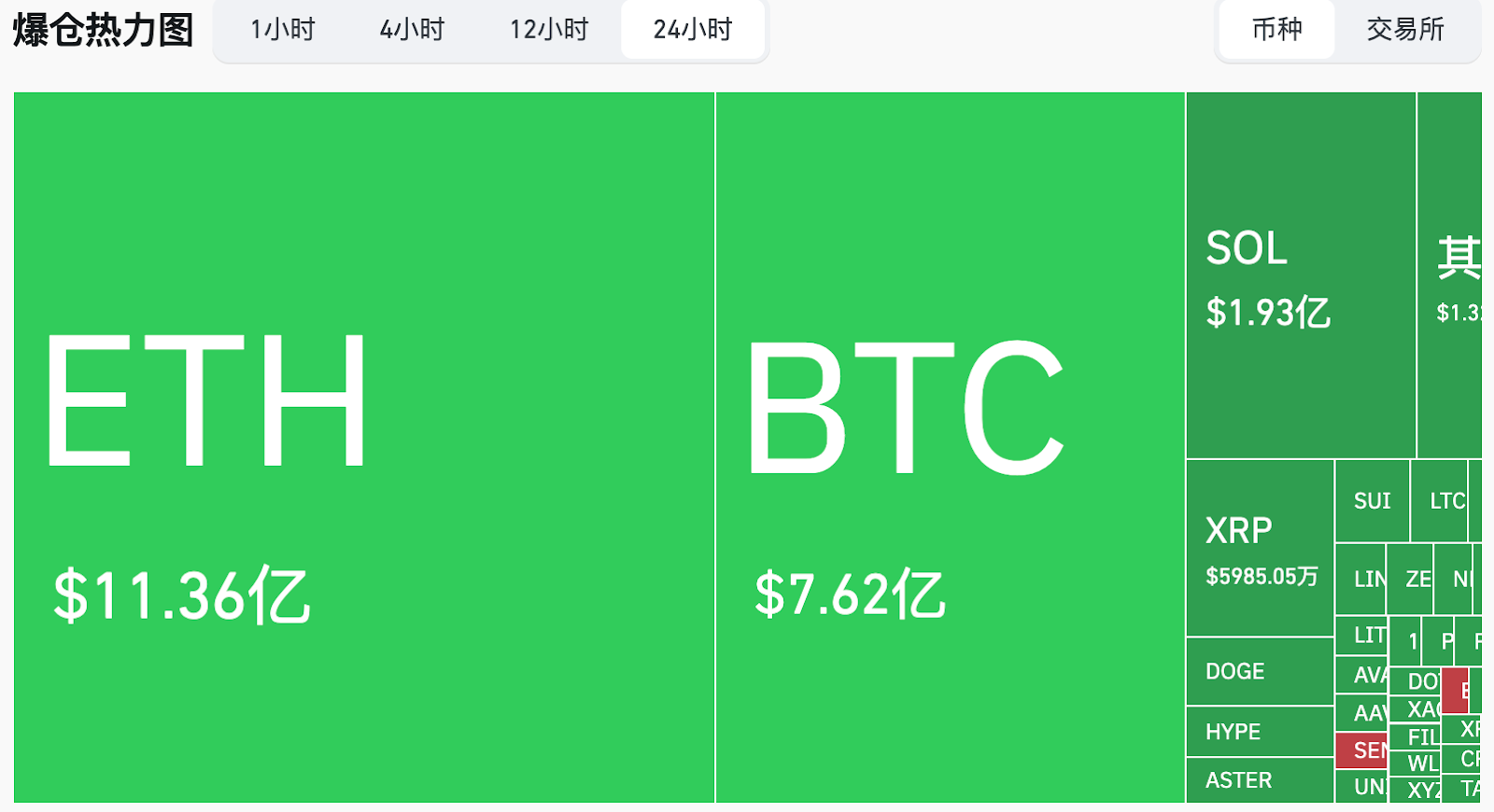
In derivatives, over the past 24 hours, $2.522 billion was liquidated, with long positions accounting for $2.411 billion and short positions $115 million. The largest single liquidation occurred on Hyperliquid - ETH-USD, worth approximately $222 million. Notably, in just the past hour, liquidation amounts reached as high as $1.14 billion.
The Starting Point of the Decline Lies Not Only Within the Crypto Market

The first domino of this round of market movement was not on-chain.

Looking at the timeline, market tension began to noticeably intensify from January 29. The sudden escalation of geopolitical risk was one of the earliest triggering factors captured by the market. The U.S. aircraft carrier USS Abraham Lincoln and its strike group entered a "lights-out" status with communications cut off, while statements from Iran also clearly shifted to a combat-ready posture. Odaily Planet Daily had previously provided a detailed analysis in From Geopolitical Tension to Liquidity Tightening, BTC Dragged into Uncontrolled Market Conditions.

Even so, the speed of this crypto market decline far exceeded expectations. What truly caused the risk to spill over rapidly was the simultaneous crash in the precious metals market.

After Gold and Silver Fell, Crypto's Uncontrolled Decline Accelerated

On January 29, gold turned downward sharply after briefly breaking above $5,600, falling to a low of around $4,740, a maximum drop of 15.7%. The adjustment in silver was even more severe, plummeting after breaking above $120 to a low of $76.6, a maximum drop of 37%.

Dirk Malakie, Managing Director of SLC Management, pointed out that the plunge in gold and silver began with the market's reaction to reports that Trump would nominate Kevin Warsh as Fed Chair. Warsh's resume carries distinct hawkish tones, which somewhat weakened the expectation of a "long-term comprehensive devaluation of the U.S. dollar." The market is re-anchoring towards a more orderly monetary policy path. Related reading: "Estée Lauder Son-in-Law" Kevin Warsh Takes Helm at the Fed, Hawkish Bigwig Turns Out to Be a Crypto Ally?

Seth R. Freeman, Senior Managing Director at GlassRatner Advisory & Capital Group, also believes that the "good news" in this nomination is that the market might not have to repeatedly deal with the uncertainty and emotional disturbance caused by Trump's continuous pressure on the Fed. The sharp fall in gold and silver already reflects the market's repricing for a stronger dollar environment. In his view, it would not be surprising if metal prices fail to show a significant rebound in this context. On the contrary, traders heavily long precious metals without effective hedging may face continued pressure, especially silver bulls. By next Monday, some trading accounts might suffer severe losses.

Additionally, analysts mentioned that month-end concentrated profit-taking trading behavior, and hedging operations by banks to guard against sudden declines, may have amplified the selling pressure in a short period.

Adrian Ash, Head of Research at BullionVault, stated that he has been involved in the precious metals market for 20 years and has never seen a similar行情. However, he downplayed the theory of "retail concentrated withdrawal," pointing out that abnormal fluctuations also occurred in basic metal markets like copper—for example, copper futures fell 4.5% on Friday. If it were only gold and silver, it could be attributed to retail sentiment, but the basic metals market has almost no retail participation.

Bitcoin Fell to a Historical Low Relative to Gold

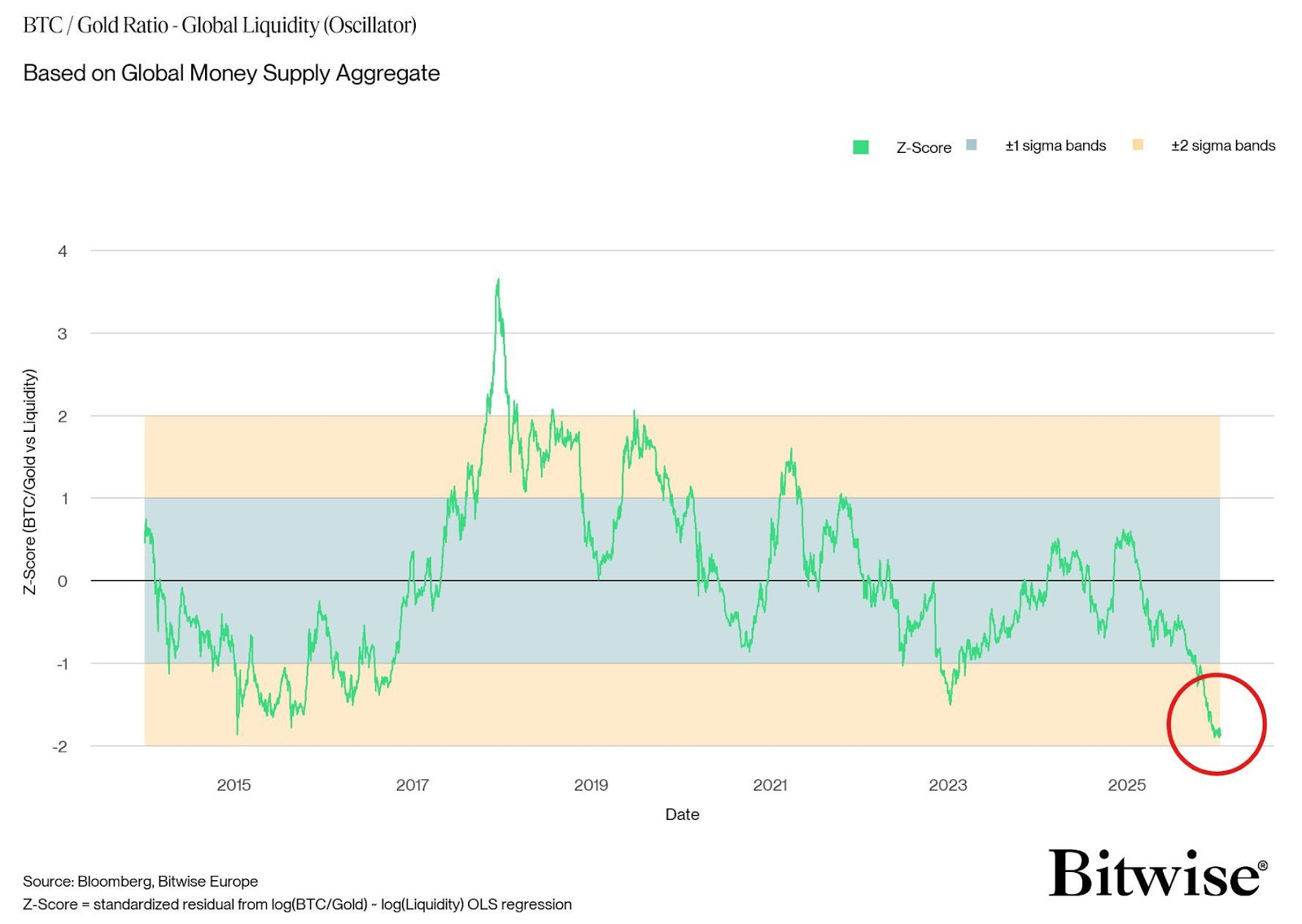
Data from Bitwise Europe shows that the price ratio of Bitcoin relative to gold has fallen to a historical low. This indicator has appeared multiple times in the past near the阶段性 bottoms of Bitcoin.

This implies two coexisting realities: on one hand, Bitcoin is currently weak relative to gold; on the other hand, this extreme weakness also leads some analysts to view the current environment as a potential accumulation zone similar to the pre-bull market launch period of 2015-2017.

The market widely observes that long-term holders are gradually absorbing recent selling pressure. As funds rotate between safe-haven assets and risk assets, some traders anticipate that a阶段性回流 from gold to Bitcoin may occur starting in February.

However, more cautious views point out that fund rotation is not inevitable and requires continuous observation of macro policy, dollar trends, and overall risk appetite changes.
Risk Transmission, Redistribution of Chips

The暴跌 in gold and silver ultimately transmitted to the crypto market. It must be said that the crypto market is now at the bottom of the food chain: when U.S. stocks rise, crypto may not rise; when U.S. stocks fall, crypto often falls deeper; and now, as precious metals fall, crypto cannot escape either. The crypto market seems to have fallen into a "follow declines but not rallies" curse.

In this situation, the "believers" long on crypto assets also seem to be losing their chips in this flood.

Garrett Bullish (@GarrettBullish), the lucky one who made the most profit in the 1011 flash crash, failed to escape this disaster. His position on Hyperliquid was fully liquidated, with a single liquidation规模 exceeding $700 million, leaving his account balance at just $53.68. This was also the largest single liquidation in this event. Data shows that his cumulative loss on Hyperliquid over the past two weeks was approximately $270 million.

On-chain records also show that since starting to use this account for trading in early October 2025, Garrett Bullish's historical cumulative PnL has lost over $128 million.
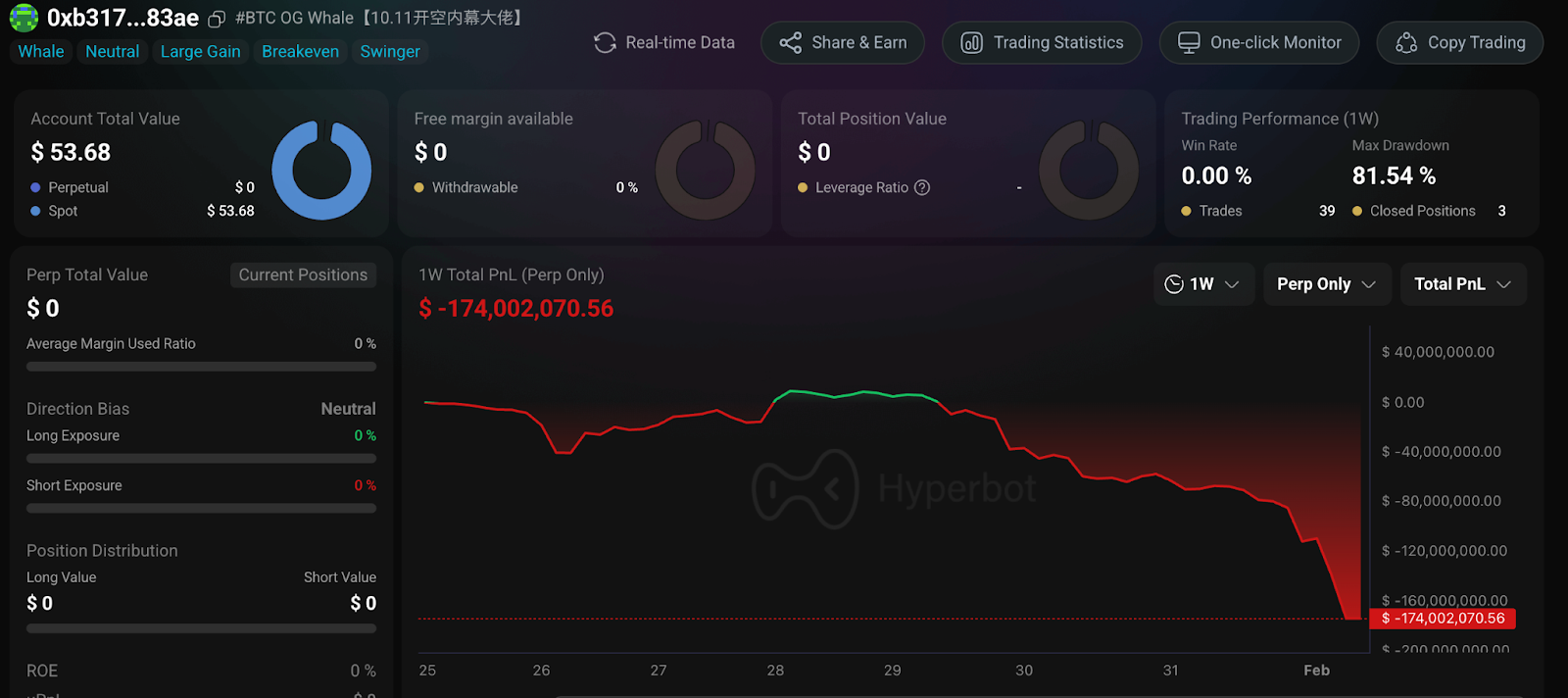
Behind the liquidations is protocol revenue. After Garrett Bullish's liquidation was completed, the Hyperliquid ecosystem treasury HLP gained approximately $15 million in收益. This single event brought HLP depositors a return of about 5.8%, translating to an annualized yield of about 110%. Data shows that HLP still holds an ETH long position worth approximately $230 million.

The whale高调做多 ETH also seems to be having a hard time. According to on-chain data monitoring, the secondary fund Trend Research under Yi Lihua has currently抵押 175,800 WETH on Aave V3, worth approximately $445 million, and borrowed about 274 million USDT. The liquidation price for the ETH position is $1,558, with a loan position health factor of 1.34. During the market decline, Trend Research continued to add margin. Yesterday, it withdrew approximately 109 million USDT from Binance and deposited it into Aave to reduce the liquidation risk of its Ethereum position.

As of January 29, Trend Research held approximately 651,300 ETH, with an average holding price of around $3,180. Calculated at the current price of $2,400, the floating loss is nearly $500 million.

Conclusion

From the升温 of geopolitical risks to the collapse of precious metals, crypto assets have become the first to be abandoned in this process. Does this indicate that it is not a safe-haven asset and has not yet truly gained the consensus support of a "value anchor,"只能 passively bearing pressure amidst the fluctuations of macro sentiment?

This round of market conditions is forcing the market to re-examine a question: In a deleveraging cycle, what justifies crypto assets being held long-term?


Questions liées

QWhat was the total amount of liquidation in the crypto market over the past 24 hours, and what was the breakdown between long and short positions?

AThe total liquidation amount was $2.522 billion. Of this, long positions accounted for $2.411 billion, while short positions accounted for $115 million.

QWhat external event, outside of the crypto market, is cited as the initial trigger for the market's downturn?

AThe initial trigger was a sharp escalation in geopolitical risk, marked by the US aircraft carrier USS Abraham Lincoln and its strike group entering a 'lights out' and communications blackout status, coupled with Iran shifting to a more combat-ready posture.

QAccording to the article, why did the prices of gold and silver crash, and how did this affect the crypto market?

AGold and silver prices crashed due to market reactions to reports that former President Trump would nominate the perceived hawkish Kevin Warsh as Federal Reserve Chair, which led to a repricing for a stronger dollar environment. This暴跌 (crash) in precious metals subsequently accelerated the失控 (loss of control) in the crypto market.

QWho was the individual trader that suffered the largest single liquidation in this event, and what was the approximate size of that liquidation?

AThe individual trader was Garrett Bullish (@GarrettBullish). The approximate size of his single liquidation on Hyperliquid was over $700 million.

QWhat does the article suggest about the current status of Bitcoin as an asset class based on its reaction to the broader market sell-off?

AThe article suggests that Bitcoin is not seen as a safe-haven asset and has not yet gained consensus as a 'store of value.' It is positioned at the 'bottom of the food chain,' often falling more deeply when other markets decline and failing to rise when they do, indicating it is passively bearing the pressure of macro sentiment shifts.

Lectures associées

Ce n'est pas Jensen Huang qui veut changer le PC, c'est le PC qui va faire sa propre révolution

L'industrie du PC, vieille de 40 ans, est en pleine transformation. En juin 2026, NVIDIA a lancé le super-puce RTX Spark pour PC Windows, marquant son entrée sur le marché des processeurs centraux. Soutenu par Microsoft et les principaux fabricants de PC, cet événement a officialisé la redéfinition de l'AI PC. Lors du Build 2026, Microsoft a repositionné Windows comme "plateforme native pour les agents d'IA locaux" et a présenté le Surface RTX Spark Dev Box. Jensen Huang a souligné que l'IA redessine l'industrie du PC, transformant l'ordinateur d'un outil passif en un assistant d'IA autonome capable d'exécuter des tâches en arrière-plan. Pourtant, le concept d'AI PC a été initialement lancé par Intel début 2026 avec ses processeurs Core Ultra de 3ᵉ génération. Le marché voit également l'arrivée de Qualcomm, AMD et Apple, signalant une tendance claire : l'IA migre massivement vers les dispositifs de calcul personnels. L'article retrace l'essor historique du duopole Wintel (Microsoft-Intel) qui a dominé l'industrie pendant des décennies, reléguant NVIDIA au rôle de fournisseur de composants. Le tournant est survenu avec les puces M d'Apple et la définition des "Copilot+ PC" par Microsoft en 2024, exigeant une puissance NPU minimale. Cependant, le manque d'applications IA locales tangibles a initialement freiné l'adoption. La stratégie de NVIDIA repose sur son écosystème. Avec 6 millions de développeurs CUDA, l'entreprise possède un avantage considérable en matière de logiciels. Le RTX Spark, une SoC intégrant CPU ARM, cœurs CUDA et mémoire unifiée, vise à porter cet écosystème sur PC portable, permettant l'exécution locale de grands modèles de langage. Trois signaux majeurs se dégagent : 1) Le PC passe d'une architecture centrée sur le CPU à une architecture centrée sur une SoC IA. 2) Il évolue d'un outil opéré par l'humain vers une plateforme de collaboration avec des agents IA autonomes. 3) La base massive de développeurs CUDA de NVIDIA trouve un nouveau support matériel grand public. Le succès dépendra du prix final, de la maturité de l'écosystème logiciel Windows sur ARM et de l'émergence d'applications phares pour les agents IA locaux. En définitive, la révolution est moins menée par un acteur spécifique que par la trajectoire inévitable de la technologie IA cherchant à s'intégrer au PC. Intel, avec ses processeurs Panther Lake, suit la même direction. Microsoft, en adaptant Windows, conserve un rôle pivot. L'ère de l'AI PC est ouverte, et l'industrie du PC est en train de se réinventer.

marsbitIl y a 45 mins

Ce n'est pas Jensen Huang qui veut changer le PC, c'est le PC qui va faire sa propre révolution

marsbitIl y a 45 mins

La SEC américaine envisage d'abroger une vieille règle de 2005 : que signifie-t-elle pour les actions tokenisées ?

Le 11 juin, la SEC américaine a proposé de supprimer les Règles 611 et 610(e) du Règlement NMS, une réforme potentielle de la structure des marchés traditionnels. La Règle 611, dite « trade-through rule », empêche les transactions d'ignorer les meilleures cotations disponibles sur d'autres plateformes. La SEC estime qu'elle est devenue moins nécessaire dans un marché désormais hautement automatisé, et qu'elle génère des coûts de conformité et une fragmentation excessive. La Règle 610(e) restreint les « cotations verrouillées » (prix d'achat égal au prix de vente) et « croisées » (prix d'achat supérieur au prix de vente). Sa suppression pourrait permettre des écarts de prix plus serrés, tout en réduisant la complexité des systèmes. Cette proposition est pertinente pour le monde de la tokenisation, car la SEC évoque explicitement les technologies de registre distribué et les contrats intelligents. En assouplissant ces règles conçues en 2005, la SEC pourrait ouvrir un espace pour des mécanismes de négociation plus innovants et compatibles avec des actifs tokenisés fonctionnant 24h/24. Cependant, cette réforme ne résout pas les défis réglementaires fondamentaux liés à la tokenisation des titres. La SEC estime que cette suppression pourrait générer des économies annuelles de 54 à 77 millions de dollars pour les acteurs du marché en réduisant les complexités induites par la réglementation.

Foresight NewsIl y a 2 h

La SEC américaine envisage d'abroger une vieille règle de 2005 : que signifie-t-elle pour les actions tokenisées ?

Foresight NewsIl y a 2 h

La transformation d'Ethena et l'anxiété de Wall Street

En juin 2026, le protocole de stablecoin Ethena a annoncé un partenariat stratégique avec le géant de la gestion d'actifs Janus Henderson. Cette collaboration marque une évolution majeure pour Ethena, qui se transforme d'un protocole DeFi natif en une entité intégrant des actifs financiers traditionnels de haut niveau. À l'origine connu pour son stablecoin USDe basé sur une stratégie delta-neutre (en utilisant des positions perpétuelles courtes pour couvrir des dépôts en cryptomonnaies), Ethena a dû réviser son modèle après que sa dépendance aux taux de financement des contrats perpétuels ait montré ses limites lors des ralentissements de marché. La plateforme a ensuite diversifié ses réserves, réduisant fortement l'exposition aux produits dérivés pour y inclure des fonds monétaires tokenisés (comme BUIDL de BlackRock), des obligations d'entreprise et, désormais via le partenariat, des fonds de CLO (Certificate of Loan Obligation) de Janus Henderson. USDe est ainsi devenu un stablecoin hybride, adossé à un mélange d'actifs cryptographiques et traditionnels (RWA). La coopération avec Janus Henderson est multidimensionnelle : intégration d'un fonds CLO dans les réserves de l'USDe, investissement de Janus Henderson dans le jeton de gouvernance ENA, utilisation de l'sUSDe (la version stakée) comme outil de gestion de trésorerie par le géant de l'asset management, et projet commun de développer des produits cotés en bourse (ETP) pour distribuer USDe et ENA à une clientèle institutionnelle. Cet engagement d'un acteur traditionnel de cette envergure reflète une "anxiété" stratégique de Wall Street face à la montée en puissance des stablecoins, devenus une couche de règlement essentielle. Face à une régulation clarifiée (loi GENIUS aux États-Unis) et à la concurrence d'autres grands noms (PayPal, banques), les institutions financières craignent de perdre le contrôle de l'accès aux clients et cherchent à sécuriser leur rôle dans les futures infrastructures financières en s'associant avec des protocoles innovants comme Ethena. Cette fusion croissante entre la finance traditionnelle et la finance décentralisée a pour cœur de bataille le marché des stablecoins.

Foresight NewsIl y a 2 h

La transformation d'Ethena et l'anxiété de Wall Street

Foresight NewsIl y a 2 h

Trading

Spot
Futures
活动图片