$15 Billion in Ammunition: What Is a16z Secretly Planning?

比推Publié le 2026-01-12Dernière mise à jour le 2026-01-12

Résumé

a16z (Andreessen Horowitz) has raised a record $15 billion in new funding, with a significant focus on cryptocurrency and AI as key future technologies. The funds are allocated across six main areas: American Dynamism, App, Bio + Health, Infrastructure, Growth, and Other Venture Strategies. The App, Infrastructure, and Growth funds are expected to drive most crypto investments, targeting application-layer projects, protocol-layer infrastructure, and mature platforms like exchanges. In 2025, a16z made 31 investments in crypto, emphasizing prediction markets (e.g., Kalshi), wallet services, privacy blockchains, stablecoins, and AI-crypto integrations. Looking ahead to 2026, a16z highlighted 17 key areas of interest, including privacy enhancements, prediction markets, stablecoin innovation, AI agents, decentralized communication, and tokenization of real-world assets. The firm aims to support groundbreaking solutions in these domains, leveraging its capital to advance the crypto ecosystem.

Source: Odaily Planet Daily

Author:Azuma(@azuma_eth)

Original Title: Following the Clues: What Will a16z, Armed with $15 Billion, Invest In?


On January 9, amidst a highly active cryptocurrency market, the venture capital giant Andreessen Horowitz (a16z) announced the completion of a new $15 billion fundraising round. This is the largest fundraising effort in the firm's history, accounting for over 18% of the total venture capital raised in the U.S. in 2025.

In the relatively short official announcement, a16z mentioned cryptocurrency twice. The most critical statement, "Our mission is to ensure that America wins the technology competition for the next 100 years, which begins with winning the key architectures of the future—artificial intelligence and cryptocurrency technology," indicates that a16z, now well-supplied, will continue to actively deploy in the cryptocurrency market.

Breakdown of the Six Major Directions

According to a16z's plan, this batch of funds will be allocated to six major directions: the American Dynamism fund is allocated $1.176 billion, the App fund $1.7 billion, the Bio + Health fund $700 million, the Infrastructure fund $1.7 billion, the Growth fund $6.75 billion, and the Other Venture Strategies fund $3 billion.

Although a16z did not explicitly designate a dedicated cryptocurrency fund in this fundraising, these six directions actually have significant overlap with the cryptocurrency space.

First is the American Dynamism fund. This is a direction with a clear "political" focus that a16z has been promoting in recent years. Its core goal is to use venture capital to rebuild America's "hard power" and national competitiveness. The fund will primarily invest in aerospace, defense, public safety, education, housing, supply chain, industry, and manufacturing. Objectively speaking, this fund has little crossover with cryptocurrency.

Second is the App fund. This is one of a16z's most traditional and VC-centric funds. Its core goal is to focus on application-layer products that can be used directly by users. The fund will mainly invest in consumer internet products, AI applications, creator tools, social products, content services, gaming, fintech, and Web3 applications, among others. This is the direction where a16z's cryptocurrency narrative is most easily realized.

Next is the Bio + Health fund. This is a16z's long-term bet outside "pure technology." Its core goal is to transform the life sciences and healthcare systems using software, data, and engineering thinking. The fund's main investment areas include biotechnology, drug development platforms, gene editing, synthetic biology, medical data and AI diagnostics, and healthcare infrastructure software. There is little direct overlap with cryptocurrency here, but DeSci could be a potential intersection point.

The Infrastructure fund focuses on infrastructure. Its core goal is to provide an indispensable technical foundation for the next generation of applications and platforms. The fund's main investment areas are cloud computing and distributed systems, AI infrastructure, data platforms, developer tools, network protocols, and blockchain underlying protocols (L1, L2, other tools). This is another core battleground for a16z in the cryptocurrency space, alongside the App fund.

The Growth fund primarily invests in Series C and later stages, as well as Pre-IPO stages. Its core goal is not to find new opportunities but to amplify returns by supporting proven winners. The fund mainly invests in mature tech companies, AI platforms, fintech unicorns, and mature Web3 infrastructure or applications. Information on a16z's official website shows that Coinbase and Kalshi are explicitly categorized under this fund.

The Other Venture Strategies fund is relatively special. It does not have a single theme but acts more like a flexible "tactical capital pool," often used for special structure transactions, cross-fund collaborative investments, emerging field experimentation, secondary market opportunities, regional or thematic experimental funds, etc. This fund has little direct crossover with cryptocurrency, but it cannot be ruled out that temporary associations may occur at special junctures, such as responsive moves during certain policy windows.

Looking at the six intended directions for this $15 billion, the App fund, Infrastructure fund, and Growth fund will be the main channels for a16z to inject capital into the primary cryptocurrency market. Among them, the App fund and Infrastructure fund will focus more on native application-layer and protocol-layer projects in the cryptocurrency market, respectively. The Growth fund will focus more on platform-type services like exchanges and prediction markets, with investments tending toward leading players in sectors that have already shown advantages.

a16z's Investment Review for 2025

According to incomplete statistics from Odaily Planet Daily, a16z made 31 investments in the broader cryptocurrency field over the past year, with two investments each in prediction market Kalshi, AI security company Doppel, and privacy blockchain Seismic. Particularly for Kalshi, a16z first co-led a $300 million Series D funding round for the company in October with Sequoia, at a valuation of $5 billion; it then invested again in November, participating in the company's $1 billion Series E round at a valuation of $11 billion. This was a16z's biggest bet in the cryptocurrency space last year.
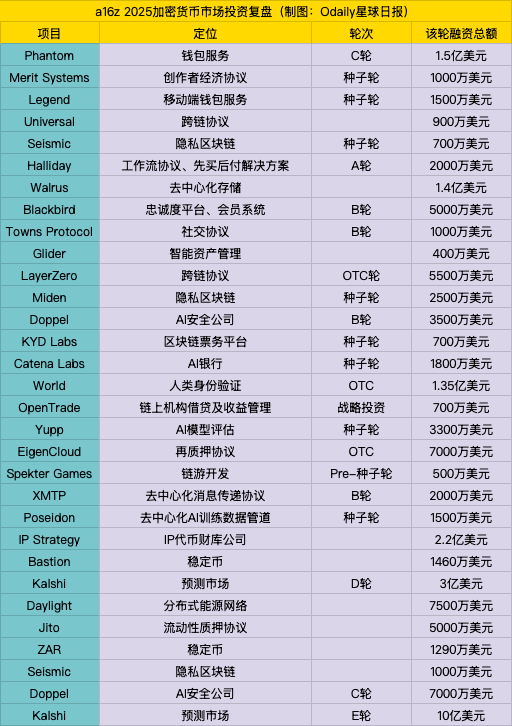
As can be seen from the statistics in the chart above, aside from the heavy bet on prediction markets, wallet services, privacy blockchains, stablecoins, and the intersection of AI and cryptocurrency were the focus of a16z's布局 in 2025. These sub-sectors can be classified under the blockchain underlying protocols and tools covered by the Infrastructure fund, as well as the fintech and AI applications covered by the App fund.

a16z's Predictions for 2026

On New Year's Day 2026, a16z Crypto officially published a New Year's outlook article. In the article, a16z mentioned 17 potential developments it is excited about for 2026, which may hint at the focus areas for the firm's future investments.
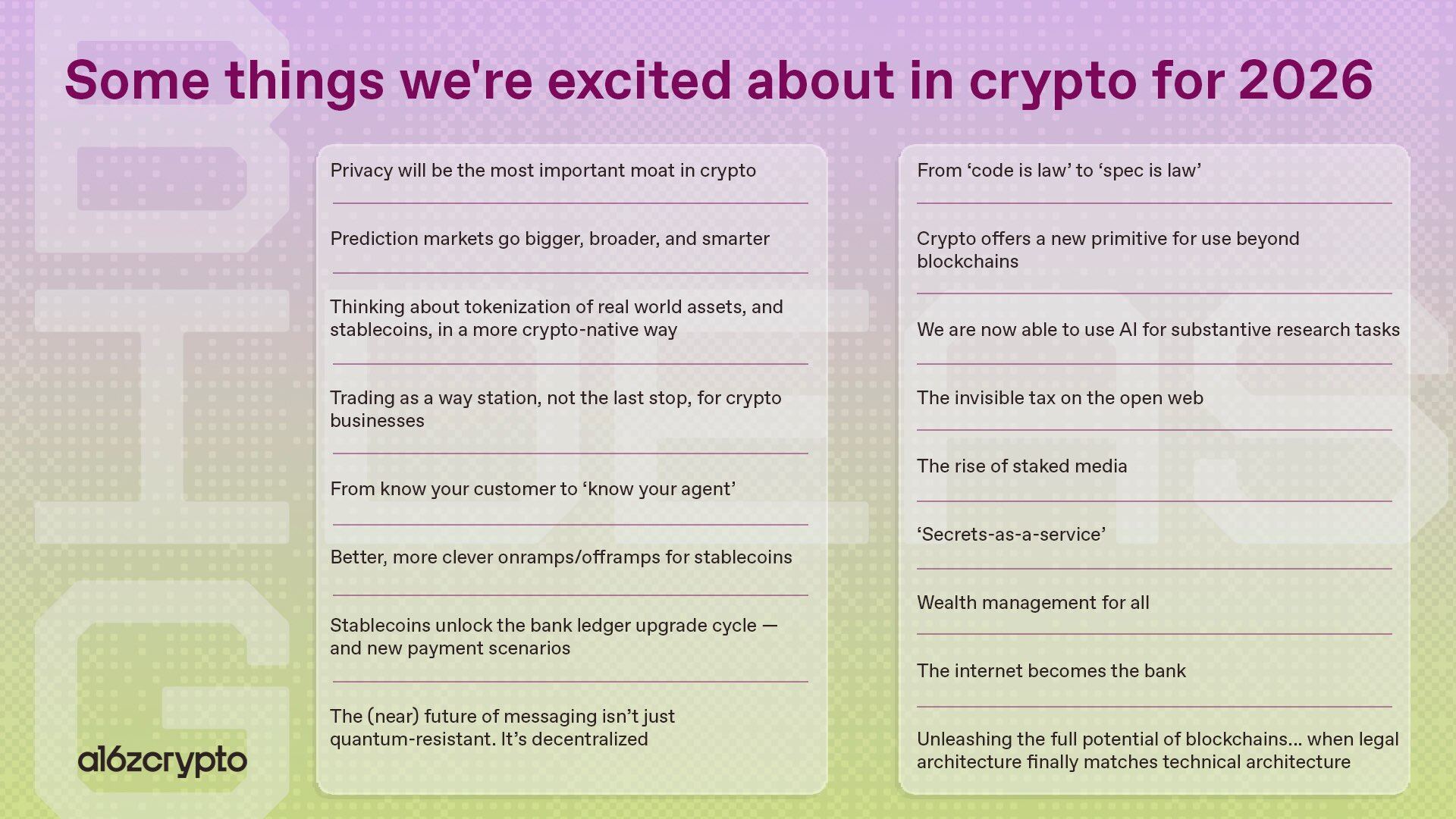
These 17 potential developments are:

  • Privacy will become the most important moat in crypto;

  • Prediction markets will become bigger, broader, and smarter;

  • Thinking more "crypto-natively" about real-world asset tokenization and stablecoins;

  • Trading is just a waystation, not the destination, for crypto businesses;

  • From "Know Your Customer" (KYC) to "Know Your Agent";

  • Better, smarter on-ramps and off-ramps for stablecoins;

  • Stablecoins will kick off a bank ledger upgrade cycle and enable new payment scenarios;

  • The future of instant messaging is not just quantum-resistant, it's decentralized;

  • From "code is law" to "norms are law";

  • Crypto is providing new kinds of foundational primitives that can be used beyond blockchains themselves;

  • We can now use AI to perform substantive research tasks;

  • The "invisible taxes" of the open internet;

  • The rise of Staked Media;

  • "Secrets-as-a-Service";

  • Wealth management for everyone;

  • The internet is becoming the bank;

  • When the legal framework finally matches the technical framework, the full potential of blockchains will be unlocked.

Among these 17 potential developments, some explicitly mention specific business models, including the sectors a16z has already heavily invested in, such as privacy, prediction markets, stablecoins, and AI. a16z also directly suggests optimization paths for these models, such as the need for smarter on-ramp and off-ramp solutions for stablecoins.

At the same time, other potential developments belong to imaginings of future states, such as the internet eventually becoming the bank. However, how these imaginings will be realized is not clearly answered by a16z. This question is left for entrepreneurs who can bring innovative solutions, and they are precisely the targets that a16z's $15 billion is most eager to find.


Twitter:https://twitter.com/BitpushNewsCN

BitPush TG Discussion Group:https://t.me/BitPushCommunity

BitPush TG Subscription: https://t.me/bitpush

Original link:https://www.bitpush.news/articles/7601990

Questions liées

QWhat is the total amount of new funds raised by a16z, and what percentage of the total US venture capital in 2025 does it represent?

Aa16z raised $15 billion in new funds, which represents over 18% of the total US venture capital in 2025.

QWhich two key technologies did a16z mention as critical for winning the future in their mission statement?

Aa16z mentioned artificial intelligence and cryptocurrency technologies as the key architectures critical for winning the future.

QWhich three funds from the $15 billion allocation are the main channels for a16z's cryptocurrency investments?

AThe App Fund, Infrastructure Fund, and Growth Fund are the main channels for a16z's cryptocurrency investments.

QWhat was the largest project a16z bet on in the cryptocurrency field in 2025, and what was its valuation in the E-round financing?

AThe largest project a16z bet on in 2025 was the prediction market Kalshi, which had a valuation of $11 billion in its E-round financing.

QAccording to a16z's New Year outlook article, what are two specific areas they are excited about for potential progress in 2026?

Aa16z is excited about privacy becoming the most important moat in crypto and prediction markets becoming larger, broader, and smarter in 2026.

Lectures associées

La narration du BTC en tant qu'« or numérique » a-t-elle échoué ?

**Résumé en français :** L'article aborde la récente chute brutale du Bitcoin (plus de 50% depuis son pic de 2025) pour explorer la solidité de son récit de "l'or numérique". L'auteur développe trois points principaux. **1. La nature de l'actif Bitcoin :** Il est présenté comme une catégorie d'actif nouvelle et potentiellement supérieure à l'or physique en raison de son plafond fixe (21 millions), de sa facilité de transfert et de sa traçabilité sur la blockchain. L'auteur souligne son stade encore précoce (taux de pénétration ~3-4%), similaire à Internet dans les années 2000, ce qui explique une volatilité extrême. **2. Comprendre la correction actuelle :** Cette chute est interprétée comme une vente cyclique prévisible post-halving (2024), amplifiée par un "grand transfert" historique. L'arrivée des ETF a permis aux investisseurs institutionnels d'entrer, incitant les premiers détenteurs (miners, early adopters) à réaliser leurs bénéfices. L'auteur note que l'amplitude des baisses historiques diminue (93% → ~50%), signe d'une maturation et d'une diversification des détenteurs. **3. Perspective à long terme :** Le potentiel est évalué par rapport à la capitalisation boursière de l'or (~20 000 Md$). Même si le Bitcoin n'en captait que 30 à 50%, sa valorisation actuelle (~1 400 Md$) laisse une marge de hausse significative. Le véritable risque n'est pas la disparition du Bitcoin, mais une mauvaise gestion de portefeuille (effet de levier, allocation excessive) ou un manque de conviction qui empêcherait de supporter les fortes volatilités. **Conclusion :** L'auteur compare cette phase à la chute d'Amazon après la bulle internet. La question n'est pas de savoir si le Bitcoin va augmenter, mais si l'investisseur a la structure et la conviction pour survivre aux turbulences. La divergence actuelle entre la performance de l'or et celle du Bitcoin refléterait moins un échec du récit qu'une période nécessaire de transition et de consolidation vers un actif de placement mature.

marsbitIl y a 29 mins

La narration du BTC en tant qu'« or numérique » a-t-elle échoué ?

marsbitIl y a 29 mins

Le récit du Bitcoin en tant qu'« or numérique » a-t-il échoué ?

L'auteur Jason propose un cadre de réflexion sur le bitcoin, en abordant trois points essentiels. Il voit le bitcoin comme un nouvel actif, une forme de « digital gold » supérieur sur le long terme : offre fixe à 21 millions d'unités, transferabilité facile et vérifiabilité totale via la blockchain. Comparant sa pénétration actuelle (3-4%) à celle d'internet ou du e-commerce à leurs débuts, il souligne son potentiel de croissance, tout en rappelant sa très grande volatilité inhérente à ce stade précoce. Concernant la récente forte baisse (de 126 000 $ à environ 61 000 $), il l'interprète comme une vente cyclique attendue après le pic post-réduction de moitié (« halving ») de 2024, et surtout comme un « grand transfert » historique des premiers détenteurs vers les nouveaux investisseurs institutionnels via les ETF. Il note que l'amplitude des corrections historiques diminue (de -93% en 2011 à -50% actuellement), signe d'une maturité croissante de l'actif. Sur le long terme, en comparant la capitalisation du bitcoin (environ 7% de celle de l'or), il estime que son potentiel de hausse reste important si le récit d'« or numérique » se réalise, même partiellement. Il met cependant en garde : le risque principal n'est pas que le bitcoin échoue, mais une mauvaise gestion du portefeuille (position trop importante, effet de levier) ou un manque de compréhension profonde de l'actif, qui pourraient forcer une sortie prématurée lors des fortes corrections. La clé, comme pour Amazon après l'éclatement de la bulle internet, est de « survivre » assez longtemps pour bénéficier de la tendance à long terme.

链捕手Il y a 40 mins

Le récit du Bitcoin en tant qu'« or numérique » a-t-il échoué ?

链捕手Il y a 40 mins

Du code à la cognition : un guide de dix mille mots sur l'évolution du cerveau robotique

Auteur: Matt White, CTO AI mondial de la Linux Foundation. Compilé par: Felix, PANews. Cette longue exploration retrace l'évolution de l'intelligence des robots, des systèmes classiques codés à la main aux approches modernes fondées sur l'IA. **L'ère pré-LLM** était dominée par une pile logicielle modulaire (perception, estimation d'état, planification, contrôle) et des arbres de comportement, prévisible mais peu adaptable. **L'apprentissage automatique** a ensuite révolutionné la perception (réseaux neuronaux) et le contrôle (apprentissage par renforcement, imitation), mais chaque compétence restait étroite et spécifique. **L'avènement des LLM** a introduit un planificateur en langage naturel, capable de décomposer une instruction en séquences d'actions atomiques exécutées par des contrôleurs existants (ex: SayCan de Google). Le saut suivant fut les **modèles Vision-Langage-Action (VLA)**, comme RT-2 de DeepMind ou OpenVLA. Ces réseaux de neurones unifiés fusionnent flux visuel et instruction linguistique pour générer directement des commandes motrices, couplant raisonnement et action. Les architectures les plus performantes, comme le GR00T de NVIDIA ou Helix de Figure AI, adoptent une **stratégie à "deux cerveaux"** : un système 2 lent (VLA, ~7-9 Hz) pour la réflexion et un système 1 rapide (~200 Hz) pour l'exécution réactive, avec parfois un système 0 réflexe pour l'équilibre. Les calculs critiques s'exécutent localement (ex: sur module NVIDIA Jetson) pour la latence et la fiabilité. **L'essor des modèles open-source** (OpenVLA, GR00T N1.7, π0) est crucial, permettant aux startups de raffiner des bases pré-entraînées avec leurs propres données, accélérant le développement et favorisant l'audit de sécurité. Cependant, des défis persistent : récupération après erreur, efficacité des données, généralisation entre corps robotiques, planification à long terme et raisonnement physique/spatial. C'est là qu'interviennent les **modèles du monde (World Models)**, comme NVIDIA Cosmos ou Meta V-JEPA 2. Ces réseaux prédisent les conséquences futures d'une action (simulant une vidéo). Ils permettent au robot d'évaluer mentalement plusieurs scénarios avant d'agir, améliorant la reprise, la généralisation et la planification. Différentes approches architecturales coexistent (diffusion de pixels, JEPA, modèles à actions latentes). L'acquisition de **données** (téléopération) reste un gouffre clé. La simulation (Isaac Sim) permet un entraînement massif. Les coûts matériels chutent rapidement (ex: robots humanoïdes à ~2500$). Les modes de défaillance des robots pilotés par LLM peuvent être étranges, nécessitant des contraintes de sécurité. En conclusion, l'intelligence robotique migre progressivement du code des ingénieurs vers des modèles apprenant le monde lui-même. Nous en sommes à une phase de progression constante (analogue à GPT-2 pour l'IA physique), promettant à terme des robots bien plus généraux et adaptatifs. La question évolue de "que peuvent-ils faire ?" vers "que devrions-nous leur faire faire ?".

marsbitIl y a 1 h

Du code à la cognition : un guide de dix mille mots sur l'évolution du cerveau robotique

marsbitIl y a 1 h

La bulle de l'IA est en train d'éclater

Le titre "La bulle de l'IA est en train d'éclater" reflète les discussions actuelles sur une potentielle surévaluation du secteur. Des figures comme Ray Dalio de Bridgewater évoquent une bulle "relativement élevée", tandis que Jensen Huang de NVIDIA souligne le potentiel de croissance de la demande en capacité de calcul. L'article compare cette situation à la bulle Internet des années 2000. Bien que celle-ci ait provoqué un krach, les infrastructures construites à l'époque (câbles sous-marins, réseaux) ont ensuite permis l'émergence de géants comme Amazon, Netflix ou le cloud. De même, les investissements massifs actuels dans l'infrastructure AI (data centers, refroidissement, énergie), estimés à 5 300 milliards de dollars d'ici 2030, pourraient jeter les bases d'une transformation durable. Un paradoxe clé est observé : le coût de l'intelligence artificielle s'effondre (baisse de >99,7% du coût par token entre 2023 et 2025), mais les dépenses des entreprises en cloud AI ont triplé. Ceci s'explique par la "Paradoxe de Jevons" appliquée à l'IA : une efficacité accrue et un coût réduit déclenchent une explosion de la demande et de nouveaux cas d'usage (agents autonomes, RAG, multimodale), intégrant l'IA dans tous les secteurs. La bulle se dégonfle déjà au niveau des startups sans réelle innovation. Le marché entre dans une phase de maturation où la valeur migre des dépenses d'investissement (CapEx) vers les applications qui optimisent les dépenses opérationnelles (OpEx). La consolidation est inévitable, éliminant les acteurs superficiels. En conclusion, comme pour Internet, une correction du marché est probable, mais elle nettoiera le terrain. Les investissements en infrastructure et la baisse radicale du coût de l'"intelligence" préparent l'avènement d'une ère où l'IA+ sera omniprésente, transformant fondamentalement tous les secteurs industriels. La bulle spéculative passera, mais l'élan de la productivité sous-jacente, lui, est bien réel.

链捕手Il y a 1 h

La bulle de l'IA est en train d'éclater

链捕手Il y a 1 h

Trading

Spot
Futures

Articles tendance

Comment acheter T

Bienvenue sur HTX.com ! Nous vous permettons d'acheter Threshold Network Token (T) de manière simple et pratique. Suivez notre guide étape par étape pour commencer votre parcours crypto.Étape 1 : Création de votre compte HTXUtilisez votre adresse e-mail ou votre numéro de téléphone pour ouvrir un compte sur HTX gratuitement. L'inscription se fait en toute simplicité et débloque toutes les fonctionnalités.Créer mon compteÉtape 2 : Choix du mode de paiement (rubrique Acheter des cryptosCarte de crédit/débit : utilisez votre carte Visa ou Mastercard pour acheter instantanément Threshold Network Token (T).Solde :utilisez les fonds du solde de votre compte HTX pour trader en toute simplicité.Prestataire tiers :pour accroître la commodité d'utilisation, nous avons ajouté des modes de paiement populaires tels que Google Pay et Apple Pay.P2P :tradez directement avec d'autres utilisateurs sur HTX.OTC (de gré à gré) : nous offrons des services personnalisés et des taux de change compétitifs aux traders.Étape 3 : stockage de vos Threshold Network Token (T)Après avoir acheté vos Threshold Network Token (T), stockez-les sur votre compte HTX. Vous pouvez également les envoyer ailleurs via un transfert sur la blockchain ou les utiliser pour trader d'autres cryptos.Étape 4 : tradez des Threshold Network Token (T)Tradez facilement Threshold Network Token (T) sur le marché Spot de HTX. Il vous suffit d'accéder à votre compte, de sélectionner la paire de trading, d'exécuter vos trades et de les suivre en temps réel. Nous offrons une expérience conviviale aux débutants comme aux traders chevronnés.

544 vues totalesPublié le 2024.12.10Mis à jour le 2026.06.02

Comment acheter T

Discussions

Bienvenue dans la Communauté HTX. Ici, vous pouvez vous tenir informé(e) des derniers développements de la plateforme et accéder à des analyses de marché professionnelles. Les opinions des utilisateurs sur le prix de T (T) sont présentées ci-dessous.

活动图片