Bitcoin’s recent tumultuous ride in the crypto market, marked by an alarming 4.11% drop that saw the price dip below $25,000, might be causing some market watchers and investors to break into a cold sweat.
Still, while fear permeates the cryptosphere, the world’s most successful tech CEOs remain unfazed, holding onto their bullish stances on Bitcoin’s future.
Bitcoin Dips Are Meant to Be Bought
On the heels of losing 1,060 points, Bitcoin plummeted from $25,850 to a low of $24,800. The sudden downswing sparked over $40 million in liquidations across perpetual future exchanges.
As regulatory oversight mounts, apprehension is surfacing among cryptocurrency enthusiasts worrying about an uncertain future.
Despite the brewing storm, tech industry stalwarts such as Michael Saylor, Tim Cook, Eric Schmidt, Jack Dorsey, and Elon Musk remain steadfast in their conviction that Bitcoin is still on its ascent.
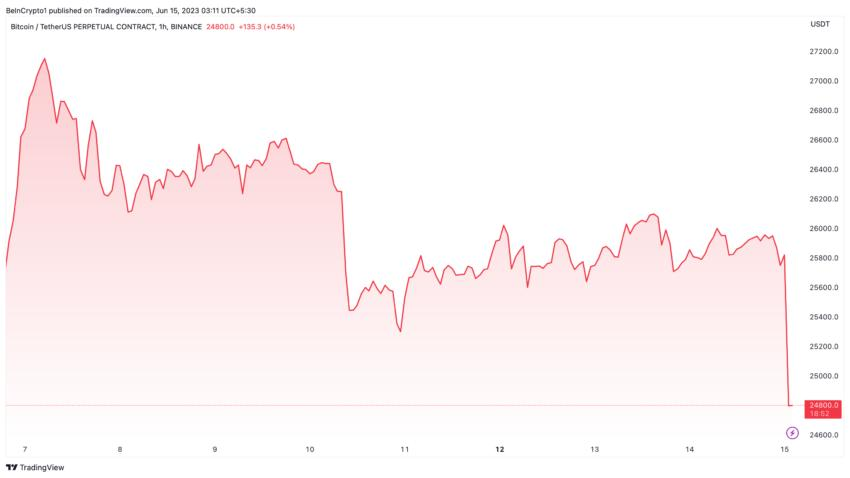
Bitcoin US Dollar PriceBitcoin US Dollar Price. Source: TradingView
MicroStrategy’s co-founder, Michael Saylor, continues to voice his bullish sentiment on Bitcoin. He recently stated that Bitcoin’s only path from the current price levels is “up.”
“Now I think the public is beginning to realize that Bitcoin is the next Bitcoin. The next logical step is for Bitcoin to 10x from here, and then 10x again. Eventually, I have confidence that the crypto exchanges will come round and realize that Bitcoin really is the dominant asset in this space,” said Saylor.
Although Saylor is known for his “maximalist” stance on Bitcoin, he is not the only tech CEO who remains bullish on Bitcoin.
Tech CEOs Understand Bitcoin’s Intrinsic Value
Apple’s CEO, Tim Cook, echoes Saylor’s perspective. Despite stating that he was not dispensing investment advice, Cook expressed his belief in Bitcoin’s place in a diversified portfolio. Therefore, revealing his ongoing interest in the pioneer cryptocurrency.
“I think it is reasonable to own Bitcoin as a part of a diversified portfolio… I have been interested in it for a while. And I have been researching it and, and so forth. And so I think it is interesting,” said Cook.
Meanwhile, Eric Schmidt, former CEO and chairman of Google, offered a slightly more tech-oriented perspective. He lauded Bitcoin’s unique and non-duplicable cryptographic feature as an “amazing advance.”
Thus, suggesting Bitcoin’s revolutionary ledger technology could be the foundation for many businesses.
“Bitcoin architecture, literally the ability of having these ledgers that cannot be replicated, is an amazing advance a lot of people build businesses on top of that,” said Schmidt.
On the other hand, Square’s CEO, Jack Dorsey, took a global perspective. He championed Bitcoin as a universally beneficial asset.
Dorsey stated that its global reach and accessibility have the potential to change the world and pledged to use his influence to ensure that potential is realized.
“I think Bitcoin benefits the entire world. I mean, what makes it incredible is like every single person in the world will benefit and get value from utilizing it. And the more accessible we make it, just that that realization that we finally have a currency that can be traded to any single point on the planet is pretty incredible,” said Dorsey.
Even Elon Musk, SpaceX’s CEO, well known for his forthright comments, came out to support Bitcoin despite voicing some environmental concerns about its energy-intensive proof of work. However, the billionaire tech magnate confirmed that he and Tesla have invested in Bitcoin and personally own some.
“I support Bitcoin… And the only significant thing going on outside of Tesla and SpaceX is Bitcoin, which both companies own Bitcoin. So apart from that, I do also own Bitcoin,” said Musk.
Be Greedy When Others Are Fearful
Despite the fear that the current dip in Bitcoin’s price has induced, it is evident from these tech CEOs’ stance that their faith in the potential of the digital asset is unshaken.
For these tech industry titans, Bitcoin’s temporary plunge does not detract from its long-term potential. They emphasize that it is not the current price but the intrinsic value of Bitcoin. Driven by Bitcoin’s technological prowess and global applicability is what keeps them bullish.
Crypto Market Sentiment Enters Fear StageCrypto Market Sentiment Enters Fear Stage. Source: Glassnode
Although the cryptocurrency market is no stranger to volatility, the chorus of supportive voices from these leading industry figures could provide a degree of reassurance for investors.
As these titans keep a watchful eye on Bitcoin’s trajectory, the question remains whether Bitcoin will rebound, when, and how high it might soar. For these tech leaders, the future of Bitcoin, despite its current dip, seems more promising than ever.






