Last week, Bitcoin Dominance (BTC.D) reached 49.2% for the first time since April 2021. As concerned investors continue from embattled altcoins, crypto exchanges have experienced an uptick in demand for Bitcoin. As the BTC price gains momentum, will it clear the $27,000 resistance?
The global altcoin market capitalization is now down 13% since the US Securities and Exchange Commission launched its lawsuit against Binance on June 5th.
Amid heightened volatility and uncertainty in the altcoin markets, crypto investors have reallocated capital to seek refuge in Bitcoin’s (BTC) censorship resistance qualities. Will this push BTC’s price above the critical $27,500 resistance?
Bitcoin Dominance Has Hit a Two-Year Peak
Since June 5, Bitcoin Dominance (BTC.D) has gained two percentage points to graze 49.30% for the first time in two years. BTC.D tracks the percentage of the total global cryptocurrency market valuation that is made up of Bitcoin’s market capitalization.
The chart below illustrates how BTC.D increased sharply from 47.21% on June 5 to 49.25% on June 12.
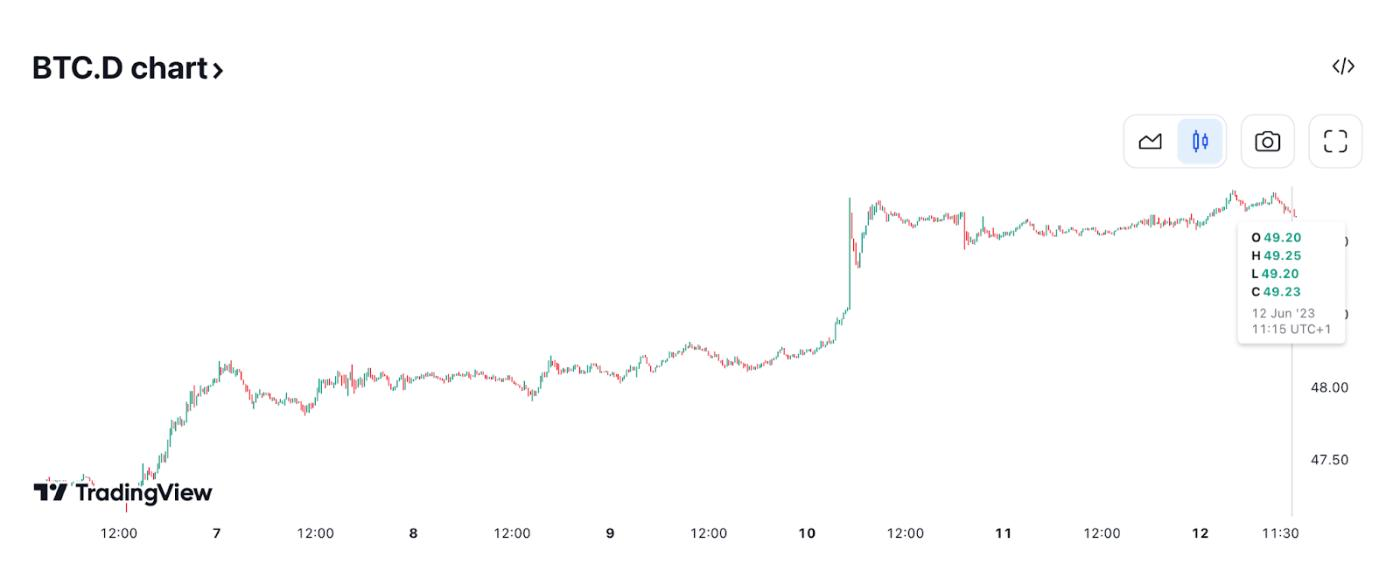
Bitcoin (BTC) Crypto Market Dominance, June 2023Bitcoin (BTC) Crypto Market Dominance, June 2023, Source: Trading View
A sharp rise in BTC Dominance indicates a shift in market sentiment and capital away from altcoins. BTC has gained the market as investors become less interested in altcoins.
Considering the 13% contraction of the altcoin markets within this period, it validates the hypothesis that crypto investors are increasingly selling off their altcoin holdings to purchase BTC.
Historically, BTC price has often witnessed a surge whenever a sudden spike in BTC.D occurs. This pattern will likely reoccur if altcoin prices continue to tank this week.
Hence BTC holders can expect more price upswing in the coming weeks.
Crypto Traders are Queuing Up More Buy Orders
In further confirmation of the bullish outlook, the order books of exchanges suggest that crypto traders are piling more orders to buy up more BTC. The Exchange On-Chain Market Depth chart shows an aggregate of the total buy/sell orders placed by Bitcoin traders across different crypto exchanges.
Currently, BTC traders have placed orders to purchase another 24,000 coins. Meanwhile, sellers have only put up 21,000 BTC for sale.
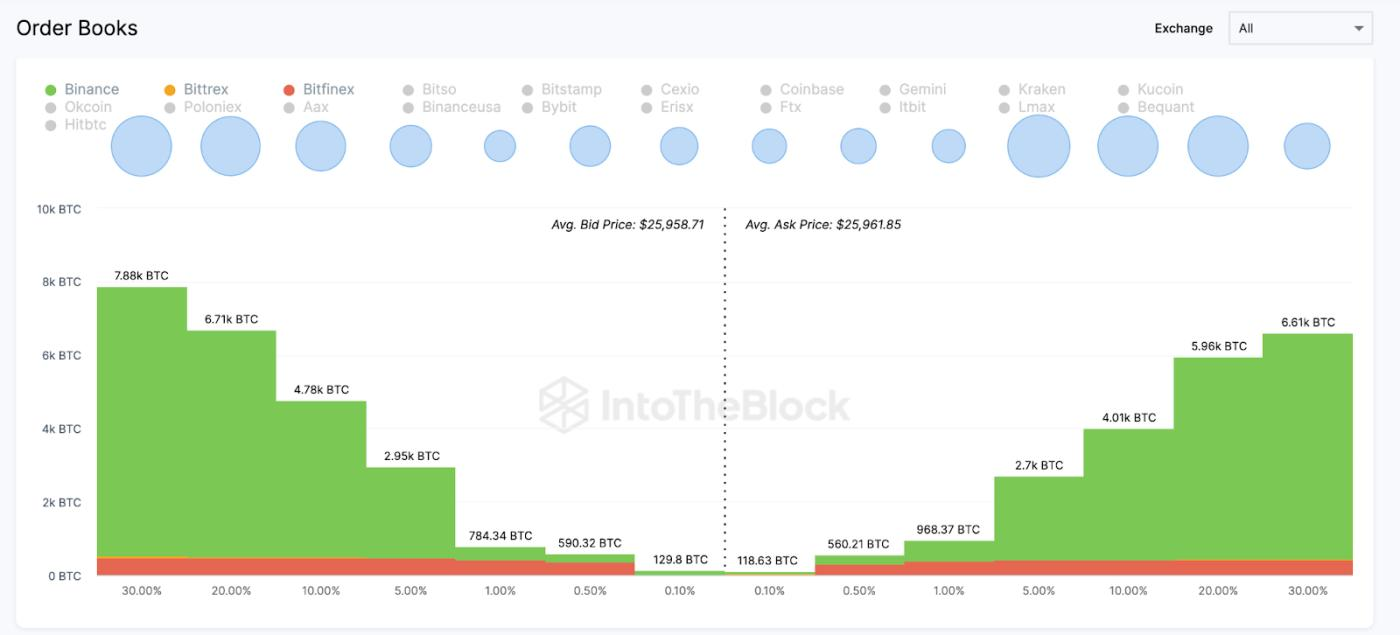
Bitcoin (BTC) Price Dominance, June 2023 - Aggregate Exchange Order BooksBitcoin (BTC) Price Dominance, June 2023 – Aggregate Exchange Order Books. Source: IntoTheBlock
When demand exceeds the supply available on exchanges, it puts upward pressure on price, and buyers begin to compete to get their orders filled.
Currently, there is a supply shortage of 3,000 BTC shortage across exchanges. This means BTC price will likely rebound once buyers begin to compete by increasing their bids to fill their orders quickly.
In conclusion, Bitcoin’s supply shortage and the growing uncertainty in the altcoin markets are two critical factors that could increase BTC price dominance in the coming weeks.
BTC Price Prediction: The $27,000 Resistance is Critical
Considering the growing concerns among altcoin investors, BTC prices will continue to dominate the charts and climb toward $29,000 in the coming weeks.
However, IntoTheBlock’s In/Out of The Money Around Price (IOMAP) data suggests BTC will face initial resistance around the $27,000 mark.
At that zone, two million investors that bought 866,000 BTC at the average price of $27,055 could trigger a pullback.
But if BTC manages to scale that resistance zone, it could make its way toward $29,000 again for the first time since April.
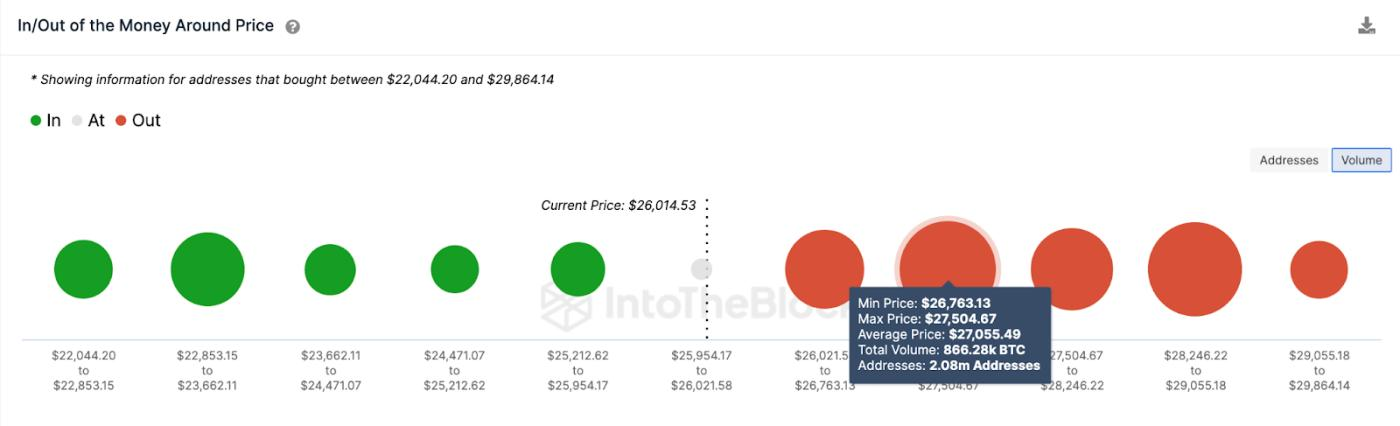
Bitcoin (BTC) Price Prediction, June 2023Bitcoin (BTC) Price Prediction, June 2023 – IOMAP. Source: IntoTheBlock
On the other hand, the bears could invalidate the bullish BTC price recovery if it unexpectedly drops below the critical $25,200 support zone.
But, the 350,000 investors that purchased 206,000 BTC at the minimum price of $25,212 will likely prevent the drop. Although unlikely, BTC could retrace further toward $23,500 if that support level cannot hold.
It is important to note that United States Fed will announce the next Interest Rate decision on June 14. Strategic whale investors may hold off on making large trades until then.