Coin Price Today May 22: Bitcoin closes for 3 consecutive weeks in the red, Altcoin and US stocks drop as traders continue to pay attention to debt ceiling negotiations

Tap Chi BitcoinPublié le 2023-05-22Dernière mise à jour le 2023-05-24

Résumé

Bitcoin continued to end the week in the red at $26,747, extending its three-week losing streak.
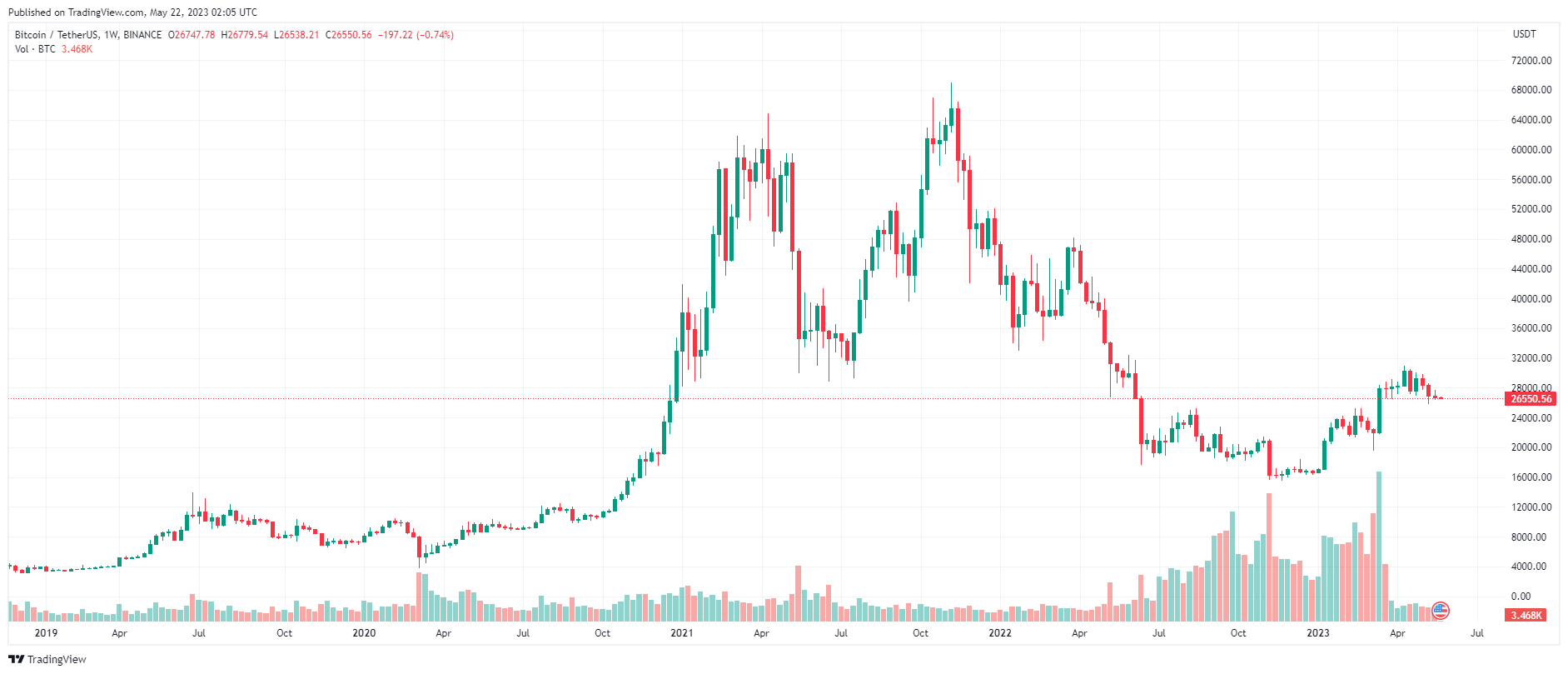
Bitcoin continued to end the week in the red at $26,747, extending its three-week losing streak.

BTC Price Chart – 1 week | Source: TradingView

Stock market futures fell slightly on Sunday evening as traders watched talks over the US debt ceiling.

Dow Jones futures contract fell 48 points, or about 0.1%. S&P 500 futures fell about 0.2% and Nasdaq 100 futures lost 0.1%.

Stocks rose last week despite uncertainty in Washington. The Nasdaq Composite rose 3.04%, while the S&P 500 gained 1.65% and the Dow inched 0.38%.

President Joe Biden and Speaker of the House, Kevin McCarthy, of California, will meet on Monday to continue negotiations. The Treasury Secretary, Janet Yellen, has said that the US could default on its debt as early as June 1.

The market continued to move higher, led by technology stocks, even in the face of potential defaults and persistent inflation. Bank of America strategist Savita Subramanian raised her year-end target for the S&P 500 to 4,300 from 4,000 to 4,300, saying that companies' focus on raising productivity would lead to more stable earnings and undervalued stocks. too high.

First-quarter earnings season is drawing to a close, with some notable reports in the coming days, including Zoom Video on Monday and Lowe's and Dick's Sporting Goods on Tuesday.

The coming week has a bunch of pretty important economic data, featuring first-quarter GDP on Thursday and a gauge of personal consumer spending inflation on Friday. The release of minutes from the US Federal Reserve's (Fed) meeting on Wednesday could also shed light on how central banks are thinking about the possibility of rate hikes.

Traders will also keep an eye on JPMorgan Chase's investment day on Monday.

In a recent tweet, Michael J. Kramer, a well-known market strategist, expressed concern about Bitcoin's ability to drop in price.

Kramer highlighted Bitcoin as the leading important indicator for risk assets in general and made predictions about a possible slide below the $20,000 mark.
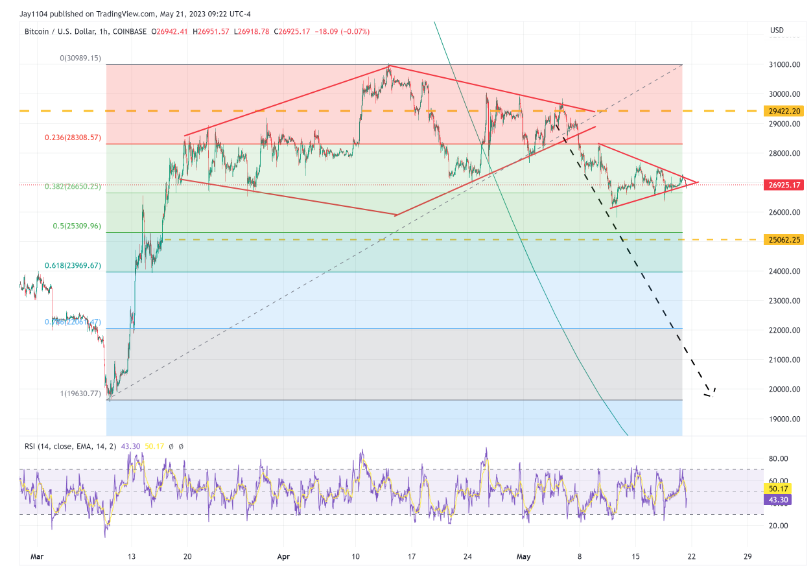
Source: Michael

A few days ago, Bitcoin struggled to break through the $27,000 level. Given these developments, Kramer's forecast for a sharp drop seems more likely.

The turmoil in the Bitcoin market coincided with dovish comments from the Chairman of the US Federal Reserve (Fed), Jerome Powell, as he hinted at the possibility that the central bank will ease a series of interest rate hikes. interest rates due to troubles in the banking sector.

An environment with such a relaxed monetary policy and low interest rates is often very favorable for risky assets, such as crypto. However, the current trend shows the opposite.

The link between Bitcoin's health and the performance of risky assets underscores the interconnectedness of cryptocurrencies and traditional markets. The chart shared by Kramer shows an uncertain future not only for Bitcoin but also for other risky assets.

The Altcoin market plunged as BTC turned around to fall around the $26,500 area this morning.

Memecoin Pepe (PEPE) led the decline, evaporating more than 10% in just 24 hours.

Many other projects are also in the red including SingularityNET (AGIX), Sui (SUI), Injective (INJ), GMX (GMX), Mask Network (MASK), Optimism (OP), Stacks (STX), MINA (MINA), ImmutableX (IMX)…
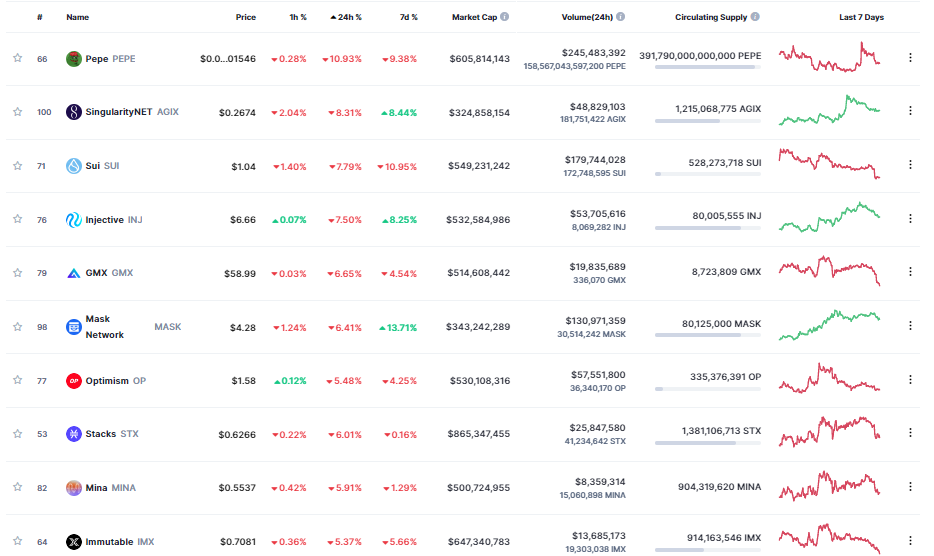
Source: Coinmarketcap

After several days of trying to hold the price above $1,800, Ethereum (ETH) has turned lower below this area and is currently hovering around $1,794, with a drop of over 1.5% on the day.
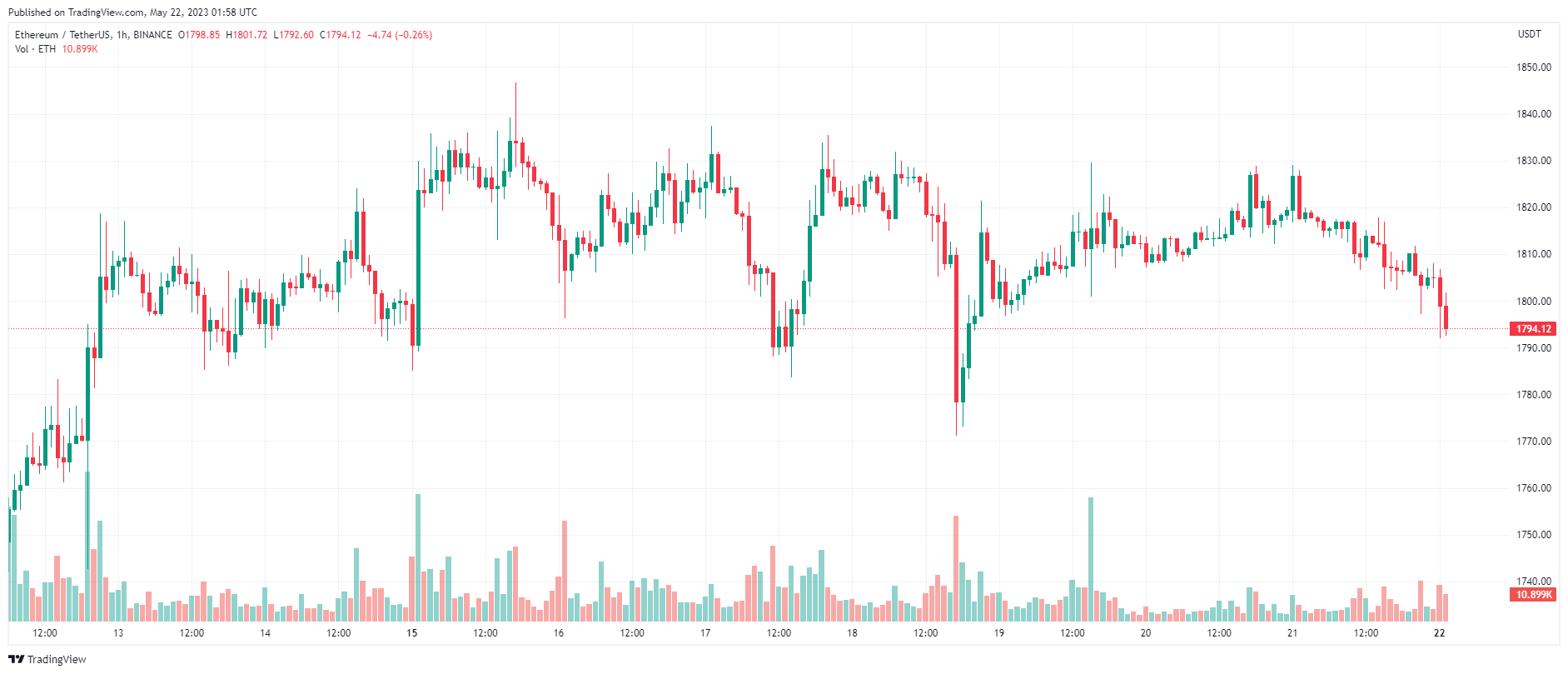
ETH price chart – 1 hour | Source: TradingView

The column “Coin Price today” will be updated at 9:00 daily with general market news, readers are welcome to follow.

Lectures associées

Investissement de marée : Nous restons optimistes quant à la chaîne industrielle de l'IA, mais pour des raisons différentes

**Résumé : L’investissement dans l’IA reste solide, mais les raisons ont changé** Malgré l’inquiétude du marché face aux méga-introductions en bourse (SpaceX, OpenAI) et aux levées de fonds massives des géants technologiques (Alphabet, Meta), ce n’est pas un signe de fin de cycle pour l’IA, mais plutôt le passage à un nouvel acte. Les dépenses d’investissement (Capex) des cinq grands fournisseurs de cloud (Alphabet, Amazon, Meta, Microsoft, Oracle) continuent d’augmenter fortement pour 2026, prouvant que les capitaux affluent toujours. La nature de ces investissements a changé : ils ne financent plus seulement les puces (GPU), mais toute l’infrastructure physique critique – électricité, transformateurs, refroidissement, raccordement au réseau – dont les goulots d’étranglement et les longs délais de construction rendent ce cycle d’investissement difficile à arrêter brusquement. Le marché s’inquiète de deux risques : 1) la croissance du Capex dépasse celle des revenus, menaçant la rentabilité (ROI), et 2) une répétition de la bulle internet de 2000. Cependant, contrairement à la surcapacité facile à créer en 2000 (fibre optique), les contraintes physiques et réglementaires actuelles limitent la surproduction. De plus, les cloud providers ont historiquement surmonté des phases de Capex élevé avant la rentabilité. Aucun signal concret (révision à la baisse des guides de Capex, annulations de commandes) ne pointe vers un arrêt imminent. Les besoins de financement actuels reflètent les défis croissants de la construction d’infrastructure, pas la fin de la course. L’histoire de l’IA est loin d’être terminée ; le scénario a simplement évolué.

marsbitIl y a 1 h

Investissement de marée : Nous restons optimistes quant à la chaîne industrielle de l'IA, mais pour des raisons différentes

marsbitIl y a 1 h

Investissement Tidal : Nous restons optimistes sur la chaîne d'approvisionnement de l'IA, mais les raisons ont changé

L'investisseur Tide Capital reste optimiste sur la chaîne industrielle de l'IA, mais la raison a changé. En 2026, la question n'est plus de savoir si l'IA est viable, mais si l'intensité des investissements peut être maintenue. Les géants du cloud (Alphabet, Amazon, Meta, Microsoft, Oracle) augmentent massivement leurs dépenses d'investissement (Capex) pour 2026, allant jusqu'à des centaines de milliards de dollars, dépassant la croissance de leurs revenus. Cela indique que le cycle d'investissement est loin d'être terminé. Les goulets d'étranglement se déplacent des puces vers des contraintes physiques plus lentes à résoudre : électricité, transformateurs, raccordement au réseau électrique (avec des délais de plusieurs années), refroidissement, etc. Les commandes pour ces composants explosent, signe d'un déploiement infrastructurel solide. Le marché s'inquiète de deux points : 1) Le Capex croît plus vite que les revenus, mettant en doute le retour sur investissement (ROI). Cependant, le cloud a historiquement surmonté de telles phases grâce à la monétisation à grande échelle. Aucun signe de ralentissement (révision des guidances, annulations de commandes) n'est visible pour l'instant. 2) Une bulle similaire à l'an 2000. La différence clé est que l'offre actuelle (infrastructure physique complexe) ne peut pas être suraugmentée aussi facilement que la fibre optique à l'époque, rendant un effondrement similaire improbable. En conclusion, les levées de fonds massives des géants reflètent les besoins de la phase suivante, plus exigeante en infrastructure, et non un sommet du cycle. La pièce de l'IA n'est pas terminée, le scénario a simplement changé.

链捕手Il y a 1 h

Investissement Tidal : Nous restons optimistes sur la chaîne d'approvisionnement de l'IA, mais les raisons ont changé

链捕手Il y a 1 h

Trading

Spot
Futures
活动图片