'Institutional demand' as large transactions on Cardano up 50X in 2022

CointelegraphPublié le 2022-03-30Dernière mise à jour le 2022-03-30

Résumé

Crypto intelligence firm IntoTheBlock reports that the number of large transactions on the Cardano blockchain has increased by more than 50X this year. 

Crypto intelligence firm IntoTheBlock reports that the number of large transactions on the Cardano blockchain has increased by more than 50X this year. 
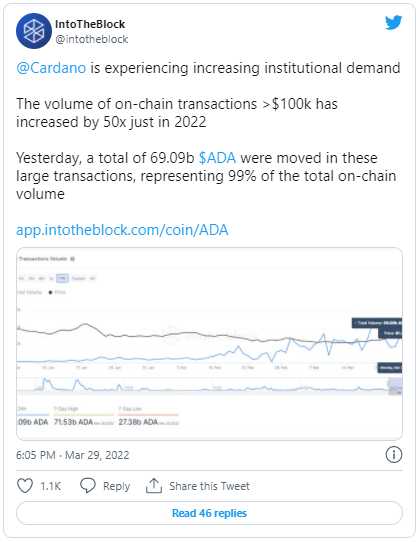
Large Transaction Volume (LTV) refers to aggregated volume from transactions denominated in Cardano’s native ADA token valued at more than $100,000. Since Jan. 1, LTV has increased from 1.35 billion ADA per day to 69 billion ADA (worth $81.4 billion) changing hands on Cardano on Mar. 28.
That’s a 51-fold increase in about three months and marks one of the highest volume levels since mid-2018, according to IntoTheBlock. In a Mar. 29 tweet, the firm said that such high volume indicates “increasing institutional demand.”
While other metrics such as average transaction size and volatility remain relatively stagnant according to the data analytics firm, total addresses have been increasing since the start of 2022. The year began with about 3.4 million addresses, which has now grown to 5 million. While only seven DApps appear on DeFi Llama currently, co-founder Charles Hoskinson said many more are expected following due to a hard fork expected mid year.
Total value locked (TVL) is currently at $303 million according to DeFi app tracker DeFiLlama, just shy of the $326 million all-time high set on Mar. 24.
Hoskinson gave a rousing keynote speech at Binance Blockchain Week in Dubai on Monday in which he spoke of the need for decentralization and the difficulties in coordination it entails. He said that “we are entering a new era,” with Web3 but the problem is that “unlike with Web2, there’s no leader” to make decisions for the industry.
“If we’re truly decentralized, we have to somehow come together and figure this out. We have to write some sort of constitution for these things; we have to decide ‘What is the Bill of Rights for the use of cryptocurrency and blockchain technology?’”
“There are two paths before us — one, we keep our integrity and we look to decentralization, find these things, understand these things,” he said. “Or, two, we ignore it. In which case we’ll have custodians, we’ll have escort keys, highly centralized, highly optimized consensus algorithms that can be reset at any time. The few will be in control of the many.
“This is the decision, and I don’t make that decision — all of you do.”


Lectures associées

Le véritable champ de bataille de l'IA se trouve dans la "Forêt sombre"

Le véritable champ de bataille de l'IA se situe dans la "forêt sombre". Alors que les modèles chinois comme SeeDance 2.0 (ByteDance), Kling 3.0 (Kuaishou) et HappyHorse (Alibaba) dominent désormais le domaine de la génération de vidéo par IA, surpassant même Sora d'OpenAI qui a été fermé, les entreprises américaines comme Anthropic se concentrent sur des domaines plus stratégiques et sensibles. Anthropic, avec son modèle Claude Mythos, a développé une capacité à découvrir et exploiter des vulnérabilités réseau, déclenchant des alertes à Wall Street et à Washington. OpenAI a répliqué avec GPT-5.4-Cyber. Cela marque un virage crucial : la course à l'IA ne concerne plus seulement le divertissement grand public (B2C), mais se déplace vers les outils de productivité d'entreprise (B2B) et la cybersécurité, un champ de bataille "en forêt sombre" où la suprématie numérique et la sécurité nationale sont en jeu. Les géants chinois excellent dans le B2C, intégrant l'IA dans leurs écosystèmes riches (comme Douyin) pour stimuler l'engagement des utilisateurs, un domaine où ils ont un avantage structurel. Cependant, le marché B2B chinois, moins développé et avec une culture de paiement différente, et le déficit significatif en puissance de calcul (les États-Unis détiennent environ 75 % de la capacité de calcul IA de pointe) rendent difficile une compétition frontale dans les domaines hautement stratégiques comme la cybersécurité. La voie recommandée pour la Chine est une guerre asymétrique : renforcer les capacités en codage (comme le fait GLM-5.1 de Zhipu AI), adapter les modèles aux puces domestiques et chercher des débouchés commerciaux auprès des clients gouvernementaux et dans les marchés émergents. Dans cette "forêt sombre" de la cybersécurité, ne pas posséder ces capacités avancées revient à être une proie potentielle.

marsbitIl y a 39 mins

Le véritable champ de bataille de l'IA se trouve dans la "Forêt sombre"

marsbitIl y a 39 mins

Trading

Spot
Futures
活动图片