How a single copy-paste mistake cost a user $50M in USDt

cointelegraphPublished on 2025-12-20Last updated on 2025-12-20

Abstract

A user lost nearly $50 million in USDt in an address poisoning scam after mistakenly copying a malicious look-alike address from their transaction history. The scam works by attackers sending small transactions to a victim's wallet using addresses that closely resemble those of the victim's trusted contacts. In this case, the victim first sent a small test transaction to the correct address but then copied a fraudulent, similar-looking address for the full $50 million transfer. Onchain investigators noted the addresses shared the same first three and last four characters, a subtle similarity that can deceive even experienced users. The stolen funds were subsequently swapped for Ether and partially laundered through Tornado Cash. This incident highlights how such attacks exploit human error rather than technical vulnerabilities. The loss occurred amid a broader surge in crypto hacks, which reached $3.4 billion in losses in 2025.

A single transaction error led to one of the largest onchain losses seen this year, after a user mistakenly sent nearly $50 million in USDt to a scam address in a classic address poisoning attack.

According to onchain investigator Web3 Antivirus, the victim lost 49,999,950 USDt (USDT) after copying a malicious wallet address from their transaction history.

Address poisoning scams rely on look-alike wallet addresses being inserted into a victim’s transaction history via small transfers. When victims later copy an address from their transaction history, they may unknowingly select the scammer’s lookalike address instead of the intended recipient.

Onchain data shows the victim initially sent a small test transaction to the correct address. Minutes later, however, the full $50 million transfer was sent to the poisoned address.
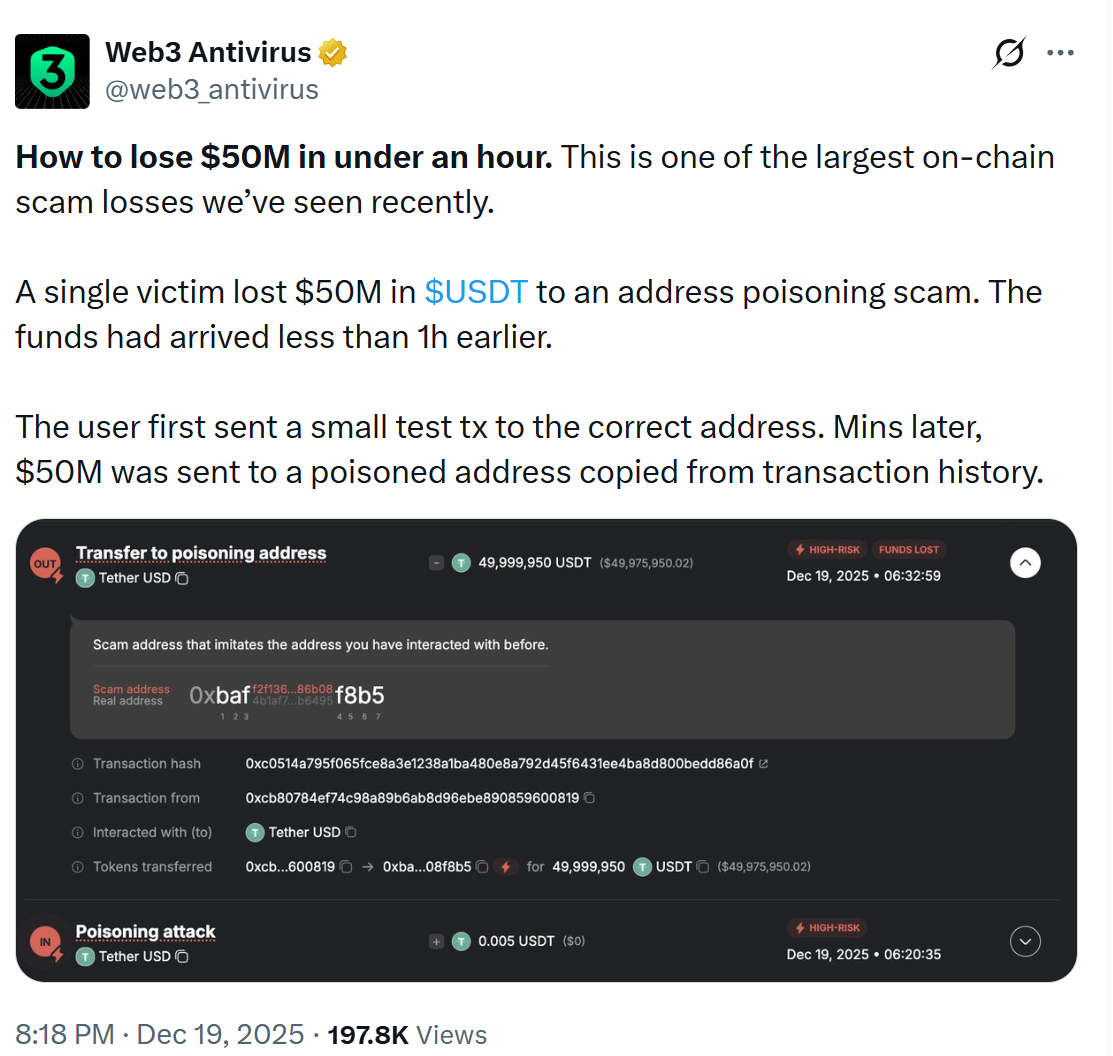
User falls victim to address poisoning scam. Source: Web3 Antivirus

Related: Attacker takes over multisig minutes after creation, drains up to $40M slowly

Subtle address similarity enough to fool experienced users

Security researcher Cos, founder of SlowMist, noted the similarity between the addresses was subtle but enough to deceive even experienced users. “You can see the first 3 characters and last 4 characters are the same,” he wrote.

The victim’s wallet had been active for roughly two years and was primarily used for USDt transfers, according to onchain analysis. Shortly before the loss, the funds were withdrawn from Binance, suggesting the wallet was being actively managed at the time of the incident.

“This is the brutal reality of address poisoning, an attack that doesn’t rely on breaking systems, but on exploiting human habits,” another onchain analyst wrote.

The attacker has since swapped the stolen USDt for Ether (ETH), splitting it into multiple wallets, and partially moved it into Tornado Cash.

Related: Binance denies reports of delayed action over funds linked to Upbit hack

Crypto hacks hit $3.4 billion in 2025

As Cointelegraph reported, crypto-related hacks resulted in $3.4 billion in losses in 2025, marking the highest annual total since 2022. The surge was largely driven by a handful of massive breaches targeting major crypto entities rather than a broad rise in average attack size.

Just three incidents accounted for 69% of total losses this year, led by the $1.4 billion hack of crypto exchange Bybit, which alone made up nearly half of all stolen funds.

Magazine: 2026 is the year of pragmatic privacy in crypto — Canton, Zcash and more

Related Questions

QWhat is an address poisoning scam and how did it lead to a $50 million loss?

AAn address poisoning scam is a type of attack where a scammer sends a small transaction to a victim's wallet using a look-alike address. The victim, when later copying an address from their transaction history, may accidentally select the scammer's fraudulent address instead of the legitimate one. In this case, the user mistakenly sent $50 million in USDt to the poisoned address.

QWhat detail did the security researcher from SlowMist point out about the fraudulent address?

AThe security researcher, Cos from SlowMist, noted that the similarity between the legitimate and the fraudulent address was very subtle. He pointed out that the first 3 characters and the last 4 characters of the two addresses were identical, which was enough to deceive even experienced users.

QWhat did the attacker do with the stolen USDt funds after the scam was successful?

AAfter successfully stealing the USDt, the attacker swapped the funds for Ether (ETH). They then split the ETH into multiple wallets and partially moved it into the privacy-focused mixing service, Tornado Cash.

QHow much was lost to crypto hacks in 2025 according to the article, and what was a major contributing factor?

AAccording to the article, crypto-related hacks resulted in $3.4 billion in losses in 2025. The surge was largely driven by a handful of massive breaches targeting major crypto entities, with just three incidents accounting for 69% of the total losses.

QWhat preliminary step did the victim take before sending the full $50 million, and why was it ineffective in preventing the loss?

AThe victim initially sent a small test transaction to the correct address. However, this was ineffective because the scammer's look-alike address was already in their transaction history from a previous, small 'poisoning' transfer. When the victim went to copy the address for the large transfer, they mistakenly selected the fraudulent one.

Related Reads

Written at the End of 2025: Code, Power, and Stablecoins

"Stablecoins have firmly established themselves as the foundational infrastructure for the next decade of financial services, with the market surpassing $300 billion in 2025. This growth is driven by a fundamental shift in trust: relying on transparent, verifiable code and math rather than opaque promises from centralized intermediaries, as starkly illustrated by the Synapse bankruptcy. Self-custody models change risk dynamics, eliminating intermediary risk (though not issuer risk) and reducing the necessity for traditional insurance like FDIC. Stablecoins offer inherent global reach, with the main bottleneck being local fiat on/off-ramps rather than rebuilding entire banking stacks per country. The emergence of payment-specific blockchains like Tempo and Arc faces the challenge of building trust from scratch, competing with the established security of networks like Solana and Ethereum. The real potential of 'agentic finance' lies in automating mundane financial tasks through smart contracts with enforced permission boundaries, providing security that traditional systems cannot. However, the rapid growth attracts teams with inadequate security practices, a critical misstep for financial infrastructure. Furthermore, as real business activity moves on-chain, solving for privacy through selective disclosure—not full anonymity—becomes crucial to prevent competitive intelligence leaks. The true opportunity lies not just in rebuilding existing fintech more efficiently but in leveraging programmable money and internet-native capital markets to reimagine financial services entirely."

marsbit43m ago

Written at the End of 2025: Code, Power, and Stablecoins

marsbit43m ago

(51/52) Weekly Market Watch | 5th Week of December | The Final Week of Tax-Loss Harvesting

**Weekly Market Watch: 5th Week of December - The Final Week of Tax-Loss Harvesting** **Market Overview & Key News:** The final week of December saw increased market volatility due to the holiday period and the expiration of major options contracts, though a clear directional trend was absent. Bitcoin closed the week nearly flat, with a marginal gain of 0.55%, while trading volume hit its lowest weekly level since July. Normal trading activity and liquidity are expected to resume after the New Year. **Macro Outlook: Strategic Commodity Clash** A significant development was China's announcement that, starting January 1, 2026, it will require special permits for white silver exports. This move is anticipated to have a major impact on global metal supply chains. In the US, October durable goods orders fell 2.2%, worse than the expected -1.5%. However, Q3 GDP growth was revised up to a strong 4.3%, significantly higher than the forecasted 3.3%, indicating resilience in consumer spending, exports, and government expenditure. **Key Upcoming Economic Event:** * December 31st, 3:00 AM EST: Release of the FOMC Meeting Minutes. **Weekly Crypto Roundup:** * **Institutional Moves:** Morgan Stanley is reportedly exploring offering crypto trading services (including spot and derivatives) to its institutional clientele. A major Russian bank executed the country's first crypto-backed loan, providing funds to a Bitcoin miner. * **Exchange Developments:** Coinbase announced the acquisition of The Clearing Company to enhance its prediction market products, with the deal expected to close in January 2026. Kraken also revealed plans to enter the prediction market arena, targeting a 2026 launch. * **Adoption:** Travel giant Trip.com has integrated stablecoin payments, allowing global users to book travel services with digital assets. * **Corporate Holdings:** MicroStrategy added $748 million to its reserves, bringing its total cash holdings to $2.19 billion. It also holds 671,288 BTC. **Layer 1 & Layer 2 Networks:** * The Solana Foundation launched Kora, an audited fee relayer and signature node for gas-free and secure remote transactions. * Major payment processor Shift4 has launched stablecoin settlement on the Polygon network. * Spire Labs deployed the first Base-based appchain on Celo, utilizing "human proofs" for privacy. * Flow Network suffered an exploit on its execution layer, resulting in a $390k loss. **Dapps & DeFi:** * **New Features:** Hyperliquid launched Perpetual Portfolio Margin on its mainnet. Polymarket is prioritizing the development of its own L2 network. Kamino Finance launched PRIME, a new yield-bearing asset on Solana. * **Expansions:** GMX is now live on Ethereum mainnet. Maple Finance facilitated its largest single loan of $500M USDC. * **New Platforms:** F(x) Protocol launched FX100 Perp, a new perp DEX with high leverage and non-liquidatable positions. * **Integrations:** Resolv expanded its assets for arbitrage trading. Hinkal Protocol partnered with Resolv Labs for private trading. Mellow Protocol integrated vaults from Fluid and Resolv. **Governance & Upcoming Alpha:** * A proposal for Aave DAO to take control of the Aave brand assets was rejected. * The Uniswap community passed the "Unification" proposal, which will burn 1 billion UNI and activate a fee switch. * LayerZero's third fee switch vote did not reach quorum, meaning protocol fees will remain off for at least another six months. * The Bitcoin community is debating the potential threat of quantum computing, with BIP-360 proposed to implement anti-quantum signatures. **Token Unlocks:** A significant number of tokens are scheduled for unlocks in early January, including: * EIGEN (Jan 1, 7.52% of supply) * LINEA (Jan 10, 6% of supply) * BB (Jan 13, 10.9% of supply) * ZKC (Jan 15, 6.71% of supply) ...among several others.

marsbit1h ago

(51/52) Weekly Market Watch | 5th Week of December | The Final Week of Tax-Loss Harvesting

marsbit1h ago

Trading

Spot
Futures

Hot Articles

Discussions

Welcome to the HTX Community. Here, you can stay informed about the latest platform developments and gain access to professional market insights. Users' opinions on the price of A (A) are presented below.

活动图片