I. Project Background and Introduction
Larry Fink, the CEO of BlackRock, believes that tokenization is the future of finance and the next step in market evolution. His stance is likely to influence other major financial players. As highlighted in our previous research on Dusk Network, Real World Assets (RWAs) are becoming a significant asset class in the cryptocurrency industry. As of May 2024, the RWA market has surpassed $6.6 billion, reflecting investors' growing interest in this innovative financial product. Tokenizing RWAs and introducing them to the blockchain can offer yield opportunities within decentralized finance (DeFi), with the asset tokenization market projected to reach $10 trillion by 2030.
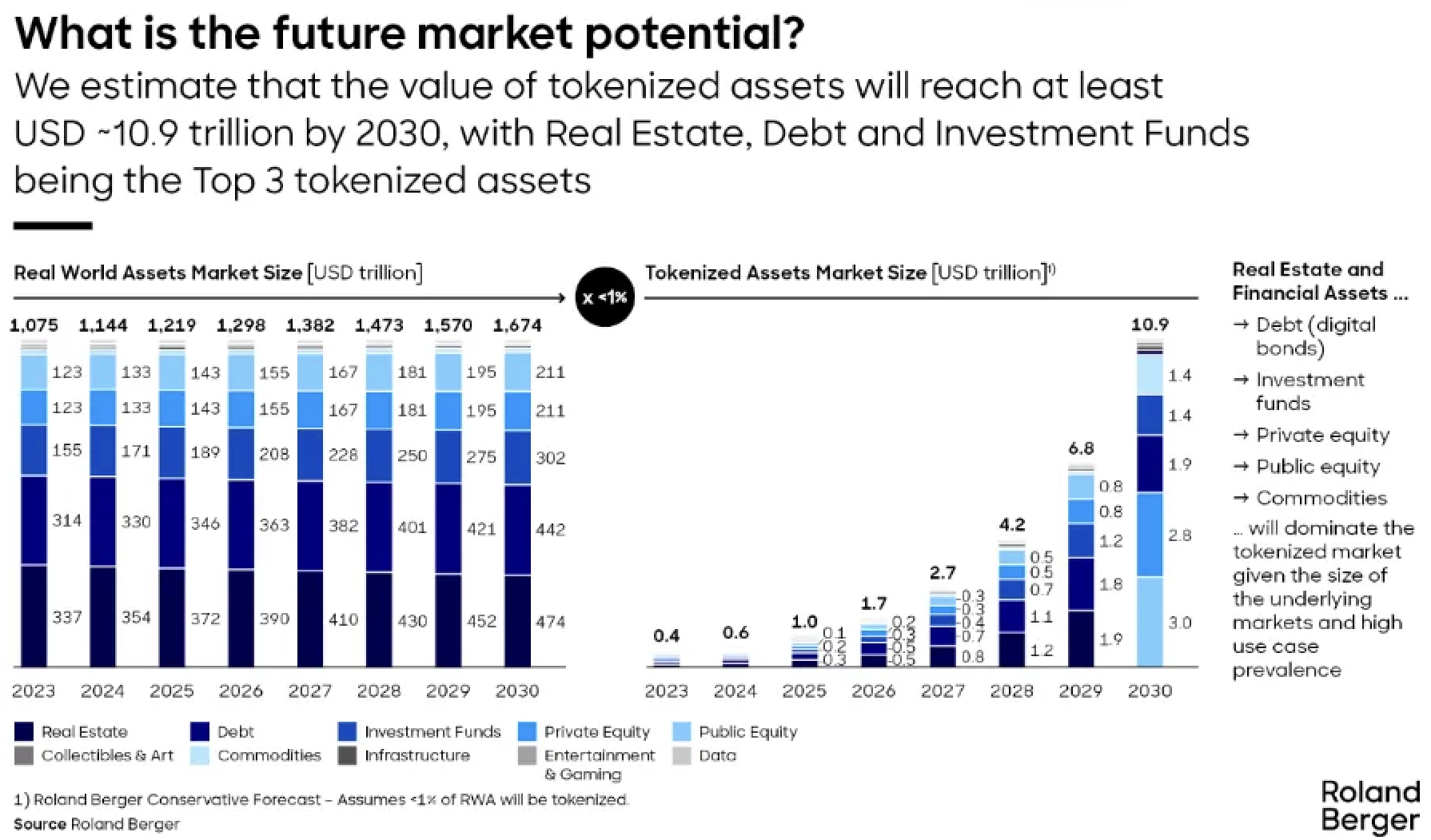
Source: Roland Berger
What makes this emerging market appealing is far beyond the yield potential for DeFi. Through asset tokenization, it enables digital fragmentation of assets—breaking down assets such as government bonds, stocks, and real estate into smaller shares. This process enhances liquidity and create opportunities for investors with varying levels of capital.
Chainlink explains the mechanics of asset tokenization with the illustration below. Its main advantages include increasing liquidity and accessibility through interoperable tokenized assets, allowing small investors to invest in high-yield assets. Additionally, the public nature of blockchains improves transparency and enhances composability by connecting the value of real-world assets to the DeFi ecosystem.
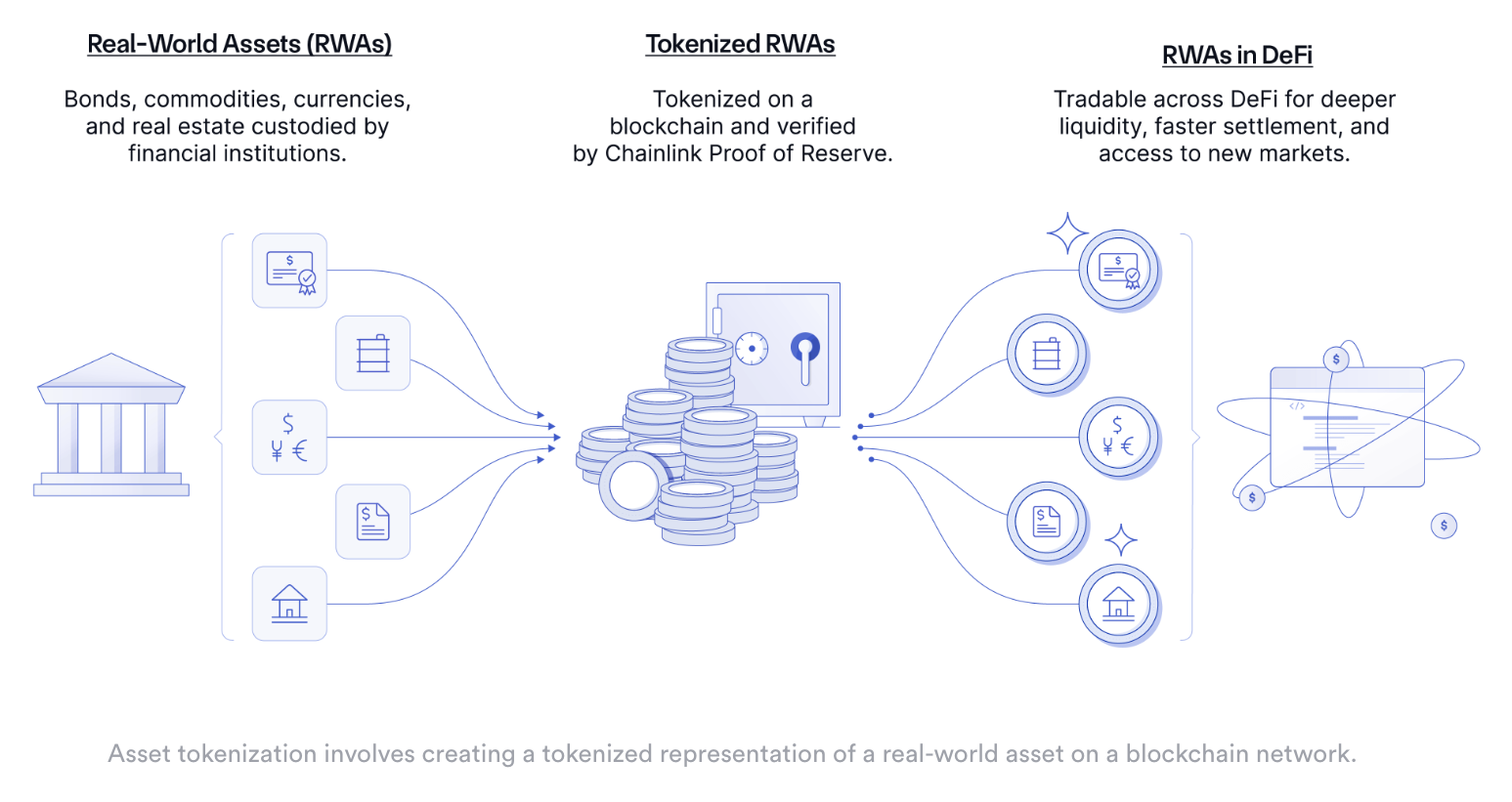
Source: Chainlink
The market value of tokenized U.S. government bonds has also grown from $114 million in 2023 to $845 million, with Franklin Templeton being the largest issuer in this asset class, accounting for about 38% of the market. According to the latest research by Ernst & Young, 64% of high-net-worth investors and 33% of institutional investors plan to increase their investment in tokenized government bonds by the end of 2024.
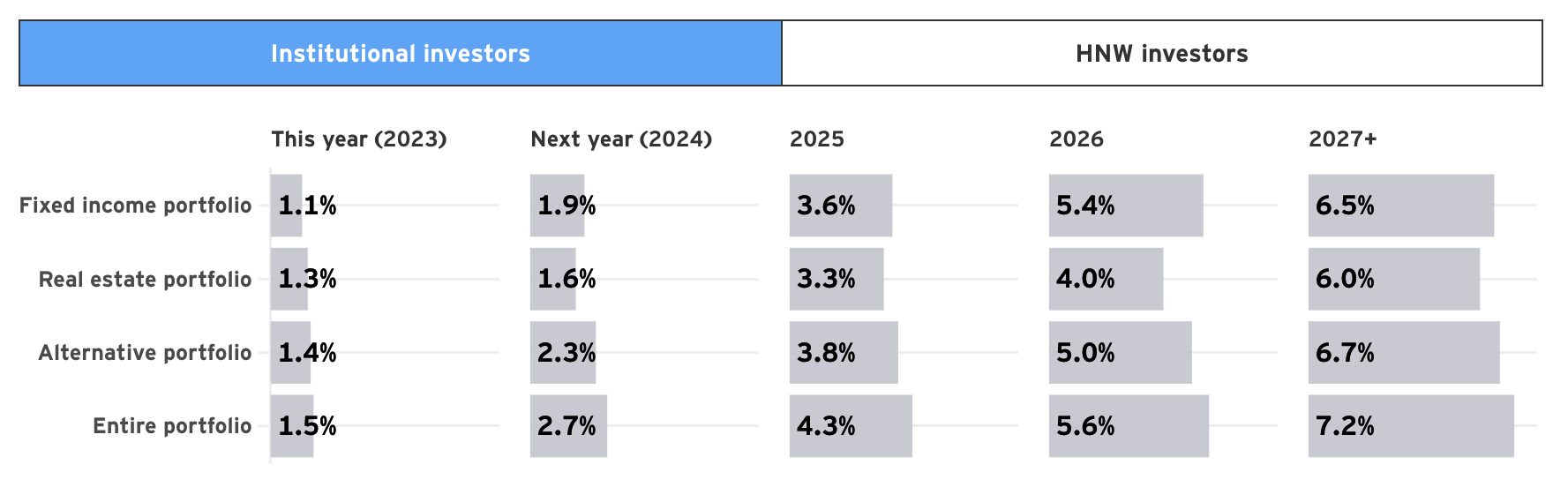
While still in its early stages, asset tokenization represents one of the most promising applications of blockchain technology. Ondo Finance is capitalizing on this trend through its treasury bond tokenization services, driving growing investor interest.
II. Technical Architecture
Ondo is transforming finance through its decentralized protocol, utilizing blockchain to offer institutional-grade products. By tokenizing stable assets from traditional finance (TradFi), Ondo combines reliability with blockchain efficiency. It has two main divisions: Asset Management and Technology. The former creates and oversees tokenized financial products, while the latter develops the supporting protocols.
Currently, Ondo Finance offers two distinct investment options:
1. USDY (Ondo US Dollar Yield Token)
This is a tokenized note backed by short-term US Treasury bills and bank deposits.
It provides an annual percentage yield (APY) of 5.30%, with a total value locked (TVL) of $315.35 million.
USDY is safer and more transparent than traditional stablecoins like USDT and USDC.
It is managed by Ankura Trust to ensure compliance and investor protection.
2. OUSG (Ondo Short-Term US Government Treasuries)
This option offers low-risk tokenized short-term US Treasuries for passive investors.
It provides an APY of 4.81%, with a TVL of $221.32 million.
In March 2024, OUSG shifted its investments from BlackRock's SHV to BUIDL.
Ondo recently launched a new version called rOUSG, which offers additional returns through extra rOUSG tokens.
III. Products and Development Paths
Ondo Finance aims to bridge TradFi and DeFi using public blockchain technology, with a focus on creating secure, transparent, and compliant financial products.
OUSG: Tokenized BlackRock's short-term US treasury bond ETF
OMMF: Tokenized BlackRock's money market fund
USDY: An alternative to yield-stablecoins
Flux Finance: A protocol supporting tokenized securities as collateral
In the next phase, Ondo aims to tokenize publicly traded securities to address liquidity and infrastructure related challenges. Ultimately, Ondo seeks to innovate within TradFi by combining centralized and decentralized mechanisms, extending the benefits of blockchain technology to broader financial services.
These products have driven significant growth, with Ondo’s TVL increasing from $40 million to $534 million. Looking ahead, Ondo plans to expand the use of tokenized cash equivalents like USDY, OUSG, and OMMF by increasing their adoption and liquidity. This will involve establishing partnerships and developing cross-chain tools to facilitate these processes.
Ondo's Flux Finance marks a significant advancement in decentralized lending. Built on Compound V2 with new features, it supports both open tokens like USDC and restricted ones like OUSG. This means you can freely lend USDC, but borrowing against OUSG as collateral requires meeting specific permission requirements to ensure compliance and security. Flux operates a peer-to-pool (p2pool) model similar to Compound, allowing users to borrow in an overcollateralized manner. Lenders earn interest on their stablecoins, while borrowers use their collateral to borrow these stablecoins and follow asset permission requirements. Flux Finance is governed by Ondo DAO.
IV. Competitive Landscape
With its partnerships with giants like BlackRock, Ondo seems to be emerging in the TradFi sector as an RWA player, filling a void left by other TradFi companies. In the DeFi space, competition is intensifying. Centrifuge focuses on tokenizing structured credit and issuing debt using NFTs. Ethena provides synthetic asset exposure, allowing users to trade without holding the underlying assets. Maple Finance offers low-collateral loans to institutions, emphasizing credit assessment and lending. Pendle handles tokenized yield trading, enabling users to separate and trade the yields of an asset.
Ondo Finance stands out for several reasons. By integrating TradFi with blockchain, it targets the vast U.S. Treasury market to achieve broad coverage. Its complementary approach involves partnering with TradFi giants like BlackRock, thereby avoiding direct competition. Additionally, Ondo offers innovative products like USDY and OUSG, providing safer and more transparent alternatives to traditional stablecoins.
V. Tokenomics
1. Summary
Market Cap Rank: #54
Fully Diluted Valuation (FDV): $131.5 billion, ranked #16
Circulating Supply: 1.44 billion ONDO (14.27% of total supply)
Total Supply: 10 billion ONDO
Max Supply: 10 billion ONDO
Next Unlock: 1.67 million ONDO (approx. $2.19 million), in 5 days
2. Token Allocation
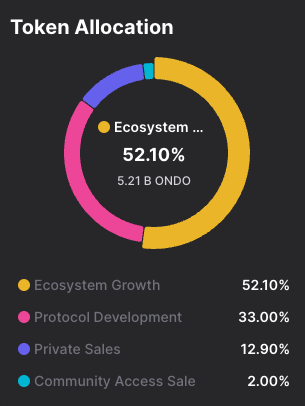
Source: Dropstab
3. Upcoming Unlock Events
June 18, 2024: 1.67 million ONDO (approx. $2.19 million)
July 18, 2024: 1.67 million ONDO (approx. $2.19 million)
August 18, 2024: 1.67 million ONDO (approx. $2.19 million)
September 18, 2024: 1.67 million ONDO (approx. $2.19 million)
October 18, 2024: 1.67 million ONDO (approx. $2.19 million)
November 18, 2024: 1.67 million ONDO (approx. $2.19 million)
December 18, 2024: 1.67 million ONDO (approx. $2.19 million)
January 18, 2025: 1.94 billion ONDO (approx. $25.5 billion)
January 18, 2026: 1.94 billion ONDO (approx. $25.5 billion)
January 18, 2027: 1.94 billion ONDO (approx. $25.5 billion)
January 18, 2028: 1.94 billion ONDO (approx. $25.5 billion)
4. Token Utility
The ONDO token is the governance token for Ondo Finance and its Flux Finance protocol. Holders have the right to vote on various proposals within the Ondo DAO, ensuring all decisions are made transparently on-chain. To submit a proposal, an individual must hold or be delegated at least 100 million ONDO voting rights. It is unclear if additional use cases will be introduced in the future.
VI. The Team, Funding History, and Ecosystem
The Ondo Finance team boasts a diverse mix of individuals from TradFi and the Web3 sector. Founder and CEO Nathan Allman and President and COO Justin Schmidt both hail from Goldman Sachs. Another key member, Katie Wheeler, comes from BlackRock. The team also includes developers from OpenSea, MakerDAO, and Boson Protocol. This blend of expertise aligns well with Ondo Finance's unique vision and goals.

Source: Ondo Finance
Seed Round: In December 2021, Ondo Finance raised $4 million at a token price of $0.013, achieving a 99.87x return on investment (ROI). A total of 300 million tokens (3% of the total supply) were bought by investors led by Pantera Capital, with an initial lock-up period of 1 year followed by a 24-month vesting period.
Public Sale: On May 12, 2022, Ondo Finance raised $10 million at a token price of $0.03, achieving a 43.28x ROI. A total of 100 million tokens (1% of the total supply) were sold on Coinlist, with a 1-year lock-up period followed by an 18-month vesting period.
Series A: In April 2022, Ondo Finance raised $20 million at a token price of $0.02, achieving a 64.92x ROI. A total of 1 billion tokens (10% of the total supply) were bought by investors led by Founders Fund, with an initial lock-up period of 1 year followed by a 24-month vesting period.
Ondo Finance has established several key partnerships to enhance its blockchain and financial services:
Aptos Foundation: This collaboration aims to integrate RWAs with blockchain technology, starting with the tokenized US Treasury product, USDY.
Thala Labs: Partnered to use USDY in Thala's AMM pools and as collateral for collateralized debt positions (CDPs), enhancing liquidity and DeFi solutions.
Wintermute: Collaborated to improve the liquidity of USDY, providing 24/7 liquidity across multiple blockchain platforms.
BlackRock: Ondo Demonstrated commitment to expanding tokenization efforts and integrating BlackRock products by investing $95 million in BlackRock's BUIDL fund.
VII. Summary
Ondo Finance stands out for several reasons. By integrating TradFi with blockchain, it targets the vast U.S. Treasury market to achieve broad coverage. Its complementary approach involves partnering with TradFi giants like BlackRock, thereby avoiding direct competition. Additionally, Ondo offers innovative products like USDY and OUSG, providing safer and more transparent alternatives to traditional stablecoins.
Pros:
The tokenization industry is poised for significant growth. Ondo Finance, in collaboration with BlackRock, is strategically positioned to bring trillions of dollars into Web3.
Ondo Finance's TVL has seen substantial growth since early 2024. RWAs in the crypto space represent a fresh and promising narrative with strong early adoption potential.
Ondo Finance is committed to developing its products to meet customer needs.
Most OUSG investments were initially in BlackRock's iShares Short Treasury Bond ETF (SHV). In March 2024, they shifted to BlackRock's USD Institutional Digital Liquidity Fund (BUIDL), aligning with Ondo's focus on asset tokenization.
Ondo Finance is a leader in the crypto RWA sector, making it a preferred choice.
Ondo Finance holds approximately 38% of BUIDL's current supply.
Cons:
The use of the ONDO token shows notable centralization risk.
While all holders can participate in governance, the largest holders have the most influence.
Approximately 85% of the total ONDO supply is controlled by the Ondo Finance team.
Ondo Finance operates where TradFi and crypto meet, entering a nascent area with potential regulatory challenges.
Bad debt is a major risk for DeFi protocols, including Ondo Finance's Flux. Bad debt occurs when the value of a borrower's collateral falls below their debt. If a borrower's equity becomes negative, Flux will use its reserves to mitigate losses. To minimize volatility and reduce the risk of bad debt, Flux only accepts stable assets as collateral.