Trump in Web3 Games: Temporary Hype or Trend?

bitcoinistPublicado a 2025-12-12Actualizado a 2025-12-12

Resumen

The article "Trump in Web3 Games: Temporary Hype or Trend?" discusses the growing integration of political brands, particularly Donald Trump’s, into the crypto industry—especially within Web3 gaming. It highlights the recent launch of the 3D game *Trump Billionaires Club*, which features an in-game economy tied to the $TRUMP memecoin and user engagement mechanics. The piece argues that while political and media-driven narratives can generate initial user interest, they often fail to retain players without clear, sustainable incentives. Many gaming tokenomics rely on short-term emotional appeal rather than long-term engagement. In response, projects like PEPENODE are emerging with simplified, routine-based reward systems—such as virtual "mining" nodes—that require no technical knowledge or hardware. PEPENODE, promoted as the "first memecoin mine-to-earn" platform, allows users to buy and upgrade virtual mining nodes to earn rewards, including memecoins like PEPE and Fartcoin. Early data shows significant pre-sale interest, with $2.3 million raised and a token price of $0.001192. The project aims to combine meme-driven engagement with predictable, recurring action—a trend gaining traction as Web3 games seek broader, more consistent user bases beyond one-time hype. The article concludes that while politically themed games attract attention, their long-term success depends on transitioning from viral momentum to habitual use through clear mechanics and recurring value.

Trusted Editorial content, reviewed by leading industry experts and seasoned editors. Ad Disclosure

Political brands are increasingly penetrating the crypto industry—and today this is most noticeable in games. This week, the Spanish business publication Cinco Días described the launch of the 3D game Trump Billionaires Club, where the in-game economy is tied to the $TRUMP memecoin and user engagement mechanics.

For the market, this is a signal not so much about a specific politician, but about a direction: Web3 gaming is once again seeking a mass audience through recognizable themes and simple progression steps. When a product is understood without training, it's easier for the user to take the first step—buy a token, enter the game, complete tasks, and return tomorrow.

But this approach has a weak spot: the majority of gaming tokenomics live only on emotions and quickly burn out if the user has no clear reason to stay in the system. That is why 2025 looks like a race for mechanics that retain attention not with promises, but with regular action and predictable rewards.

Against this backdrop, memecoins are getting another chance to break out of the "buy and forget" mode into a format where the token becomes a participation tool. And here, the new project PEPENODE is trying to fill the niche: to combine meme energy with a clear gaming routine of mining, without requiring iron, electricity, or technical skills.

BUY PEPENODE

Why Gaming Memecoins Are Returning Attention to Simple Mechanics

Web3 games in 2025 need one thing: to convert the noise around a brand into a daily habit. Political and media themes provide traffic, but do not guarantee retention—users quickly leave if progress seems random or too complex.

Parallelly, the infrastructure side has become less painful for retail. According to Cointelegraph, average commissions on the Ethereum network after the Dencun update have noticeably decreased: in March 2025, the average swap was valued at approximately $0.39 versus around $86 a year earlier.

Hence the trend: projects are competing not only with memes, but also with "grounded" reward cycles—from simplified game quests to mining simulations. Against this backdrop, many investors are becoming interested in other market directions, including the list of the best altcoins for 2025.

PEPENODE currently looks like one of the variants in this logic, because it bets on regular activity and a clear interface, not on complex economics.

How PEPENODE Turns "Mining" into a Game Without Iron

The key idea of PEPENODE is positioning as the "world's first memecoin mine-to-earn": instead of classical mining with equipment, the project offers a virtual "mining" system. The entry is built around nodes and reward levels. This addresses three market pains at once: boring mining models, weak early incentives, and technical complexity for newcomers.
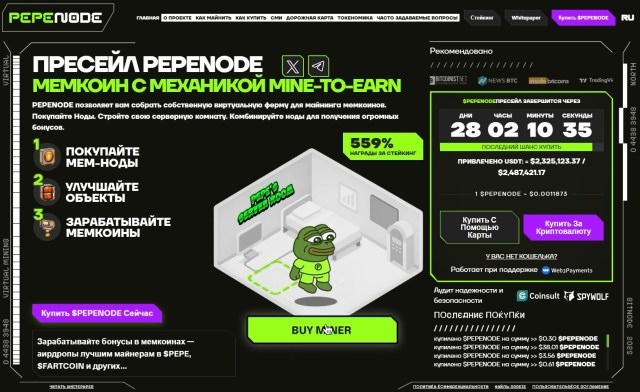
In product terms, this looks like a gamified panel. You buy and configure "node-miners," improve nodes to increase efficiency, and receive rewards, including memecoins like PEPE and Fartcoin. Importantly, the scenario of "enter — improve — collect reward" is simpler than dealing with iron and expenses.

Interest is also heating up the early demand dynamics. According to the presale team's data, PEPENODE has already attracted $2.3 million, and the token price is $0.001192. This is the level at which the base of early participants usually forms, if the product really promises activity after launch.

Large wallet tracking data indicates 2 purchases for a total of $215K; the largest deal—$51K—took place on February 8, 2025.

This bet has a clear logic: if the game finds an audience after launch, then "mining as a habit" may turn out to be stronger than the one-time hype around a loud name.

Editorial Process for bitcoinist is centered on delivering thoroughly researched, accurate, and unbiased content. We uphold strict sourcing standards, and each page undergoes diligent review by our team of top technology experts and seasoned editors. This process ensures the integrity, relevance, and value of our content for our readers.

Daria Vlasova

Follow

Crypto journalist, specializes in the digital asset market, DeFi platforms, and Web3 projects. Graduate of the Economics Faculty of Moscow State University. Since 2019, she has been writing about the crypto industry, tokenomics, and the development of new digital economy models.

Full Profile

Related Posts

Even 0.1 $BTC is financial independence for decades. But that's not enough

MEXC KYC Reward December 2025: First Trade Loss Coverage (100% Loss Coverage Up to 50 USDT)

Best crypto presale: MAXI stands out among meme-presale projects

Best crypto to buy now: MAXI attracts global attention after a surge in trading volume

Best crypto to buy now: Bitcoin Hyper (HYPER) shows the strongest growth signals

New crypto that could explode today: Pepenode (PEPENODE) predicted to surge strongly in the next few hours

Preguntas relacionadas

QWhat is the main focus of the article regarding Web3 gaming trends in 2025?

AThe article focuses on the trend of Web3 gaming shifting towards simple, engaging mechanics and meme-driven economies to attract and retain a mass audience, moving away from complex models that rely solely on hype.

QWhat specific project is highlighted as an example of combining meme energy with a playable mining routine?

AThe project highlighted is PEPENODE, which positions itself as the 'first meme coin mine-to-earn' project, offering a virtual mining system with nodes and reward levels instead of traditional hardware-based mining.

QAccording to the article, what is the key weakness of many gaming tokenomics models that rely on emotions and hype?

ATheir key weakness is that they quickly lose value and user interest if there is no clear reason for the user to stay in the system, as they lack predictable, regular rewards and sustainable engagement mechanics.

QWhat infrastructure development is mentioned as making the market less painful for retail participants?

AThe article mentions that average commissions on the Ethereum network have noticeably decreased after the Dencun update, with the average swap fee estimated at around $0.39 in March 2025 compared to about $86 a year earlier.

QWhat early traction data is provided for the PEPENODE project in its pre-sale phase?

AThe pre-sale for PEPENODE had attracted $2.3 million, with a token price of $0.001192. Data also indicated two large purchases totaling $215K, with the largest single transaction being $51K on February 8, 2025.

Lecturas Relacionadas

STAR 50 Soars 10.73%, Why Did A-Shares Stage a "V-Shaped Reversal"?

After a prolonged decline, the Chinese A-share market staged a strong rally on July 21. The STAR 50 index surged 10.73%, its largest single-day gain in nearly a year, leading a broad-based "V-shaped" reversal. The Shanghai Composite Index rose 1.79%, the Shenzhen Component Index gained 4.81%, and the ChiNext Index jumped 7.05%. Total market turnover reached 2.97 trillion yuan, an increase of 256.1 billion yuan from the previous session, with over 3,100 stocks advancing. The semiconductor sector spearheaded the rebound, with related ETFs posting significant gains. Analysts attribute the surge to three converging factors. First, coordinated capital inflows from "national team" institutions, insurance funds, listed company buybacks, and fund house self-purchases have bolstered market liquidity and confidence. Second, supportive policy signals, including commitments from regulators to ensure stable market operations, provided a favorable backdrop. Third, a stabilization and recovery in overseas markets, notably South Korea, created a positive external environment. Institutions suggest the most severe panic selling phase for the tech sector has likely passed, following a significant digestion of crowded positions and leveraged funds. While short-term volatility may persist, the medium to long-term outlook remains underpinned by enduring trends like AI computing demand expansion and semiconductor localization. The market's focus now shifts to the sustainability of supportive fund flows, earnings reports, and upcoming catalysts from the global AI industry chain.

marsbitHace 5 min(s)

STAR 50 Soars 10.73%, Why Did A-Shares Stage a "V-Shaped Reversal"?

marsbitHace 5 min(s)

U.S. Tech Momentum Stocks Post Largest Single-Day Gain Ever, But Is the Plunge Over?

US tech momentum stocks staged a sharp rebound on Tuesday (July 21st). Morgan Stanley's TMT Momentum Factor surged over 12%, marking its largest single-day gain on record, exceeding even peaks from the 2000 dot-com bubble. Key momentum indices from Goldman Sachs also posted their strongest daily performances in years. The rally was led by semiconductors, with the Philadelphia Semiconductor Index jumping 4.6%. This rebound followed three consecutive down days and a cumulative 33% plunge in momentum stocks, one of the steepest drawdowns since the dot-com era. Analysts attribute the surge largely to a short squeeze. Heavy selling had pushed high-beta momentum stocks into deeply oversold territory, forcing many short sellers, particularly in Asia, to cover their positions, creating a self-reinforcing buying spiral. However, the rebound's internals appear weak. Trading volume was notably low, and advancing stocks still lagged decliners on the S&P 500, indicating a narrow, concentrated rally rather than broad market participation. Diverging views emerge on the outlook. BTIG warns the bounce has hit key resistance and recommends selling into strength, citing extreme volatility and historical parallels to past market tops. Conversely, Goldman Sachs and UBS believe the momentum unwind is nearing its end, suggesting it may be time to gradually add exposure, as positioning has been significantly reduced. They caution, however, that high volatility warrants a measured approach, potentially using defined-risk strategies. The upcoming earnings season, particularly reports from major tech firms like Alphabet, is seen as a critical test for the rally's sustainability. Simultaneously, bond markets flashed a warning, with yields rising partly due to spiking oil prices. Analysts note that if long-term Treasury yields break decisively higher, it could pose a significant headwind for equities, especially growth stocks.

marsbitHace 12 min(s)

U.S. Tech Momentum Stocks Post Largest Single-Day Gain Ever, But Is the Plunge Over?

marsbitHace 12 min(s)

U.S. Tech Momentum Stocks Record Largest Single-Day Gain Ever, but Has the Rout Ended?

U.S. tech momentum stocks staged a dramatic rebound on Tuesday, July 21st. Key momentum indices like the Morgan Stanley TMT Momentum Factor and Goldman Sachs' High Beta Momentum Long Index posted historic or near-historic single-day gains, fueled largely by semiconductor stocks. This sharp rally followed a severe three-day sell-off that saw momentum stocks plunge 33%, marking one of the steepest pullbacks since the dot-com bubble. Analysts attribute the bounce primarily to a short squeeze, as forced covering from over-leveraged traders, particularly in Asia, created a buying spiral. However, the rally's health is questioned due to weak market breadth—overall trading volume was low, and decliners outnumbered advancers in the S&P 500 despite the index's gain—suggesting a narrow, concentrated surge rather than broad recovery. Opinions on the sustainability diverge. BTIG strategists warn the rebound has hit key resistance levels, citing extreme volatility and historic stock dispersion as signs of an ongoing broader correction, and recommend selling into strength. Conversely, Goldman Sachs and UBS view the aggressive momentum unwinding as nearing its end, noting reduced positioning and a lack of new fundamental catalysts. They suggest the sell-off presents a selective opportunity to add exposure, albeit cautiously and gradually using defined-risk strategies. The immediate trajectory hinges on the ongoing earnings season, with market focus on Alphabet's capital expenditure guidance for AI investment clarity. Meanwhile, bond markets present a risk, with rising Treasury yields—potentially heading toward 5.5%—and widening credit spreads for mega-cap tech companies posing a threat to equity valuations. The combination of technical factors, earnings results, and macro conditions leaves the durability of the rebound in doubt.

链捕手Hace 15 min(s)

U.S. Tech Momentum Stocks Record Largest Single-Day Gain Ever, but Has the Rout Ended?

链捕手Hace 15 min(s)

Long-Divided Must Unite, Long-United Must Divide: When L1 Becomes Its Own Rollup, What Is Ethereum's Endgame?

"The Inevitable Cycle: When L1 Becomes Its Own Rollup – What is Ethereum's Endgame?" For years, the Ethereum community grappled with concerns that L2s were fragmenting the ecosystem and eroding L1's value. While L2s provided cheaper execution, they also splintered liquidity and the unified user experience of a single chain. This has prompted a fundamental reassessment of the relationship between L1 and L2. Ethereum's roadmap is evolving. The "Scale" initiative merges L1 and L2 expansion into a holistic framework. L1 itself is advancing with higher gas limits, statelessness, and zkEVM verification, no longer content to be just a low-throughput settlement layer. Consequently, the primary value proposition of L2s is shifting from merely providing cheap blockspace to offering L1 cannot easily provide: application-specific optimizations, privacy features, and flexible governance models. L2s are becoming a spectrum of execution environments with varying degrees of security inheritance from Ethereum. A critical challenge in this multi-chain future is interoperability. The vision is to make Ethereum "feel like one chain again." This relies on advancements in native account abstraction (like EIP-7702) and intent-based architectures (Open Intents Framework), where users declare desired outcomes, and solvers handle the complex cross-chain execution. Furthermore, shortening Ethereum's finality time from minutes to seconds is crucial, as it underpins trust between chains for bridges, stablecoins, and cross-chain applications. Perhaps the most provocative idea is that Ethereum L1 itself could become a form of "its own Rollup." As zkEVM and proof systems mature, high-performance nodes could execute transactions and generate validity proofs. Regular validators would then verify these proofs instead of re-executing all transactions. This blurs the traditional L1/L2 hierarchy, making "Rollup" more of a general execution-verification architecture. Native Rollup aims to integrate L2 validation more directly into the Ethereum protocol, allowing L2s to inherit L1's security more fully and move away from reliance on security councils. In the end, L2s are not destined to replace L1 or be made obsolete by it. The likely future is a unified system where diverse execution environments—each optimized for specific use cases like DeFi, gaming, or privacy—coexist. They will share a common foundation of security, liquidity, and verifiable state, seamlessly connected to restore a cohesive user experience. The next phase for Ethereum is not just about scaling through separation, but about intelligently reintegrating what was separated back into a coherent whole.

链捕手Hace 31 min(s)

Long-Divided Must Unite, Long-United Must Divide: When L1 Becomes Its Own Rollup, What Is Ethereum's Endgame?

链捕手Hace 31 min(s)

Trading

Spot
活动图片





