STAR 50 Soars 10.73%, Why Did A-Shares Stage a "V-Shaped Reversal"?

marsbitPublicado a 2026-07-22Actualizado a 2026-07-22

Resumen

After a prolonged decline, the Chinese A-share market staged a strong rally on July 21. The STAR 50 index surged 10.73%, its largest single-day gain in nearly a year, leading a broad-based "V-shaped" reversal. The Shanghai Composite Index rose 1.79%, the Shenzhen Component Index gained 4.81%, and the ChiNext Index jumped 7.05%. Total market turnover reached 2.97 trillion yuan, an increase of 256.1 billion yuan from the previous session, with over 3,100 stocks advancing. The semiconductor sector spearheaded the rebound, with related ETFs posting significant gains. Analysts attribute the surge to three converging factors. First, coordinated capital inflows from "national team" institutions, insurance funds, listed company buybacks, and fund house self-purchases have bolstered market liquidity and confidence. Second, supportive policy signals, including commitments from regulators to ensure stable market operations, provided a favorable backdrop. Third, a stabilization and recovery in overseas markets, notably South Korea, created a positive external environment. Institutions suggest the most severe panic selling phase for the tech sector has likely passed, following a significant digestion of crowded positions and leveraged funds. While short-term volatility may persist, the medium to long-term outlook remains underpinned by enduring trends like AI computing demand expansion and semiconductor localization. The market's focus now shifts to the sustainability of supportive fund...

After several consecutive days of declines, the market welcomed a strong rebound.

On the morning of July 21, A-shares staged a "V-shaped reversal," with multiple indices subsequently surging rapidly. At the close, the STAR 50 Index soared 10.73%, marking its highest single-day gain in nearly a year. The three major indices all closed in positive territory, with the Shanghai Composite Index rising 1.79%, the Shenzhen Component Index climbing 4.81%, and the ChiNext Index advancing 7.05%.

The combined trading volume for the three major exchanges was 2.97 trillion yuan, an increase of 256.1 billion yuan from the previous day. At the individual stock level, over 3,100 stocks rose, with more than a hundred hitting their daily upside limit. As the vanguard of the rebound, the semiconductor industry chain saw a full-scale surge, led by sectors such as equipment, memory, wafers, and HBM. Sectors like oil and gas, banking, coal, and motorcycles were among the decliners.

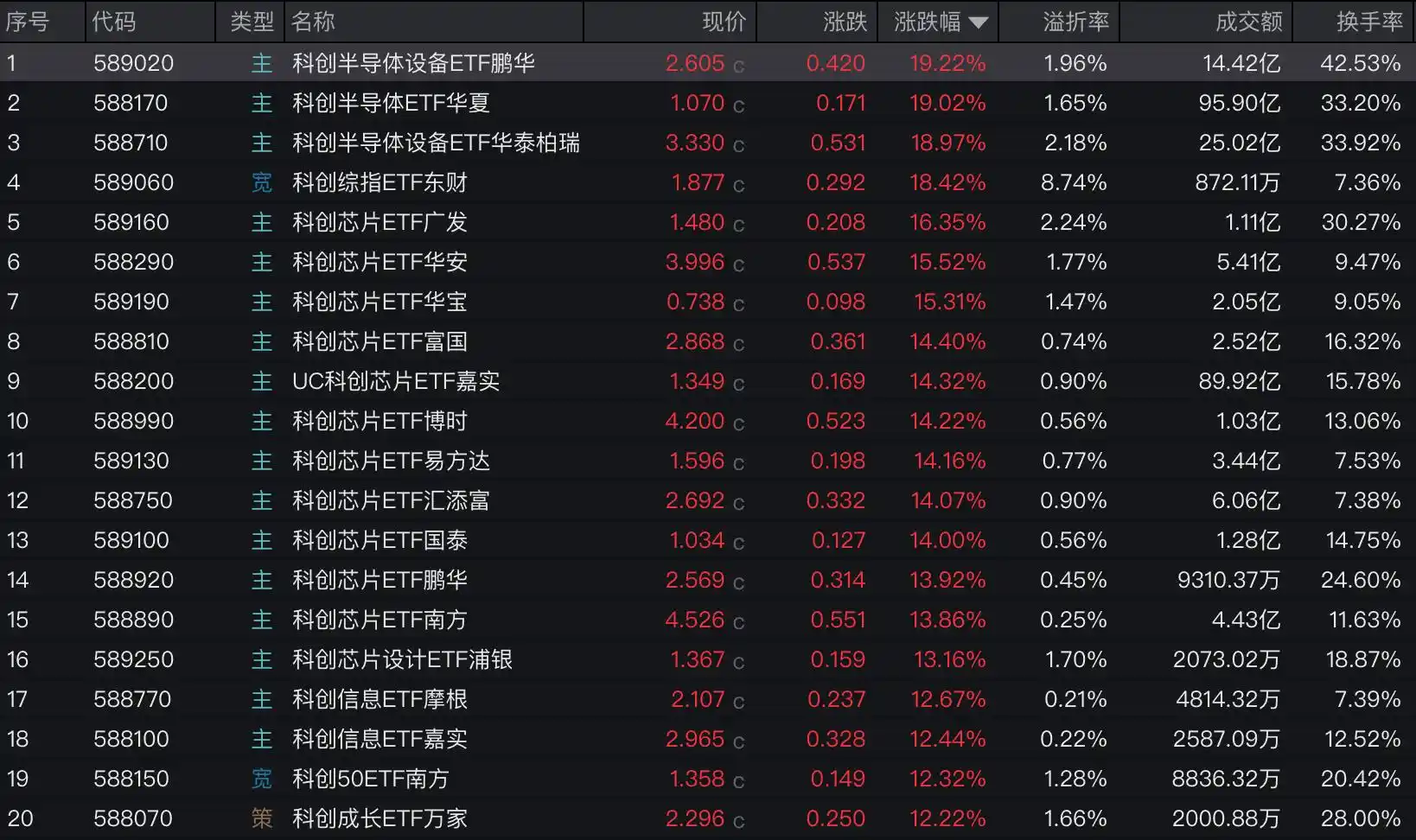
Boosted by the semiconductor rally, related thematic ETFs surged sharply, with as many as 73 products gaining over 10% intraday. Among them, Penghua STAR Semiconductor Equipment ETF, ChinaAMC STAR Semiconductor ETF, Huatai-PineBridge STAR Semiconductor Equipment ETF, and East Money STAR Composite Index ETF all rose over 18%. GF, Huaan, and Huabao's STAR Chip ETFs gained over 15%.
Triple Factors in Resonance

Today's powerful rebound in A-shares stemmed from the resonance of three factors.

First, multiple sources of funds announced market entry. Since July 19th, positive signals have emerged frequently from the capital side, ranging from "national team" and insurance capital increases in holdings to listed company buybacks and self-purchases by public and private funds.

Jinying Fund's analysis notes that the sustained entry of stabilizing funds has effectively boosted market confidence. "During the previous sustained and significant market decline, investors' risk-averse sentiment was concentratedly released, and A-share valuations gradually returned to a reasonable range. Meanwhile, major capital players seized the opportunity to enter the market, not only supporting market liquidity but also laying a solid foundation for market stabilization."

Wind data shows that over the last two trading days, multiple broad-based ETFs experienced significant volume expansion. On July 20th, broad-based ETFs saw a combined net inflow of 59.061 billion yuan. Among them, ChinaAMC STAR 50 ETF, Huatai-PineBridge CSI 300 ETF, and E Fund ChiNext ETF recorded net inflows of 13.7 billion yuan, 12.52 billion yuan, and 9.4 billion yuan, respectively. On July 21st, these three broad-based ETFs remained active, with trading volumes reaching 17.322 billion yuan, 15.266 billion yuan, and 12.895 billion yuan respectively.

Second, policy support. On July 20th, China Securities Regulatory Commission (CSRC) Chairman Wu Qing presided over an investor symposium, clearly stating the commitment to "fully maintain stable market operation." Bosera Fund believes that after the technology sector experienced a full adjustment earlier, releasing valuation pressure, coupled with the resonance of policy and capital factors, triggered today's concentrated rebound in the technology growth sector.

Third, the stabilization and rebound of overseas markets provided a favorable external environment for this round of A-share recovery. Jinying Fund points out that the global equity market previously underwent a rapid deleveraging and relatively full adjustment process, with indices in many regions experiencing deep valuation corrections, establishing an objective basis for stabilization and rebound.

Overseas markets, represented by the Korean stock market, took the lead in initiating a recovery. After falling over 30% from its historical peak, effectively clearing substantial risks, the Korea Composite Index (KOSPI) today saw a reversal from its decline, rebounding sharply by 3.56%, led by core Korean tech giants.

Jinying Fund states that alongside the collective warming of the global technology sector, it provided strong support for the synchronized rebound of A-share technology stocks.

The Most Panicked Stage Is Likely Over

Regarding whether the technology sector has emerged from the gloom, institutions provided analysis from short, medium, and long-term perspectives.

"After the rapid adjustment earlier, the crowdedness of the technology sector has been significantly digested," believes Bosera Fund. After consecutive days of decline in margin financing balances, the deleveraging process is nearing its end. Statements from central SOEs increasing holdings and insurance capital's commitment to add positions have released clear signals of long-term capital entering the market, supporting the valuation floor for the technology sector.

Jinying Fund indicates that the current market is still in the tail end of the deleveraging and sentiment-grinding stage. With the continuous inflow of allocation funds and significant clearance of panic-driven selling, follow-up attention can be paid to relatively good investment opportunities within the short-term oversold rebound.

"In the short term, the positive release of policy signals has to some extent alleviated the market's liquidity shock and panic sentiment. The concentrated deleveraging of margin financing has relatively eased, but the market still needs time to find its bottom. After the index's single-day overshoot, volatility in the technology sector remains high, and follow-up requires lowering market volatility." China Europe Fund suggests focusing on the sustainability of the 'national team' holdings increase, the pace of margin financing and quantitative fund replenishment, and performance verification during the intensive mid-year report disclosure period.

"After this round of oversold rebound, a new medium-term market cycle still awaits new heavyweight industrial catalysts. The Q2 earnings reports from overseas cloud providers in late July are a key node for verifying returns on capital expenditure." Jinying Fund analyzes that, from a medium-term perspective, subsequent differentiation clues within the AI industry chain depend on whether specific segments can maintain their rising share of demand and continued supply bottlenecks. For links where supply bottlenecks may loosen, valuation centers might face downward revisions. AI technology investment still needs to focus on core links with relatively tight supply and demand.

In the view of Bosera Fund, industrial trends such as the expansion of AI computing demand and semiconductor import substitution have not changed due to short-term adjustments. The growth resilience of technology leaders has been preliminarily verified in mid-year report performances. The short-term market may still experience fluctuations, but the most panicked stage for the technology sector is likely over. Subsequently, with the continuous landing of industrial catalysts, the technology growth direction still possesses medium- to long-term allocation value.

This article is from "*Caijing* New Media," author: Jiang Jinli, editor: Jiang Shizhou

Preguntas relacionadas

QWhy did the A-share market stage a 'V-shaped reversal' on July 21st according to the article?

AThe article states that the strong rebound in the A-share market stemmed from the resonance of three key factors: 1) Multiple sources of funds announcing entry into the market, including the 'national team,' insurance funds, company buybacks, and public and private fund self-purchases. 2) Policy support, highlighted by a speech from the CSRC chairman pledging to 'fully maintain stable market operations.' 3) The stabilization and rebound of overseas markets, such as the South Korean stock market, which provided a favorable external environment for A-shares' recovery.

QWhat was the single-day percentage gain for the STAR 50 Index on July 21st, and what is its significance?

AThe STAR 50 Index surged by 10.73% on July 21st. According to the article, this represents its highest single-day gain in nearly a year.

QWhich sector was the main driving force behind the market rebound, and how did related ETFs perform?

AThe semiconductor industry chain was the main driving force behind the rebound, with equipment, storage, wafers, HBM, and other segments leading the gains. Bolstered by this sector's performance, related thematic ETFs saw sharp increases. The article notes that 73 products saw intraday gains exceeding 10%, with several prominent ETFs, like those tracking STAR Board semiconductor equipment, gaining over 18%.

QWhat are the short- to medium-term outlooks provided by fund managers for the technology sector after this rebound?

AFund managers offered a tiered outlook. In the short term, institutions like Boshi Fund believe the most panic-driven stage for the tech sector has likely passed, though volatility may persist. Jin Ying Fund suggests the market is in the tail-end of deleveraging and sentiment bottoming, presenting opportunities from the short-term oversold bounce. For the medium term, they caution that a sustained new uptrend requires fresh, significant industry catalysts and advise focusing on AI supply chain segments with tight supply-demand dynamics, as others facing looser supply might see valuation corrections.

QHow did the trading volume and breadth of the market change on July 21st compared to the previous day?

AThe combined turnover for the three major exchanges reached 2.97 trillion yuan on July 21st, an increase of 256.1 billion yuan from the previous day. In terms of market breadth, over 3,100 stocks rose, with more than 100 hitting their daily price limit (涨停).

Lecturas Relacionadas

MSX US Stock Daily Observation: Baidu 2026 Q2 Earnings: AI Revenue Accounts for Half of Core Business for Two Consecutive Quarters, 283% GPU Cloud Growth Boosts Business Transformation

**MSX Daily US Stock Observation: Baidu 2026 Q2 Earnings Report** Baidu's Q2 2026 earnings present a clear picture of a company in transition. Total revenue declined slightly to RMB 313.25 billion, missing market expectations. This was driven by a continued double-digit contraction (-19%) in its core online marketing (advertising) business. The key highlight is the structural shift within the company's operations. AI-related revenue reached RMB 125 billion, accounting for approximately half of Baidu's core business income for the second consecutive quarter. Within AI, growth is heavily skewed towards infrastructure: AI cloud infrastructure revenue grew 50% year-over-year to RMB 73 billion, with GPU cloud revenue surging 283%. In contrast, AI application and AI-native marketing services revenue grew only 3% and remained flat, respectively, indicating slower commercialization on the application side. Profitability metrics were mixed. While adjusted operating profit and EBITDA exceeded expectations, demonstrating cost control, adjusted earnings per ADS of RMB 7.22 fell short by about 26%. This gap is largely attributed to depreciation and amortization costs linked to significant AI infrastructure investments, which continue to pressure bottom-line profit realization. The company holds a substantial cash position of RMB 2831 billion, providing runway for continued investment. The critical challenge ahead is translating the explosive growth in AI infrastructure (like GPU cloud) into stronger monetization from AI applications to bridge the gap between operational profit and per-share earnings.

Odaily星球日报Hace 2 min(s)

MSX US Stock Daily Observation: Baidu 2026 Q2 Earnings: AI Revenue Accounts for Half of Core Business for Two Consecutive Quarters, 283% GPU Cloud Growth Boosts Business Transformation

Odaily星球日报Hace 2 min(s)

Bitwise CIO: Three Major Cognitive Errors Common Among Crypto Investors Today

Bitwise CIO Matt Hougan highlights three key misconceptions he believes many crypto investors currently hold, presenting them as opportunities for those who see beyond them. First, investors significantly underestimate the total addressable market for crypto applications. While many view platforms like Uniswap only as tools for trading crypto assets (a ~$2 trillion market), their true potential lies in tokenizing and trading *all* asset classes—such as stocks and bonds—which represent markets hundreds of trillions of dollars in size. Second, there's a persistent overestimation of traditional financial institutions' ability to dominate crypto-native sectors. Examples like PayPal's stable币 (with ~1% market share vs. Tether/Circle's 88%) and Fidelity's custody business (trailing Coinbase) show that crypto-native firms often win due to faster iteration, focused expertise, and established user trust within the crypto ecosystem. Third, investors linearly extrapolate future on-chain transaction volumes from today's data, severely underestimating potential growth. The shift to 24/7 trading for tokenized assets could multiply trading hours by 5x. When combined with AI agents that may execute trades far more frequently than humans, transaction volumes could grow by 10x to 100x, massively boosting revenue for underlying blockchains and applications. Hougan concludes that the gap between the rapid pace of industry change and slower mainstream perception updates creates significant investment opportunities.

marsbitHace 5 min(s)

Bitwise CIO: Three Major Cognitive Errors Common Among Crypto Investors Today

marsbitHace 5 min(s)

Two IPOs in Half a Month: Hefei Becomes China's Fourth City

Hefei, China's "Capital of Venture Capital," Ascends to Fourth Place in A-P-Share Market Value with Two Recent IPOs Within two weeks, two major IPOs propelled Hefei's A-share market capitalization from 1.27 trillion yuan to over 4.55 trillion yuan, ranking the city fourth nationwide, behind only Beijing, Shenzhen, and Shanghai. This surge is led by Changxin's massive listing, creating over 1 trillion yuan in paper gains for state-owned investors. Simultaneously, Hefei's GDP growth leads among Chinese cities exceeding 1 trillion yuan GDP. This success stems not from gambling on single companies, but from a decades-long, systematic "industrial investment" strategy. Hefei targets critical gaps in its industrial chain, providing patient capital. It invested in BOE in 2008 to secure display panels for its appliance hub, in Changxin in 2016 for semiconductors, and in NIO in 2020 to anchor a new energy vehicle cluster. Each investment was calculated based on long-term industrial necessity. Another IPO, Guoyi Quantum, originates from Hefei's ecosystem. Founded by a prodigy inspired by his professor's experience with overpriced foreign instruments, it symbolizes high-end scientific instrument localization. Behind the trillion-yuan paper gains is remarkable political continuity and a self-reinforcing cycle. Proceeds from earlier successful exits (e.g., BOE, NIO) were reinvested into newer projects like Changxin. The strategy withstands individual project failures and transcends typical government terms, focusing on decade-long industrial cultivation. Hefei's system integrates the University of Science and Technology of China for tech talent, state capital for long-term funding, and an unwavering focus on building complete industrial chains. While risks remain—market volatility, intense EV competition, quantum's commercialization timeline—Hefei demonstrates that when a government calculates returns over decades, the outcome differs fundamentally from short-term bets.

marsbitHace 8 min(s)

Two IPOs in Half a Month: Hefei Becomes China's Fourth City

marsbitHace 8 min(s)

Trading

Spot
活动图片