Long-Divided Must Unite, Long-United Must Divide: When L1 Becomes Its Own Rollup, What Is Ethereum's Endgame?

链捕手Publicado a 2026-07-22Actualizado a 2026-07-22

Resumen

"The Inevitable Cycle: When L1 Becomes Its Own Rollup – What is Ethereum's Endgame?" For years, the Ethereum community grappled with concerns that L2s were fragmenting the ecosystem and eroding L1's value. While L2s provided cheaper execution, they also splintered liquidity and the unified user experience of a single chain. This has prompted a fundamental reassessment of the relationship between L1 and L2. Ethereum's roadmap is evolving. The "Scale" initiative merges L1 and L2 expansion into a holistic framework. L1 itself is advancing with higher gas limits, statelessness, and zkEVM verification, no longer content to be just a low-throughput settlement layer. Consequently, the primary value proposition of L2s is shifting from merely providing cheap blockspace to offering L1 cannot easily provide: application-specific optimizations, privacy features, and flexible governance models. L2s are becoming a spectrum of execution environments with varying degrees of security inheritance from Ethereum. A critical challenge in this multi-chain future is interoperability. The vision is to make Ethereum "feel like one chain again." This relies on advancements in native account abstraction (like EIP-7702) and intent-based architectures (Open Intents Framework), where users declare desired outcomes, and solvers handle the complex cross-chain execution. Furthermore, shortening Ethereum's finality time from minutes to seconds is crucial, as it underpins trust between chains for bridges, s...

"Are L2s cannibalizing L1's value?" "Is Ethereum losing its global composability?" During the years when L2s were at the peak of their popularity, such anxieties almost permeated the entire Ethereum community.

In Ethereum's scaling framework at that time, L1 was the stable but expensive settlement layer, while L2s, as cheap and efficient execution layers, indeed granted Ethereum more block space, but also gradually eroded the experience of a "unified chain."

Therefore, over the past two years, these questions have continuously driven Ethereum to re-examine the relationship between L1 and L2.

On one hand, Ethereum L1 persistently increased the Gas Limit, advanced statelessness and zkEVM verification, no longer content with merely being a low-throughput settlement base; on the other hand, community discussions intensified. Early this year, Vitalik explicitly stated that as Ethereum's own scaling capabilities improve, some premises of the roadmap established five years ago—which viewed L2s as the primary scaling solution—had already changed.

More recently, Ethereum researcher Barnabé Monnot further expressed the need to re-evaluate the long-term relationship between L1 and L2, including how L2s should create value in the future, why finality needs to be dramatically shortened, and whether L1 could also become a sort of "rollup of itself" as proof systems gradually enter the mainnet validation process.

While these viewpoints do not yet equate to a confirmed protocol roadmap, they provide a valuable lens for observation.

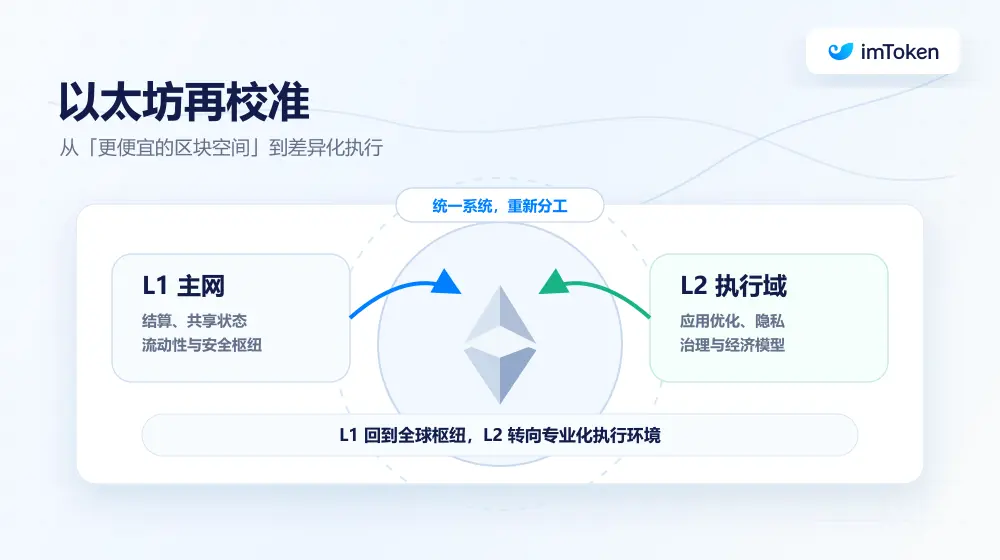
Ultimately, the problem Ethereum faces today is not just about continuing to increase block space, but rather how to re-divide labor among L1, L2, execution layers, and settlement layers as transactions, assets, and user states are dispersed across an increasing number of execution environments.
1. Ethereum Hasn't "Abandoned" L2, But Must Find a New Positioning

To be realistic, when the Ethereum scaling roadmap centered around Rollups was initially formed, L2's most important task was relatively singular: to provide Ethereum with more and cheaper transaction space.

Under the technological conditions of that time, this division of labor was quite reasonable.

Because Ethereum validators all needed to re-execute L1 transactions, mainnet throughput couldn't be aggressively increased in the short term. Rollups, however, could execute transactions in batches off-chain, submitting only compressed data or state commitments back to the mainnet, retaining a degree of Ethereum's security properties while significantly reducing unit transaction costs.

Thus, scaling gradually formed two parallel paths: L1 remained restrained, prioritizing decentralization and security, while L2s accommodated new transactions, continuously reducing costs through Blobs, data compression, and proof technologies.

But now, the premises of this division have changed.

In 2026, the Ethereum Foundation consolidated its protocol work, merging the previously separate "Scaling L1" and "Scaling Blobs" into a unified Scale roadmap. Increasing the Gas Limit, expanding data availability, optimizing execution clients, advancing statelessness, and zkEVM attester clients were all placed within the same scaling framework.

In other words, Ethereum no longer views L1 and L2 scaling as two separate tasks but has begun to reallocate execution, consensus, and data capacity from a system-wide perspective.

This change does not mean Ethereum is preparing to abandon L2s or pull all activity back to the mainnet. On the contrary, it means L2s can no longer easily justify their long-term value merely by being "faster and cheaper."

After all, if L1 itself can increase execution capacity by several orders of magnitude while maintaining security and decentralization, then ordinary EVM execution and low-cost block space will no longer be capabilities unique to L2s; L2s will need to shift focus towards providing differentiated needs that L1 cannot uniformly satisfy, such as application-specific optimizations, privacy features, and more flexible governance and economic models.

The Ethereum Foundation's latest statement this year on the L1-L2 relationship also explicitly emphasizes this. Previously, L2's primary goal was to scale Ethereum, with differentiation and customization as secondary values; now, it's about providing differentiated functionality while continuing to contribute additional scaling capacity.

Correspondingly, L1 needs to become a sufficiently powerful, permissionless, and highly resilient global hub, carrying settlement, shared state, liquidity, and DeFi.

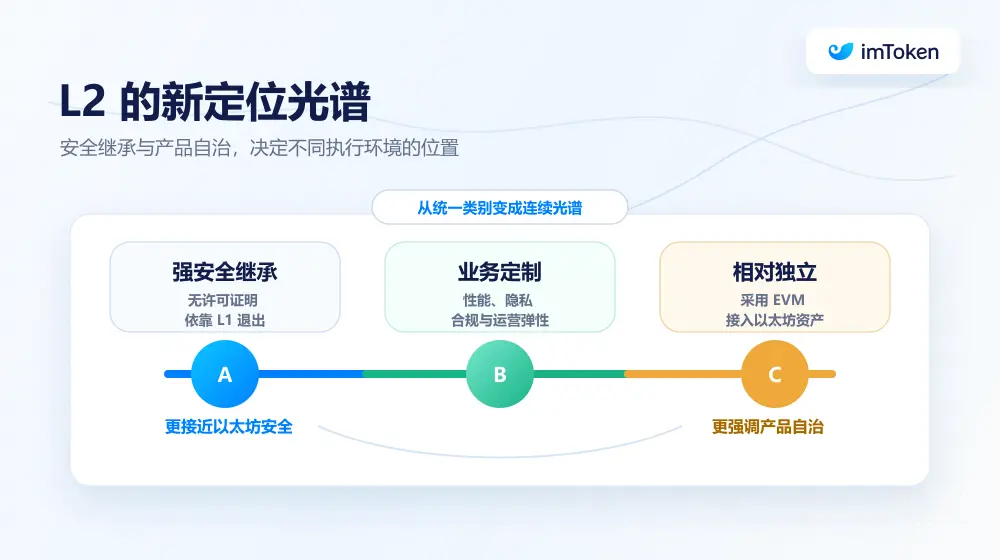
This essentially pushes L2 from a uniform technical category towards a more complex continuum:

  • At one end of the spectrum are Rollups that aim to inherit as many of Ethereum's security properties as possible, seeking to reduce multisig security committees, open permissionless proof mechanisms, and ensure users can still exit to L1 even if operators cease functioning.
  • In the middle are execution environments that inherit some Ethereum properties based on business needs, potentially possessing stronger management permissions, independent sequencers, or specific compliance designs in exchange for performance, privacy, and operational flexibility.
  • At the other end might be chains that adopt EVM, use Ethereum assets, or connect to some cross-chain facilities, but are relatively independent in terms of security and settlement.

This is why Ethereum isn't abandoning L2s, but rather redefining the division of labor. Essentially, over the past 3-5 years, L2 first and foremost represented a scaling technology; in the future, it is more likely to represent a set of execution environments that establish different security, settlement, and liquidity relationships with Ethereum.
2. Interoperability Isn't Just About Cross-Chain, But How States Trust Each Other

However, as Ethereum scales into a system comprising numerous L2s, another perennial issue gradually surfaces: the proliferation of L2s inevitably fragments liquidity, account states, and application experiences.

This has been vividly demonstrated in actual usage over the past few years. For instance, users might hold assets on one chain, use applications on another, and need to go to a third chain to complete a transaction. This results in the same stable币 having different versions across networks, and the same account needing to handle different Gas Tokens, bridges, and asset entry points.

Therefore, interoperability has become an increasingly important part of Ethereum's roadmap.

The Ethereum protocol team has focused its 2026 "Improve UX" roadmap on two directions: native account abstraction and interoperability, believing the core to solving L2 fragmentation lies in making Ethereum "feel like one chain again." This vision relies on the maturation of intent-based architecture.

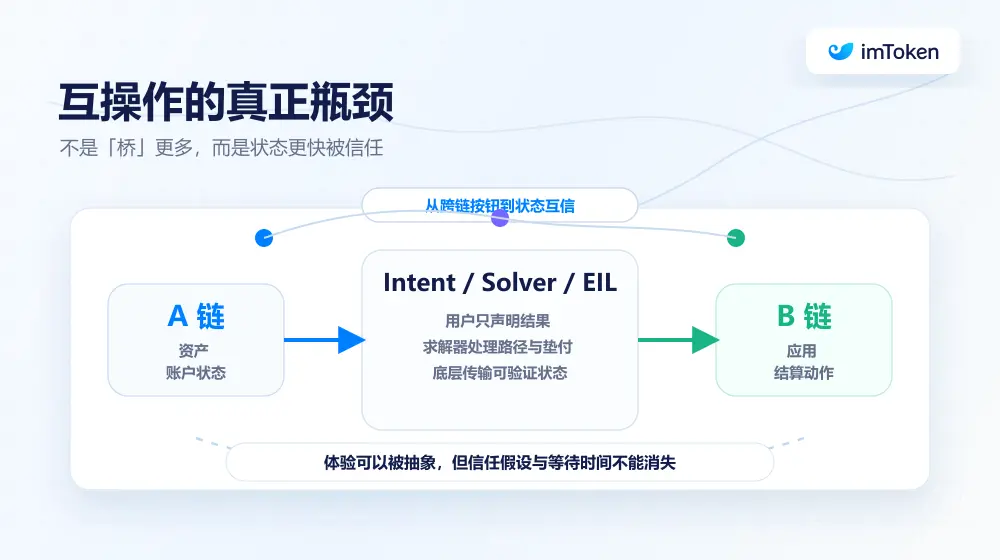
  • Among them, the Open Intents Framework allows users to simply declare their desired outcome, such as "convert a certain asset on Chain A to USDC on Chain B," with solvers handling path computation, bridging, execution, and fund rebalancing behind the scenes.
  • A step further, the Ethereum Interoperability Layer (EIL) attempts to build a trustless transport layer, aiming for cross-L2 transactions to have an experience indistinguishable from single-chain transactions.

On the account side, EIP-7702 in the Pectra upgrade already allows traditional EOAs to temporarily execute smart contract code, supporting transaction batching, gas sponsorship, and recovery mechanisms. Subsequent native account abstraction proposals, represented by EIP-8141, aim to further embed smart account logic into the protocol, making smart contract wallets the default account form and reducing reliance on additional Bundlers, Relayers, and intermediary services.

The L1 Fast Finality proposal attempts to provide a stronger confirmation signal within tens of seconds, before full finality is achieved, significantly shortening application wait times in most normal scenarios. This directly benefits all cross-chain applications relying on L1 finality, which is crucial for bridges, stablecoin settlement, and RWA asset trading.

Because the real bottleneck for many cross-chain interactions isn't whether a message can be sent, but when the target chain can be sufficiently confident that the state on the source chain will not be reverted.

A commonly overlooked point is that a transaction being included in a block does not mean it has achieved finality—from a user's perspective, a transaction might show success within seconds, but for bridges, exchanges, lending protocols, and cross-chain solvers, they still need to assess the possibility of this transaction being affected by a chain reorganization, and whether they can release assets or execute the next operation on another chain based on it.

This is why many cross-chain services today that appear "instant" do not actually wait for the source chain to achieve finality; rather, solvers or liquidity providers advance the funds. This mechanism optimizes user experience but doesn't make the underlying wait time disappear.
Therefore, Ethereum's long-term goal is to gradually shorten finality itself from minutes to seconds. However, this is not a single upgrade scheduled for deployment, but a set of research tasks requiring phased advancement, including decoupling finality votes from fork choice, optimizing validator sets, vote aggregation and network propagation, and gradually changing the consensus protocol.

Overall, good interoperability experience is not about giving dozens of chains the same cross-chain button, but about enabling different execution environments to trust each other's states faster and at lower cost.

3. When L1 Becomes a Rollup, Does the Layered Boundary Still Exist?

If the repositioning of L2s and shortening finality are adjustments within the existing layered architecture, then another point raised by Barnabé touches the very definition of L1 and L2: with proof systems entering the Ethereum mainnet, L1 may eventually also become a sort of "rollup of itself."

This sounds somewhat counterintuitive.

After all, a rollup is typically understood as a scaling network built on top of L1; it executes transactions externally, with L1 validating the state results. So how could Ethereum, being the underlying consensus and settlement network, become its own L2?

Understanding this viewpoint requires first separating "Rollup" from the hierarchical relationship. In today's Ethereum, after a node receives a block, it needs to re-execute all transactions within, independently compute state changes, and judge whether the block adheres to protocol rules.

This model ensures nodes can verify independently, but it also means the network's overall execution capacity must be constrained by ordinary nodes' hardware capabilities. The more computation in a block, the more hardware and time validators need to complete execution.

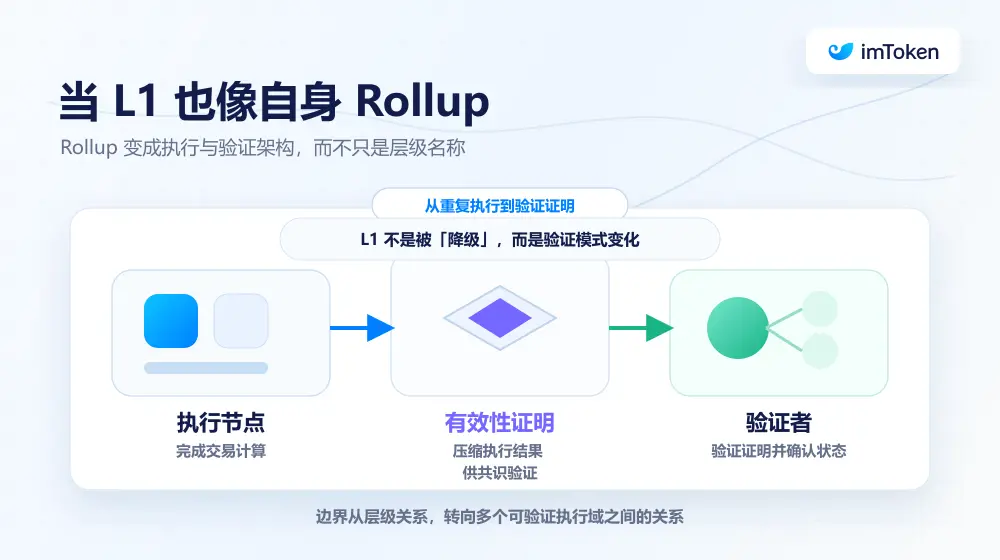
In the future, as real-time proofs and L1 zkEVM mature, transactions can still be computed by high-performance execution nodes, but ordinary validators may not need to personally re-execute every transaction. For instance, after an execution node completes computation and generates a validity proof, other validators only need to verify the smaller, cheaper proof to confirm the state transition is correct.

From the perspective of the relationship between execution and verification, this indeed shares similarities with Rollups: a subset of participants is responsible for high-performance execution, execution results are compressed into cryptographic proofs, and a broader set of consensus participants no longer repeats all computations, but verifies proofs and confirms the final state.

Therefore, Barnabé's phrase "L1 becoming its own rollup" is better understood as a summary of this verification paradigm, not that the Ethereum mainnet will be placed on another underlying chain or be "demoted" to its own L2.

His point is that when proofs gradually replace repeated execution by all nodes, a rollup may no longer be just a layer name above L1, but become a more general execution and verification architecture.
This will further blur the traditional boundary between L1 and L2.

On one hand, L1 can expand its own execution capacity with zkEVM proofs; on the other hand, Native Rollups aim to allow L2s to more directly invoke validation capabilities within the Ethereum protocol, with L1 validating L2 state transitions in a more native, unified manner.

Today, different Rollups typically need to build their own proof systems, verification contracts, upgrade mechanisms, and security committees. Once a proof system has errors, a protocol needs emergency upgrades, or an operator fails, users often still rely on additional governance and trust structures. The long-term direction of Native Rollups is to turn part of the Rollup validation logic into a native Ethereum capability, allowing L2s to reduce self-built security structures, inherit L1's state transition rules more completely, and potentially move away from security committees.

Going a step further, when multiple L2s can rely on faster L1 confirmation, unified proof mechanisms, and synchronous composability to access each other's states, their relationship with the mainnet may no longer be connected by bridges as it is today.

They would be more like multiple execution domains under the same Ethereum consensus, some responsible for general finance, some for gaming, social, or payments, some providing privacy or special compliance capabilities. They have different execution logics and product forms, yet collectively rely on a set of verifiable state, security foundations, and asset settlement systems.

Of course, this remains a long-term direction.

But regardless of the final form these technologies take, they have already transformed the L1-L2 boundary from a clear architectural line into a spectrum of different degrees of security inheritance.

In Conclusion

Long-divided, must unite; long-united, must divide.

Ethereum once gained global composability through shared state; later, it split execution out via Rollups to gain greater capacity. Now, its task is to reconnect the fragmented assets, accounts, and applications without undoing the scaling achievements.

For ordinary users, the ideal Ethereum should never be a network map of dozens of chains, different Gas tokens, and bridges. Where transactions execute, where liquidity comes from, and who ultimately settles can gradually be handled by wallets, applications, and underlying protocols. However, the trust assumptions, security boundaries, and exit paths involved cannot be hidden along with the operational experience.

Therefore, the endgame for L2s is perhaps neither replacing L1 nor being made obsolete by an increasingly scalable L1. Instead, it is to become a set of execution environments with different functionalities and performances, yet sharing security, liquidity, and state relationships.

In the past, Ethereum gained greater capacity by splitting execution apart.

In the next phase, let's see if, after being split apart, it can still be put back together as one Ethereum.


Criptos en tendencia

Preguntas relacionadas

QAccording to the article, what is the main reason for the shift in the division of roles between L1 and L2?

AThe shift is driven by the premise that L1 is no longer just a low-throughput settlement layer. With advancements like increased Gas Limit, statelessness, and zkEVM verification, Ethereum L1 is enhancing its own scalability. This means L2 can no longer justify its long-term value solely based on being 'faster and cheaper.' L2 must now focus on providing differentiated needs that L1 cannot uniformly satisfy, such as application-specific optimizations, privacy features, and more flexible governance and economic models.

QWhat is the primary goal of the 'Scale' roadmap that merged the previously separate 'Expanding L1' and 'Expanding Blob' workstreams?

AThe primary goal of the unified 'Scale' roadmap is to approach L1 and L2 scaling not as two separate tasks, but from the perspective of the entire system. It aims to reallocate execution, consensus, and data capacity holistically, allowing Ethereum to become a more powerful, permissionless, and resilient global hub for settlement, shared state, liquidity, and DeFi.

QHow does the article define the spectrum of future L2 roles in relation to Ethereum L1?

AThe article defines a complex continuous spectrum for L2 roles. At one end are Rollups that inherit as much of Ethereum's security properties as possible. In the middle are execution environments that inherit some Ethereum properties for specific business needs like performance or privacy. At the other end are chains that are relatively independent in security and settlement but might use EVM, Ethereum assets, or cross-chain facilities. Thus, L2 will represent a set of execution environments with different security, settlement, and liquidity relationships with Ethereum.

QWhat does the researcher Barnabé Monnot suggest about the future relationship between L1 and Rollup architecture?

ABarnabé Monnot suggests that as proof systems gradually enter the mainnet validation process, L1 itself could become a 'rollup of itself' in a sense. This means that with technologies like real-time proofs and L1 zkEVM, high-performance nodes could execute transactions and generate validity proofs. Other validators would then verify these proofs instead of re-executing every transaction, blurring the traditional boundary between L1 and L2. In this future, 'Rollup' might become a more generic execution and verification architecture rather than just a layer above L1.

QWhat are the two key directions of Ethereum's 'Improve UX' roadmap for 2026, as mentioned in the article, to address L2 fragmentation?

AThe two key directions are native account abstraction and interoperability. The goal is to make Ethereum 'feel like one chain again.' This relies on the maturity of intent-based architectures like the Open Intents Framework (which lets users declare desired outcomes) and the Ethereum Interoperability Layer (EIL), which aims to build a trustless transport layer for seamless cross-L2 transactions.

Lecturas Relacionadas

Are Kalshi and Polymarket Founders at Odds? This Business Rivalry Is More Brutal Than You Think

"The Rivalry Between Kalshi and Polymarket Founders Turns Bitter and Litigious" The intense feud between Tarek Mansour, CEO of Kalshi, and Shayne Coplan, founder of Polymarket, has escalated far beyond typical business competition into personal animosity and regulatory battles. Both lead billion-dollar prediction market platforms, but their approaches differ sharply. Kalshi positions itself as the compliant operator, securing U.S. regulatory approval before launching. In contrast, Polymarket initially operated offshore, allowing U.S. users to access its platform via VPN, which drew regulatory scrutiny. The conflict reached a peak in November 2024 when FBI agents raided Coplan's New York apartment. While Coplan publicly blamed political motives, his team privately suspected Kalshi was involved. According to sources, Kalshi's lawyers had previously reported Polymarket's operations to federal prosecutors, highlighting its accessibility to U.S. users despite a ban. This incident fueled mutual accusations and underhanded tactics, including social media smear campaigns and attempts to sabotage each other's major business deals. Their rivalry also played out in Washington, influencing regulatory debates. Kalshi actively lobbied against Polymarket's practices, framing them as illegal and unethical. Polymarket, after facing a CFTC fine and investigation, later acquired a licensed U.S. firm to launch a domestic app, regaining a foothold. Despite the hostility, both companies have seen massive growth, with combined trading volumes soaring. However, increased regulatory scrutiny, particularly around insider trading on Polymarket's platform, continues to pose challenges. The founders' deep-seated mutual disdain ensures their battle for market dominance remains as much a personal vendetta as a commercial one.

marsbitHace 6 min(s)

Are Kalshi and Polymarket Founders at Odds? This Business Rivalry Is More Brutal Than You Think

marsbitHace 6 min(s)

Bank of America Quietly Positions: Could $6 Trillion in Bank Deposits Flow into Stablecoins?

Bank of America (BofA) is making strategic moves in digital assets, appointing senior leaders to advance a platform covering stablecoins, tokenized deposits, custody, and crypto settlement. This comes amid a broader discussion about the potential migration of trillions in bank deposits to stablecoins. A cited TBAC report estimated up to $6.6 trillion in transactional deposits could be at risk of moving to stablecoins long-term, a point BofA's CEO previously conditioned on stablecoins being allowed to pay interest. The regulatory landscape is evolving, with the GENIUS Act setting a final implementation deadline for January 2027. Major banks, however, are not waiting; JPMorgan, Citi, BofA, and others are already developing tokenized deposit networks and services. Industry observers note that while retail crypto trading is sluggish, institutional adoption of stablecoins for real-world use cases is driving growth. Despite the activity, some analysts remain cautious, noting banks have a long history of blockchain announcements and that true structural change is slow. The stablecoin market itself has seen a recent dip from its peak. Optimistic projections, however, foresee significant growth, with stablecoin settlement volume already reaching $33 trillion in 2025. The race is on for the post-January 2027 landscape, where regulatory clarity is expected to accelerate the fusion of traditional finance and crypto.

marsbitHace 11 min(s)

Bank of America Quietly Positions: Could $6 Trillion in Bank Deposits Flow into Stablecoins?

marsbitHace 11 min(s)

STAR 50 Soars 10.73%, Why Did A-Shares Stage a "V-Shaped Reversal"?

After a prolonged decline, the Chinese A-share market staged a strong rally on July 21. The STAR 50 index surged 10.73%, its largest single-day gain in nearly a year, leading a broad-based "V-shaped" reversal. The Shanghai Composite Index rose 1.79%, the Shenzhen Component Index gained 4.81%, and the ChiNext Index jumped 7.05%. Total market turnover reached 2.97 trillion yuan, an increase of 256.1 billion yuan from the previous session, with over 3,100 stocks advancing. The semiconductor sector spearheaded the rebound, with related ETFs posting significant gains. Analysts attribute the surge to three converging factors. First, coordinated capital inflows from "national team" institutions, insurance funds, listed company buybacks, and fund house self-purchases have bolstered market liquidity and confidence. Second, supportive policy signals, including commitments from regulators to ensure stable market operations, provided a favorable backdrop. Third, a stabilization and recovery in overseas markets, notably South Korea, created a positive external environment. Institutions suggest the most severe panic selling phase for the tech sector has likely passed, following a significant digestion of crowded positions and leveraged funds. While short-term volatility may persist, the medium to long-term outlook remains underpinned by enduring trends like AI computing demand expansion and semiconductor localization. The market's focus now shifts to the sustainability of supportive fund flows, earnings reports, and upcoming catalysts from the global AI industry chain.

marsbitHace 49 min(s)

STAR 50 Soars 10.73%, Why Did A-Shares Stage a "V-Shaped Reversal"?

marsbitHace 49 min(s)

U.S. Tech Momentum Stocks Post Largest Single-Day Gain Ever, But Is the Plunge Over?

US tech momentum stocks staged a sharp rebound on Tuesday (July 21st). Morgan Stanley's TMT Momentum Factor surged over 12%, marking its largest single-day gain on record, exceeding even peaks from the 2000 dot-com bubble. Key momentum indices from Goldman Sachs also posted their strongest daily performances in years. The rally was led by semiconductors, with the Philadelphia Semiconductor Index jumping 4.6%. This rebound followed three consecutive down days and a cumulative 33% plunge in momentum stocks, one of the steepest drawdowns since the dot-com era. Analysts attribute the surge largely to a short squeeze. Heavy selling had pushed high-beta momentum stocks into deeply oversold territory, forcing many short sellers, particularly in Asia, to cover their positions, creating a self-reinforcing buying spiral. However, the rebound's internals appear weak. Trading volume was notably low, and advancing stocks still lagged decliners on the S&P 500, indicating a narrow, concentrated rally rather than broad market participation. Diverging views emerge on the outlook. BTIG warns the bounce has hit key resistance and recommends selling into strength, citing extreme volatility and historical parallels to past market tops. Conversely, Goldman Sachs and UBS believe the momentum unwind is nearing its end, suggesting it may be time to gradually add exposure, as positioning has been significantly reduced. They caution, however, that high volatility warrants a measured approach, potentially using defined-risk strategies. The upcoming earnings season, particularly reports from major tech firms like Alphabet, is seen as a critical test for the rally's sustainability. Simultaneously, bond markets flashed a warning, with yields rising partly due to spiking oil prices. Analysts note that if long-term Treasury yields break decisively higher, it could pose a significant headwind for equities, especially growth stocks.

marsbitHace 56 min(s)

U.S. Tech Momentum Stocks Post Largest Single-Day Gain Ever, But Is the Plunge Over?

marsbitHace 56 min(s)

Trading

Spot

Artículos destacados

Qué es $S$

Entendiendo SPERO: Una Visión General Completa Introducción a SPERO A medida que el panorama de la innovación continúa evolucionando, la aparición de tecnologías web3 y proyectos de criptomonedas juega un papel fundamental en la configuración del futuro digital. Un proyecto que ha atraído la atención en este campo dinámico es SPERO, denotado como SPERO,$$s$. Este artículo tiene como objetivo reunir y presentar información detallada sobre SPERO, para ayudar a entusiastas e inversores a comprender sus fundamentos, objetivos e innovaciones dentro de los dominios web3 y cripto. ¿Qué es SPERO,$$s$? SPERO,$$s$ es un proyecto único dentro del espacio cripto que busca aprovechar los principios de descentralización y tecnología blockchain para crear un ecosistema que promueva la participación, la utilidad y la inclusión financiera. El proyecto está diseñado para facilitar interacciones de igual a igual de nuevas maneras, proporcionando a los usuarios soluciones y servicios financieros innovadores. En su esencia, SPERO,$$s$ tiene como objetivo empoderar a los individuos al proporcionar herramientas y plataformas que mejoren la experiencia del usuario en el espacio de las criptomonedas. Esto incluye habilitar métodos de transacción más flexibles, fomentar iniciativas impulsadas por la comunidad y crear caminos para oportunidades financieras a través de aplicaciones descentralizadas (dApps). La visión subyacente de SPERO,$$s$ gira en torno a la inclusividad, buscando cerrar brechas dentro de las finanzas tradicionales mientras aprovecha los beneficios de la tecnología blockchain. ¿Quién es el Creador de SPERO,$$s$? La identidad del creador de SPERO,$$s$ sigue siendo algo oscura, ya que hay recursos públicos limitados que proporcionan información de fondo detallada sobre su(s) fundador(es). Esta falta de transparencia puede derivarse del compromiso del proyecto con la descentralización, una ética que muchos proyectos web3 comparten, priorizando las contribuciones colectivas sobre el reconocimiento individual. Al centrar las discusiones en torno a la comunidad y sus objetivos colectivos, SPERO,$$s$ encarna la esencia del empoderamiento sin señalar a individuos específicos. Como tal, comprender la ética y la misión de SPERO sigue siendo más importante que identificar a un creador singular. ¿Quiénes son los Inversores de SPERO,$$s$? SPERO,$$s$ cuenta con el apoyo de una diversa gama de inversores que van desde capitalistas de riesgo hasta inversores ángeles dedicados a fomentar la innovación en el sector cripto. El enfoque de estos inversores generalmente se alinea con la misión de SPERO, priorizando proyectos que prometen avances tecnológicos sociales, inclusión financiera y gobernanza descentralizada. Estas fundaciones de inversores suelen estar interesadas en proyectos que no solo ofrecen productos innovadores, sino que también contribuyen positivamente a la comunidad blockchain y sus ecosistemas. El respaldo de estos inversores refuerza a SPERO,$$s$ como un contendiente notable en el dominio de proyectos cripto que evoluciona rápidamente. ¿Cómo Funciona SPERO,$$s$? SPERO,$$s$ emplea un marco multifacético que lo distingue de los proyectos de criptomonedas convencionales. Aquí hay algunas de las características clave que subrayan su singularidad e innovación: Gobernanza Descentralizada: SPERO,$$s$ integra modelos de gobernanza descentralizada, empoderando a los usuarios para participar activamente en los procesos de toma de decisiones sobre el futuro del proyecto. Este enfoque fomenta un sentido de propiedad y responsabilidad entre los miembros de la comunidad. Utilidad del Token: SPERO,$$s$ utiliza su propio token de criptomoneda, diseñado para servir diversas funciones dentro del ecosistema. Estos tokens permiten transacciones, recompensas y la facilitación de servicios ofrecidos en la plataforma, mejorando la participación y la utilidad general. Arquitectura en Capas: La arquitectura técnica de SPERO,$$s$ apoya la modularidad y escalabilidad, permitiendo la integración fluida de características y aplicaciones adicionales a medida que el proyecto evoluciona. Esta adaptabilidad es fundamental para mantener la relevancia en el cambiante paisaje cripto. Participación de la Comunidad: El proyecto enfatiza iniciativas impulsadas por la comunidad, empleando mecanismos que incentivan la colaboración y la retroalimentación. Al nutrir una comunidad sólida, SPERO,$$s$ puede abordar mejor las necesidades de los usuarios y adaptarse a las tendencias del mercado. Enfoque en la Inclusión: Al ofrecer tarifas de transacción bajas e interfaces amigables para el usuario, SPERO,$$s$ busca atraer a una base de usuarios diversa, incluyendo a individuos que anteriormente pueden no haber participado en el espacio cripto. Este compromiso con la inclusión se alinea con su misión general de empoderamiento a través de la accesibilidad. Cronología de SPERO,$$s$ Entender la historia de un proyecto proporciona información crucial sobre su trayectoria de desarrollo y hitos. A continuación se presenta una cronología sugerida que mapea eventos significativos en la evolución de SPERO,$$s$: Fase de Conceptualización e Ideación: Las ideas iniciales que forman la base de SPERO,$$s$ fueron concebidas, alineándose estrechamente con los principios de descentralización y enfoque comunitario dentro de la industria blockchain. Lanzamiento del Whitepaper del Proyecto: Tras la fase conceptual, se lanzó un whitepaper completo que detalla la visión, los objetivos y la infraestructura tecnológica de SPERO,$$s$ para generar interés y retroalimentación de la comunidad. Construcción de Comunidad y Primeras Interacciones: Se realizaron esfuerzos de divulgación activa para construir una comunidad de primeros adoptantes y posibles inversores, facilitando discusiones en torno a los objetivos del proyecto y obteniendo apoyo. Evento de Generación de Tokens: SPERO,$$s$ llevó a cabo un evento de generación de tokens (TGE) para distribuir sus tokens nativos a los primeros seguidores y establecer liquidez inicial dentro del ecosistema. Lanzamiento de la dApp Inicial: La primera aplicación descentralizada (dApp) asociada con SPERO,$$s$ se puso en marcha, permitiendo a los usuarios interactuar con las funcionalidades centrales de la plataforma. Desarrollo Continuo y Alianzas: Actualizaciones y mejoras continuas a las ofertas del proyecto, incluyendo alianzas estratégicas con otros actores en el espacio blockchain, han moldeado a SPERO,$$s$ en un jugador competitivo y en evolución en el mercado cripto. Conclusión SPERO,$$s$ se erige como un testimonio del potencial de web3 y las criptomonedas para revolucionar los sistemas financieros y empoderar a los individuos. Con un compromiso con la gobernanza descentralizada, la participación comunitaria y funcionalidades diseñadas de manera innovadora, allana el camino hacia un paisaje financiero más inclusivo. Como con cualquier inversión en el espacio cripto que evoluciona rápidamente, se anima a los posibles inversores y usuarios a investigar a fondo y participar de manera reflexiva con los desarrollos en curso dentro de SPERO,$$s$. El proyecto muestra el espíritu innovador de la industria cripto, invitando a una mayor exploración de sus innumerables posibilidades. Mientras el viaje de SPERO,$$s$ aún se desarrolla, sus principios fundamentales pueden, de hecho, influir en el futuro de cómo interactuamos con la tecnología, las finanzas y entre nosotros en ecosistemas digitales interconectados.

150 Vistas totalesPublicado en 2024.12.17Actualizado en 2024.12.17

Qué es $S$

Qué es AGENT S

Agent S: El Futuro de la Interacción Autónoma en Web3 Introducción En el paisaje en constante evolución de Web3 y las criptomonedas, las innovaciones están redefiniendo constantemente cómo los individuos interactúan con las plataformas digitales. Uno de estos proyectos pioneros, Agent S, promete revolucionar la interacción humano-computadora a través de su marco agente abierto. Al allanar el camino para interacciones autónomas, Agent S busca simplificar tareas complejas, ofreciendo aplicaciones transformadoras en inteligencia artificial (IA). Esta exploración detallada profundizará en las complejidades del proyecto, sus características únicas y las implicaciones para el dominio de las criptomonedas. ¿Qué es Agent S? Agent S se presenta como un marco agente abierto innovador, diseñado específicamente para abordar tres desafíos fundamentales en la automatización de tareas informáticas: Adquisición de Conocimiento Específico del Dominio: El marco aprende inteligentemente de diversas fuentes de conocimiento externas y experiencias internas. Este enfoque dual le permite construir un rico repositorio de conocimiento específico del dominio, mejorando su rendimiento en la ejecución de tareas. Planificación a Largo Plazo de Tareas: Agent S emplea planificación jerárquica aumentada por la experiencia, un enfoque estratégico que facilita la descomposición y ejecución eficiente de tareas complejas. Esta característica mejora significativamente su capacidad para gestionar múltiples subtareas de manera eficiente y efectiva. Manejo de Interfaces Dinámicas y No Uniformes: El proyecto introduce la Interfaz Agente-Computadora (ACI), una solución innovadora que mejora la interacción entre agentes y usuarios. Utilizando Modelos de Lenguaje Multimodal de Gran Escala (MLLMs), Agent S puede navegar y manipular diversas interfaces gráficas de usuario sin problemas. A través de estas características pioneras, Agent S proporciona un marco robusto que aborda las complejidades involucradas en la automatización de la interacción humana con las máquinas, preparando el terreno para una multitud de aplicaciones en IA y más allá. ¿Quién es el Creador de Agent S? Si bien el concepto de Agent S es fundamentalmente innovador, la información específica sobre su creador sigue siendo elusiva. El creador es actualmente desconocido, lo que resalta ya sea la etapa incipiente del proyecto o la elección estratégica de mantener a los miembros fundadores en el anonimato. Independientemente de la anonimidad, el enfoque sigue siendo en las capacidades y el potencial del marco. ¿Quiénes son los Inversores de Agent S? Dado que Agent S es relativamente nuevo en el ecosistema criptográfico, la información detallada sobre sus inversores y patrocinadores financieros no está documentada explícitamente. La falta de información disponible públicamente sobre las bases de inversión u organizaciones que apoyan el proyecto plantea preguntas sobre su estructura de financiamiento y hoja de ruta de desarrollo. Comprender el respaldo es crucial para evaluar la sostenibilidad del proyecto y su posible impacto en el mercado. ¿Cómo Funciona Agent S? En el núcleo de Agent S se encuentra una tecnología de vanguardia que le permite funcionar de manera efectiva en diversos entornos. Su modelo operativo se basa en varias características clave: Interacción Humano-Computadora Similar a la Humana: El marco ofrece planificación avanzada de IA, esforzándose por hacer que las interacciones con las computadoras sean más intuitivas. Al imitar el comportamiento humano en la ejecución de tareas, promete elevar las experiencias de los usuarios. Memoria Narrativa: Empleada para aprovechar experiencias de alto nivel, Agent S utiliza memoria narrativa para hacer un seguimiento de las historias de tareas, mejorando así sus procesos de toma de decisiones. Memoria Episódica: Esta característica proporciona a los usuarios una guía paso a paso, permitiendo que el marco ofrezca apoyo contextual a medida que se desarrollan las tareas. Soporte para OpenACI: Con la capacidad de ejecutarse localmente, Agent S permite a los usuarios mantener el control sobre sus interacciones y flujos de trabajo, alineándose con la ética descentralizada de Web3. Fácil Integración con APIs Externas: Su versatilidad y compatibilidad con varias plataformas de IA aseguran que Agent S pueda encajar sin problemas en ecosistemas tecnológicos existentes, convirtiéndolo en una opción atractiva para desarrolladores y organizaciones. Estas funcionalidades contribuyen colectivamente a la posición única de Agent S dentro del espacio cripto, ya que automatiza tareas complejas y de múltiples pasos con una intervención humana mínima. A medida que el proyecto evoluciona, sus posibles aplicaciones en Web3 podrían redefinir cómo se desarrollan las interacciones digitales. Cronología de Agent S El desarrollo y los hitos de Agent S pueden encapsularse en una cronología que resalta sus eventos significativos: 27 de septiembre de 2024: El concepto de Agent S fue lanzado en un documento de investigación integral titulado “Un Marco Agente Abierto que Usa Computadoras Como un Humano”, mostrando las bases del proyecto. 10 de octubre de 2024: El documento de investigación fue puesto a disposición del público en arXiv, ofreciendo una exploración profunda del marco y su evaluación de rendimiento basada en el benchmark OSWorld. 12 de octubre de 2024: Se lanzó una presentación en video, proporcionando una visión visual de las capacidades y características de Agent S, involucrando aún más a posibles usuarios e inversores. Estos marcadores en la cronología no solo ilustran el progreso de Agent S, sino que también indican su compromiso con la transparencia y la participación comunitaria. Puntos Clave Sobre Agent S A medida que el marco Agent S continúa evolucionando, varios atributos clave destacan, subrayando su naturaleza innovadora y potencial: Marco Innovador: Diseñado para proporcionar un uso intuitivo de las computadoras similar a la interacción humana, Agent S aporta un enfoque novedoso a la automatización de tareas. Interacción Autónoma: La capacidad de interactuar de manera autónoma con las computadoras a través de GUI significa un salto hacia soluciones informáticas más inteligentes y eficientes. Automatización de Tareas Complejas: Con su metodología robusta, puede automatizar tareas complejas y de múltiples pasos, haciendo que los procesos sean más rápidos y menos propensos a errores. Mejora Continua: Los mecanismos de aprendizaje permiten a Agent S mejorar a partir de experiencias pasadas, mejorando continuamente su rendimiento y eficacia. Versatilidad: Su adaptabilidad en diferentes entornos operativos como OSWorld y WindowsAgentArena asegura que pueda servir a una amplia gama de aplicaciones. A medida que Agent S se posiciona en el paisaje de Web3 y criptomonedas, su potencial para mejorar las capacidades de interacción y automatizar procesos significa un avance significativo en las tecnologías de IA. A través de su marco innovador, Agent S ejemplifica el futuro de las interacciones digitales, prometiendo una experiencia más fluida y eficiente para los usuarios en diversas industrias. Conclusión Agent S representa un audaz avance en la unión de la IA y Web3, con la capacidad de redefinir cómo interactuamos con la tecnología. Aunque aún se encuentra en sus primeras etapas, las posibilidades para su aplicación son vastas y atractivas. A través de su marco integral que aborda desafíos críticos, Agent S busca llevar las interacciones autónomas al primer plano de la experiencia digital. A medida que nos adentramos más en los reinos de las criptomonedas y la descentralización, proyectos como Agent S sin duda desempeñarán un papel crucial en la configuración del futuro de la tecnología y la colaboración humano-computadora.

561 Vistas totalesPublicado en 2025.01.14Actualizado en 2025.01.14

Qué es AGENT S

Cómo comprar S

¡Bienvenido a HTX.com! Hemos hecho que comprar Sonic (S) sea simple y conveniente. Sigue nuestra guía paso a paso para iniciar tu viaje de criptos.Paso 1: crea tu cuenta HTXUtiliza tu correo electrónico o número de teléfono para registrarte y obtener una cuenta gratuita en HTX. Experimenta un proceso de registro sin complicaciones y desbloquea todas las funciones.Obtener mi cuentaPaso 2: ve a Comprar cripto y elige tu método de pagoTarjeta de crédito/débito: usa tu Visa o Mastercard para comprar Sonic (S) al instante.Saldo: utiliza fondos del saldo de tu cuenta HTX para tradear sin problemas.Terceros: hemos agregado métodos de pago populares como Google Pay y Apple Pay para mejorar la comodidad.P2P: tradear directamente con otros usuarios en HTX.Over-the-Counter (OTC): ofrecemos servicios personalizados y tipos de cambio competitivos para los traders.Paso 3: guarda tu Sonic (S)Después de comprar tu Sonic (S), guárdalo en tu cuenta HTX. Alternativamente, puedes enviarlo a otro lugar mediante transferencia blockchain o utilizarlo para tradear otras criptomonedas.Paso 4: tradear Sonic (S)Tradear fácilmente con Sonic (S) en HTX's mercado spot. Simplemente accede a tu cuenta, selecciona tu par de trading, ejecuta tus trades y monitorea en tiempo real. Ofrecemos una experiencia fácil de usar tanto para principiantes como para traders experimentados.

1.1k Vistas totalesPublicado en 2025.01.15Actualizado en 2026.06.02

Cómo comprar S

Discusiones

Bienvenido a la comunidad de HTX. Aquí puedes mantenerte informado sobre los últimos desarrollos de la plataforma y acceder a análisis profesionales del mercado. A continuación se presentan las opiniones de los usuarios sobre el precio de S (S).

活动图片