TRON Integration Pushes Kolo Further Into Real-World Stablecoin Payments – Details

bitcoinistPublicado a 2026-02-05Actualizado a 2026-02-05

Resumen

Kolo's integration with the TRON network enables direct TRC-20 USDT transfers to Kolo cards, allowing near-real-time settlement after on-chain confirmation. This move aims to reduce reliance on traditional exchanges and banking systems, streamlining the use of on-chain liquidity for everyday payments. Amid broader crypto volatility, TRON is defending the $0.30 price level, with its technical structure remaining intact despite market weakness. TRX continues to trade within a key consolidation range, supported by rising long-term moving averages and declining selling pressure. Kolo has processed over $250 million in transactions, with 30% occurring on the TRON network, highlighting TRON’s growing role in real-world payments. Lower transaction costs and faster confirmations make TRON suitable for frequent, smaller transactions. The network has also surpassed Ethereum in USDT circulating supply, reflecting its increasing adoption in practical, real-world stablecoin usage.

Trusted Editorial content, reviewed by leading industry experts and seasoned editors. Ad Disclosure

TRON is attempting to defend the $0.30 level as broader crypto markets remain under sustained selling pressure and risk appetite stays fragile. Price action across major assets has been dominated by deleveraging and reduced spot participation, leaving altcoins particularly exposed to downside volatility. Within this context, TRON’s ability to hold key technical levels is being closely watched, not only as a price signal but also as a reflection of ongoing network activity and real-world usage.

Against this uncertain market backdrop, Kolo announced its integration with the TRON network, enabling direct TRC-20 USDT transfers to Kolo cards with near-real-time settlement following on-chain confirmation. The integration allows funds to move from the TRON network to payment cards without relying on traditional exchange withdrawals or banking rails, reducing settlement delays that have historically limited practical usage of on-chain liquidity.

Rather than signaling speculative expansion, this development highlights an operational use case at a time when markets are contracting. With stablecoin flows increasingly concentrated on the TRC-20 USDT standard, the integration underscores how existing blockchain infrastructure is being used to support everyday transactions even during market stress.

TRON’s Growing Role in Stablecoin Payments

Recent data around Kolo provides useful context for understanding TRON’s role in today’s stablecoin market. Kolo has processed more than $250 million in total transaction volume to date, with roughly 30% of that activity executed directly on the TRON network. This concentration is notable given the broad range of chains available for stablecoin transfers and points to sustained usage rather than short-term experimentation.

The platform has also recorded a high number of individual deposits, reinforcing the idea that TRC-20 USDT is increasingly used as a settlement rail for everyday payments and routine transfers, rather than solely for trading or arbitrage.

Lower transaction costs and faster confirmation times make the TRON network particularly suited for smaller, frequent payments, which tend to dominate real-world spending behavior. Kolo’s design emphasizes speed and operational simplicity, allowing users to open an account, complete verification, and begin spending within minutes, while remaining fully compliant with global KYC and AML requirements.

At the network level, this activity aligns with a broader structural shift. TRON has now surpassed Ethereum in USDT circulating supply, reflecting where stablecoins are actually being held and moved at scale.
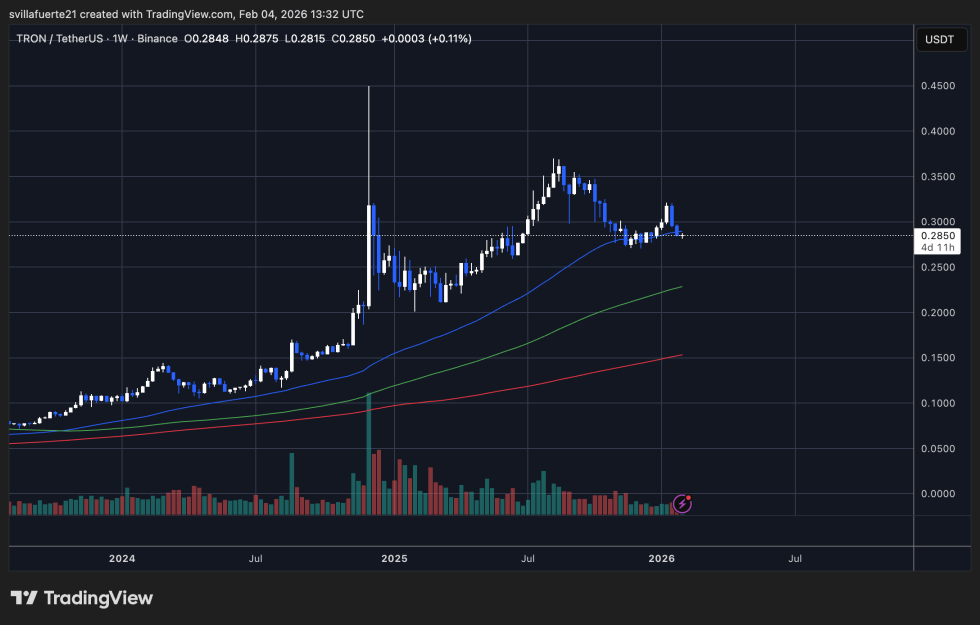

TRX Price Holds Key Structure Amid Market Weakness

TRON (TRX) continues to trade near the $0.28–$0.30 zone, a level that has become structurally important on the weekly chart. After a strong advance throughout 2024, price entered a consolidation phase following the sharp spike and rejection above the $0.35 area. Since then, TRX has been moving sideways, suggesting the market is digesting prior gains rather than entering a clear distribution phase.

TRX testing critical demand level | Source: TRXUSDT chart on TradingView

From a trend perspective, the broader structure remains constructive. Price is still holding above the rising 100-week moving average (blue), which has acted as dynamic support during pullbacks. The 200-week moving average (green) continues to slope higher well below the current price, reinforcing that the long-term trend remains intact despite recent volatility. The 50-week moving average (red) also continues to rise, indicating that long-term momentum has not yet broken.

Volume behavior supports this interpretation. The largest volume spike occurred during the impulsive rally, while recent weeks show declining activity, consistent with consolidation rather than aggressive selling. This suggests sellers are not pressing the market with urgency.

However, the inability to decisively reclaim and hold above $0.30 highlights near-term caution. A sustained break below the $0.27–$0.28 range would weaken the structure and expose deeper support near the 100-week average. Conversely, a clean weekly close above $0.30 would signal renewed strength and open the door for a retest of prior highs.

Featured image from ChatGPT, chart from TradingView.com 

Editorial Process for bitcoinist is centered on delivering thoroughly researched, accurate, and unbiased content. We uphold strict sourcing standards, and each page undergoes diligent review by our team of top technology experts and seasoned editors. This process ensures the integrity, relevance, and value of our content for our readers.

Sebastian Villafuerte

Follow

Sebastian's journey into the world of crypto began four years ago, driven by a fascination with the potential of blockchain technology to revolutionize financial systems. His initial exploration focused on understanding the intricacies of various crypto projects, particularly those focused on building innovative financial solutions. Through countless hours of research and learning, Sebastian developed a deep understanding of the underlying technologies, market dynamics, and potential applications of cryptocurrencies. As his knowledge grew, Sebastian felt compelled to share his insights with others. He began actively contributing to online discussions on platforms like X and LinkedIn, focusing on fintech and crypto-related content. His goal was to expose valuable trends and insights to a wider audience, fostering a deeper understanding of the rapidly evolving crypto landscape. Sebastian's contributions quickly gained recognition, and he became a trusted voice in the online crypto community. To further enhance his expertise, Sebastian pursued a UC Berkeley Fintech: Frameworks, Applications, and Strategies certification. This rigorous program equipped him with valuable skills and knowledge regarding Financial Technology, bridging the gap between traditional finance (TradFi) and decentralized finance (DeFi). The certification deepened his understanding of the broader financial landscape and its intersection with blockchain technology. Sebastian's passion for finance and writing is evident in his work. He enjoys delving into financial research, analyzing market trends, and exploring the latest developments in the crypto space. In his spare time, Sebastian can often be found immersed in charts, studying 10-K forms, or engaging in thought-provoking discussions about the future of finance. Sebastian's journey as a crypto analyst and investor has been marked by a relentless pursuit of knowledge and a dedication to sharing his insights. His ability to navigate the complex world of crypto, combined with his passion for financial research and communication, makes him a valuable asset to the industry. As the crypto landscape continues to evolve, Sebastian remains at the forefront, providing valuable insights and contributing to the growth of this revolutionary technology.

Full Profile

Related Posts

Les altcoins dans le rouge : l’altseason n’aura plus jamais lieu sur le marché crypto ?

Claude IA évoque une phase haussière sur les cryptomonnaies : trois jetons à surveiller en février 2026

Famous Analyst Says Altcoin Holders Will Be Disappointed, Bitcoin Rotation Not Coming?

Cardano’s Big Rally In Sight? ADA’s Interest Sees Subtle Shift As Smart Money Accumulates

From Boom To Goodbye: NFT Marketplace Nifty Gateway To End Operations

ONDO’s Silent Accumulation: Whales Absorb The 1.94B Unlock While Price Bleeds

Criptos en tendencia

Preguntas relacionadas

QWhat is the significance of Kolo's integration with the TRON network?

AThe integration enables direct TRC-20 USDT transfers to Kolo cards with near-real-time settlement, allowing funds to move from the TRON network to payment cards without relying on traditional exchange withdrawals or banking rails. This reduces settlement delays and supports practical usage of on-chain liquidity for everyday transactions.

QWhat percentage of Kolo's total transaction volume is executed on the TRON network?

AApproximately 30% of Kolo's total transaction volume, which is over $250 million, is executed directly on the TRON network.

QWhy is the TRON network particularly suited for real-world payments according to the article?

AThe TRON network is suited for real-world payments due to its lower transaction costs and faster confirmation times, which are ideal for smaller, frequent payments that dominate real-world spending behavior.

QWhat key technical level is TRON (TRX) attempting to defend amidst market weakness?

ATRON (TRX) is attempting to defend the $0.30 level, which is a structurally important zone on the weekly chart. A break below the $0.27–$0.28 range would weaken its market structure.

QHow does the article characterize the current trend and momentum for TRX based on its moving averages?

AThe broader structure remains constructive as TRX is holding above the rising 100-week moving average, and the 200-week moving average continues to slope higher, indicating the long-term trend is intact. The 50-week moving average is also rising, showing that long-term momentum has not broken.

Lecturas Relacionadas

STAR 50 Soars 10.73%, Why Did A-Shares Stage a "V-Shaped Reversal"?

After a prolonged decline, the Chinese A-share market staged a strong rally on July 21. The STAR 50 index surged 10.73%, its largest single-day gain in nearly a year, leading a broad-based "V-shaped" reversal. The Shanghai Composite Index rose 1.79%, the Shenzhen Component Index gained 4.81%, and the ChiNext Index jumped 7.05%. Total market turnover reached 2.97 trillion yuan, an increase of 256.1 billion yuan from the previous session, with over 3,100 stocks advancing. The semiconductor sector spearheaded the rebound, with related ETFs posting significant gains. Analysts attribute the surge to three converging factors. First, coordinated capital inflows from "national team" institutions, insurance funds, listed company buybacks, and fund house self-purchases have bolstered market liquidity and confidence. Second, supportive policy signals, including commitments from regulators to ensure stable market operations, provided a favorable backdrop. Third, a stabilization and recovery in overseas markets, notably South Korea, created a positive external environment. Institutions suggest the most severe panic selling phase for the tech sector has likely passed, following a significant digestion of crowded positions and leveraged funds. While short-term volatility may persist, the medium to long-term outlook remains underpinned by enduring trends like AI computing demand expansion and semiconductor localization. The market's focus now shifts to the sustainability of supportive fund flows, earnings reports, and upcoming catalysts from the global AI industry chain.

marsbitHace 27 min(s)

STAR 50 Soars 10.73%, Why Did A-Shares Stage a "V-Shaped Reversal"?

marsbitHace 27 min(s)

U.S. Tech Momentum Stocks Post Largest Single-Day Gain Ever, But Is the Plunge Over?

US tech momentum stocks staged a sharp rebound on Tuesday (July 21st). Morgan Stanley's TMT Momentum Factor surged over 12%, marking its largest single-day gain on record, exceeding even peaks from the 2000 dot-com bubble. Key momentum indices from Goldman Sachs also posted their strongest daily performances in years. The rally was led by semiconductors, with the Philadelphia Semiconductor Index jumping 4.6%. This rebound followed three consecutive down days and a cumulative 33% plunge in momentum stocks, one of the steepest drawdowns since the dot-com era. Analysts attribute the surge largely to a short squeeze. Heavy selling had pushed high-beta momentum stocks into deeply oversold territory, forcing many short sellers, particularly in Asia, to cover their positions, creating a self-reinforcing buying spiral. However, the rebound's internals appear weak. Trading volume was notably low, and advancing stocks still lagged decliners on the S&P 500, indicating a narrow, concentrated rally rather than broad market participation. Diverging views emerge on the outlook. BTIG warns the bounce has hit key resistance and recommends selling into strength, citing extreme volatility and historical parallels to past market tops. Conversely, Goldman Sachs and UBS believe the momentum unwind is nearing its end, suggesting it may be time to gradually add exposure, as positioning has been significantly reduced. They caution, however, that high volatility warrants a measured approach, potentially using defined-risk strategies. The upcoming earnings season, particularly reports from major tech firms like Alphabet, is seen as a critical test for the rally's sustainability. Simultaneously, bond markets flashed a warning, with yields rising partly due to spiking oil prices. Analysts note that if long-term Treasury yields break decisively higher, it could pose a significant headwind for equities, especially growth stocks.

marsbitHace 34 min(s)

U.S. Tech Momentum Stocks Post Largest Single-Day Gain Ever, But Is the Plunge Over?

marsbitHace 34 min(s)

U.S. Tech Momentum Stocks Record Largest Single-Day Gain Ever, but Has the Rout Ended?

U.S. tech momentum stocks staged a dramatic rebound on Tuesday, July 21st. Key momentum indices like the Morgan Stanley TMT Momentum Factor and Goldman Sachs' High Beta Momentum Long Index posted historic or near-historic single-day gains, fueled largely by semiconductor stocks. This sharp rally followed a severe three-day sell-off that saw momentum stocks plunge 33%, marking one of the steepest pullbacks since the dot-com bubble. Analysts attribute the bounce primarily to a short squeeze, as forced covering from over-leveraged traders, particularly in Asia, created a buying spiral. However, the rally's health is questioned due to weak market breadth—overall trading volume was low, and decliners outnumbered advancers in the S&P 500 despite the index's gain—suggesting a narrow, concentrated surge rather than broad recovery. Opinions on the sustainability diverge. BTIG strategists warn the rebound has hit key resistance levels, citing extreme volatility and historic stock dispersion as signs of an ongoing broader correction, and recommend selling into strength. Conversely, Goldman Sachs and UBS view the aggressive momentum unwinding as nearing its end, noting reduced positioning and a lack of new fundamental catalysts. They suggest the sell-off presents a selective opportunity to add exposure, albeit cautiously and gradually using defined-risk strategies. The immediate trajectory hinges on the ongoing earnings season, with market focus on Alphabet's capital expenditure guidance for AI investment clarity. Meanwhile, bond markets present a risk, with rising Treasury yields—potentially heading toward 5.5%—and widening credit spreads for mega-cap tech companies posing a threat to equity valuations. The combination of technical factors, earnings results, and macro conditions leaves the durability of the rebound in doubt.

链捕手Hace 37 min(s)

U.S. Tech Momentum Stocks Record Largest Single-Day Gain Ever, but Has the Rout Ended?

链捕手Hace 37 min(s)

Long-Divided Must Unite, Long-United Must Divide: When L1 Becomes Its Own Rollup, What Is Ethereum's Endgame?

"The Inevitable Cycle: When L1 Becomes Its Own Rollup – What is Ethereum's Endgame?" For years, the Ethereum community grappled with concerns that L2s were fragmenting the ecosystem and eroding L1's value. While L2s provided cheaper execution, they also splintered liquidity and the unified user experience of a single chain. This has prompted a fundamental reassessment of the relationship between L1 and L2. Ethereum's roadmap is evolving. The "Scale" initiative merges L1 and L2 expansion into a holistic framework. L1 itself is advancing with higher gas limits, statelessness, and zkEVM verification, no longer content to be just a low-throughput settlement layer. Consequently, the primary value proposition of L2s is shifting from merely providing cheap blockspace to offering L1 cannot easily provide: application-specific optimizations, privacy features, and flexible governance models. L2s are becoming a spectrum of execution environments with varying degrees of security inheritance from Ethereum. A critical challenge in this multi-chain future is interoperability. The vision is to make Ethereum "feel like one chain again." This relies on advancements in native account abstraction (like EIP-7702) and intent-based architectures (Open Intents Framework), where users declare desired outcomes, and solvers handle the complex cross-chain execution. Furthermore, shortening Ethereum's finality time from minutes to seconds is crucial, as it underpins trust between chains for bridges, stablecoins, and cross-chain applications. Perhaps the most provocative idea is that Ethereum L1 itself could become a form of "its own Rollup." As zkEVM and proof systems mature, high-performance nodes could execute transactions and generate validity proofs. Regular validators would then verify these proofs instead of re-executing all transactions. This blurs the traditional L1/L2 hierarchy, making "Rollup" more of a general execution-verification architecture. Native Rollup aims to integrate L2 validation more directly into the Ethereum protocol, allowing L2s to inherit L1's security more fully and move away from reliance on security councils. In the end, L2s are not destined to replace L1 or be made obsolete by it. The likely future is a unified system where diverse execution environments—each optimized for specific use cases like DeFi, gaming, or privacy—coexist. They will share a common foundation of security, liquidity, and verifiable state, seamlessly connected to restore a cohesive user experience. The next phase for Ethereum is not just about scaling through separation, but about intelligently reintegrating what was separated back into a coherent whole.

链捕手Hace 53 min(s)

Long-Divided Must Unite, Long-United Must Divide: When L1 Becomes Its Own Rollup, What Is Ethereum's Endgame?

链捕手Hace 53 min(s)

Trading

Spot

Artículos destacados

Cómo comprar TRX

¡Bienvenido a HTX.com! Hemos hecho que comprar TRON (TRX) sea simple y conveniente. Sigue nuestra guía paso a paso para iniciar tu viaje de criptos.Paso 1: crea tu cuenta HTXUtiliza tu correo electrónico o número de teléfono para registrarte y obtener una cuenta gratuita en HTX. Experimenta un proceso de registro sin complicaciones y desbloquea todas las funciones.Obtener mi cuentaPaso 2: ve a Comprar cripto y elige tu método de pagoTarjeta de crédito/débito: usa tu Visa o Mastercard para comprar TRON (TRX) al instante.Saldo: utiliza fondos del saldo de tu cuenta HTX para tradear sin problemas.Terceros: hemos agregado métodos de pago populares como Google Pay y Apple Pay para mejorar la comodidad.P2P: tradear directamente con otros usuarios en HTX.Over-the-Counter (OTC): ofrecemos servicios personalizados y tipos de cambio competitivos para los traders.Paso 3: guarda tu TRON (TRX)Después de comprar tu TRON (TRX), guárdalo en tu cuenta HTX. Alternativamente, puedes enviarlo a otro lugar mediante transferencia blockchain o utilizarlo para tradear otras criptomonedas.Paso 4: tradear TRON (TRX)Tradear fácilmente con TRON (TRX) en HTX's mercado spot. Simplemente accede a tu cuenta, selecciona tu par de trading, ejecuta tus trades y monitorea en tiempo real. Ofrecemos una experiencia fácil de usar tanto para principiantes como para traders experimentados.

1.8k Vistas totalesPublicado en 2024.12.10Actualizado en 2026.06.02

Cómo comprar TRX

Discusiones

Bienvenido a la comunidad de HTX. Aquí puedes mantenerte informado sobre los últimos desarrollos de la plataforma y acceder a análisis profesionales del mercado. A continuación se presentan las opiniones de los usuarios sobre el precio de TRX (TRX).

活动图片













