
Trading Moment: Gold and Silver Hit New Highs, Ethereum Holds Firm at $3,000, Will Bitcoin See a 'Christmas Rally'?

marsbitPublicado a 2025-12-22Actualizado a 2025-12-22

Resumen

Gold and silver hit record highs amid safe-haven demand, with gold surpassing $4,400 and silver reaching $69. Bitcoin consolidates around $88,000, as analysts debate potential "Santa rally" targets of $98,000–$100,000 or a drop to $70,000–$75,000. Ethereum holds near $3,000, with whale accumulation suggesting bullish sentiment. Altcoins like AAVE faced volatility, while NFT and GameFi sectors gained. Crypto ETFs saw outflows, except for Solana and XRP. Key events include large Bitcoin options expiry on December 26 and upcoming token unlocks.

Daily key market data review and trend analysis, produced by PANews.

1. Market Observation

Driven by expectations of Fed rate cuts in 2026 and escalating geopolitical tensions, the macro market is showing strong risk-off sentiment. Gold and silver prices both hit record highs, with spot gold breaking through $4,400 for the first time, up about 66% year-to-date; silver climbed above $69, poised for its best annual gain of over 100% since 1979. Platinum also surpassed $2,000 for the first time since 2008, with a year-to-date increase of over 120%. Although traders widely bet on two Fed rate cuts in 2026, Cleveland Fed President Beth Hammack, who will soon have an FOMC vote, believes there is no need to adjust rates in the coming months due to persistent high inflation, hinting that the neutral rate might be higher than commonly perceived. Ahead of the Christmas holiday, U.S. stock futures edged up, but the New York Stock Exchange will close early on Wednesday, Christmas Eve, and will be closed on Thursday for Christmas Day. Looking ahead, Goldman Sachs analysts predict gold will rise further to $4,900 per ounce next year, while TD Securities believes that although silver prices may pull back, 2026 will be a year led by platinum and palladium in commodity prices.

Bitcoin has been oscillating between $84,000 and $94,000 for a month, currently hovering around $88,000. Bullish analysts like AlphaBTC and Captain Faibik anticipate a "Santa Claus rally," believing the correction is over and the asset could soon break out and surge toward the $98,000 to $100,000 zone; Korinek_Trades, based on Elliott Wave theory, predicts the price could reach a new high of $150,000. Ignas points out that the massive options expiration on December 26 could push the price toward $96,000.

However, bearish voices are equally notable. Santiment founder Maksim Balashevich, analyzing social media sentiment, believes the market hasn't shown enough "panic" to confirm a bottom, and Bitcoin could still fall to $75,000. CryptoQuant analyst CryptoOnchain warns that due to a $1.4 billion inflow of BTC into Binance, the price might correct to the demand zone of $70,000 to $72,000. Analysts like Killa and Doctor Profit predict the market could experience months of consolidation before starting the next deep decline in Q1 2026, targeting $60,000. Fidelity's Jurrien Timmer believes the four-year cycle isn't over, and the bear market could last until 2026, with support between $65,000 and $75,000. On-chain data analyst Murphy notes that the $80,000 to $90,000 range has accumulated significant筹码, while $70,000 to $80,000 is a liquidity vacuum zone, likely to become strong support. Long-term, Galaxy Digital's Alex Thorn predicts BTC could reach $250,000 by the end of 2027, while Arthur Hayes believes the Fed's RMP program is essentially quantitative easing, and once the market realizes this, BTC will quickly surge toward $124,000 to $200,000.

Ethereum's trend is also at a critical juncture, consolidating around the $3,000 psychological level. Technical analysts Ted Pillows and Dami-Defi point out that ETH is in a contracting triangle pattern; if it can break above $3,000 and the 200-day moving average effectively, it could test $3,200 or even $4,200; if rejected, it might retest the support zone of $2,700 to $2,800. Marcus Corvinus also mentions that after breaking below the ascending channel, the price found support in the demand zone of $2,750 to $2,850 and is now at a crucial moment for direction selection. Man of Bitcoin倾向于 believes the price might first pull back to the $2,825 to $2,894 area before breaking upward. Notably, on-chain data shows positive signals; analyst CW发现, although small whale holdings have decreased, addresses holding over 10,000 ETH have been accumulating significantly since July, with their buying rate reaching historically high levels, indicating high expectations for a potential major rebound. Michaël van de Poppe analyzes from a market sentiment cycle perspective,认为 the current pessimistic rhetoric around ETH is similar to the "death" talk at $1,600, which often presents a contrarian opportunity.

In the altcoin market, the Aave project recently experienced sharp volatility. Its second-largest holder sold 230,000 AAVE at a loss of $13.45 million, causing the price to drop 12% from $176 to $156 briefly. Subsequently, the Aave community proposed transferring brand ownership and social accounts to DAO control, sparking market discussion about whether this truly embodies "decentralization." Additionally, BitMEX co-founder Arthur Hayes believes the "altseason" has always been here, but investors need to focus on new narratives rather than repeating history. He cited Solana's rise from $7 to nearly $300 and the rise of Hyperliquid as examples and expressed optimism about the potential of Ethena (ENA).

2. Key Data (As of December 22, 13:00 HKT)

(Data source: CoinAnk, Upbit, SoSoValue, CoinMarketCap)

  • Bitcoin: $88,833 (Year-to-date: -5.1%), Daily spot trading volume: $27.13 billion

  • Ethereum: $3,022 (Year-to-date: -9.33%), Daily spot trading volume: $25.11 billion

  • Fear & Greed Index: 24 (Fear)

  • Average GAS: BTC: 1.2 sat/vB, ETH: 0.04 Gwei

  • Market Dominance: BTC 58.5%, ETH 12.4%

  • Upbit 24-hour trading volume ranking: XRP, BTC, ETH, SOL, DOOD

  • 24-hour BTC Long/Short Ratio: 50.01% / 49.99%

  • Sector Performance: NFT sector up 8.48%, GameFi sector up 4.47%

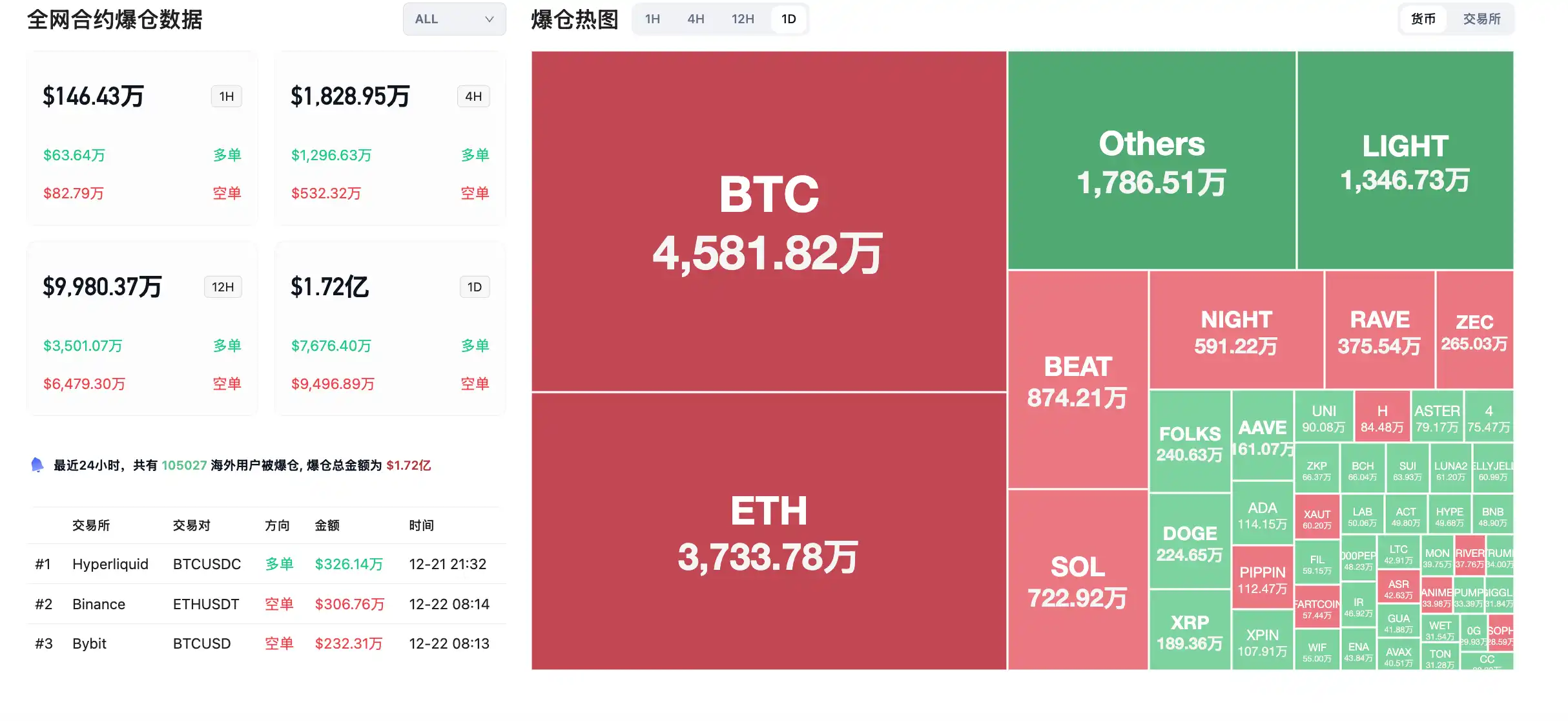
  • 24-hour Liquidation Data: 105,027 people liquidated globally, total liquidation amount $172 million, including BTC liquidations $45.818 million, ETH liquidations $37.3378 million, SOL liquidations $7.229 million
3. ETF Flows (As of December 21)

  • Bitcoin ETF: Net outflow of $497 million last week

  • Ethereum ETF: Net outflow of $644 million last week

  • Solana ETF: Net inflow of $66.55 million last week

  • XRP ETF: Net inflow of $82.04 million last week

4. Today's Outlook

  • Aster will launch the fifth phase of its airdrop on December 22, distributing 1.2% of the total supply.

  • Binance Wallet: Bitway (BTW) Pre-TGE activity will begin on December 22.

  • MetaPlanet's extraordinary general meeting will be held on December 22, with the preferred stock issuance proposal pending review.

  • The U.S. Bureau of Economic Analysis will release Q3 GDP data on December 23.

  • Binance will remove multiple leveraged trading pairs including DOT/FDUSD, ENA/FDUSD.

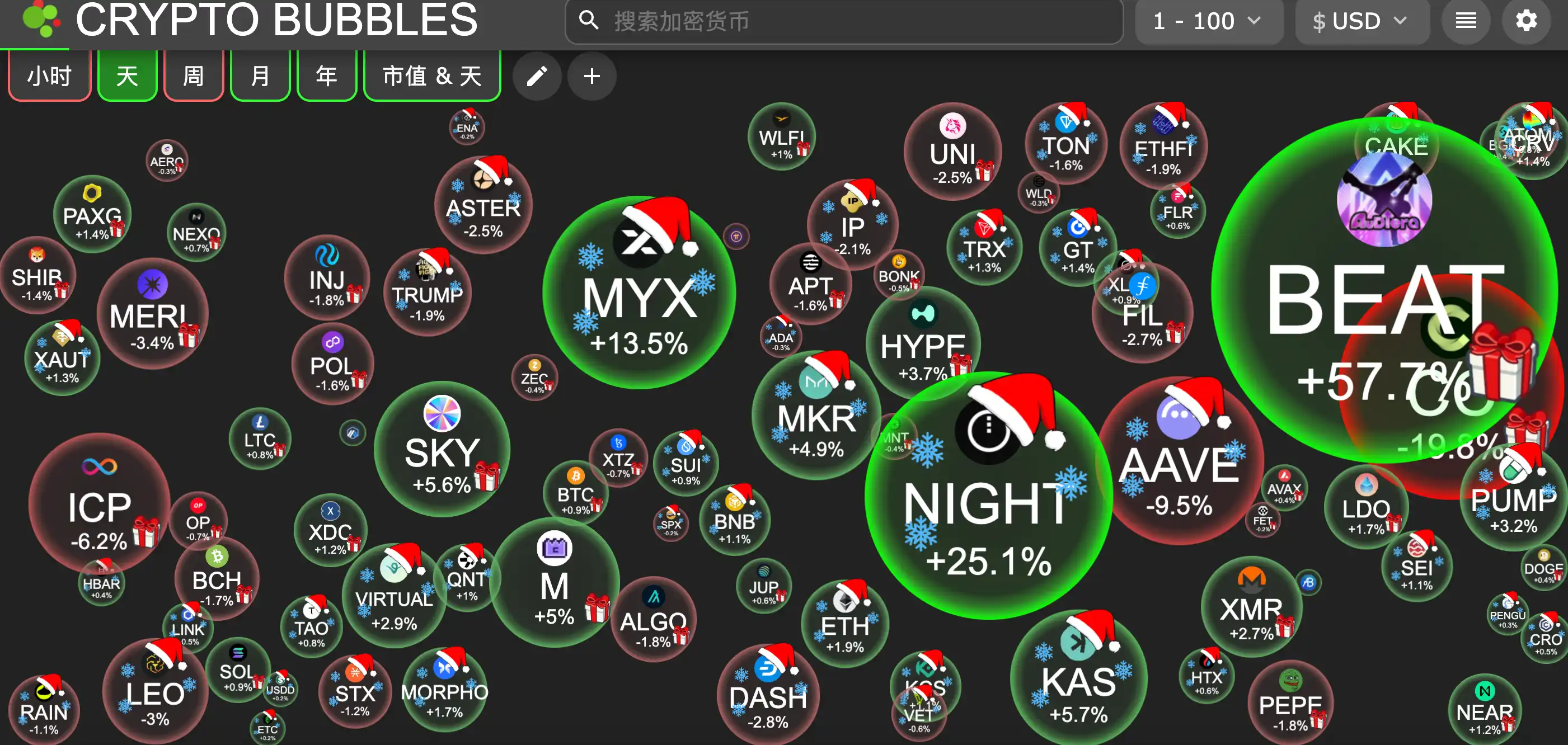
Today's top gainers among the top 100 coins by market cap: Audiera up 57.7%, Midnight up 25.1%, MYX Finance up 13.5%, Kaspa up 5.7%, Sky (prev. Maker) up 5.6%.
5. Hot News

  • Data: Tokens like H, XPL, SOON are set for large unlocks, with H's unlock valued at approximately $14.8 million.

  • Weekly Preview | Approximately $23 billion in Bitcoin options expire on December 26; Aster launches fifth phase airdrop activity.

  • Uniswap protocol fee switch proposal UNIfication reaches quorum, expected to take effect this week.

  • Data: Tokens like H, XPL, SOON will see large unlocks next week, with H's unlock valued at approximately $14.8 million.

  • Dragonfly Capital deposited 6 million MNT to Bybit in the past 7 days, worth $6.95 million.

  • NFT trading volume increased 11.31% to $68.98 million this week, with the number of buyers surging 50.28%.

  • Hilbert Group acquired high-frequency trading platform Enigma Nordic for $32 million.

  • Vitalik sold various tokens including UNI, BNB over two days.

  • Machi Big Brother坚持做多 net loss of about $3.515 million in the past month, with a win rate of 55.56%.


Criptos en tendencia

Preguntas relacionadas

QWhat are the key factors driving the surge in gold and silver prices to record highs?

AThe surge in gold and silver prices is primarily driven by expectations of Fed rate cuts in 2026 and heightened geopolitical tensions, which have fueled strong safe-haven demand in the macro market.

QWhat is the current price range Bitcoin has been consolidating in, and what are the bullish price targets mentioned by analysts?

ABitcoin has been consolidating between $84,000 and $94,000 for a month. Bullish analysts like AlphaBTC and Captain Faibik anticipate a 'Santa Claus rally' with a potential breakout towards the $98,000 to $100,000 region, while Korinek_Trades predicts a new high of $150,000 based on Elliott Wave theory.

QWhat negative signals for Bitcoin's price are identified from on-chain and exchange data?

ANegative signals include a lack of 'panic' sentiment on social media suggesting a potential drop to $75,000, a $1.4 billion inflow of BTC into Binance indicating a possible correction to the $70,000-$72,000 demand zone, and analysts predicting a deeper drop to $60,000 after months of consolidation.

QWhat is the critical technical level for Ethereum's price, and what on-chain data suggests optimism for its future?

AEthereum is consolidating around the critical $3,000 level. On-chain data shows that addresses holding over 10,000 ETH have been accumulating significantly since July, with their buying rate at historically high levels, indicating strong confidence in a potential major rebound.

QWhich cryptocurrency ETFs saw net outflows last week, and which saw net inflows according to the data?

ALast week, Bitcoin ETFs saw a net outflow of $497 million and Ethereum ETFs saw a net outflow of $644 million. In contrast, Solana ETF saw a net inflow of $66.55 million and XRP ETF saw a net inflow of $82.04 million.

Lecturas Relacionadas

STAR 50 Soars 10.73%, Why Did A-Shares Stage a "V-Shaped Reversal"?

After a prolonged decline, the Chinese A-share market staged a strong rally on July 21. The STAR 50 index surged 10.73%, its largest single-day gain in nearly a year, leading a broad-based "V-shaped" reversal. The Shanghai Composite Index rose 1.79%, the Shenzhen Component Index gained 4.81%, and the ChiNext Index jumped 7.05%. Total market turnover reached 2.97 trillion yuan, an increase of 256.1 billion yuan from the previous session, with over 3,100 stocks advancing. The semiconductor sector spearheaded the rebound, with related ETFs posting significant gains. Analysts attribute the surge to three converging factors. First, coordinated capital inflows from "national team" institutions, insurance funds, listed company buybacks, and fund house self-purchases have bolstered market liquidity and confidence. Second, supportive policy signals, including commitments from regulators to ensure stable market operations, provided a favorable backdrop. Third, a stabilization and recovery in overseas markets, notably South Korea, created a positive external environment. Institutions suggest the most severe panic selling phase for the tech sector has likely passed, following a significant digestion of crowded positions and leveraged funds. While short-term volatility may persist, the medium to long-term outlook remains underpinned by enduring trends like AI computing demand expansion and semiconductor localization. The market's focus now shifts to the sustainability of supportive fund flows, earnings reports, and upcoming catalysts from the global AI industry chain.

marsbitHace 39 min(s)

STAR 50 Soars 10.73%, Why Did A-Shares Stage a "V-Shaped Reversal"?

marsbitHace 39 min(s)

U.S. Tech Momentum Stocks Post Largest Single-Day Gain Ever, But Is the Plunge Over?

US tech momentum stocks staged a sharp rebound on Tuesday (July 21st). Morgan Stanley's TMT Momentum Factor surged over 12%, marking its largest single-day gain on record, exceeding even peaks from the 2000 dot-com bubble. Key momentum indices from Goldman Sachs also posted their strongest daily performances in years. The rally was led by semiconductors, with the Philadelphia Semiconductor Index jumping 4.6%. This rebound followed three consecutive down days and a cumulative 33% plunge in momentum stocks, one of the steepest drawdowns since the dot-com era. Analysts attribute the surge largely to a short squeeze. Heavy selling had pushed high-beta momentum stocks into deeply oversold territory, forcing many short sellers, particularly in Asia, to cover their positions, creating a self-reinforcing buying spiral. However, the rebound's internals appear weak. Trading volume was notably low, and advancing stocks still lagged decliners on the S&P 500, indicating a narrow, concentrated rally rather than broad market participation. Diverging views emerge on the outlook. BTIG warns the bounce has hit key resistance and recommends selling into strength, citing extreme volatility and historical parallels to past market tops. Conversely, Goldman Sachs and UBS believe the momentum unwind is nearing its end, suggesting it may be time to gradually add exposure, as positioning has been significantly reduced. They caution, however, that high volatility warrants a measured approach, potentially using defined-risk strategies. The upcoming earnings season, particularly reports from major tech firms like Alphabet, is seen as a critical test for the rally's sustainability. Simultaneously, bond markets flashed a warning, with yields rising partly due to spiking oil prices. Analysts note that if long-term Treasury yields break decisively higher, it could pose a significant headwind for equities, especially growth stocks.

marsbitHace 46 min(s)

U.S. Tech Momentum Stocks Post Largest Single-Day Gain Ever, But Is the Plunge Over?

marsbitHace 46 min(s)

U.S. Tech Momentum Stocks Record Largest Single-Day Gain Ever, but Has the Rout Ended?

U.S. tech momentum stocks staged a dramatic rebound on Tuesday, July 21st. Key momentum indices like the Morgan Stanley TMT Momentum Factor and Goldman Sachs' High Beta Momentum Long Index posted historic or near-historic single-day gains, fueled largely by semiconductor stocks. This sharp rally followed a severe three-day sell-off that saw momentum stocks plunge 33%, marking one of the steepest pullbacks since the dot-com bubble. Analysts attribute the bounce primarily to a short squeeze, as forced covering from over-leveraged traders, particularly in Asia, created a buying spiral. However, the rally's health is questioned due to weak market breadth—overall trading volume was low, and decliners outnumbered advancers in the S&P 500 despite the index's gain—suggesting a narrow, concentrated surge rather than broad recovery. Opinions on the sustainability diverge. BTIG strategists warn the rebound has hit key resistance levels, citing extreme volatility and historic stock dispersion as signs of an ongoing broader correction, and recommend selling into strength. Conversely, Goldman Sachs and UBS view the aggressive momentum unwinding as nearing its end, noting reduced positioning and a lack of new fundamental catalysts. They suggest the sell-off presents a selective opportunity to add exposure, albeit cautiously and gradually using defined-risk strategies. The immediate trajectory hinges on the ongoing earnings season, with market focus on Alphabet's capital expenditure guidance for AI investment clarity. Meanwhile, bond markets present a risk, with rising Treasury yields—potentially heading toward 5.5%—and widening credit spreads for mega-cap tech companies posing a threat to equity valuations. The combination of technical factors, earnings results, and macro conditions leaves the durability of the rebound in doubt.

链捕手Hace 49 min(s)

U.S. Tech Momentum Stocks Record Largest Single-Day Gain Ever, but Has the Rout Ended?

链捕手Hace 49 min(s)

Long-Divided Must Unite, Long-United Must Divide: When L1 Becomes Its Own Rollup, What Is Ethereum's Endgame?

"The Inevitable Cycle: When L1 Becomes Its Own Rollup – What is Ethereum's Endgame?" For years, the Ethereum community grappled with concerns that L2s were fragmenting the ecosystem and eroding L1's value. While L2s provided cheaper execution, they also splintered liquidity and the unified user experience of a single chain. This has prompted a fundamental reassessment of the relationship between L1 and L2. Ethereum's roadmap is evolving. The "Scale" initiative merges L1 and L2 expansion into a holistic framework. L1 itself is advancing with higher gas limits, statelessness, and zkEVM verification, no longer content to be just a low-throughput settlement layer. Consequently, the primary value proposition of L2s is shifting from merely providing cheap blockspace to offering L1 cannot easily provide: application-specific optimizations, privacy features, and flexible governance models. L2s are becoming a spectrum of execution environments with varying degrees of security inheritance from Ethereum. A critical challenge in this multi-chain future is interoperability. The vision is to make Ethereum "feel like one chain again." This relies on advancements in native account abstraction (like EIP-7702) and intent-based architectures (Open Intents Framework), where users declare desired outcomes, and solvers handle the complex cross-chain execution. Furthermore, shortening Ethereum's finality time from minutes to seconds is crucial, as it underpins trust between chains for bridges, stablecoins, and cross-chain applications. Perhaps the most provocative idea is that Ethereum L1 itself could become a form of "its own Rollup." As zkEVM and proof systems mature, high-performance nodes could execute transactions and generate validity proofs. Regular validators would then verify these proofs instead of re-executing all transactions. This blurs the traditional L1/L2 hierarchy, making "Rollup" more of a general execution-verification architecture. Native Rollup aims to integrate L2 validation more directly into the Ethereum protocol, allowing L2s to inherit L1's security more fully and move away from reliance on security councils. In the end, L2s are not destined to replace L1 or be made obsolete by it. The likely future is a unified system where diverse execution environments—each optimized for specific use cases like DeFi, gaming, or privacy—coexist. They will share a common foundation of security, liquidity, and verifiable state, seamlessly connected to restore a cohesive user experience. The next phase for Ethereum is not just about scaling through separation, but about intelligently reintegrating what was separated back into a coherent whole.

链捕手Hace 1 hora(s)

Long-Divided Must Unite, Long-United Must Divide: When L1 Becomes Its Own Rollup, What Is Ethereum's Endgame?

链捕手Hace 1 hora(s)

Trading

Spot

Artículos destacados

Cómo comprar O

¡Bienvenido a HTX.com! Hemos hecho que comprar O1 exchange (O) sea simple y conveniente. Sigue nuestra guía paso a paso para iniciar tu viaje de criptos.Paso 1: crea tu cuenta HTXUtiliza tu correo electrónico o número de teléfono para registrarte y obtener una cuenta gratuita en HTX. Experimenta un proceso de registro sin complicaciones y desbloquea todas las funciones.Obtener mi cuentaPaso 2: ve a Comprar cripto y elige tu método de pagoTarjeta de crédito/débito: usa tu Visa o Mastercard para comprar O1 exchange (O) al instante.Saldo: utiliza fondos del saldo de tu cuenta HTX para tradear sin problemas.Terceros: hemos agregado métodos de pago populares como Google Pay y Apple Pay para mejorar la comodidad.P2P: tradear directamente con otros usuarios en HTX.Over-the-Counter (OTC): ofrecemos servicios personalizados y tipos de cambio competitivos para los traders.Paso 3: guarda tu O1 exchange (O)Después de comprar tu O1 exchange (O), guárdalo en tu cuenta HTX. Alternativamente, puedes enviarlo a otro lugar mediante transferencia blockchain o utilizarlo para tradear otras criptomonedas.Paso 4: tradear O1 exchange (O)Tradear fácilmente con O1 exchange (O) en HTX's mercado spot. Simplemente accede a tu cuenta, selecciona tu par de trading, ejecuta tus trades y monitorea en tiempo real. Ofrecemos una experiencia fácil de usar tanto para principiantes como para traders experimentados.

128 Vistas totalesPublicado en 2026.06.19Actualizado en 2026.06.29

Cómo comprar O

Cómo comprar PROS

¡Bienvenido a HTX.com! Hemos hecho que comprar Pharos (PROS) sea simple y conveniente. Sigue nuestra guía paso a paso para iniciar tu viaje de criptos.Paso 1: crea tu cuenta HTXUtiliza tu correo electrónico o número de teléfono para registrarte y obtener una cuenta gratuita en HTX. Experimenta un proceso de registro sin complicaciones y desbloquea todas las funciones.Obtener mi cuentaPaso 2: ve a Comprar cripto y elige tu método de pagoTarjeta de crédito/débito: usa tu Visa o Mastercard para comprar Pharos (PROS) al instante.Saldo: utiliza fondos del saldo de tu cuenta HTX para tradear sin problemas.Terceros: hemos agregado métodos de pago populares como Google Pay y Apple Pay para mejorar la comodidad.P2P: tradear directamente con otros usuarios en HTX.Over-the-Counter (OTC): ofrecemos servicios personalizados y tipos de cambio competitivos para los traders.Paso 3: guarda tu Pharos (PROS)Después de comprar tu Pharos (PROS), guárdalo en tu cuenta HTX. Alternativamente, puedes enviarlo a otro lugar mediante transferencia blockchain o utilizarlo para tradear otras criptomonedas.Paso 4: tradear Pharos (PROS)Tradear fácilmente con Pharos (PROS) en HTX's mercado spot. Simplemente accede a tu cuenta, selecciona tu par de trading, ejecuta tus trades y monitorea en tiempo real. Ofrecemos una experiencia fácil de usar tanto para principiantes como para traders experimentados.

146 Vistas totalesPublicado en 2026.06.22Actualizado en 2026.06.29

Cómo comprar PROS

Qué es VERONA

I. Introducción al Proyecto VERONA es una blockchain construida para todos, en todas partes a través de la abstracción de cadenas. Utilizando su capa de Abstracción Generalizada, VERONA se distingue por integrar funcionalidades complejas de blockchain, como cuentas, firmas e interoperabilidad, directamente a nivel de protocolo. Este enfoque permite interactuar con aplicaciones de blockchain sin necesidad de entender las tecnologías subyacentes.1) Información Básica Nombre: VERONA (VERONA)III. Enlaces Relacionados Enlace al sitio web oficial: https://xion.burnt.com/ Libro Blanco: https://xion.burnt.com/whitepaper.pdf Exploradores: https://explorer.burnt.com/ Redes Sociales: https://x.com/burnt_xion Nota: La introducción del proyecto proviene de los materiales publicados o proporcionados por el equipo oficial del proyecto, que es solo para referencia y no constituye asesoramiento de inversión. HTX no se hace responsable de ninguna pérdida directa o indirecta resultante.

171 Vistas totalesPublicado en 2026.06.22Actualizado en 2026.06.22

Qué es VERONA

Discusiones

Bienvenido a la comunidad de HTX. Aquí puedes mantenerte informado sobre los últimos desarrollos de la plataforma y acceder a análisis profesionales del mercado. A continuación se presentan las opiniones de los usuarios sobre el precio de A (A).

活动图片













