Artículos Relacionados con Mindset

El Centro de Noticias de HTX ofrece los artículos más recientes y un análisis profundo sobre "Mindset", cubriendo tendencias del mercado, actualizaciones de proyectos, desarrollos tecnológicos y políticas regulatorias en la industria de cripto.
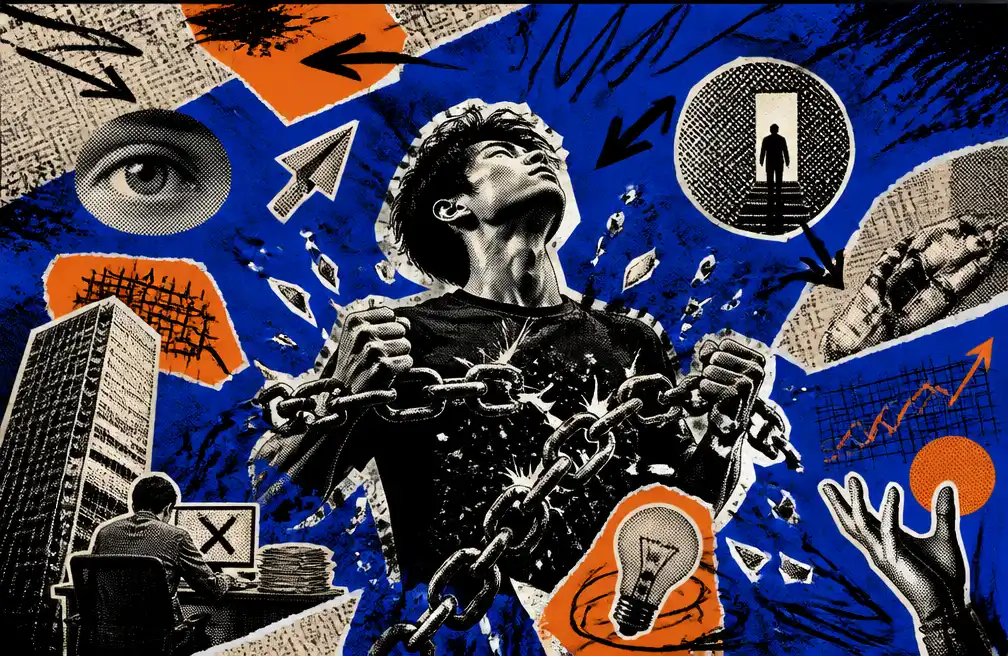

Dan Koe's New Essay: Escaping the Fate of the Wage Slave, How to Survive the AI Replacement Wave?

Dan Koe argues that the true threat in the AI era isn't technology itself, but a reliance on others for one's livelihood and happiness. The core problem is "wage slavery"—spending life on unfulfilling work. To survive and thrive, one must escape this by building their own enterprise. The key is developing five elements: Agency (initiative), Taste (discernment), Persuasion, Persistence, and Iteration. These boil down to problem-solving skills and experiential knowledge, which cannot be learned passively but only through doing your own projects. The solution is to become "unemployable" by shifting your identity. This requires: 1) Radically changing your environment to force growth, 2) Choosing a medium (like content creation) that provides real feedback through trial and error, and 3) Mastering either code or, preferably, media (content). Content creation is more valuable because its subjective nature and need for human perspective create a durable advantage over generic AI output. To start, define your life's work by answering foundational questions about your innate knowledge, unique abilities, and contrarian beliefs. Then, immediately act by publishing your first piece of content. The cycle of creating, receiving feedback, and iterating is the essential path to developing the skills needed for an independent, meaningful career and financial resilience.

marsbit06/23 12:27

Dan Koe's New Essay: Escaping the Fate of the Wage Slave, How to Survive the AI Replacement Wave?

marsbit06/23 12:27

To Those Ordinary People Who Haven't Invested in AI: You Think You're Late, You're Just Lacking Your Own Worldview

**Summary:** The article argues that ordinary investors feeling FOMO over missing the AI investment boom lack not timing, but their own independent worldview. Most people chase "what to buy" based on others' opinions (FOMO, envy) rather than fundamental analysis. This leads to costly mistakes: not knowing when to exit winning trades or cut losses on losing ones. The core solution is to develop a personal, long-term (5-10 year) worldview about societal shifts and technological bottlenecks. For most, building this from scratch (Path A) is too demanding. A practical alternative (Path B) is to follow the **capital expenditures (capex)** and strategic investments of visionary leaders, as their money reveals true conviction more reliably than their words. Five key figures to track for different AI perspectives are highlighted: Jensen Huang (NVIDIA, infrastructure), Elon Musk (Tesla/SpaceX/xAI, capex signals), Sam Altman (OpenAI, commercialization, but beware hype), Dario Amodei (Anthropic, technical/safety focus), and Liang Wenfeng (DeepSeek, efficiency/anti-consensus view). The article details how to read capex signals from hyperscalers' financial reports, NVIDIA's revenue breakdown, and strategic investments. It maps the complete AI产业链 (supply chain) from raw materials/energy to models/applications, explaining value flow and inter-dependencies (e.g., how a model release triggers demand across chips, memory, and optics). Finally, it provides an action plan: secure personal finances first, allocate a limited portfolio percentage (max 25%) to the theme, prefer broad ETFs (like QQQ), use dollar-cost averaging over 6-12 months, and write down strict investment rules beforehand to combat emotional errors during market volatility. The conclusion is that a stable, personally-held worldview enables disciplined, long-term investment far more than chasing short-term trends.

marsbit05/26 09:10

To Those Ordinary People Who Haven't Invested in AI: You Think You're Late, You're Just Lacking Your Own Worldview

marsbit05/26 09:10

Interview with KK, UXLINK Ecosystem Lead: Not a Prisoner, Just a Player, Staying in Web3 Because 'It's Fun'

Interview with Kongkou (KK), UXLINK Ecosystem Lead: "Not a Prisoner, Just a Player – Staying in Web3 Because It’s Fun" KK, UXLINK’s Ecosystem Lead, shares his unconventional journey into Web3. With a background in economics and experience spanning Swedish manufacturing supply chains, Hasselblad (under DJI), and community growth in Web3, he emphasizes adaptability over formal credentials. He entered Web3 in 2021, learning through hands-on experience—earning and losing in NFTs, participating in early Solana trading, and navigating GameFi downturns. He believes real learning comes from taking risks and experiencing losses firsthand. At UXLINK, KK drove significant growth through well-timed, mechanism-focused campaigns like joint airdrops, leveraging Telegram’s invite-based reward system. He stresses that timing and structure matter more than creativity in driving user adoption. KK also reflects on a major security breach UXLINK suffered—a costly lesson highlighting that security is a discipline issue, not just a technical one. He advises strict measures like physical isolation, avoiding cloud-stored seed phrases, and using dedicated devices for financial operations. Despite challenges, he remains in Web3 for the positive team environment and personal enjoyment. He embraces AI tools for work and life, balances stress with sports like climbing and squash, and advises newcomers to network actively and keep learning. Beyond Web3, KK is a craft beer enthusiast, recommending Japanese lagers for beginners and stouts or IPAs for advanced drinkers, with a shout-out to Shanghai’s 233 Bar. His philosophy centers on staying relaxed, avoiding industry burnout, and valuing longevity over short-term gains.

marsbit03/10 09:32

Interview with KK, UXLINK Ecosystem Lead: Not a Prisoner, Just a Player, Staying in Web3 Because 'It's Fun'

marsbit03/10 09:32

In the Coming Decades, What Could Be Your Most Important Skill?

The most important skill for the future is agency: the ability to take self-directed action without external permission. Unlike specialized skills, which risk obsolescence, agency enables continuous adaptation and learning. Highly agentic individuals act autonomously, treat life as an experiment, and persist through failure. They see challenges as solvable problems rather than impossibilities. In the AI era, agency becomes even more critical. While AI can generate content and automate tasks, it lacks vision and context. Human creators who use AI as a tool—infusing their unique perspective and purpose—will thrive. The fear of AI replacing humans stems from a misunderstanding: tools evolve, but agency and vision remain irreplaceable. Generalists, not specialists, will succeed because they integrate diverse knowledge to solve problems and adapt to change. The education system often promotes conformity, but agency requires breaking free from predefined paths. Humans possess five core capacities: computation, transformation (creation), variation (idea generation), selection (error correction), and attention (perspective-shifting). These remain foundational regardless of technological advances. To cultivate agency, start by setting a goal, study others’ processes, experiment, identify patterns, and create your own methods. Teaching others solidifies understanding. Social media serves as a modern "playground" for practicing agency—offering low-risk experimentation, feedback, and skill development. Ultimately, agency is the art of self-direction, ensuring relevance and resilience in any future.

marsbit01/14 14:35

In the Coming Decades, What Could Be Your Most Important Skill?

marsbit01/14 14:35

The Truth of Trading: A Numbers Game of Patterns and Probabilities

The Truth of Trading: A Numbers Game of Patterns and Probability Most traders fail not due to a lack of methods or information, but because they misunderstand the nature of trading. Mark Douglas, in "Trading in the Zone," redefines the market as a probabilistic environment where an edge only materializes over a sufficiently long period. Trading is not about prediction or seeking certainty; it is a numbers game of pattern recognition. A valid trading pattern does not guarantee that any single trade will be profitable. It merely indicates a historical probability of success. Each individual trade outcome is random, but the overall probability distribution over many trades is not. Traders must evaluate performance like a casino: focus on long-term expectation and repeated execution, not single wins or losses. Accepting that "anything can happen" is liberating. It removes the emotional sting from losses, enables disciplined stop-loss execution, and eliminates hesitation. The ideal "flow state" is not excitement but emotional neutrality—executing the plan without attachment to outcomes or need to be right. Ultimately, traders cannot control results, but they can control their execution. Success comes from emotional detachment and consistent repetition. When traders stop trying to prove themselves right and let the probabilities work over time, they align with the true nature of the market: a numbers game based on pattern recognition and disciplined repetition.

深潮12/26 02:45

The Truth of Trading: A Numbers Game of Patterns and Probabilities

深潮12/26 02:45

The Truth of Trading: A Numbers Game of Patterns and Probabilities

The Truth of Trading: A Numbers Game of Patterns and Probabilities Most traders fail not due to a lack of methods or information, but because they misunderstand the nature of trading. Mark Douglas, in "Trading in the Zone," redefines trading: it is not about prediction or certainty, but a probabilistic environment where edges manifest only over time. Thus, experienced traders summarize it as a pattern-recognition numbers game. Trading isn’t forecasting; it’s executing a plan amid uncertainty. No single trade can be guaranteed. Patterns don’t predict outcomes—they only define probabilistic edges. A valid pattern means historically higher chance of profit, not a promised win. Losses don’t invalidate the method; they are part of randomness. Individual trade outcomes are random, but the overall probability distribution isn’t. Profit comes from expectancy multiplied by repetition, not single trade accuracy. Accepting "anything can happen" liberates traders: losses feel less offensive, stop-losses are executed cleanly, and emotional interference fades. The "flow state" is emotional neutrality—no need to prove correctness or fear mistakes. It’s loyalty to the process. Trading is a numbers game: identify edges, repeat executions, and let large samples reveal results. Many traders intellectually agree but emotionally reject this: they judge themselves per trade, expect every pattern to work, take losses personally, and abandon strategies after few failures. The key isn’t a better method, but correct execution. You can’t control outcomes, but you can control execution. Patterns offer probability, not promises. Consistency requires emotional detachment and repetitive discipline. When traders stop proving themselves right and let probabilities work, trading succeeds.

marsbit12/26 01:59

The Truth of Trading: A Numbers Game of Patterns and Probabilities

marsbit12/26 01:59

活动图片