Artículos Relacionados con Community

El Centro de Noticias de HTX ofrece los artículos más recientes y un análisis profundo sobre "Community", cubriendo tendencias del mercado, actualizaciones de proyectos, desarrollos tecnológicos y políticas regulatorias en la industria de cripto.

Aleo's First APAC Community Event to Land in Shanghai, Collaborating with OpenBuild to Build a Privacy Computing Developer Ecosystem

Aleo, in collaboration with the open-source developer community OpenBuild, will host its first Asia-Pacific (APAC) community event, "Aleo Shanghai Community Event," on July 26, 2026, in Shanghai. This event marks a key step in Aleo's APAC ecosystem expansion and aims to bring together developers, entrepreneurs, Web3 professionals, and AI enthusiasts to explore the trends in Zero-Knowledge (ZK) proofs, programmable privacy technology, and the innovative opportunities arising from the convergence of AI and privacy computing. Differing from traditional tech talks, the event emphasizes hands-on developer participation. Attendees will have the opportunity to experience Aleo's privacy infrastructure firsthand, engage in real on-chain interactions, and provide direct feedback to the Aleo team. The agenda will feature the official launch of Aleo's APAC Hackathon program, including details on competition mechanics, prizes, mentorship, and team formation. A core focus will be the theme "AI × Programmable Privacy," examining how privacy computing can serve as critical infrastructure for the next generation of the internet, particularly with the rise of AI Agents. A panel discussion titled "Do Agents Need Privacy by Default?" will delve into data security, identity privacy, and trusted interactions for AI Agents in future commercial applications. The event will also include product demonstrations, community networking, and free discussion sessions, designed to foster connections among local developers and advance the regional developer community. **Event Details:** * **Name:** Aleo Shanghai Community Event * **Date:** July 26, 2026 (Sunday), 13:30–18:00 * **Location:** Shengbang International Plaza, Shanghai * **Organizers:** Aleo × OpenBuild **About Aleo:** Aleo is a Layer-1 blockchain enabling programmable privacy, allowing developers to build decentralized applications that combine privacy with on-chain verifiability. It is backed by investors including a16z, Haun Ventures, Samsung Next, and SoftBank. **About OpenBuild:** OpenBuild is an open-source collaborative community for developers, focused on frontier technologies like Web3 and AI, supporting builders through the entire journey from idea to product realization.

marsbit07/16 05:54

Aleo's First APAC Community Event to Land in Shanghai, Collaborating with OpenBuild to Build a Privacy Computing Developer Ecosystem

marsbit07/16 05:54

GPT-5.6 Sol Suddenly Gets Dumber Overnight? Thinking Budget Slashed from 960 to 128, No More Fixed-Intelligence Models?

The article discusses widespread user reports that OpenAI's GPT-5.6 Sol model, specifically its "Max" reasoning tier, has become less capable at complex, deep reasoning tasks. Users noted faster but shallower responses. Community investigation revealed an unpublicized internal parameter called "juice value," representing computational budget for reasoning. Observations indicated this value for the Max tier dropped dramatically from 960 to 128. In response, OpenAI's Thibault Sottiaux stated there was no intentional reduction in model capability ("nerf"). He explained the changes were part of an experiment to investigate unexpected high token usage following GPT-5.6's launch, which introduced features like longer reasoning and larger context windows. The experiment temporarily adjusted the "juice" parameter and rolled back the context window from 372k to 272k tokens to diagnose the usage spike. Sottiaux asserted these settings have been reverted and highlighted ongoing optimizations. The controversy highlights a tension between AI as a reliable, fixed-capability tool and its reality as a cloud service where providers can adjust performance parameters. The article argues that for AI to be trusted enterprise infrastructure, providers need clearer, transparent guarantees about the specific performance boundaries associated with service tiers.

marsbit07/15 03:28

GPT-5.6 Sol Suddenly Gets Dumber Overnight? Thinking Budget Slashed from 960 to 128, No More Fixed-Intelligence Models?

marsbit07/15 03:28

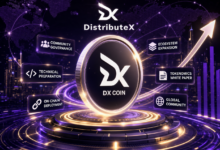
DistributeX Unveils DX Coin Ecosystem Roadmap, Advancing Preparations for Its On-Chain Launch

DistributeX has unveiled the DX Coin Ecosystem Roadmap, detailing its preparations for the upcoming on-chain launch of DX Coin. The roadmap outlines key phases focusing on community governance, technical readiness, blockchain deployment, and ecosystem growth. Current efforts are centered on building community consensus and completing technical groundwork. This includes launching community votes to select the official DX Coin logo and decide on the preferred blockchain network for integration. The platform will also implement features like on-chain wallet binding and contribution tracking to prepare for future data synchronization and rewards. Before the official launch, DistributeX will publish a Tokenomics White Paper detailing the token's issuance, governance, and long-term strategy, and will take a snapshot of eligible community accounts for future asset allocation. The subsequent deployment phase will involve smart contract deployment, security audits, community airdrops, and developing liquidity on decentralized exchanges. Looking further ahead, planned utilities for DX Coin encompass cross-chain interoperability, decentralized governance, digital rights, staking, and other Web3 applications. This roadmap aims to provide the community with clear visibility into the platform's plans, as DistributeX works to establish a solid foundation for DX Coin's on-chain ecosystem and long-term expansion.

TheNewsCrypto07/13 15:02

DistributeX Unveils DX Coin Ecosystem Roadmap, Advancing Preparations for Its On-Chain Launch

TheNewsCrypto07/13 15:02

Refunds! Claude 4.8 Sees Overnight Major 'Dumb-Down', GPT-5.6's Computational Power Reportedly 'Halved'

The AI community is currently alarmed by widespread reports of significant performance degradation in two leading models. This article details a "mass self-testing frenzy" triggered by a mysterious prompt designed to detect a hidden "Juice" value, representing a model's reasoning compute budget. On OpenAI's side, users suspect a covert, limited test of a "GPT-5.6-sol" model is underway. When using a specific XML prompt on the Codex platform, a normal "gpt-5.5 xhigh" model reportedly returns a Juice value of 768. However, some users routed to the suspected GPT-5.6 test receive a drastically reduced value of 128—a six-fold decrease. This has sparked debate on whether it signifies a major efficiency leap or a "watered-down, low-cost version" achieved by slashing reasoning depth to save computational expenses. Simultaneously, Anthropic's Claude models, particularly the flagship Opus 4.8 Max, are facing intense user backlash for a perceived "physical brain cut." Users on platforms like Reddit report a dramatic decline in the model's once-impressive reasoning, with complaints of it becoming "absurdly" weakened, performing worse than older, lighter models like Haiku. Specific criticisms include: losing long-context memory, refusing to think deeply even in high-reasoning modes, providing instant incorrect answers, and engaging in unhelpful, argumentative, or "gaslighting" behavior where it contradicts users unnecessarily. The article speculates these "stealth downgrades" might be a calculated corporate strategy. Companies could initially release models with temporarily boosted compute to create an illusion of a major breakthrough, then silently scale back parameters later to manage unsustainable inference costs. A proposed underlying cause is a tightened funding environment, potentially exacerbated by SpaceX's massive IPO soaking up market liquidity, which could delay AI company IPOs and force cost-cutting measures like model "nerfing." The core issue highlighted is the asymmetry of information: subscribers pay for a service that can be silently and fundamentally altered without notification or explanation. The viral "Juice test" resonates because it represents users' desire for transparency about what they are actually paying for.

marsbit06/30 12:08

Refunds! Claude 4.8 Sees Overnight Major 'Dumb-Down', GPT-5.6's Computational Power Reportedly 'Halved'

marsbit06/30 12:08

活动图片