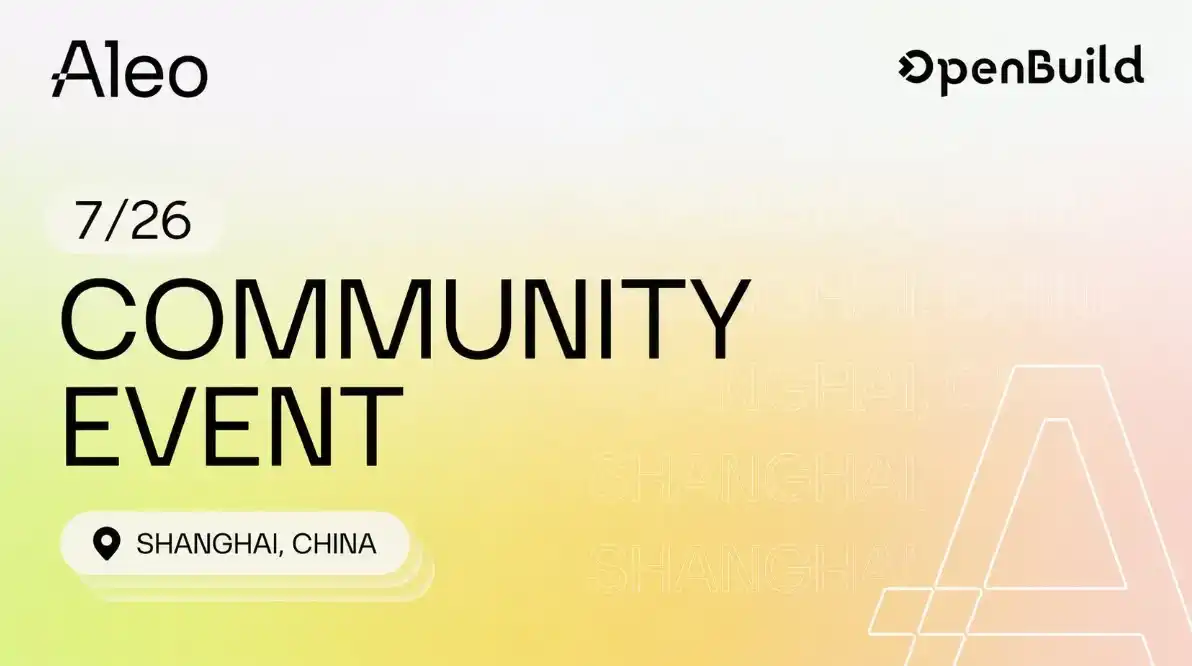
Aleo's First APAC Community Event to Land in Shanghai, Collaborating with OpenBuild to Build a Privacy Computing Developer Ecosystem
Aleo, in collaboration with the open-source developer community OpenBuild, will host its first Asia-Pacific (APAC) community event, "Aleo Shanghai Community Event," on July 26, 2026, in Shanghai. This event marks a key step in Aleo's APAC ecosystem expansion and aims to bring together developers, entrepreneurs, Web3 professionals, and AI enthusiasts to explore the trends in Zero-Knowledge (ZK) proofs, programmable privacy technology, and the innovative opportunities arising from the convergence of AI and privacy computing.
Differing from traditional tech talks, the event emphasizes hands-on developer participation. Attendees will have the opportunity to experience Aleo's privacy infrastructure firsthand, engage in real on-chain interactions, and provide direct feedback to the Aleo team. The agenda will feature the official launch of Aleo's APAC Hackathon program, including details on competition mechanics, prizes, mentorship, and team formation.
A core focus will be the theme "AI × Programmable Privacy," examining how privacy computing can serve as critical infrastructure for the next generation of the internet, particularly with the rise of AI Agents. A panel discussion titled "Do Agents Need Privacy by Default?" will delve into data security, identity privacy, and trusted interactions for AI Agents in future commercial applications.
The event will also include product demonstrations, community networking, and free discussion sessions, designed to foster connections among local developers and advance the regional developer community.
**Event Details:**
* **Name:** Aleo Shanghai Community Event
* **Date:** July 26, 2026 (Sunday), 13:30–18:00
* **Location:** Shengbang International Plaza, Shanghai
* **Organizers:** Aleo × OpenBuild
**About Aleo:** Aleo is a Layer-1 blockchain enabling programmable privacy, allowing developers to build decentralized applications that combine privacy with on-chain verifiability. It is backed by investors including a16z, Haun Ventures, Samsung Next, and SoftBank.
**About OpenBuild:** OpenBuild is an open-source collaborative community for developers, focused on frontier technologies like Web3 and AI, supporting builders through the entire journey from idea to product realization.
marsbit07/16 05:54