No Surge, No Meme: As Crypto Moves into the Real World, Will 2026 Be the First Year of 'On-Chain Wall Street'?

marsbitPublicado a 2025-12-19Actualizado a 2025-12-19

In the final months of 2025, the atmosphere of a bear market began to spread.

Bitcoin slid from its high of $120,000, ETF inflows stalled at one point, various cryptocurrencies diverged in their trends, and the once sentiment-igniting Meme coins also began to lose interest. Compared to the end of 2021, this time there was no sudden regulatory crackdown, and aside from the 1011 crash, there didn't seem to be a severe liquidity crisis, yet it still felt like something was off.

If the crypto world of 2025 was a recalibration of true and false value, then will crypto be better in 2026?

This article attempts to find the answer. Perhaps we need to accept the fact that the crypto industry may be entering an era no longer driven by one-sided surges or "casino narratives."

I. Macro Winds Warm, Bitcoin Still Stands in the Spotlight

Over the past year, Bitcoin's price performance and market positioning have undergone significant changes.

After hitting a new all-time high of $120,000, the market began to pull back, volatility increased, and market sentiment gradually cooled. Unlike past rallies driven by retail investors, the main force behind this round of increases was the institutional money behind ETFs. Looking at holding costs, CryptoQuant analyst Axel Adler Jr. pointed out last month that the average holding cost for US ETFs was $79,000, which many also see as one of the price support levels. Therefore, Bitcoin's current trend is increasingly resembling a high-volatility institutional asset. On one hand, it has an anti-inflation positioning similar to gold; on the other hand, like tech stocks, it is influenced by macro sentiment and risk appetite, exhibiting beta properties.

From a broader macro background, 2025 was a year of回暖 (warming) sentiment for global risk assets. AI was the main theme, US stocks continuously hit new highs, the Fed announced three rate cuts in December, and the market re-entered a stage of warming liquidity expectations. The FOMC's year-end economic projections showed that the US GDP growth expectation for 2026 was also revised up from 1.8% to 2.2%–2.5%. The general expectation is that easing will continue next year, which might be a positive for assets like Bitcoin.

But the market is not without risks. If the economy suddenly weakens in 2026, or inflation rebounds unexpectedly, risk assets could still face significant adjustments.

II. Regulatory Turning Point: Policy Moves in the US and Hong Kong

Another important change in 2025 was the formal framing of regulation.

In the US, two key bills were passed. The first is the stablecoin bill (GENIUS Act), which clarifies the definition of stablecoins, reserve requirements, and issuance qualification thresholds, providing a compliance path for mainstream stablecoin issuers. This bill was signed into law by the President in July 2025 and will take effect 18 months after signing or 120 days after regulators issue final rules. The second is the Crypto-Asset Market Structure Act (CLARITY Act), which systematically divides the boundary between "security tokens" (regulated by the SEC) and "commodity tokens" (regulated by the CFTC) and proposes tiered regulation. This bill will be submitted to the Senate for deliberation in January, after which it may still require the President's signature, with an effective date to be determined. Meanwhile, the SEC has also accelerated the approval of more crypto ETFs, opening channels for institutional products.

In Hong Kong, China, regulatory步伐 (pace) also accelerated. In 2025, the Hong Kong Monetary Authority (HKMA) introduced a regulatory regime for stablecoin issuers, clearly requiring all Hong Kong-based stablecoin issuances to be licensed. This means that future issuances of stablecoins like USD or RMB in Hong Kong will need to meet certain capital and compliance requirements. Furthermore, HashKey has been listed on the Hong Kong Stock Exchange, becoming the first compliant platform with crypto trading as its core business to IPO in Hong Kong, a milestone event.

Overall, the regulatory trends in the US and Hong Kong, China, are both about suppressing illegal speculation while opening channels for legal business, pushing the industry towards institutionalization and compliance.

III. Three Main Themes: Stablecoins, Prediction Markets, On-Chain Stocks

Over the past few years, the most stable growth curve in the crypto industry has actually been stablecoins.

By 2025, the global stablecoin issuance volume had exceeded $300 billion, with the two major coins, USDT and USDC, accounting for over 80% combined. Stablecoins are becoming part of the global payment network. Whether it's USDT or USDC, the usage scenarios of these stablecoins have penetrated into daily merchants and cross-border settlements.

In 2026, stablecoins are likely to be closer to the real world than ever before. Traditional giants like Visa, Stripe, and PayPal are already using stablecoins for settlements. For example, Stripe already supports merchants subscribing with stablecoins, with real, landed services already available.
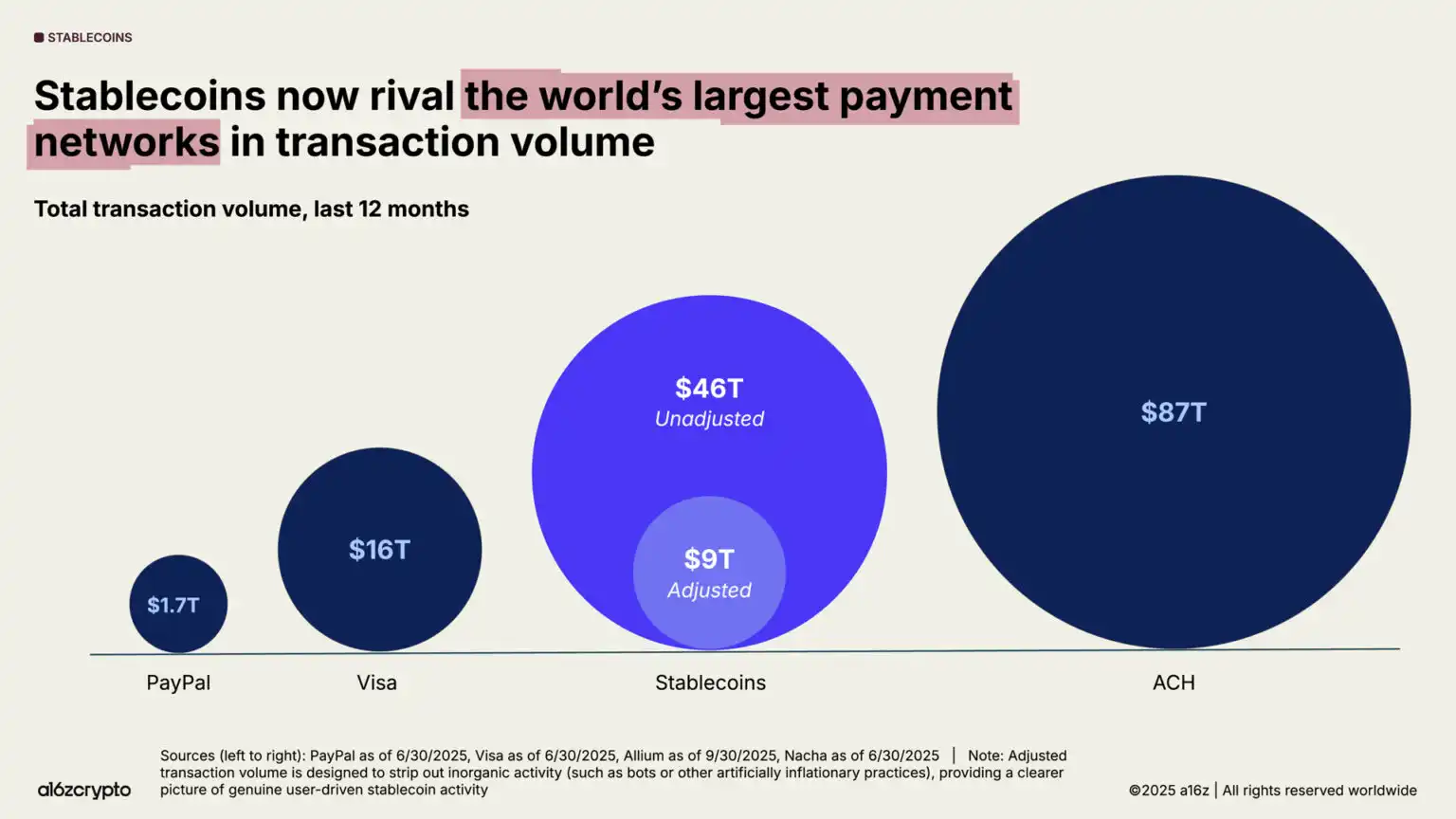
Image Source: a16z

Furthermore, with regulatory clarity, treasury-backed stablecoins (backed by high-quality assets) and regional stablecoins are expected to emerge, such as digital currency bridge projects promoted by Japan and the EU.

Another area worth watching is prediction markets.

Originally, most people thought prediction market products were too niche or non-compliant. But now, under themes like US elections, sports events, and economic data, they are gradually becoming a combination of "on-chain betting + pricing tools."

For example, Kalshi obtained a formal futures license from the US CFTC, allowing it to legally launch prediction trading related to macroeconomic data. Its valuation has now climbed to $11 billion. Polymarket, relying on topics like US elections and entertainment events, has also become a place for a large number of users to bet and gauge sentiment.

In 2026, prediction markets may move out of the purely speculative circle. For instance, users are not just betting on wins or losses but are using money to vote, expressing their judgment on the probability of a certain outcome. This collective intelligence pricing method could potentially be used by media, research institutions, and even trading strategies for reference. Additionally, AI will open up new possibilities for prediction markets, making them no longer rely solely on human betting but capable of automatically analyzing data, placing orders themselves, and even generating new markets. This will make prediction markets react faster and smarter, gradually becoming a tool for judging risks and trends, not just a place for gambling.

The last one that cannot be ignored is the development of on-chain stocks.

Simply put, the crypto industry is now not only trading crypto assets but also starting to move real-world assets onto the chain. For example, Securitize plans to launch the first fully compliant on-chain stock trading platform in 2026. Tokens purchased on-chain by users correspond to real company shares, entitling them to voting rights and dividends.

IV. Edge Narratives Emerge: New Directions That Might Take Off in 2026

https://a16zcrypto.com/posts/article/big-ideas-things-excited-about-crypto-2026/
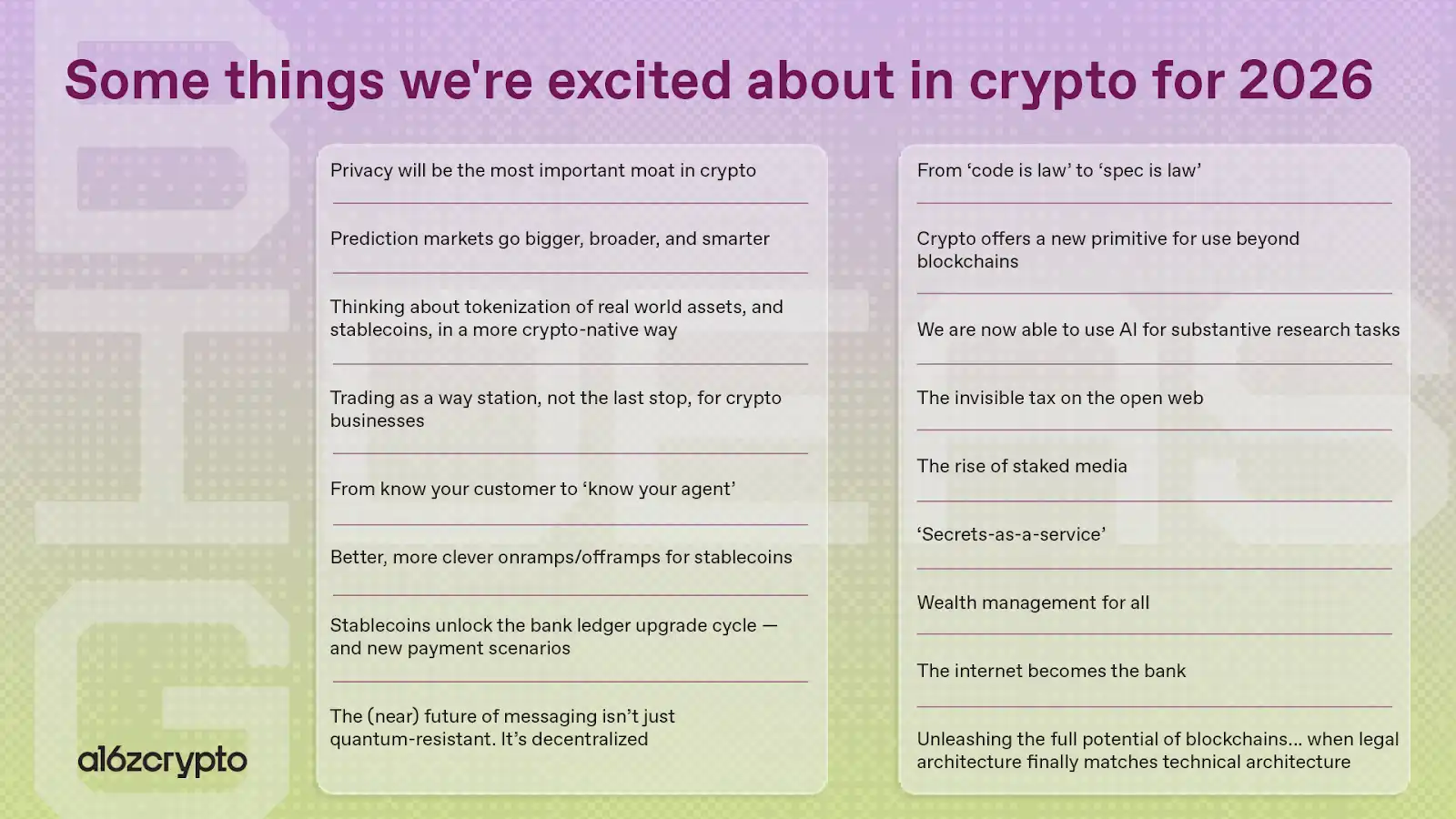
Image Source: a16z

1. The Identity Problem of AI Agents

As AI agents begin to participate in trading, browsing, placing orders, and even interacting with smart contracts, a key question is brought to the table: how do these non-human identities prove "who they are"?

The "Know Your Agent" (KYA) concept proposed by a16z aims to solve this very problem. On-chain, any agent initiating a transaction must have clear permissions and attribution, requiring cryptographic signature credentials for transactions. In 2026, this may become a prerequisite for the large-scale deployment of on-chain AI.

2. x402-like Protocols and Micropayments

a16z predicts that in the process of AI Agents widely trading data, calling computing power, and reading interfaces, we will enter an era of "automatic settlement + programmable payments."

No longer needing manual payments, AI Agents can identify needs among themselves and automatically execute payments. This is the real-world problem that protocols like x402 are solving. In 2026, their presence will become increasingly strong.

3. Privacy Chains Will Receive More Attention

a16z points out a key trend: compared to performance competition converging, privacy will become the core moat of future public chains. In the past, people worried that privacy chains were not conducive to regulation and lacked transparency. But now the problem is reversed: business data is too sensitive, and without privacy protection, compliant institutions simply dare not go on-chain. Precisely because of this, chains that come with privacy protection by default are becoming attractive. Once users use these chains, their data won't be easily leaked, migration costs are higher, naturally forming new user stickiness, which is essentially a network effect.

4. Staked Media

In the era of AI generating vast amounts of content, judging whether a statement is reliable cannot just depend on who said it, but also on whether there is a cost for saying it. Therefore, a16z proposes a new media model where content creators not only speak out but also "stake" their positions through methods like locking stakes, prediction markets, and NFT credentials.

For example, if you express a bullish view on ETH, you simultaneously lock up your own held ETH as collateral; if you make an election prediction, you also place a bet on-chain yourself. These公开 (public) interest bindings will make content more than just empty talk. If this play can work, it might become the new normal for on-chain media in the future.

Of course, the a16z report proposes far more than these few directions. This article focuses on selecting 4 trends we believe are more representative for elaboration. Other directions are also worth关注 (attention), such as: stablecoin on/off-ramp upgrades, RWA crypto-native transformation, stablecoins driving bank ledger system upgrades, diversification of wealth management, the rise of AI research assistants, real-time content profit-sharing mechanisms for AI agents, decentralized anti-quantum communication, "privacy as a service" becoming infrastructure, DeFi security paradigm shifts, intelligent prediction markets, verifiable cloud computing, focusing on product-market fit (PMF), and crypto bills unleashing more potential of blockchain.

Interested readers can refer to the original a16z report for further in-depth understanding.

V. The Crypto Industry is Moving Out of Its Internal Cycle

The early growth of the crypto industry was mostly built on a self-congratulatory system. Issuing coins, rebates, and airdrops all tried to attract more insiders to stay, but this closed loop is gradually being broken by reality.

From Polymarket to USDT, to the cross-border application of USDC, we see more and more people who are not Web3 users utilizing blockchain tools. Street vendors in Lagos may not understand wallet structures, but they know using USDT is much faster than bank transfers. In high-inflation countries, savers flock to USDC just for避险 (hedging), not speculation. One of the most直观 (intuitive) changes appears in payment scenarios in developing countries. For example, the Philippine trading platform Coins.ph partnered with Circle to open a low-cost USDC remittance channel.

The trend behind this shows that crypto technology is being embedded into real-world scenarios like cross-border payments and remittance channels. The true future of crypto might lie in how to use technology to solve real problems, allowing more ordinary people to use blockchain unconsciously.

VI. The Crypto Industry from a KOL Perspective

A recent discussion on "whether spending years in the crypto industry was worth it" was essentially a collective复盘 (review) of the industry.

Castle Island Ventures partner Nic Carter @nic_carter continued the reflection on "wasting 8 years in crypto,"坦言 (frankly admitting) that the ones that have truly achieved significant PMF (Product-Market Fit) so far are still only Bitcoin, stablecoins, DEXs, and prediction markets. He chooses to maintain pragmatic idealism, accepting that bubbles and狂热 (mania) are part of the path, not the whole thing.

Dragonfly partner Haseeb @hosseeb was more blunt, pointing out that the problem isn't the existence of the casino, but that if you only focus on the casino's glamour, you will miss the real transformation of the industry. He believes cryptocurrency is a better carrier for finance; it will forever change the nature of money. He hopes the industry maintains patience: "The Industrial Revolution also took 50 years to change productivity. We are only 15 years in."

The summary by XHunt & Biteye founder @DeFiTeddy2020 is also extremely real. In his view, the crypto industry can quickly expose the essence of finance. It faces projects going to zero, prices decoupling from fundamentals, and even insider trading, manipulation, and harvesting. It is not a温床 (hotbed) for idealism but a market that constantly educates participants with real money, which is very mentally磨练 (tempering).

Regarding the future development direction of the industry, KOL 币圈女菩萨 @xincctnnq (Crypto Bodhisattva) provided a long-term perspective. What crypto is truly trying to solve are long-term issues like the monetary system, contract execution, digital property rights, capital market efficiency, and financial inclusion. Even if the results are distant and the process rough, it is worth continuous尝试 (attempts).

Furthermore, trader & analyst @CryptoPainter gave a more market-structure-oriented explanation. The crypto market repeats its consistent operating mechanism: "value investment" - "belief investment" - "emotional speculation" - "complete disappointment," and then starts over. This cycle appeared in 2018 and 2022 and is destined to happen again. Gamblers and casinos are not anomalies but part of consuming the bubble and completing the market's self-regulation.

The stance of Figment Capital member DougieDeLuca @DougieDeLuca is like a阶段性 (stage) summary. He直言 (stated bluntly), "Crypto is dead" doesn't mean the price goes to zero or blocks stop working, but that "Crypto as a closed industry form is dying." True success should be integrating Crypto technology into ordinary people's daily lives.

From a more institutional perspective, KOL & researcher蓝狐 (Blue Fox) @lanhubiji mentioned that while old users are starting to withdraw, newcomers with traditional finance backgrounds are entering. In their perception, crypto is a long-term trend that has already entered a path of standardization, interoperability, and scaling. In three years, a brand-new on-chain finance era, the on-chain Wall Street era, will gradually reveal itself.

The judgment of LD Capital founder易理华 (Jack Yi) @Jackyi_ld is closer to the current cycle level. He pointed out that the recent crypto downturn is more of a阶段性 (stage) resonance of liquidity and macro events. Currently, negative factors are gradually being digested. With the dual benefits of rate cut expectations and crypto policies, he remains optimistic about the subsequent market.

At a more macro level of regulation and industry structure, the judgment of Hashkey Group Chairman肖风 (Xiao Feng) is particularly systematic. He proposed three future trends:

First, the global crypto regulatory trend is shifting from "voluntary acceptance" to "mandatory inclusion." Governments are gradually clearing out offshore gray areas, and crypto trading is moving towards licensing. Taking Hong Kong, China as an example, since June 2023, all unlicensed trading platforms need to exit the market.

Second, crypto is no longer just native assets like BTC and ETH. More traditional financial assets are migrating onto the chain through tokenization, forming a new type of compliant securitized market.

Third, moving from "off-chain" to "on-chain," he judges that the second half of 2026 might be the key node for the雏形 (prototype) of "On-Chain Wall Street" to land.

VII. Conclusion

Will crypto be better in 2026?

If you're期待 (expecting) "coin prices to skyrocket," then the answer might be not necessarily.

But if you're asking whether this industry is moving towards a more real and useful direction, then the answer is perhaps yes.

From crypto ETFs to stablecoin payments, from on-chain treasuries to prediction markets, from on-chain Agents to decentralized AI, all these indicate one thing:

The crypto industry may begin to land in the direction of the real world and might increasingly resemble a twin financial system parallel to the real world's financial system, resonating with the stock market, macro liquidity, policy expectations, and even the AI cycle.


Criptos en tendencia

Preguntas relacionadas

QWhat are the three main trends in the crypto industry for 2026 as highlighted in the article?

AThe three main trends are: 1) Stablecoins becoming more integrated into real-world payments and settlements, 2) Prediction markets evolving beyond pure speculation into tools for collective intelligence and risk assessment, and 3) The development of compliant on-chain stock trading platforms where tokens represent real company shares.

QAccording to the article, how is Bitcoin's market behavior changing in 2025?

ABitcoin's price behavior is becoming more volatile and its market positioning is shifting. After reaching a new all-time high of $120,000, its price retreated with increased volatility. Unlike previous retail-driven rallies, this cycle was primarily driven by institutional funds through ETFs. It is increasingly behaving like a high-volatility institutional asset, with aspects of an inflation-resistant store of value like gold, but also a beta attribute influenced by macro sentiment and risk appetite, similar to tech stocks.

QWhat key regulatory developments occurred in the US in 2025, as mentioned in the text?

ATwo key US regulatory acts were passed: 1) The stablecoin bill (GENIUS Act), which defines stablecoins, sets reserve requirements, and establishes issuance qualifications, providing a compliance path for mainstream issuers. It was signed into law in July 2025. 2) The Crypto Asset Market Structure Act (CLARITY Act), which systematically distinguishes between 'security tokens' (regulated by the SEC) and 'commodity tokens' (regulated by the CFTC) and proposes tiered regulation. It was submitted to the Senate for review in January, with an effective date pending.

QWhat is the concept of 'Know Your Agent' (KYA) proposed by a16z, and why is it important?

A'Know Your Agent' (KYA) is a concept proposed by a16z to address the identity and permissioning of AI agents as they begin to participate in transactions, browsing, ordering, and interacting with smart contracts. It requires that any agent initiating an on-chain transaction must have clear permissions and attribution, needing cryptographically signed credentials. This is seen as a prerequisite for the large-scale deployment of on-chain AI in 2026, ensuring accountability and security for non-human actors.

QHow does the article suggest the crypto industry is moving beyond its 'closed-loop' system?

AThe article suggests the industry is moving beyond its internal, self-referential cycle by increasingly solving real-world problems and being used by people outside the Web3 space. Examples include merchants in Lagos using USDT for faster payments than banks, savers in high-inflation countries using USDC for避险, and platforms like Coins.ph in the Philippines offering low-cost USDC remittance channels. This indicates crypto technology is being embedded into real-world scenarios like cross-border payments and remittances, making it useful for ordinary people without them necessarily understanding the underlying blockchain technology.

Lecturas Relacionadas

STAR 50 Soars 10.73%, Why Did A-Shares Stage a "V-Shaped Reversal"?

After a prolonged decline, the Chinese A-share market staged a strong rally on July 21. The STAR 50 index surged 10.73%, its largest single-day gain in nearly a year, leading a broad-based "V-shaped" reversal. The Shanghai Composite Index rose 1.79%, the Shenzhen Component Index gained 4.81%, and the ChiNext Index jumped 7.05%. Total market turnover reached 2.97 trillion yuan, an increase of 256.1 billion yuan from the previous session, with over 3,100 stocks advancing. The semiconductor sector spearheaded the rebound, with related ETFs posting significant gains. Analysts attribute the surge to three converging factors. First, coordinated capital inflows from "national team" institutions, insurance funds, listed company buybacks, and fund house self-purchases have bolstered market liquidity and confidence. Second, supportive policy signals, including commitments from regulators to ensure stable market operations, provided a favorable backdrop. Third, a stabilization and recovery in overseas markets, notably South Korea, created a positive external environment. Institutions suggest the most severe panic selling phase for the tech sector has likely passed, following a significant digestion of crowded positions and leveraged funds. While short-term volatility may persist, the medium to long-term outlook remains underpinned by enduring trends like AI computing demand expansion and semiconductor localization. The market's focus now shifts to the sustainability of supportive fund flows, earnings reports, and upcoming catalysts from the global AI industry chain.

marsbitHace 39 min(s)

STAR 50 Soars 10.73%, Why Did A-Shares Stage a "V-Shaped Reversal"?

marsbitHace 39 min(s)

U.S. Tech Momentum Stocks Post Largest Single-Day Gain Ever, But Is the Plunge Over?

US tech momentum stocks staged a sharp rebound on Tuesday (July 21st). Morgan Stanley's TMT Momentum Factor surged over 12%, marking its largest single-day gain on record, exceeding even peaks from the 2000 dot-com bubble. Key momentum indices from Goldman Sachs also posted their strongest daily performances in years. The rally was led by semiconductors, with the Philadelphia Semiconductor Index jumping 4.6%. This rebound followed three consecutive down days and a cumulative 33% plunge in momentum stocks, one of the steepest drawdowns since the dot-com era. Analysts attribute the surge largely to a short squeeze. Heavy selling had pushed high-beta momentum stocks into deeply oversold territory, forcing many short sellers, particularly in Asia, to cover their positions, creating a self-reinforcing buying spiral. However, the rebound's internals appear weak. Trading volume was notably low, and advancing stocks still lagged decliners on the S&P 500, indicating a narrow, concentrated rally rather than broad market participation. Diverging views emerge on the outlook. BTIG warns the bounce has hit key resistance and recommends selling into strength, citing extreme volatility and historical parallels to past market tops. Conversely, Goldman Sachs and UBS believe the momentum unwind is nearing its end, suggesting it may be time to gradually add exposure, as positioning has been significantly reduced. They caution, however, that high volatility warrants a measured approach, potentially using defined-risk strategies. The upcoming earnings season, particularly reports from major tech firms like Alphabet, is seen as a critical test for the rally's sustainability. Simultaneously, bond markets flashed a warning, with yields rising partly due to spiking oil prices. Analysts note that if long-term Treasury yields break decisively higher, it could pose a significant headwind for equities, especially growth stocks.

marsbitHace 47 min(s)

U.S. Tech Momentum Stocks Post Largest Single-Day Gain Ever, But Is the Plunge Over?

marsbitHace 47 min(s)

U.S. Tech Momentum Stocks Record Largest Single-Day Gain Ever, but Has the Rout Ended?

U.S. tech momentum stocks staged a dramatic rebound on Tuesday, July 21st. Key momentum indices like the Morgan Stanley TMT Momentum Factor and Goldman Sachs' High Beta Momentum Long Index posted historic or near-historic single-day gains, fueled largely by semiconductor stocks. This sharp rally followed a severe three-day sell-off that saw momentum stocks plunge 33%, marking one of the steepest pullbacks since the dot-com bubble. Analysts attribute the bounce primarily to a short squeeze, as forced covering from over-leveraged traders, particularly in Asia, created a buying spiral. However, the rally's health is questioned due to weak market breadth—overall trading volume was low, and decliners outnumbered advancers in the S&P 500 despite the index's gain—suggesting a narrow, concentrated surge rather than broad recovery. Opinions on the sustainability diverge. BTIG strategists warn the rebound has hit key resistance levels, citing extreme volatility and historic stock dispersion as signs of an ongoing broader correction, and recommend selling into strength. Conversely, Goldman Sachs and UBS view the aggressive momentum unwinding as nearing its end, noting reduced positioning and a lack of new fundamental catalysts. They suggest the sell-off presents a selective opportunity to add exposure, albeit cautiously and gradually using defined-risk strategies. The immediate trajectory hinges on the ongoing earnings season, with market focus on Alphabet's capital expenditure guidance for AI investment clarity. Meanwhile, bond markets present a risk, with rising Treasury yields—potentially heading toward 5.5%—and widening credit spreads for mega-cap tech companies posing a threat to equity valuations. The combination of technical factors, earnings results, and macro conditions leaves the durability of the rebound in doubt.

链捕手Hace 49 min(s)

U.S. Tech Momentum Stocks Record Largest Single-Day Gain Ever, but Has the Rout Ended?

链捕手Hace 49 min(s)

Long-Divided Must Unite, Long-United Must Divide: When L1 Becomes Its Own Rollup, What Is Ethereum's Endgame?

"The Inevitable Cycle: When L1 Becomes Its Own Rollup – What is Ethereum's Endgame?" For years, the Ethereum community grappled with concerns that L2s were fragmenting the ecosystem and eroding L1's value. While L2s provided cheaper execution, they also splintered liquidity and the unified user experience of a single chain. This has prompted a fundamental reassessment of the relationship between L1 and L2. Ethereum's roadmap is evolving. The "Scale" initiative merges L1 and L2 expansion into a holistic framework. L1 itself is advancing with higher gas limits, statelessness, and zkEVM verification, no longer content to be just a low-throughput settlement layer. Consequently, the primary value proposition of L2s is shifting from merely providing cheap blockspace to offering L1 cannot easily provide: application-specific optimizations, privacy features, and flexible governance models. L2s are becoming a spectrum of execution environments with varying degrees of security inheritance from Ethereum. A critical challenge in this multi-chain future is interoperability. The vision is to make Ethereum "feel like one chain again." This relies on advancements in native account abstraction (like EIP-7702) and intent-based architectures (Open Intents Framework), where users declare desired outcomes, and solvers handle the complex cross-chain execution. Furthermore, shortening Ethereum's finality time from minutes to seconds is crucial, as it underpins trust between chains for bridges, stablecoins, and cross-chain applications. Perhaps the most provocative idea is that Ethereum L1 itself could become a form of "its own Rollup." As zkEVM and proof systems mature, high-performance nodes could execute transactions and generate validity proofs. Regular validators would then verify these proofs instead of re-executing all transactions. This blurs the traditional L1/L2 hierarchy, making "Rollup" more of a general execution-verification architecture. Native Rollup aims to integrate L2 validation more directly into the Ethereum protocol, allowing L2s to inherit L1's security more fully and move away from reliance on security councils. In the end, L2s are not destined to replace L1 or be made obsolete by it. The likely future is a unified system where diverse execution environments—each optimized for specific use cases like DeFi, gaming, or privacy—coexist. They will share a common foundation of security, liquidity, and verifiable state, seamlessly connected to restore a cohesive user experience. The next phase for Ethereum is not just about scaling through separation, but about intelligently reintegrating what was separated back into a coherent whole.

链捕手Hace 1 hora(s)

Long-Divided Must Unite, Long-United Must Divide: When L1 Becomes Its Own Rollup, What Is Ethereum's Endgame?

链捕手Hace 1 hora(s)

Trading

Spot

Artículos destacados

Qué es MEME 2.0

Memecoin 2.0: El Ascenso de $MEME 2.0 en el Mundo de las Criptomonedas Introducción En el panorama siempre cambiante de las criptomonedas, ha surgido un nuevo contendiente. Memecoin 2.0, simbolizada como $MEME 2.0, lleva el concepto de las monedas meme a un emocionante nuevo nivel. Como un subproducto del Memecoin original, este proyecto ha capturado la atención de la comunidad cripto al cambiar el enfoque de los incentivos financieros típicos a una experiencia comprometida y entretenida. Operando en la blockchain de Ethereum, Memecoin 2.0 redefine audazmente la participación de la comunidad en la esfera cripto. ¿Qué es Memecoin 2.0, $MEME 2.0? En su núcleo, Memecoin 2.0 es un proyecto de criptomoneda que prioriza el espíritu comunitario y la diversión asociada con la cultura meme. A diferencia de las criptomonedas convencionales, que se concentran en casos de uso prácticos y beneficios tangibles, Memecoin 2.0 se distingue al abrazar el lado más liviano de la moneda digital. El proyecto existe sin promesas de utilidad, un mapa estructurado o retornos financieros, enfocándose en cambio en fomentar una comunidad vibrante centrada en memes y en el disfrute compartido. Al hacerlo, aprovecha la creciente tendencia de la cultura meme en el espacio en línea, convirtiéndose en un jugador único en el mundo de los activos digitales. Creador de Memecoin 2.0, $MEME 2.0 A pesar de la extensa investigación sobre los orígenes de Memecoin 2.0, la identidad explícita de su creador sigue siendo desconocida. Esta anonimidad no es inusual en la comunidad cripto, donde muchos proyectos son liderados por individuos o grupos que prefieren permanecer en las sombras. La falta de información disponible públicamente sobre el creador podría verse como un movimiento estratégico, poniendo el foco en la participación comunitaria en lugar de la notoriedad individual dentro del espacio. Inversores de Memecoin 2.0, $MEME 2.0 La información sobre los inversores o el respaldo financiero de Memecoin 2.0 es escasa. Esta ausencia de detalles puede sugerir que el proyecto es autofinanciado o que su enfoque en la comunidad en lugar de las estructuras de inversión tradicionales ha atraído a un tipo diferente de apoyo. Dado que el mundo de las monedas meme generalmente involucra una participación más de base en lugar de inversión institucional, este enfoque está alineado con la ética de los proyectos impulsados por la comunidad. ¿Cómo Funciona Memecoin 2.0, $MEME 2.0? Memecoin 2.0 opera completamente en la blockchain de Ethereum, capitalizando sus robustas características de seguridad y escalabilidad. Al aprovechar las fortalezas de Ethereum, Memecoin 2.0 puede ofrecer un entorno seguro para las interacciones de los usuarios, asegurando que las transacciones sean tanto eficientes como rentables. Uno de los atributos únicos de Memecoin 2.0 radica en su estructura impulsada por la comunidad. El valor y la popularidad del token $MEME 2.0 derivan de la participación activa de sus usuarios, en vez de de una utilidad inherente. Este diseño refuerza el enfoque del proyecto en el aspecto de entretenimiento de las criptomonedas, lo que implica que la risa y la participación comunitaria son las verdaderas monedas que impulsan su éxito. Además, el proyecto encaja dentro del ecosistema más amplio de las monedas meme, donde el valor de cada moneda meme oscila basado en la cultura, tendencias y la participación de la comunidad, en lugar de principios económicos tradicionales. Cronología de Memecoin 2.0, $MEME 2.0 Para entender mejor la evolución y los hitos de Memecoin 2.0, aquí hay una cronología que destaca eventos significativos en su historia: 2024: Se reconoce la creación de Memecoin 2.0 como una ramificación del Memecoin original, estableciéndose dentro del contexto próspero de las monedas meme mientras opera en la blockchain de Ethereum. 13 de julio de 2024: Memecoin 2.0 se posiciona oficialmente como una moneda meme centrada en la comunidad en la red de Ethereum, enfatizando su enfoque centrado en el entretenimiento que invita a los usuarios a participar y crecer. Puntos Clave Sobre Memecoin 2.0, $MEME 2.0 Varios rasgos críticos definen a Memecoin 2.0: Enfoque Centrado en la Comunidad: La misión principal de Memecoin 2.0 es crear una experiencia comunitaria divertida y atractiva, capitalizando en el disfrute colectivo derivado de la cultura memética. Construido sobre Ethereum: Operar en la blockchain de Ethereum proporciona al proyecto una infraestructura esencial que garantiza seguridad y escalabilidad. Falta de Utilidad o Hoja de Ruta: En un notable desvío de las criptomonedas tradicionales, Memecoin 2.0 no promete características utilitarias ni retornos financieros, reafirmando su compromiso con la participación comunitaria y el compromiso social. Enfoque en la Cultura Memética: Al abrazar los aspectos humorísticos y culturales del fenómeno meme, Memecoin 2.0 proporciona una plataforma para que los usuarios interactúen con cripto tanto fuera de línea como en línea. Contexto Adicional: La Importancia de las Monedas Meme Las monedas meme han surgido como una clase distinta de criptomonedas, a menudo impulsadas por el humor y un enfoque desenfadado para el comercio. Estas monedas generalmente carecen de una utilidad significativa o hojas de ruta de desarrollo, atrayendo a los usuarios con la promesa de diversión, interacción comunitaria y relevancia cultural. En el panorama del ecosistema cripto más amplio, las monedas meme reviven la importancia de la participación comunitaria, revirtiendo enfoques únicamente motivados por el lucro. Proyectos como Memecoin 2.0 inauguran una era donde el entretenimiento puede armonizar con las aspiraciones financieras, convirtiendo la blockchain en un parque de diversiones para la creatividad y la interacción social. Conclusión Memecoin 2.0, o $MEME 2.0, encarna una nueva ola de criptomonedas que prioriza la participación comunitaria sobre estructuras financieras rígidas. Con un enfoque en el humor y la interacción social, capitaliza sobre la fascinación que rodea la cultura meme. Al operar en la blockchain de Ethereum, Memecoin 2.0 aprovecha las capacidades de la tecnología mientras se mantiene firme en su compromiso con el valor de entretenimiento de la moneda digital. A medida que el espacio alrededor de las criptomonedas continúa evolucionando, Memecoin 2.0 sirve como un testimonio de la noción de que el futuro de los activos digitales podría depender, en gran medida, de experiencias compartidas, risas y sólidas conexiones comunitarias. En el mundo impredecible de las criptomonedas, quizás la alegría pueda ser tan valiosa como la ganancia financiera tradicional.

135 Vistas totalesPublicado en 2024.04.04Actualizado en 2024.12.03

Qué es MEME 2.0

Cómo comprar MEME

¡Bienvenido a HTX.com! Hemos hecho que comprar Memeland (MEME) sea simple y conveniente. Sigue nuestra guía paso a paso para iniciar tu viaje de criptos.Paso 1: crea tu cuenta HTXUtiliza tu correo electrónico o número de teléfono para registrarte y obtener una cuenta gratuita en HTX. Experimenta un proceso de registro sin complicaciones y desbloquea todas las funciones.Obtener mi cuentaPaso 2: ve a Comprar cripto y elige tu método de pagoTarjeta de crédito/débito: usa tu Visa o Mastercard para comprar Memeland (MEME) al instante.Saldo: utiliza fondos del saldo de tu cuenta HTX para tradear sin problemas.Terceros: hemos agregado métodos de pago populares como Google Pay y Apple Pay para mejorar la comodidad.P2P: tradear directamente con otros usuarios en HTX.Over-the-Counter (OTC): ofrecemos servicios personalizados y tipos de cambio competitivos para los traders.Paso 3: guarda tu Memeland (MEME)Después de comprar tu Memeland (MEME), guárdalo en tu cuenta HTX. Alternativamente, puedes enviarlo a otro lugar mediante transferencia blockchain o utilizarlo para tradear otras criptomonedas.Paso 4: tradear Memeland (MEME)Tradear fácilmente con Memeland (MEME) en HTX's mercado spot. Simplemente accede a tu cuenta, selecciona tu par de trading, ejecuta tus trades y monitorea en tiempo real. Ofrecemos una experiencia fácil de usar tanto para principiantes como para traders experimentados.

255 Vistas totalesPublicado en 2024.12.12Actualizado en 2026.06.02

Cómo comprar MEME

Discusiones

Bienvenido a la comunidad de HTX. Aquí puedes mantenerte informado sobre los últimos desarrollos de la plataforma y acceder a análisis profesionales del mercado. A continuación se presentan las opiniones de los usuarios sobre el precio de MEME (MEME).

活动图片













