Institutional Adoption Isn't Adding Value, It's Bleeding Crypto Dry

marsbitPublicado a 2026-02-24Actualizado a 2026-02-24

Resumen

The article argues that institutional adoption of crypto is not about supporting the ecosystem but rather extracting value from it. Traditional financial institutions, such as Tether, Coinbase, Circle, and BlackRock, are generating billions in revenue from crypto through stablecoins, ETFs, and other financial products, often surpassing the economic gains of the underlying protocols. The author highlights that institutions are primarily focused on profit maximization, using crypto as a new revenue stream by packaging it into traditional financial instruments. The piece warns that the crypto economy risks becoming a source of liquidity for traditional finance, with capital being drained away rather than retained within the ecosystem. The author calls for the urgent development of crypto-native institutions—such as on-chain asset management and financial products—to keep economic value within the crypto space and prevent its absorption by traditional finance. The conclusion is that without prioritizing native crypto institutions, "institutional adoption" will lead to assimilation rather than victory for the crypto economy.

Author | Meltem Demirors

Compiled by | Odaily Planet Daily (@OdailyChina)

Translator | DingDang (@XiaMiPP)

Institutions have finally "entered crypto"—but they're not here to take over your bags. They're here to turn the crypto economy into a fee-generating machine for their AUM (Assets Under Management) accumulation. This isn't a judgment or criticism, just an observation of fact.

The following thoughts primarily address crypto as a digital currency/token economy, not merely as financial infrastructure blockchains (the latter, in the vast majority of cases, does not require a native token, as proven by the architecture of most DeFi governance tokens).

This is a view I've held since last year's Digital Assets Summit, where the title of my opening keynote was "Believe in Something." Everything that has happened in the past twelve months hasn't changed my view, only made the picture clearer.

Recently, my friends Evgeny from Wintermute and Dean from Markets Inc wrote two great articles discussing what so-called "institutional adoption" really means and its impact on market cycles. This inspired me to write a third piece, building on their work and adding a new perspective—the changing capital landscape and the erupting AUM war.

If you're short on time, here's the one-sentence summary:

"Institutional adoption" is not a mission; it's an extraction strategy. The only question left is: Can crypto build and fund its own institutions fast enough to keep economic value on-chain, rather than letting it continuously leak out to TradFi?

TradFi is Already Extracting Most of the Crypto Economy's Value

Just follow the money flow to see who the real winners are in the crypto world today: not DeFi protocols, but the very financial companies that Satoshi Nakamoto sought to replace in the Bitcoin whitepaper.

  • Just the two major stablecoins, USDT and USDC, generate approximately $10 billion in net interest spread annually, accruing to Tether (a private company), Coinbase, and Circle (public companies). These companies are certainly important participants in the crypto economy, but they serve their shareholders first.
  • Cantor Fitzgerald—led by current US Secretary of Commerce Howard Lutnick—earns hundreds of millions of dollars annually by holding US Treasuries for Tether and organizing trades around digital asset companies and investment products.
  • Former US President Trump, his family, and partners have also cumulatively profited billions of dollars through expanding crypto projects and token vehicles.
  • BlackRock's Bitcoin ETF, IBIT, grew to approximately $100 billion AUM in about 18 months, becoming the fastest-growing ETF in history and one of the company's most profitable products (more on that later).
  • Apollo Global Management and its peers are quietly funneling crypto collateral and corporate treasury balances into their own credit and multi-asset funds.

Annually, traditional financial institutions extract tens of billions of dollars in assets and profits from the crypto economy—and in many cases, they capture more economic upside than the protocols that initially created the value.

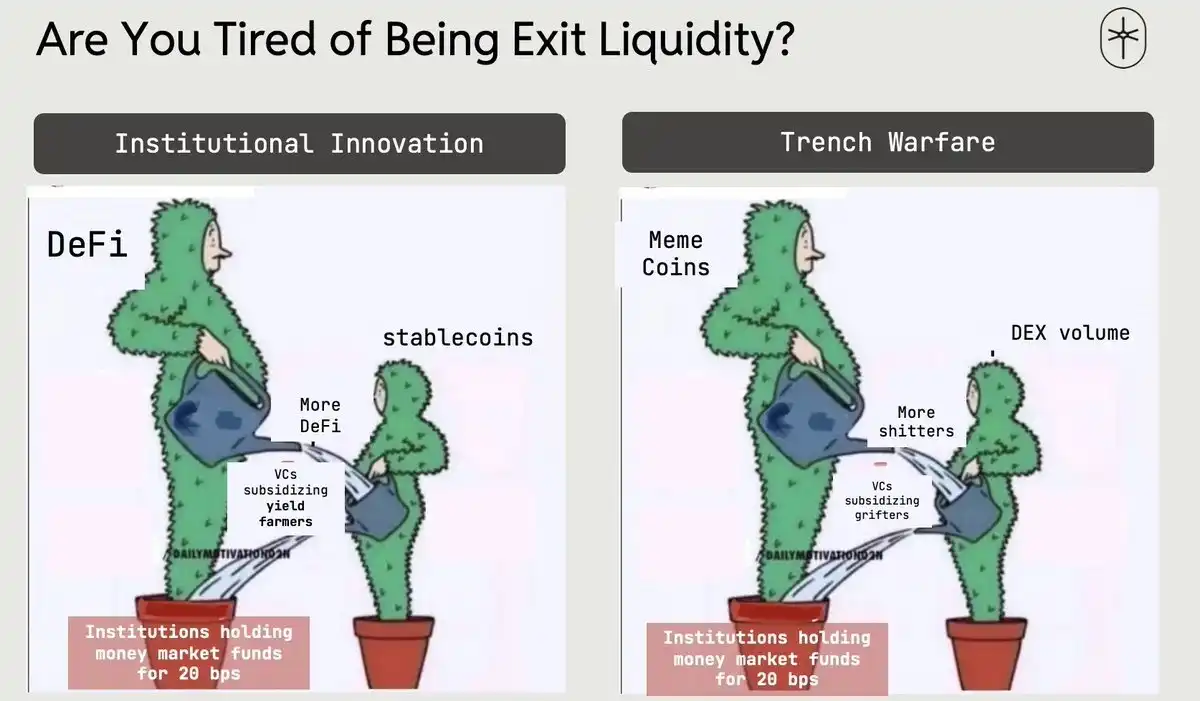
Those "institutional innovators" cheering for "adoption" at countless conferences and the trench warriors obsessing over memecoins on Twitter are more alike than you think. We should stop licking boots and start using our brains.
How Do Institutions Actually Think?

Corporations have one core function: profit maximization. Cryptocurrency can achieve this in two ways:

  • Cost Side: Distributed ledgers, on-chain collateral, and instant settlement can significantly reduce back and middle-office operational costs, improving collateral liquidity and utilization (see my previous notes on fungible liquidity).
  • Revenue Side: Packaging crypto into ETFs, tokenized funds, structured products, custody services, basis trade packages, lending, treasury management solutions... all throw off hefty fee streams, plus mindless hype from the crypto community on Twitter.

Over the past decade, institutions focused primarily on the first way.

When we founded DCG in 2015, I spent three full years pitching the advantages of Bitcoin's global ledger and final settlement mechanism to almost every financial institution. At that time, financial services firms did not see crypto as a new revenue source. It was considered too risky; and the potential gains from shilling altcoins weren't enough to convince boards to take on the reputational and compliance risk.

After leaving DCG, I joined CoinShares in early 2018. The company's AUM grew from tens of millions to billions of dollars gradually. The few independent investment managers who dared to embrace Bitcoin—like Cathie Wood, Murray Stahl, Ross Stevens—were ultimately richly rewarded for their courage.

Early 2024 became a watershed moment. Institutions began using crypto as a tool for the second path: a new revenue source.

While there had been sporadic institutional participation before, the launch of BlackRock's IBIT Bitcoin ETF blew the dam wide open. IBIT became the most successful ETF ever, significantly boosting BlackRock's earnings. Key numbers:

  • IBIT reached $70 billion AUM in its first year, becoming the fastest ETF to reach that size in history, about five times faster than the previous record holder, SPDR Gold Shares (GLD).
  • After IBIT options launched in late 2024, it attracted over $30 billion in new inflows, while competitors' flows largely stalled, giving it over half the market share of all Bitcoin ETF AUM.
  • IBIT's current ~$100 billion AUM generates hundreds of millions of dollars in annual fee revenue for BlackRock, making it even more profitable than the company's nearly trillion-dollar S&P 500 index fund.

The conclusion: IBIT showed the playbook to every major asset manager and financial services firm—take Bitcoin or other digital assets → package into traditional fund structures → list them → become a stable, hefty fee stream. Everything that follows—DATs, tokenized treasuries, on-chain money market funds—is just running that playbook over and over.

The AI Capex Supercycle: A Black Hole for Capital

Switching gears slightly to another mega-trend—this is also why we launched Crucible immediately after IBIT's launch in 2024. The energy-compute value chain is reshaping the global capital stack in real-time.

Building the AI economy—chips, data centers, power, factories, etc.—will require trillions of dollars in capital expenditure over the next decade, and that money has to come from somewhere. All liquid assets not directly tied to AI—crypto, non-AI stocks, even credit—are being sold to chase those perceived as "must-have" AI plays.

Simultaneously, many LPs are over-allocated in private markets, with slower exits and distributions, and are quietly cutting or delaying new private credit and PE commitments. This leads to longer, lumpier, less predictable fundraising cycles, and a fierce battle for quality AUM channels between asset managers and PEs. The result is that anything that looks like a capital pool gets drained.

On-Chain Capital: The Next AUM Frontier

In this AUM war, crypto is no longer a quirky toy but trillions in potential management规模, sitting right there.

IBIT proved crypto is both a money printer and a "honeypot" for institutional allocators. The Trump administration has also made it clear it will create an extremely permissive environment for all sorts of crypto innovation.

On-chain asset management and treasury规模 already amount to hundreds of billions:

  • ~$300 billion in stablecoin supply, with ~60% in USDT and 25% in USDC;
  • DeFi Total Value Locked (TVL) of ~$90–100 billion, spread across Ethereum, Solana, BSC, Hyperliquid, etc.;
  • Hundreds of billions more in Real World Asset (RWA) products via tokenized money funds (like BlackRock's BUIDL), tokenized gold (like Tether Gold, PAXG), and consumer credit products (like Figure's tokenized HELOCs).

But the average yield on this on-chain capital is only 2–4%, while traditional money market funds offer ~4.1%, and even Lido's $18 billion stETH pool yields only ~2.3%.

To a hungry asset accumulation machine, this isn't "DeFi TVL," it's under-monetized cash flow—ready to be packaged, staked, re-lent, and fee'd. For institutions, this is as natural as breathing.
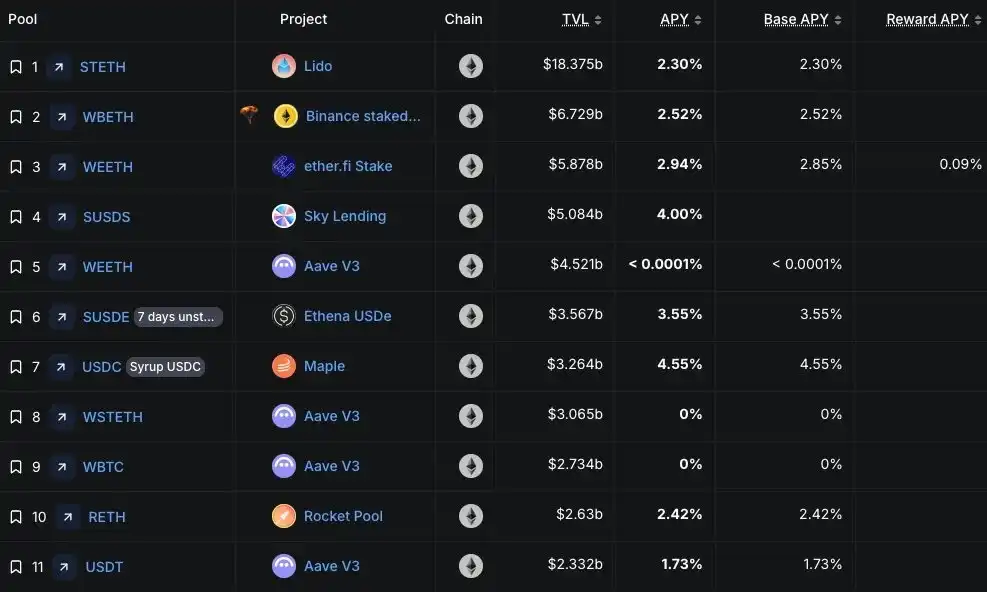
Image from DefiLlama

Tokenization and regulated wrapper products have turned previously "untouchable" crypto capital into fee-generating AUM that fits existing custody and risk frameworks. As companies, DAOs, and protocols accumulate large crypto treasuries and seek safer external yield, asset managers can repackage these assets into tokenized funds, money market funds, and structured products. For firms facing fundraising pressure and saturated traditional channels, "raiding" crypto balance sheets is one of the cleanest paths to grow fee AUM.

A Wake-Up Call

Just as Western economies introduced populations that did not share their culture and values and are now suffering the social and economic consequences, crypto stands on the brink of a similar existential crisis. The crypto economy and its leading thinkers are introducing financial institutions that do not share our values, institutions that are not here to co-build native economic growth, and our industry will soon taste the same social and economic bitterness.

Left unchecked, the crypto economy will become just another liquidity sleeve for TradFi's AUM machines. The only way out is to accelerate the building and scaling of our own native institutions—on-chain asset managers, risk managers, underwriters, financial products, crypto-native allocators—to compete for treasury AUM, design products that truly serve crypto's long-term interests, and keep more economic value inside the crypto ecosystem rather than leaking out to corporate P&Ls.

If we don't prioritize working with crypto-native institutions now, "institutional adoption" won't be a victory; it will be an annexation.

Believe in something. Otherwise, we'll have nothing left.

Related Reading

The War Between Stablecoins and Banking Probably Doesn't Exist

Preguntas relacionadas

QWhat is the main argument presented in the article regarding institutional adoption of crypto?

AThe article argues that institutional adoption is not about building up the crypto economy but is instead an extraction strategy where traditional financial institutions (TradFi) are siphoning value and fees from the crypto space to enrich themselves, rather than supporting native crypto growth.

QWhich traditional financial institutions are cited as major beneficiaries extracting value from the crypto economy?

AMajor beneficiaries include Tether, Coinbase, Circle, Cantor Fitzgerald, BlackRock (via its IBIT ETF), Apollo Global Management, and even former President Trump and his associates through crypto projects and tokens.

QHow does the article describe the role of BlackRock's IBIT Bitcoin ETF in the current market cycle?

AThe IBIT ETF is described as a watershed moment that demonstrated crypto as a new revenue source. It became the fastest-growing ETF in history, generating hundreds of millions in annual fees for BlackRock and providing a blueprint for other institutions to package crypto into traditional fund structures for lucrative fee generation.

QWhat does the article identify as the primary threat if crypto fails to build its own native institutions?

AThe primary threat is that the crypto economy will become just another liquidity pool for traditional finance's AUM (Assets Under Management) machines, with economic value constantly leaking out to TradFi balance sheets instead of being retained within the crypto ecosystem for its long-term benefit.

QWhat solution does the author propose to prevent the extraction of value by traditional institutions?

AThe author proposes accelerating the creation and growth of native crypto institutions—such as on-chain asset managers, risk management firms, underwriters, and crypto-native financial products—to compete for treasury AUM and design products that serve crypto's long-term interests, keeping economic value within the ecosystem.

Lecturas Relacionadas

STAR 50 Soars 10.73%, Why Did A-Shares Stage a "V-Shaped Reversal"?

After a prolonged decline, the Chinese A-share market staged a strong rally on July 21. The STAR 50 index surged 10.73%, its largest single-day gain in nearly a year, leading a broad-based "V-shaped" reversal. The Shanghai Composite Index rose 1.79%, the Shenzhen Component Index gained 4.81%, and the ChiNext Index jumped 7.05%. Total market turnover reached 2.97 trillion yuan, an increase of 256.1 billion yuan from the previous session, with over 3,100 stocks advancing. The semiconductor sector spearheaded the rebound, with related ETFs posting significant gains. Analysts attribute the surge to three converging factors. First, coordinated capital inflows from "national team" institutions, insurance funds, listed company buybacks, and fund house self-purchases have bolstered market liquidity and confidence. Second, supportive policy signals, including commitments from regulators to ensure stable market operations, provided a favorable backdrop. Third, a stabilization and recovery in overseas markets, notably South Korea, created a positive external environment. Institutions suggest the most severe panic selling phase for the tech sector has likely passed, following a significant digestion of crowded positions and leveraged funds. While short-term volatility may persist, the medium to long-term outlook remains underpinned by enduring trends like AI computing demand expansion and semiconductor localization. The market's focus now shifts to the sustainability of supportive fund flows, earnings reports, and upcoming catalysts from the global AI industry chain.

marsbitHace 23 min(s)

STAR 50 Soars 10.73%, Why Did A-Shares Stage a "V-Shaped Reversal"?

marsbitHace 23 min(s)

U.S. Tech Momentum Stocks Post Largest Single-Day Gain Ever, But Is the Plunge Over?

US tech momentum stocks staged a sharp rebound on Tuesday (July 21st). Morgan Stanley's TMT Momentum Factor surged over 12%, marking its largest single-day gain on record, exceeding even peaks from the 2000 dot-com bubble. Key momentum indices from Goldman Sachs also posted their strongest daily performances in years. The rally was led by semiconductors, with the Philadelphia Semiconductor Index jumping 4.6%. This rebound followed three consecutive down days and a cumulative 33% plunge in momentum stocks, one of the steepest drawdowns since the dot-com era. Analysts attribute the surge largely to a short squeeze. Heavy selling had pushed high-beta momentum stocks into deeply oversold territory, forcing many short sellers, particularly in Asia, to cover their positions, creating a self-reinforcing buying spiral. However, the rebound's internals appear weak. Trading volume was notably low, and advancing stocks still lagged decliners on the S&P 500, indicating a narrow, concentrated rally rather than broad market participation. Diverging views emerge on the outlook. BTIG warns the bounce has hit key resistance and recommends selling into strength, citing extreme volatility and historical parallels to past market tops. Conversely, Goldman Sachs and UBS believe the momentum unwind is nearing its end, suggesting it may be time to gradually add exposure, as positioning has been significantly reduced. They caution, however, that high volatility warrants a measured approach, potentially using defined-risk strategies. The upcoming earnings season, particularly reports from major tech firms like Alphabet, is seen as a critical test for the rally's sustainability. Simultaneously, bond markets flashed a warning, with yields rising partly due to spiking oil prices. Analysts note that if long-term Treasury yields break decisively higher, it could pose a significant headwind for equities, especially growth stocks.

marsbitHace 31 min(s)

U.S. Tech Momentum Stocks Post Largest Single-Day Gain Ever, But Is the Plunge Over?

marsbitHace 31 min(s)

U.S. Tech Momentum Stocks Record Largest Single-Day Gain Ever, but Has the Rout Ended?

U.S. tech momentum stocks staged a dramatic rebound on Tuesday, July 21st. Key momentum indices like the Morgan Stanley TMT Momentum Factor and Goldman Sachs' High Beta Momentum Long Index posted historic or near-historic single-day gains, fueled largely by semiconductor stocks. This sharp rally followed a severe three-day sell-off that saw momentum stocks plunge 33%, marking one of the steepest pullbacks since the dot-com bubble. Analysts attribute the bounce primarily to a short squeeze, as forced covering from over-leveraged traders, particularly in Asia, created a buying spiral. However, the rally's health is questioned due to weak market breadth—overall trading volume was low, and decliners outnumbered advancers in the S&P 500 despite the index's gain—suggesting a narrow, concentrated surge rather than broad recovery. Opinions on the sustainability diverge. BTIG strategists warn the rebound has hit key resistance levels, citing extreme volatility and historic stock dispersion as signs of an ongoing broader correction, and recommend selling into strength. Conversely, Goldman Sachs and UBS view the aggressive momentum unwinding as nearing its end, noting reduced positioning and a lack of new fundamental catalysts. They suggest the sell-off presents a selective opportunity to add exposure, albeit cautiously and gradually using defined-risk strategies. The immediate trajectory hinges on the ongoing earnings season, with market focus on Alphabet's capital expenditure guidance for AI investment clarity. Meanwhile, bond markets present a risk, with rising Treasury yields—potentially heading toward 5.5%—and widening credit spreads for mega-cap tech companies posing a threat to equity valuations. The combination of technical factors, earnings results, and macro conditions leaves the durability of the rebound in doubt.

链捕手Hace 33 min(s)

U.S. Tech Momentum Stocks Record Largest Single-Day Gain Ever, but Has the Rout Ended?

链捕手Hace 33 min(s)

Long-Divided Must Unite, Long-United Must Divide: When L1 Becomes Its Own Rollup, What Is Ethereum's Endgame?

"The Inevitable Cycle: When L1 Becomes Its Own Rollup – What is Ethereum's Endgame?" For years, the Ethereum community grappled with concerns that L2s were fragmenting the ecosystem and eroding L1's value. While L2s provided cheaper execution, they also splintered liquidity and the unified user experience of a single chain. This has prompted a fundamental reassessment of the relationship between L1 and L2. Ethereum's roadmap is evolving. The "Scale" initiative merges L1 and L2 expansion into a holistic framework. L1 itself is advancing with higher gas limits, statelessness, and zkEVM verification, no longer content to be just a low-throughput settlement layer. Consequently, the primary value proposition of L2s is shifting from merely providing cheap blockspace to offering L1 cannot easily provide: application-specific optimizations, privacy features, and flexible governance models. L2s are becoming a spectrum of execution environments with varying degrees of security inheritance from Ethereum. A critical challenge in this multi-chain future is interoperability. The vision is to make Ethereum "feel like one chain again." This relies on advancements in native account abstraction (like EIP-7702) and intent-based architectures (Open Intents Framework), where users declare desired outcomes, and solvers handle the complex cross-chain execution. Furthermore, shortening Ethereum's finality time from minutes to seconds is crucial, as it underpins trust between chains for bridges, stablecoins, and cross-chain applications. Perhaps the most provocative idea is that Ethereum L1 itself could become a form of "its own Rollup." As zkEVM and proof systems mature, high-performance nodes could execute transactions and generate validity proofs. Regular validators would then verify these proofs instead of re-executing all transactions. This blurs the traditional L1/L2 hierarchy, making "Rollup" more of a general execution-verification architecture. Native Rollup aims to integrate L2 validation more directly into the Ethereum protocol, allowing L2s to inherit L1's security more fully and move away from reliance on security councils. In the end, L2s are not destined to replace L1 or be made obsolete by it. The likely future is a unified system where diverse execution environments—each optimized for specific use cases like DeFi, gaming, or privacy—coexist. They will share a common foundation of security, liquidity, and verifiable state, seamlessly connected to restore a cohesive user experience. The next phase for Ethereum is not just about scaling through separation, but about intelligently reintegrating what was separated back into a coherent whole.

链捕手Hace 49 min(s)

Long-Divided Must Unite, Long-United Must Divide: When L1 Becomes Its Own Rollup, What Is Ethereum's Endgame?

链捕手Hace 49 min(s)

Trading

Spot
活动图片





