Design, Development, Legal, Sports... Polymarket Launches 'Full-Stack' Talent Grab

Odaily星球日报Publicado a 2026-04-15Actualizado a 2026-04-15

Resumen

Polymarket, a leading prediction market platform, is aggressively expanding its team across multiple domains following competitor Kalshi's recent $22 billion valuation funding round. Key hires and strategic acquisitions are central to its growth strategy. Design remains a priority, with the design lead actively recruiting to strengthen the platform's distinctive blue-and-white branding. Engineering recruitment is also intensive, highlighted by the acquisition of API platform Dome, whose co-founders joined Polymarket, and the hiring of a former Aave engineering VP. Multiple senior engineering roles are currently open. For its US platform, Polymarket is bolstering legal and compliance expertise, adding a former RBC Capital Markets veteran as Legal Counsel. In a significant move, it hired a former Fanatics CBO to lead sports business development, which sparked a non-compete lawsuit from Fanatics, revealing complex industry entanglements. Further hires include a former Coinbase institutional product lead to handle institutional liquidity sales, a marketing head from MrBeast's team, and a Citadel veteran for exchange upgrades. Polymarket is also recruiting for HR and a Head of Markets, indicating the talent competition in the prediction market space is far from over.

Original|Odaily Planet Daily(@OdailyChina)

Author|Wenser(@wenser 2010 )

After Kalshi completed a new funding round in March with a valuation of $22 billion, Polymarket, one of the two giants in the prediction market, couldn't sit still.

Apart from the news that it was previously seeking funding with a $20 billion valuation, Polymarket has also been busy recruiting new team members recently for platform development and business expansion. From the list of new team members joining Polymarket, we might get a glimpse of the focus and突围 directions of this former prediction market霸主, now the "perennial runner-up".

Odaily Planet Daily will provide a梳理 and analysis based on Polymarket's recruitment information in this article.

Design Remains a Top Priority: Design Lead Posted Recruitment Plan in January

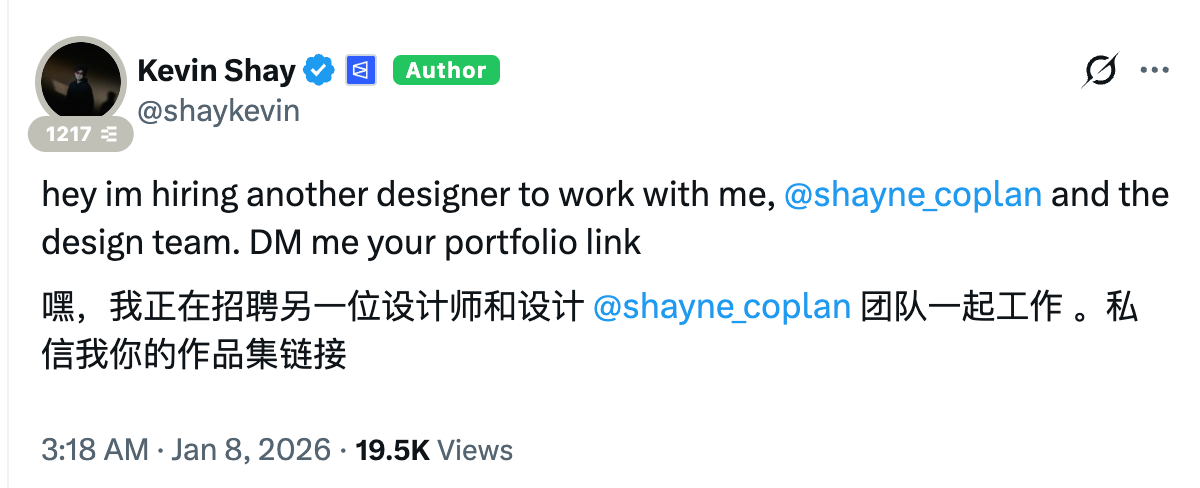
In January of this year, Polymarket's Head of Design, Kevin Shay, posted a tweet stating that he was recruiting designers. Apart from distinguishing itself from Kalshi's green and white UI, Polymarket's blue and white UI remains an important design language and iconic symbol. Its previously opened pop-up grocery store in New York also used corresponding blue and white elements in its design. In the crucial battle for brand突围, design is still a top priority for Polymarket's development.

Additionally, according to the official recruitment page, there are currently 2 design-related positions still open.
Development Engineers Continuously Recruited: Emphasizing Both Talent Acquisition and External Recruitment

As the business cornerstone of platform development, developers are also a key driving force behind Polymarket's recent business expansion. The strategy adopted by Polymarket's talent recruitment team is to emphasize both talent acquisition and external recruitment.

Kurush Dubash & Kunal Roy, Two Co-founders of Dome

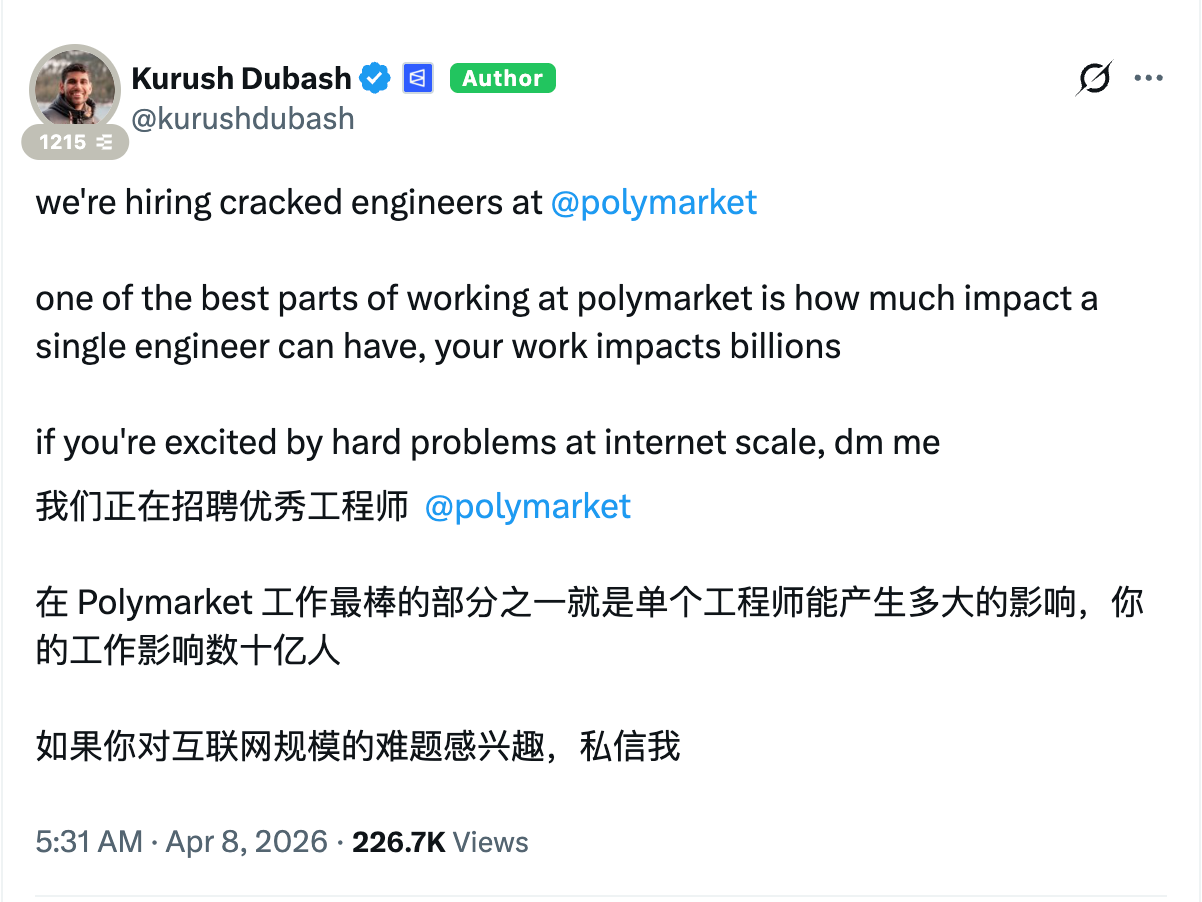
In February, the prediction market API platform Dome was officially acquired by Polymarket. Subsequently, Dome's two co-founders, Kurush Dubash and Kunal Roy, also joined Polymarket. In April, they posted tweets recruiting top engineers, beginning to show a "person-to-person"火热 recruitment phenomenon.

It is worth mentioning that Polymarket also acquired the executive search firm Lunch in the same month; many of the executives and team members mentioned later were contacted and recruited by the leaders of this company; in March, Polymarket also acquired the DeFi infrastructure startup Brahma, and most of its team members have also been integrated into the Polymarket team.
Josh Stevens, Vice President of Engineering

On March 24th, former Aave engineer and senior vice president Josh announced that he had joined Polymarket. And just half a month later, he was already posting again on his personal account to recruit engineers. It seems that the developer gap at the rapidly developing Polymarket is much larger than outsiders might imagine.
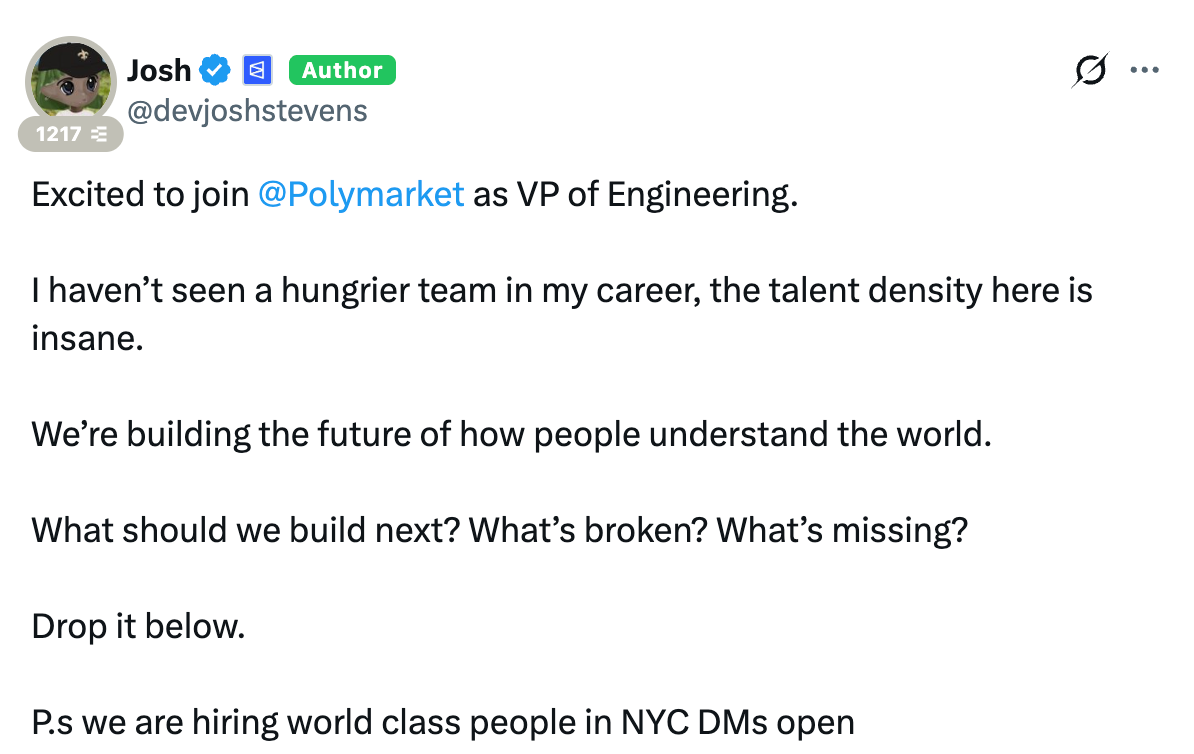
Joining announcement tweet in March
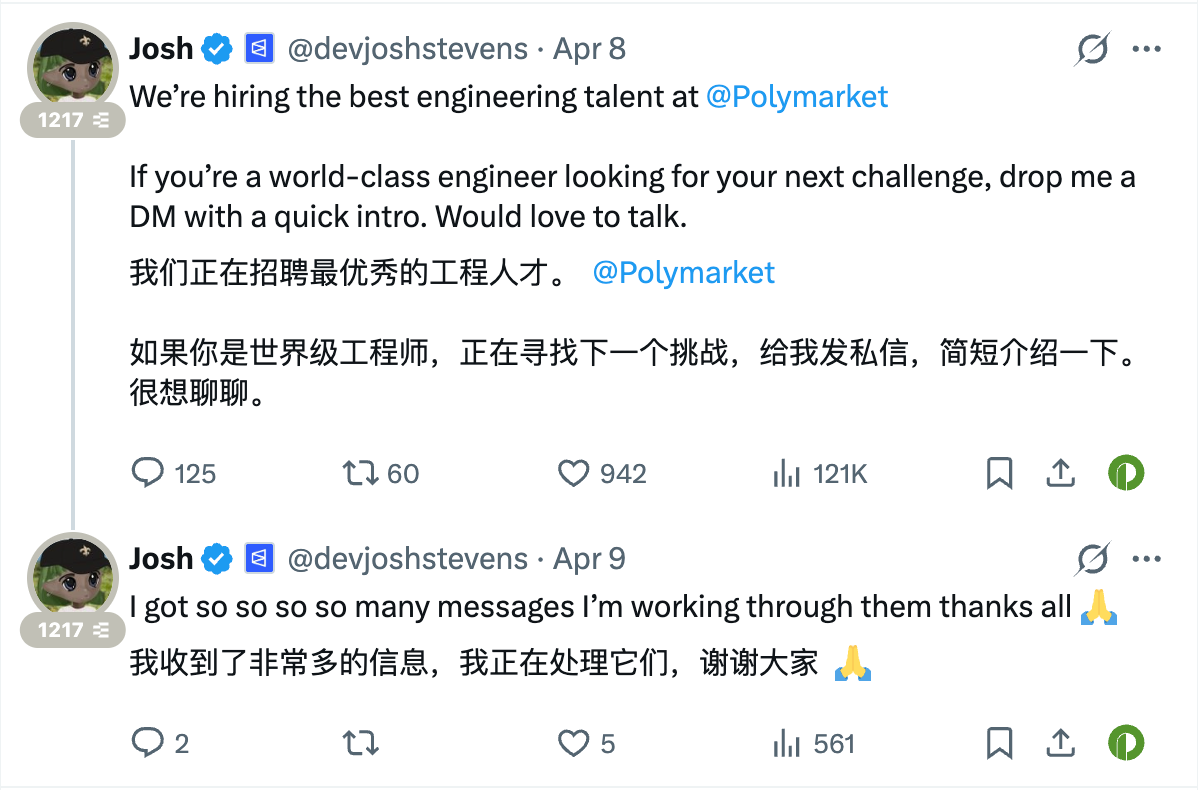
Posting recruitment information again in early April

Additionally, according to the official recruitment page information, the developer positions currently being recruited by Polymarket include Senior Backend Engineer (US Platform), C/C++ Senior Engineer (US Platform), Smart Contract Developer, Mobile AI Engineer, and Senior Platform Infrastructure Engineer. Interested friends can try applying.

Compliance, Legal, and Sports Betting Talent: Personnel Reserves for Polymarket's US Platform

Last November, by acquiring the US-compliant trading platform QCX, Polymarket finally managed to return to the US market. Facing the increasingly stringent regulatory environment in the US market and the regulatory contradictions between federal agencies and state/local courts, Polymarket has had to once again strengthen its talent reserves in legal and compliance aspects.

Matthew Lischin, Legal Counsel for Polymarket US Platform

In February 2026, after ending his 13-year tenure at RBC Capital Markets (the investment banking division of Royal Bank of Canada), Matthew Lischin finally joined Polymarket as the Head of North America Global Markets Legal Team. Public information shows that he will focus on the legal compliance of complex financial products such as equity derivatives and margin loans.

It is worth mentioning that when he posted on LinkedIn announcing his departure from RBC, Polymarket's Chief Legal Officer, Neal Kumar, left a comment to communicate. Perhaps due to this opportunity, Lischin later posted确认 joining the Polymarket US platform as Legal Counsel,直言: "The wish has finally come true!"

Ari Borod, Former Fanatics Executive Becomes President of Sports Business Development

In February 2026, after ending his 4-year tenure as Chief Commercial Officer (CBO) and other positions at the well-known sports betting platform Fanatics, Ari Borod subsequently plunged into Polymarket, the prediction market霸主 and rising star in sports betting.

Unexpectedly, due to his sensitive career experience, it also triggered a non-compete lawsuit from his former employer Fanatics. Although the lawsuit was eventually settled out of court, it must be said that in the process of the prediction market's growth, friction with traditional industries like sports betting may not only exist at the regulatory level but also at the talent争夺 level.

Public information shows that Ari Borod led the strategic transformation of Fanatics from fan merchandise to sports betting business. Earlier, he served as Chief Commercial Officer and Chief Operating Officer at The Action Network and worked at FanDuel for six years, rising from Assistant General Counsel to Vice President of Sports at Fanatics.

However, in the non-compete lawsuit filed by Fanatics in a Florida court, court documents revealed another shocking thing - Fanatics founder Michael Rubin and Fanatics Betting and Gaming CEO Matt King personally hold shares in Kalshi. It just goes to show that real business warfare is everywhere. Furthermore, even more laughably, Fanatics had previously been involved in a non-compete lawsuit for hiring Mike Hermalyn, former Senior Vice President of Growth at DraftKings. It seems因果循环,报应不爽 (karma is a cycle, retribution is not pleasant).

Institutional Liquidity Awaits Introduction: Former Coinbase Institutional Product Lead

On April 2nd, former Coinbase Head of Institutional & Retail Products, Brooke Rizzetto, officially announced joining Polymarket, stating that she would later be responsible for "institutional liquidity sales." After working at Coinbase for over 4 years, Brooke Rizzetto began seeking new ways of information pricing and liquidity introduction from the prediction market赛道.
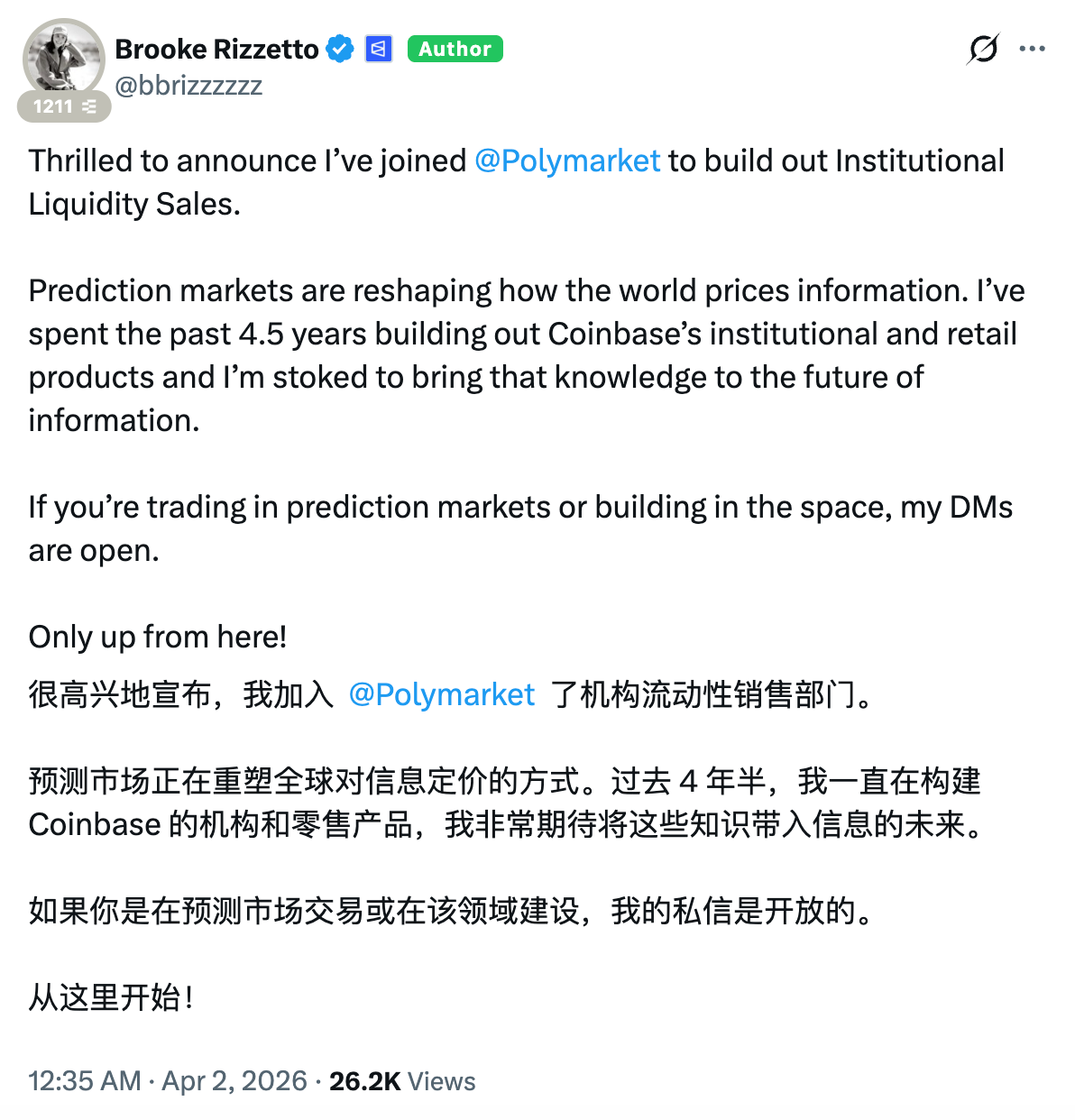
In addition to the above personnel, other team members recently joining Polymarket include former "MrBeast (YouTube's top influencer Beast Mr.)" viral marketing lead Josh Tucker, and Citadel hedge fund veteran of 8 years Mukilan Ashok,主要负责 marketing, exchange platform upgrades and other business.

Furthermore, Polymarket's Head of People Recruitment, Matthew Kendall Clark, recently pointed out in a post that they are currently recruiting Personnel Recruitment Staff and Polymarket Head of Markets. This "talent arms race" among prediction market platforms is clearly still in the land-grabbing stage, far from over.

For more information about Polymarket's recruitment, please check its official recruitment page.

Preguntas relacionadas

QWhat is the valuation of Kalshi after its latest funding round in March, as mentioned in the article?

AKalshi was valued at $22 billion after its latest funding round in March.

QWhich two key strategies is Polymarket using to recruit developers for its platform expansion?

APolymarket is using talent acquisition and external recruitment as its key strategies to recruit developers.

QWho was hired as the President of Sports Business Development at Polymarket, and what controversy was associated with this hire?

AAri Borod was hired as the President of Sports Business Development, and his hiring led to a non-compete lawsuit from his former employer, Fanatics, which was eventually settled out of court.

QWhat specific role will Brooke Rizzetto, formerly of Coinbase, take on at Polymarket?

ABrooke Rizzetto will be responsible for institutional liquidity sales at Polymarket.

QWhich two companies did Polymarket acquire to support its talent recruitment and platform development efforts?

APolymarket acquired Dome, a prediction market API platform, and Brahma, a DeFi infrastructure startup, to support its talent recruitment and platform development.

Lecturas Relacionadas

STAR 50 Soars 10.73%, Why Did A-Shares Stage a "V-Shaped Reversal"?

After a prolonged decline, the Chinese A-share market staged a strong rally on July 21. The STAR 50 index surged 10.73%, its largest single-day gain in nearly a year, leading a broad-based "V-shaped" reversal. The Shanghai Composite Index rose 1.79%, the Shenzhen Component Index gained 4.81%, and the ChiNext Index jumped 7.05%. Total market turnover reached 2.97 trillion yuan, an increase of 256.1 billion yuan from the previous session, with over 3,100 stocks advancing. The semiconductor sector spearheaded the rebound, with related ETFs posting significant gains. Analysts attribute the surge to three converging factors. First, coordinated capital inflows from "national team" institutions, insurance funds, listed company buybacks, and fund house self-purchases have bolstered market liquidity and confidence. Second, supportive policy signals, including commitments from regulators to ensure stable market operations, provided a favorable backdrop. Third, a stabilization and recovery in overseas markets, notably South Korea, created a positive external environment. Institutions suggest the most severe panic selling phase for the tech sector has likely passed, following a significant digestion of crowded positions and leveraged funds. While short-term volatility may persist, the medium to long-term outlook remains underpinned by enduring trends like AI computing demand expansion and semiconductor localization. The market's focus now shifts to the sustainability of supportive fund flows, earnings reports, and upcoming catalysts from the global AI industry chain.

marsbitHace 29 min(s)

STAR 50 Soars 10.73%, Why Did A-Shares Stage a "V-Shaped Reversal"?

marsbitHace 29 min(s)

U.S. Tech Momentum Stocks Post Largest Single-Day Gain Ever, But Is the Plunge Over?

US tech momentum stocks staged a sharp rebound on Tuesday (July 21st). Morgan Stanley's TMT Momentum Factor surged over 12%, marking its largest single-day gain on record, exceeding even peaks from the 2000 dot-com bubble. Key momentum indices from Goldman Sachs also posted their strongest daily performances in years. The rally was led by semiconductors, with the Philadelphia Semiconductor Index jumping 4.6%. This rebound followed three consecutive down days and a cumulative 33% plunge in momentum stocks, one of the steepest drawdowns since the dot-com era. Analysts attribute the surge largely to a short squeeze. Heavy selling had pushed high-beta momentum stocks into deeply oversold territory, forcing many short sellers, particularly in Asia, to cover their positions, creating a self-reinforcing buying spiral. However, the rebound's internals appear weak. Trading volume was notably low, and advancing stocks still lagged decliners on the S&P 500, indicating a narrow, concentrated rally rather than broad market participation. Diverging views emerge on the outlook. BTIG warns the bounce has hit key resistance and recommends selling into strength, citing extreme volatility and historical parallels to past market tops. Conversely, Goldman Sachs and UBS believe the momentum unwind is nearing its end, suggesting it may be time to gradually add exposure, as positioning has been significantly reduced. They caution, however, that high volatility warrants a measured approach, potentially using defined-risk strategies. The upcoming earnings season, particularly reports from major tech firms like Alphabet, is seen as a critical test for the rally's sustainability. Simultaneously, bond markets flashed a warning, with yields rising partly due to spiking oil prices. Analysts note that if long-term Treasury yields break decisively higher, it could pose a significant headwind for equities, especially growth stocks.

marsbitHace 36 min(s)

U.S. Tech Momentum Stocks Post Largest Single-Day Gain Ever, But Is the Plunge Over?

marsbitHace 36 min(s)

U.S. Tech Momentum Stocks Record Largest Single-Day Gain Ever, but Has the Rout Ended?

U.S. tech momentum stocks staged a dramatic rebound on Tuesday, July 21st. Key momentum indices like the Morgan Stanley TMT Momentum Factor and Goldman Sachs' High Beta Momentum Long Index posted historic or near-historic single-day gains, fueled largely by semiconductor stocks. This sharp rally followed a severe three-day sell-off that saw momentum stocks plunge 33%, marking one of the steepest pullbacks since the dot-com bubble. Analysts attribute the bounce primarily to a short squeeze, as forced covering from over-leveraged traders, particularly in Asia, created a buying spiral. However, the rally's health is questioned due to weak market breadth—overall trading volume was low, and decliners outnumbered advancers in the S&P 500 despite the index's gain—suggesting a narrow, concentrated surge rather than broad recovery. Opinions on the sustainability diverge. BTIG strategists warn the rebound has hit key resistance levels, citing extreme volatility and historic stock dispersion as signs of an ongoing broader correction, and recommend selling into strength. Conversely, Goldman Sachs and UBS view the aggressive momentum unwinding as nearing its end, noting reduced positioning and a lack of new fundamental catalysts. They suggest the sell-off presents a selective opportunity to add exposure, albeit cautiously and gradually using defined-risk strategies. The immediate trajectory hinges on the ongoing earnings season, with market focus on Alphabet's capital expenditure guidance for AI investment clarity. Meanwhile, bond markets present a risk, with rising Treasury yields—potentially heading toward 5.5%—and widening credit spreads for mega-cap tech companies posing a threat to equity valuations. The combination of technical factors, earnings results, and macro conditions leaves the durability of the rebound in doubt.

链捕手Hace 39 min(s)

U.S. Tech Momentum Stocks Record Largest Single-Day Gain Ever, but Has the Rout Ended?

链捕手Hace 39 min(s)

Long-Divided Must Unite, Long-United Must Divide: When L1 Becomes Its Own Rollup, What Is Ethereum's Endgame?

"The Inevitable Cycle: When L1 Becomes Its Own Rollup – What is Ethereum's Endgame?" For years, the Ethereum community grappled with concerns that L2s were fragmenting the ecosystem and eroding L1's value. While L2s provided cheaper execution, they also splintered liquidity and the unified user experience of a single chain. This has prompted a fundamental reassessment of the relationship between L1 and L2. Ethereum's roadmap is evolving. The "Scale" initiative merges L1 and L2 expansion into a holistic framework. L1 itself is advancing with higher gas limits, statelessness, and zkEVM verification, no longer content to be just a low-throughput settlement layer. Consequently, the primary value proposition of L2s is shifting from merely providing cheap blockspace to offering L1 cannot easily provide: application-specific optimizations, privacy features, and flexible governance models. L2s are becoming a spectrum of execution environments with varying degrees of security inheritance from Ethereum. A critical challenge in this multi-chain future is interoperability. The vision is to make Ethereum "feel like one chain again." This relies on advancements in native account abstraction (like EIP-7702) and intent-based architectures (Open Intents Framework), where users declare desired outcomes, and solvers handle the complex cross-chain execution. Furthermore, shortening Ethereum's finality time from minutes to seconds is crucial, as it underpins trust between chains for bridges, stablecoins, and cross-chain applications. Perhaps the most provocative idea is that Ethereum L1 itself could become a form of "its own Rollup." As zkEVM and proof systems mature, high-performance nodes could execute transactions and generate validity proofs. Regular validators would then verify these proofs instead of re-executing all transactions. This blurs the traditional L1/L2 hierarchy, making "Rollup" more of a general execution-verification architecture. Native Rollup aims to integrate L2 validation more directly into the Ethereum protocol, allowing L2s to inherit L1's security more fully and move away from reliance on security councils. In the end, L2s are not destined to replace L1 or be made obsolete by it. The likely future is a unified system where diverse execution environments—each optimized for specific use cases like DeFi, gaming, or privacy—coexist. They will share a common foundation of security, liquidity, and verifiable state, seamlessly connected to restore a cohesive user experience. The next phase for Ethereum is not just about scaling through separation, but about intelligently reintegrating what was separated back into a coherent whole.

链捕手Hace 55 min(s)

Long-Divided Must Unite, Long-United Must Divide: When L1 Becomes Its Own Rollup, What Is Ethereum's Endgame?

链捕手Hace 55 min(s)

Trading

Spot
活动图片





