Crypto Morning Brief: Inflation Data Positive, Uniswap Proposes Burning 100 Million UNI Tokens and Enabling Fee Switch

深潮Publicado a 2025-12-19Actualizado a 2025-12-19

Resumen

Crypto Market Update: U.S. inflation data came in better than expected, with the November CPI at 2.7% year-on-year, fueling expectations for potential Fed rate cuts. The SEC issued new guidance on crypto assets and DLT, clarifying rules for broker-dealers, asset protection, and trading systems. In major industry moves, Uniswap's governance proposal to burn 100 million UNI tokens and activate a fee switch has entered final voting. Bitwise filed for a spot Sui ETF, Tether hinted at developing a new OS, and Standard Chartered Hong Kong launched tokenized deposit services. Other developments include a tokenized public stock on Solana, ICE's potential investment in MoonPay, and a $70M raise for Solana DePIN project Fuse Energy.

Author: Deep Tide TechFlow

Yesterday's Market Dynamics

US Releases Important Economic Data

According to Jinshi Data, US initial jobless claims for the week ending December 13 were 224,000, compared to an expectation of 225,000.

According to Jinshi Data, the US November unadjusted CPI year-on-year was 2.7%, compared to an expectation of 3.1%.

Hassett: Latest CPI Report Surprisingly Good, Fed Has Significant Room for Rate Cuts

According to Jinshi Data, on Thursday, White House National Economic Council Director Hassett welcomed the November CPI report, stating that the US economy is exhibiting high growth and falling inflation. He said: "I'm not saying we're declaring victory on prices, but this is a surprisingly good CPI report." Hassett stated that wage growth is outpacing price growth, US taxpayers will see large refunds next year, and the government will help lower mortgage rates. He said: "The Fed has significant room for rate cuts." Hassett is a leading candidate to replace Powell as the next Fed Chair. He also suggested that the Fed should be more transparent in the future. "I think the Fed has to double down on transparency. Whoever leads the Fed should lay all the cards on the table so we can figure out what's really happening at that institution."

US SEC Releases Regulatory FAQ Related to Crypto Assets and Distributed Ledger Technology

According to an official announcement, the US SEC's Division of Trading and Markets released Frequently Asked Questions (FAQs) on activities related to crypto assets and Distributed Ledger Technology (DLT), aiming to provide compliance guidance for market participants. The content covers the following core areas:

  1. Broker-Dealer Responsibilities: Non-security crypto assets are not subject to Securities Exchange Act Rule 15c3-3. However, if they are "crypto asset securities," brokers can establish "control" under this rule to meet compliance requirements. The SEC has no objection to assets in non-paper form.

  2. Customer Asset Protection: If a crypto asset is not a product registered under the Securities Act, SIPC (Securities Investor Protection Corporation) will not provide protection. The SEC suggests treating non-security crypto assets as "financial assets" and placing them in a "securities account" under UCC Article 8 to strengthen the independence of customer assets during clearing and bankruptcy.

  3. Dual Asset Trading Pairs: National Securities Exchanges (NSE) and Alternative Trading Systems (ATS) can offer paired trading of "crypto securities/non-security assets," provided they meet regulatory requirements and disclose relevant information in detail on Form ATS or ATS-N.

  4. Transfer Agents and DLT: If a transfer agent provides security transfer services for a crypto asset issuer, and the asset is a registered security under Section 12, it must register with the SEC. The SEC does not object to using blockchain as the primary ledger, provided it meets federal regulations for record-keeping and supervision.

  5. Clearing, Settlement, and ETPs: When a registered broker operates an ATS, it can clear customer trades within its own account ledger; the SEC does not mandate registration as a clearing agency. For ETPs referencing crypto assets, the SEC does not object to their operation referencing the 2006 no-action letter for commodity ETPs.

Bitwise Files S-1 with US SEC, Proposes Spot Sui ETF

According to an official filing, Bitwise has filed a Form S-1 with the US SEC, proposing a spot Bitwise Sui ETF aimed at tracking the value of Sui held by the Trust (net of fees). The Trust's Sui will be custodied by Coinbase Custody, with plans to stake a portion of the assets.

Tether CEO: Will Eventually Launch a Pear Operating System

Stablecoin company Tether yesterday announced the launch of PearPass, a peer-to-peer (P2P) password manager designed to eliminate the risk of users' encrypted information being leaked to the cloud. The company's CEO, Paolo Ardoino, shared a community analysis article on platform X and stated: "Will eventually launch a Pear Operating System (Pear OS)".

Uniswap Founder: Final Governance Vote Submitted for Unification Proposal, Proposes Burning 100 Million UNI Tokens and Enabling Fee Switch

According to Uniswap founder Hayden Adams, the Unification proposal has been submitted for a final governance vote. Voting will begin on December 19 at 10:30 PM ET and end on December 25.

If the proposal passes, after a 2-day timelock, the following measures will be executed: Burn 100 million UNI tokens; Activate the fee switch for versions v2 and v3 on the mainnet, beginning the burning of UNI tokens, including Unichain fees; Uniswap Labs will align with Uniswap governance through a contractual agreement, which is legally binding under Wyoming DUNA law.

Hong Kong Economic Times: Standard Chartered Hong Kong Launches Tokenized Deposit Service

According to the Hong Kong Economic Times, Standard Chartered Bank (Hong Kong) and Ant International, under the framework of the Hong Kong Monetary Authority's DLT regulatory sandbox and Ensemble project, have tokenized Ant International's HKD, RMB, and USD accounts through Ant International's blockchain treasury management platform "Whale Platform".

The report stated that this tokenized solution was co-developed, allowing Ant International business entities to adopt a new treasury management model, accelerating the shift to this new model and enabling 24/7 real-time transfers of HKD, RMB, and USD funds.

Mahesh Kini, Global Head of Cash Management Business at Standard Chartered, said that as companies' reliance on instant liquidity increases, the market demand for real-time and 24/7 treasury management is growing rapidly.

Forward Industries Announces Its Tokenized Stock is Live on Solana Blockchain

According to Businesswire, Nasdaq-listed Solana treasury company Forward Industries announced that its SEC-registered stock is now live on the Solana blockchain via the Superstate platform. It is reported that eligible investors can also use the company's tokenized stock as collateral to borrow stablecoins, thereby gaining on-chain liquidity while maintaining investment exposure to the underlying equity.

NYSE Parent Intercontinental Exchange in Talks to Invest in Crypto Payments Company MoonPay

According to Bloomberg, Intercontinental Exchange Inc., the parent company of the New York Stock Exchange, is in talks to invest in crypto payments company MoonPay Inc. Sources revealed that MoonPay is close to completing a new funding round targeting a valuation of approximately $5 billion. This investment would be part of that funding round.

Listed Company VivoPower Partners with Korea's Lean Ventures to Acquire Ripple Equity

According to CoinDesk, Nasdaq-listed company VivoPower (VVPR), through its digital assets division Vivo Federation, has partnered with Korean asset management company Lean Ventures to plan raising $300 million to acquire equity in Ripple Labs, serving Korean institutional and qualified retail investors.

At the current XRP price, this investment would indirectly provide exposure to approximately 450 million XRP tokens, worth about $900 million. VivoPower has received approval from Ripple to purchase the first tranche of preferred shares and is negotiating additional acquisitions with existing institutional holders.

Solana-based DePIN Project Fuse Energy Completes $70 Million Series B Funding Round Led by Lowercarbon and Balderton

According to SolanaFloor, the Solana-based DePIN project Fuse Energy announced the completion of a $70 million Series B funding round. This round was led by Lowercarbon Capital and Balderton Capital, valuing the company at $5 billion.

Market Trends
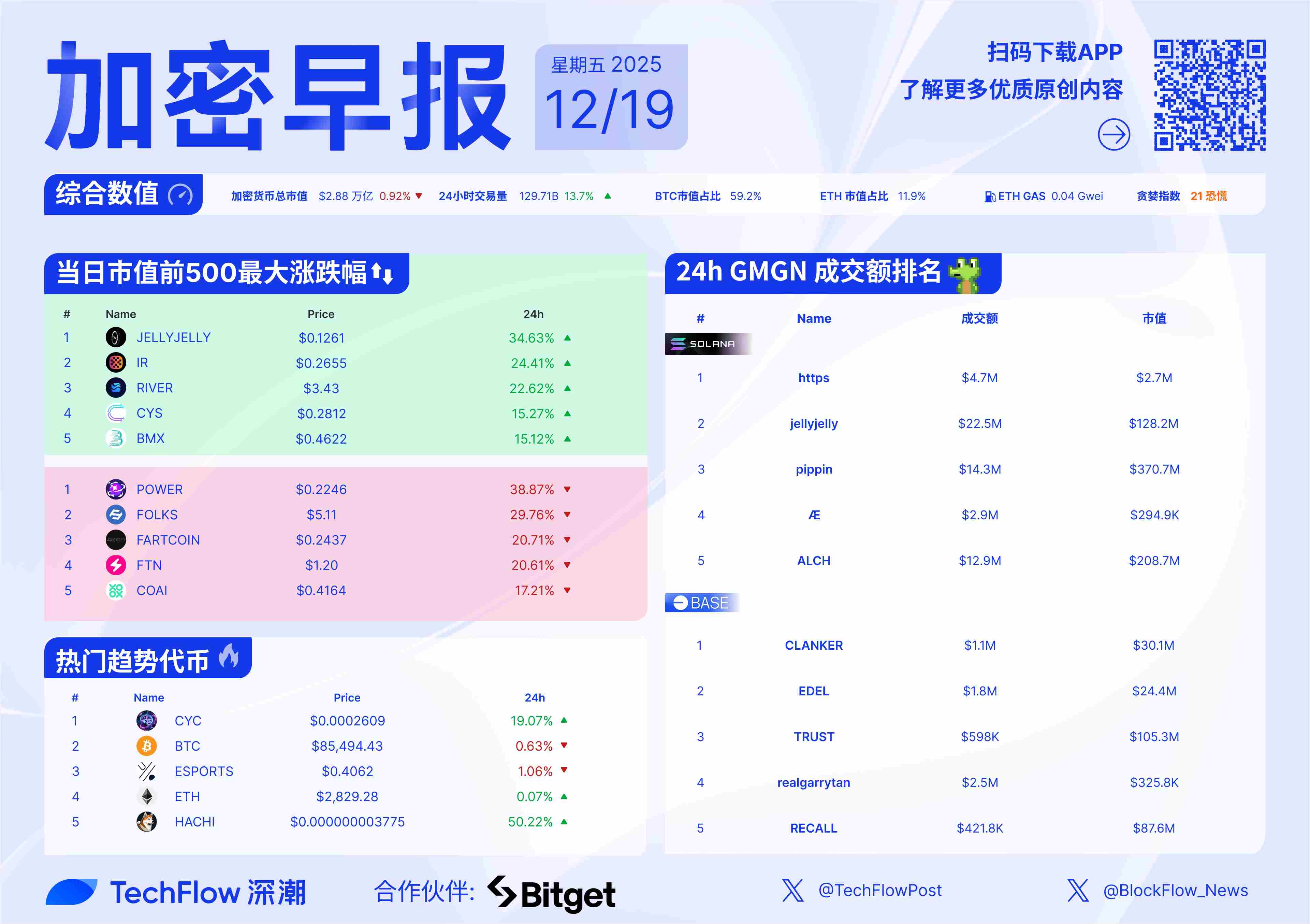
Recommended Reading

After Profiting $580K, I'm Shorting ETH Again with $1 Million

This article analyzes the current state of the cryptocurrency market, particularly the price volatility of Ethereum (ETH) and investment strategies. The author details the reasons for shorting ETH, the dynamics of marginal buyers and sellers in the market, and the impact of strategies by major market participants like Tom Lee on the ETH market. The article also discusses the relationship between the maturation of the cryptocurrency market and the value of technology products and assets.

From AI to Labubu, From Gold to Crypto: Why Are Speculative Bubbles Everywhere Globally?

This article explores the phenomenon of speculative bubbles worldwide, particularly the economic risks in hot areas like artificial intelligence (AI), cryptocurrency, and others. It analyzes historical speculative bubbles, compares them to the current irrational exuberance in markets, and points out the potential economic consequences of these bubbles.

NY Times: The Untold Story Behind Trump's Embrace of Crypto

This article discusses a New York Times piece revealing the Trump administration's support for cryptocurrency and its effects, including policy relaxation, market volatility, an innovation boom, and potential risks. It details the rise and fall of crypto enterprises, the risks of leveraged trading, and the development trend of asset tokenization, while also analyzing the Trump family's business布局 in the cryptocurrency space.

Frontline Report | Web3 Lawyer Deciphers Latest Changes in US Stock Tokenization!

This article details how US stock tokenization is a key item on the US financial infrastructure agenda. While it won't fundamentally change how Wall Street operates in the short term, its development is gradually shifting from "whether it's compliant" to "how to implement it." The article provides a detailed interpretation of the latest progress in US stock tokenization, including regulatory reforms by Nasdaq and DTCC, the SEC's regulatory stance, and the specific implementation paths of tokenization technology.

The On-Chain Evolution of Private Credit: From Ledger to Investable Product

This article explains that tokenized private credit is the fastest-growing category, growing from less than $50,000 to about $2.4 billion, showing its potential among on-chain assets. Tokenized private credit is divided into "representative" and "distributive" models; the former only records loan information, while the latter enables the on-chain transfer of assets. Movable private credit assets not only provide liquidity but also enable faster settlement, higher transparency, and more flexible custody methods.


Criptos en tendencia

Preguntas relacionadas

QWhat was the US unadjusted CPI annual rate for November and how did it compare to expectations?

AThe US unadjusted CPI annual rate for November was 2.7%, which was lower than the expected 3.1%.

QWhat specific actions does the Uniswap Unification proposal include if it passes?

AIf the Uniswap Unification proposal passes, it will execute the following measures: burn 100 million UNI tokens, activate the fee switch for v2 and v3 on the mainnet to begin burning UNI (including Unichain fees), and Uniswap Labs will align with Uniswap governance through a legally binding contract agreement under Wyoming DUNA law.

QWhich two firms co-led the $70 million Series B funding round for the Solana-based DePIN project Fuse Energy?

AThe $70 million Series B funding round for Fuse Energy was co-led by Lowercarbon Capital and Balderton Capital.

QWhat new type of ETF did Bitwise file an S-1 form with the US SEC to launch?

ABitwise filed an S-1 form with the US SEC to launch a spot-type Bitwise Sui ETF.

QAccording to the SEC's guidance, under what condition would SIPC protection NOT be provided for a customer's crypto assets?

ASIPC protection will not be provided if the crypto asset is not a product registered under the Securities Act.

Lecturas Relacionadas

STAR 50 Soars 10.73%, Why Did A-Shares Stage a "V-Shaped Reversal"?

After a prolonged decline, the Chinese A-share market staged a strong rally on July 21. The STAR 50 index surged 10.73%, its largest single-day gain in nearly a year, leading a broad-based "V-shaped" reversal. The Shanghai Composite Index rose 1.79%, the Shenzhen Component Index gained 4.81%, and the ChiNext Index jumped 7.05%. Total market turnover reached 2.97 trillion yuan, an increase of 256.1 billion yuan from the previous session, with over 3,100 stocks advancing. The semiconductor sector spearheaded the rebound, with related ETFs posting significant gains. Analysts attribute the surge to three converging factors. First, coordinated capital inflows from "national team" institutions, insurance funds, listed company buybacks, and fund house self-purchases have bolstered market liquidity and confidence. Second, supportive policy signals, including commitments from regulators to ensure stable market operations, provided a favorable backdrop. Third, a stabilization and recovery in overseas markets, notably South Korea, created a positive external environment. Institutions suggest the most severe panic selling phase for the tech sector has likely passed, following a significant digestion of crowded positions and leveraged funds. While short-term volatility may persist, the medium to long-term outlook remains underpinned by enduring trends like AI computing demand expansion and semiconductor localization. The market's focus now shifts to the sustainability of supportive fund flows, earnings reports, and upcoming catalysts from the global AI industry chain.

marsbitHace 17 min(s)

STAR 50 Soars 10.73%, Why Did A-Shares Stage a "V-Shaped Reversal"?

marsbitHace 17 min(s)

U.S. Tech Momentum Stocks Post Largest Single-Day Gain Ever, But Is the Plunge Over?

US tech momentum stocks staged a sharp rebound on Tuesday (July 21st). Morgan Stanley's TMT Momentum Factor surged over 12%, marking its largest single-day gain on record, exceeding even peaks from the 2000 dot-com bubble. Key momentum indices from Goldman Sachs also posted their strongest daily performances in years. The rally was led by semiconductors, with the Philadelphia Semiconductor Index jumping 4.6%. This rebound followed three consecutive down days and a cumulative 33% plunge in momentum stocks, one of the steepest drawdowns since the dot-com era. Analysts attribute the surge largely to a short squeeze. Heavy selling had pushed high-beta momentum stocks into deeply oversold territory, forcing many short sellers, particularly in Asia, to cover their positions, creating a self-reinforcing buying spiral. However, the rebound's internals appear weak. Trading volume was notably low, and advancing stocks still lagged decliners on the S&P 500, indicating a narrow, concentrated rally rather than broad market participation. Diverging views emerge on the outlook. BTIG warns the bounce has hit key resistance and recommends selling into strength, citing extreme volatility and historical parallels to past market tops. Conversely, Goldman Sachs and UBS believe the momentum unwind is nearing its end, suggesting it may be time to gradually add exposure, as positioning has been significantly reduced. They caution, however, that high volatility warrants a measured approach, potentially using defined-risk strategies. The upcoming earnings season, particularly reports from major tech firms like Alphabet, is seen as a critical test for the rally's sustainability. Simultaneously, bond markets flashed a warning, with yields rising partly due to spiking oil prices. Analysts note that if long-term Treasury yields break decisively higher, it could pose a significant headwind for equities, especially growth stocks.

marsbitHace 25 min(s)

U.S. Tech Momentum Stocks Post Largest Single-Day Gain Ever, But Is the Plunge Over?

marsbitHace 25 min(s)

U.S. Tech Momentum Stocks Record Largest Single-Day Gain Ever, but Has the Rout Ended?

U.S. tech momentum stocks staged a dramatic rebound on Tuesday, July 21st. Key momentum indices like the Morgan Stanley TMT Momentum Factor and Goldman Sachs' High Beta Momentum Long Index posted historic or near-historic single-day gains, fueled largely by semiconductor stocks. This sharp rally followed a severe three-day sell-off that saw momentum stocks plunge 33%, marking one of the steepest pullbacks since the dot-com bubble. Analysts attribute the bounce primarily to a short squeeze, as forced covering from over-leveraged traders, particularly in Asia, created a buying spiral. However, the rally's health is questioned due to weak market breadth—overall trading volume was low, and decliners outnumbered advancers in the S&P 500 despite the index's gain—suggesting a narrow, concentrated surge rather than broad recovery. Opinions on the sustainability diverge. BTIG strategists warn the rebound has hit key resistance levels, citing extreme volatility and historic stock dispersion as signs of an ongoing broader correction, and recommend selling into strength. Conversely, Goldman Sachs and UBS view the aggressive momentum unwinding as nearing its end, noting reduced positioning and a lack of new fundamental catalysts. They suggest the sell-off presents a selective opportunity to add exposure, albeit cautiously and gradually using defined-risk strategies. The immediate trajectory hinges on the ongoing earnings season, with market focus on Alphabet's capital expenditure guidance for AI investment clarity. Meanwhile, bond markets present a risk, with rising Treasury yields—potentially heading toward 5.5%—and widening credit spreads for mega-cap tech companies posing a threat to equity valuations. The combination of technical factors, earnings results, and macro conditions leaves the durability of the rebound in doubt.

链捕手Hace 27 min(s)

U.S. Tech Momentum Stocks Record Largest Single-Day Gain Ever, but Has the Rout Ended?

链捕手Hace 27 min(s)

Long-Divided Must Unite, Long-United Must Divide: When L1 Becomes Its Own Rollup, What Is Ethereum's Endgame?

"The Inevitable Cycle: When L1 Becomes Its Own Rollup – What is Ethereum's Endgame?" For years, the Ethereum community grappled with concerns that L2s were fragmenting the ecosystem and eroding L1's value. While L2s provided cheaper execution, they also splintered liquidity and the unified user experience of a single chain. This has prompted a fundamental reassessment of the relationship between L1 and L2. Ethereum's roadmap is evolving. The "Scale" initiative merges L1 and L2 expansion into a holistic framework. L1 itself is advancing with higher gas limits, statelessness, and zkEVM verification, no longer content to be just a low-throughput settlement layer. Consequently, the primary value proposition of L2s is shifting from merely providing cheap blockspace to offering L1 cannot easily provide: application-specific optimizations, privacy features, and flexible governance models. L2s are becoming a spectrum of execution environments with varying degrees of security inheritance from Ethereum. A critical challenge in this multi-chain future is interoperability. The vision is to make Ethereum "feel like one chain again." This relies on advancements in native account abstraction (like EIP-7702) and intent-based architectures (Open Intents Framework), where users declare desired outcomes, and solvers handle the complex cross-chain execution. Furthermore, shortening Ethereum's finality time from minutes to seconds is crucial, as it underpins trust between chains for bridges, stablecoins, and cross-chain applications. Perhaps the most provocative idea is that Ethereum L1 itself could become a form of "its own Rollup." As zkEVM and proof systems mature, high-performance nodes could execute transactions and generate validity proofs. Regular validators would then verify these proofs instead of re-executing all transactions. This blurs the traditional L1/L2 hierarchy, making "Rollup" more of a general execution-verification architecture. Native Rollup aims to integrate L2 validation more directly into the Ethereum protocol, allowing L2s to inherit L1's security more fully and move away from reliance on security councils. In the end, L2s are not destined to replace L1 or be made obsolete by it. The likely future is a unified system where diverse execution environments—each optimized for specific use cases like DeFi, gaming, or privacy—coexist. They will share a common foundation of security, liquidity, and verifiable state, seamlessly connected to restore a cohesive user experience. The next phase for Ethereum is not just about scaling through separation, but about intelligently reintegrating what was separated back into a coherent whole.

链捕手Hace 43 min(s)

Long-Divided Must Unite, Long-United Must Divide: When L1 Becomes Its Own Rollup, What Is Ethereum's Endgame?

链捕手Hace 43 min(s)

Trading

Spot

Artículos destacados

Cómo comprar UNI

¡Bienvenido a HTX.com! Hemos hecho que comprar Uniswap (UNI) sea simple y conveniente. Sigue nuestra guía paso a paso para iniciar tu viaje de criptos.Paso 1: crea tu cuenta HTXUtiliza tu correo electrónico o número de teléfono para registrarte y obtener una cuenta gratuita en HTX. Experimenta un proceso de registro sin complicaciones y desbloquea todas las funciones.Obtener mi cuentaPaso 2: ve a Comprar cripto y elige tu método de pagoTarjeta de crédito/débito: usa tu Visa o Mastercard para comprar Uniswap (UNI) al instante.Saldo: utiliza fondos del saldo de tu cuenta HTX para tradear sin problemas.Terceros: hemos agregado métodos de pago populares como Google Pay y Apple Pay para mejorar la comodidad.P2P: tradear directamente con otros usuarios en HTX.Over-the-Counter (OTC): ofrecemos servicios personalizados y tipos de cambio competitivos para los traders.Paso 3: guarda tu Uniswap (UNI)Después de comprar tu Uniswap (UNI), guárdalo en tu cuenta HTX. Alternativamente, puedes enviarlo a otro lugar mediante transferencia blockchain o utilizarlo para tradear otras criptomonedas.Paso 4: tradear Uniswap (UNI)Tradear fácilmente con Uniswap (UNI) en HTX's mercado spot. Simplemente accede a tu cuenta, selecciona tu par de trading, ejecuta tus trades y monitorea en tiempo real. Ofrecemos una experiencia fácil de usar tanto para principiantes como para traders experimentados.

477 Vistas totalesPublicado en 2024.12.12Actualizado en 2026.06.02

Cómo comprar UNI

Discusiones

Bienvenido a la comunidad de HTX. Aquí puedes mantenerte informado sobre los últimos desarrollos de la plataforma y acceder a análisis profesionales del mercado. A continuación se presentan las opiniones de los usuarios sobre el precio de UNI (UNI).

活动图片












