Cardano Founder Hoskinson Says He’s ‘Taking A Break’: Here’s What Happened

bitcoinistPublicado a 2026-06-04Actualizado a 2026-06-04

Resumen

Cardano founder Charles Hoskinson announced he is "taking a break" on X, following a tense livestream where he expressed frustration over his limited power within Cardano's decentralized governance system. This comes amid growing ecosystem pressures, highlighted by the shutdown of the key analytics platform TapTools due to senior departures and rising costs. Hoskinson argued that Cardano's governance, designed to shift control to the community, now leaves him with no unilateral authority over the treasury, protocol upgrades, or brand infrastructure. He noted he is often blamed for ADA's price and ecosystem issues despite having no direct control. This dynamic was recently seen when a Cardano Foundation funding proposal for a 2026 summit was rejected by the community vote. The situation underscores a central tension for Cardano: its governance can reject major spending but may struggle to act swiftly to support critical infrastructure during a downturn. Hoskinson's break reflects the personal strain of this decentralized model, where founder influence is intentionally limited.

Charles Hoskinson, the founder of Cardano and CEO of Input Output, abruptly told followers on X that he is “taking a break,” following a tense livestream on June 2 in which he questioned what power he actually has to stop project failures and funding disputes inside Cardano’s decentralized governance system.

The post was brief: “I’m taking a break. TTYL.” Hoskinson gave no explicit explanation. But the timing points to a broader frustration that has been building around Cardano’s ecosystem funding, the shutdown of TapTools, and the practical consequences of Voltaire-era governance moving authority away from founding entities and toward on-chain decision-making.

TapTools Shutdown Puts Cardano Governance Under Pressure

TapTools, one of the most visible analytics and data platforms in the Cardano ecosystem, said it would wind down operations after nearly four years, citing a series of senior departures and rising operating costs. According to the platform, both co-founders, its chief operating officer and chief technology officer had already left earlier this year. A backend developer who stepped into the CTO role later also departed, leaving the company without technical capacity it said could not be replaced quickly enough to keep the platform running responsibly.

The shutdown clearly hit a nerve. In his livestream, Hoskinson warned that the second half of the year could bring further stress across Cardano DeFi.

“So this year is going to be very hard. The second half of the year for Cardano, we’re probably going to see more dApps in DeFi die and a consolidation happen. I’m not exactly sure what my role or place is to resolve this.”

His core argument was not that Cardano lacked resources, but that the network’s governance and funding architecture no longer gives him unilateral control over those resources. Hoskinson said he is often blamed for ADA’s market performance and ecosystem setbacks, while having no direct command over the treasury, protocol upgrades or brand infrastructure.

“You know, I keep getting criticized relentlessly online. People every single day post on my Twitter feed the price of ADA and blame me for it collapsing. And I’d really like to know, I just like to understand what my agency is here.”

Hoskinson Says He Lacks Control

The comments reflect a deeper tension in Cardano’s current phase. Cardano’s governance system was designed to shift control from founding entities to ADA holders, delegated representatives and other governance bodies. That structure gives the community more formal authority over treasury withdrawals and protocol decisions, but it also makes emergency coordination more difficult when key ecosystem companies are under pressure.

The same governance dynamic was visible days earlier when the Cardano Foundation canceled Cardano Summit 2026 in Singapore after its treasury funding proposal failed to reach the required two-thirds approval threshold. A revised request for roughly 7.8 million ADA received majority support but still fell short, while a smaller EMURGO proposal for a Cardano presence at TOKEN2049 Singapore was approved.

For Hoskinson, TapTools appears to have become a case study in the limits of founder influence after decentralization. He said the resources intended to grow and govern the ecosystem were assigned to separate entities, not to him personally.

“I don’t have any special powers with Cardano. I don’t have any governance keys. I don’t have any ability to even initiate a hard fork, much less a protocol parameter change. I don’t have access to the treasury. I don’t even own the trademark for the name Cardano.”

He continued: “All of the funding that was given for growing the ecosystem and governing the ecosystem was given to separate entities. And at the all-time high, it was billions of dollars. It was not given to me.”

The episode leaves Cardano facing an uncomfortable test. Its governance system is now powerful enough to reject major spending requests, including those from core ecosystem institutions. The harder question is whether it can also move quickly enough to preserve critical infrastructure during a market downturn without recreating the centralized dependency it was designed to remove.

At press time, ADA traded at $0.1886.
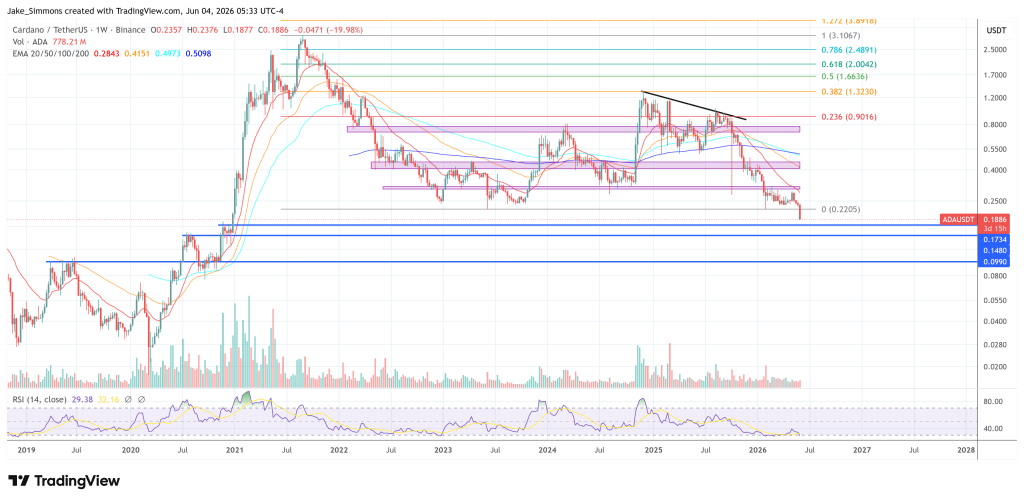
ADA drops below key support, 1-day chart | Source: ADAUSDT on TradingView.com

Criptos en tendencia

Preguntas relacionadas

QWhy did Charles Hoskinson announce he is taking a break?

ACharles Hoskinson announced he is taking a break after a tense livestream where he expressed frustration over his limited power to intervene in project failures and funding disputes within Cardano's decentralized governance system.

QWhat recent event contributed to the pressure on Cardano's governance?

AThe recent shutdown of TapTools, a major analytics and data platform in the Cardano ecosystem, contributed significantly to the pressure. It highlighted challenges in ecosystem funding and the practical difficulties of decentralized governance during market stress.

QAccording to Hoskinson, what does he lack control over in the Cardano ecosystem?

AHoskinson stated he lacks unilateral control over key aspects of Cardano. He has no governance keys, cannot initiate hard forks or protocol changes, has no access to the treasury, and does not own the Cardano trademark. Funding for ecosystem growth was allocated to separate entities, not to him personally.

QWhat was the outcome of the Cardano Foundation's proposal for Cardano Summit 2026?

AThe Cardano Foundation's treasury funding proposal for Cardano Summit 2026 in Singapore failed to reach the required two-thirds approval threshold. A revised request for about 7.8 million ADA received majority support but still fell short, leading to the event's cancellation.

QWhat broader challenge for Cardano does the TapTools shutdown and funding disputes illustrate?

AThese events illustrate the broader challenge of whether Cardano's decentralized governance system, while effective at preventing centralized control, can act quickly and decisively enough to preserve critical ecosystem infrastructure and respond to emergencies during a market downturn.

Lecturas Relacionadas

Podcast Notes | Conversation with GSR Asset Management Head: To Determine if This Crypto Rally is Real, Just Watch the Lending Rates on Aave

Podcast Summary: Dialogue with GSR's Head of Asset Management: To Determine if This Crypto Rally is Real, Just Check Lending Rates on Aave Andy Baehr, Managing Director of Asset Management at GSR, discusses the current crypto market, characterizing it as stuck in a state of "ambivalence" with short-lived, unsustainable rallies. He outlines a simple framework: the market moves between "ambivalence" and "conviction" (sustained upward momentum). Currently, every rally resembles a single-stage rocket booster that quickly fizzles out. Baehr identifies three key signals to watch: 1) DeFi lending rates, 2) the potential passage of the CLARITY Act, and 3) the market forming a consensus on the "Fed hawkish peak." He emphasizes that the most immediate indicator for the sustainability of the recent CPI-triggered rally is the USDC borrowing rate on Aave, currently around 3.75%—close to U.S. Treasury yields. The absence of a credit spread indicates low leverage demand and a lack of market energy. He explains that a healthy, sustained rally requires layered buying pressure. Last year's rally progressed from an ETH short squeeze to crypto-native trader influx and finally to ETF inflows. Currently, this structure is missing. Other potential structural buyers like Digital Asset Treasury (DAT) companies are absent, and ETF flows have proven transient. Baehr notes that while small-cap crypto tokens outperformed large caps in Q2—a potential sign of capitation in major assets—capital is also flowing to more exciting opportunities like AI stocks and tech IPOs, leaving crypto sidelined. Regarding DeFi, he highlights that platforms like Aave provide a clear, real-time signal of leverage demand through their supply/demand-driven interest rates. A significant, sustained rate increase would signal genuine market conviction. He also observes the quiet emergence of fixed-income-like products and vaults in DeFi. On regulation, the probability of the CLARITY Act passing before the August 7th deadline has dropped linearly from 75% to below 40% on Polymarket. Baehr suggests its passage would be treated as a bullish surprise, a potent driver for price movement. However, political hurdles, including ethical clause debates and disclosures about the First Family's crypto profits, remain significant obstacles. Ultimately, the market awaits clarity on the Fed's terminal rate under Chair Warsh. Until the "Fed Solstice"—the point where the market collectively understands the peak of hawkish policy—sustained conviction will be difficult to achieve.

marsbitHace 17 min(s)

Podcast Notes | Conversation with GSR Asset Management Head: To Determine if This Crypto Rally is Real, Just Watch the Lending Rates on Aave

marsbitHace 17 min(s)

7 Months After the Collapse of Huiwang, Southeast Asia's Escrow Platforms Undergo a Major Reshuffle

Following the collapse of Huione Pay—dubbed the "Alipay of Southeast Asia"—seven months ago, the region's underground financial guarantee platform sector is undergoing a significant reshuffle. This power vacuum has been swiftly filled by emerging platforms such as XinBi, Tiger/Navigator, JinBei (renamed JinBo), Dali/Tiancheng, and FullyLight. These platforms, operating largely via Telegram and offering services like escrow for illicit transactions, have absorbed the vast user base and markets left behind by Huione. While positioning themselves as "trust intermediaries," their primary clientele consists of networks involved in online scams, money laundering, illegal gambling, and even human trafficking. For instance, the Tiger/Navigator platform explicitly provides "escrow" services for kidnapping-for-ransom operations ("强押车交易"). Data underscores the immense scale: Huione alone processed over $103 billion in cryptocurrency payments and facilitated over $31 billion through its escrow market before its downfall, linking it to Cambodia's notorious Prince Group. Since its collapse, competitors have seen explosive growth. For example, the XinBi platform has accumulated over $1.6 billion in total USDT revenue, while platforms like NewPay, OkPay (under Dali), and FullyLight Wallet collectively processed over $4.8 billion in USDT in a single year. This ecosystem thrives in regions like Cambodia and Myanmar, where regulatory gaps allow these platforms to act as critical financial infrastructure for sprawling cybercrime industries, from scam compounds to online casinos. The article concludes that the moniker "Southeast Asian Alipay" is a misnomer, obscuring the platforms' fundamental role in enabling serious criminal enterprises rather than representing legitimate financial innovation.

Odaily星球日报Hace 1 hora(s)

7 Months After the Collapse of Huiwang, Southeast Asia's Escrow Platforms Undergo a Major Reshuffle

Odaily星球日报Hace 1 hora(s)

Trading

Spot

Artículos destacados

Cómo comprar ADA

¡Bienvenido a HTX.com! Hemos hecho que comprar Cardano (ADA) sea simple y conveniente. Sigue nuestra guía paso a paso para iniciar tu viaje de criptos.Paso 1: crea tu cuenta HTXUtiliza tu correo electrónico o número de teléfono para registrarte y obtener una cuenta gratuita en HTX. Experimenta un proceso de registro sin complicaciones y desbloquea todas las funciones.Obtener mi cuentaPaso 2: ve a Comprar cripto y elige tu método de pagoTarjeta de crédito/débito: usa tu Visa o Mastercard para comprar Cardano (ADA) al instante.Saldo: utiliza fondos del saldo de tu cuenta HTX para tradear sin problemas.Terceros: hemos agregado métodos de pago populares como Google Pay y Apple Pay para mejorar la comodidad.P2P: tradear directamente con otros usuarios en HTX.Over-the-Counter (OTC): ofrecemos servicios personalizados y tipos de cambio competitivos para los traders.Paso 3: guarda tu Cardano (ADA)Después de comprar tu Cardano (ADA), guárdalo en tu cuenta HTX. Alternativamente, puedes enviarlo a otro lugar mediante transferencia blockchain o utilizarlo para tradear otras criptomonedas.Paso 4: tradear Cardano (ADA)Tradear fácilmente con Cardano (ADA) en HTX's mercado spot. Simplemente accede a tu cuenta, selecciona tu par de trading, ejecuta tus trades y monitorea en tiempo real. Ofrecemos una experiencia fácil de usar tanto para principiantes como para traders experimentados.

1.5k Vistas totalesPublicado en 2024.12.10Actualizado en 2026.06.02

Cómo comprar ADA

Discusiones

Bienvenido a la comunidad de HTX. Aquí puedes mantenerte informado sobre los últimos desarrollos de la plataforma y acceder a análisis profesionales del mercado. A continuación se presentan las opiniones de los usuarios sobre el precio de ADA (ADA).

活动图片













