Selling Block Space is Dead: Public Chains Must Find a New Way

marsbitPublicado a 2026-07-22Actualizado a 2026-07-22

Resumen

"Blockchain infrastructure as a neutral, generalized platform is no longer a viable business model. This article argues that simply selling block space has failed, evidenced by the fact that only one public blockchain, Hyperliquid, was among 14 crypto firms surpassing $200M in annual revenue recently. Hyperliquid's revenue vastly outpaces others like Arbitrum, highlighting a crisis. The future lies in public chains pivoting away from neutrality to become product studios, application distributors, payment rails, or vertical SaaS providers, directly serving paying customers. The piece also covers key industry events: a major exploit on Ostium, attributed to vulnerabilities in its off-chain price oracle, underscores the critical security needs for protocols bridging off-chain markets. Additionally, it discusses the necessity of abstracting complex financial instruments like options. Experts argue that to achieve mass adoption, options should be packaged as user-friendly products—such as yield vaults, binary options, or structured products—rather than marketed with their technical complexity. Finally, the radar section notes developments including Yearn's fixed-rate lending product Flex, community backlash over Base's strategy changes, the launch of a DXY perpetuals DEX called Plether, and Starknet's focus on institutional-grade privacy and quantum resistance."

Author:Castle Labs

Compiled by: TechFlow

TechFlow Insights: Over the past two years, 14 crypto companies have achieved annual revenues exceeding $200 million, with only one being a public chain—Hyperliquid. When Arbitrum generated $430,000 in monthly revenue while Hyperliquid reached $58 million (a 100x difference), public chains finally realized: the business of selling block space is no longer viable. They must either transform into product studios and application distributors or focus on vertical industries as SaaS providers—the era of neutral infrastructure is coming to an end.
We've spent considerable time recently researching revenue issues, covering both applications and public chains.

Applications have always been strong revenue generators; they directly reach customers and must deliver value.

Public chains have long supported ecosystems through grants and protocol upgrades, but now they too must shift direction toward serving paying customers, or risk depleting their treasuries.

Over the past two years, 14 crypto companies have generated revenues over $200 million, with only one being a public chain.
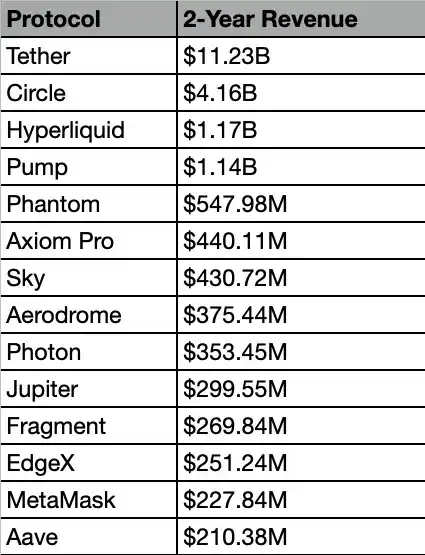
That is Hyperliquid.

To illustrate the gap between public chains: Arbitrum generated only $430,000 in revenue over the past 30 days, while Hyperliquid generated approximately $58 million (over 100 times more).

But things are changing. Public chains understand that block space is no longer a business model; they need to focus on other revenue sources. We've already seen the first movers striving to become product studios, application distributors, payment rails, or vertical SaaS stacks. This will undoubtedly continue, with more public chains moving away from neutral infrastructure toward ownership in specific verticals.

Ostium Vulnerability Results in Over 40% TVL Loss

Last week, Ostium's LP vault was attacked, resulting in a loss of 23,752,746 USDC. The attacker compromised the off-chain infrastructure that feeds price data into the protocol.
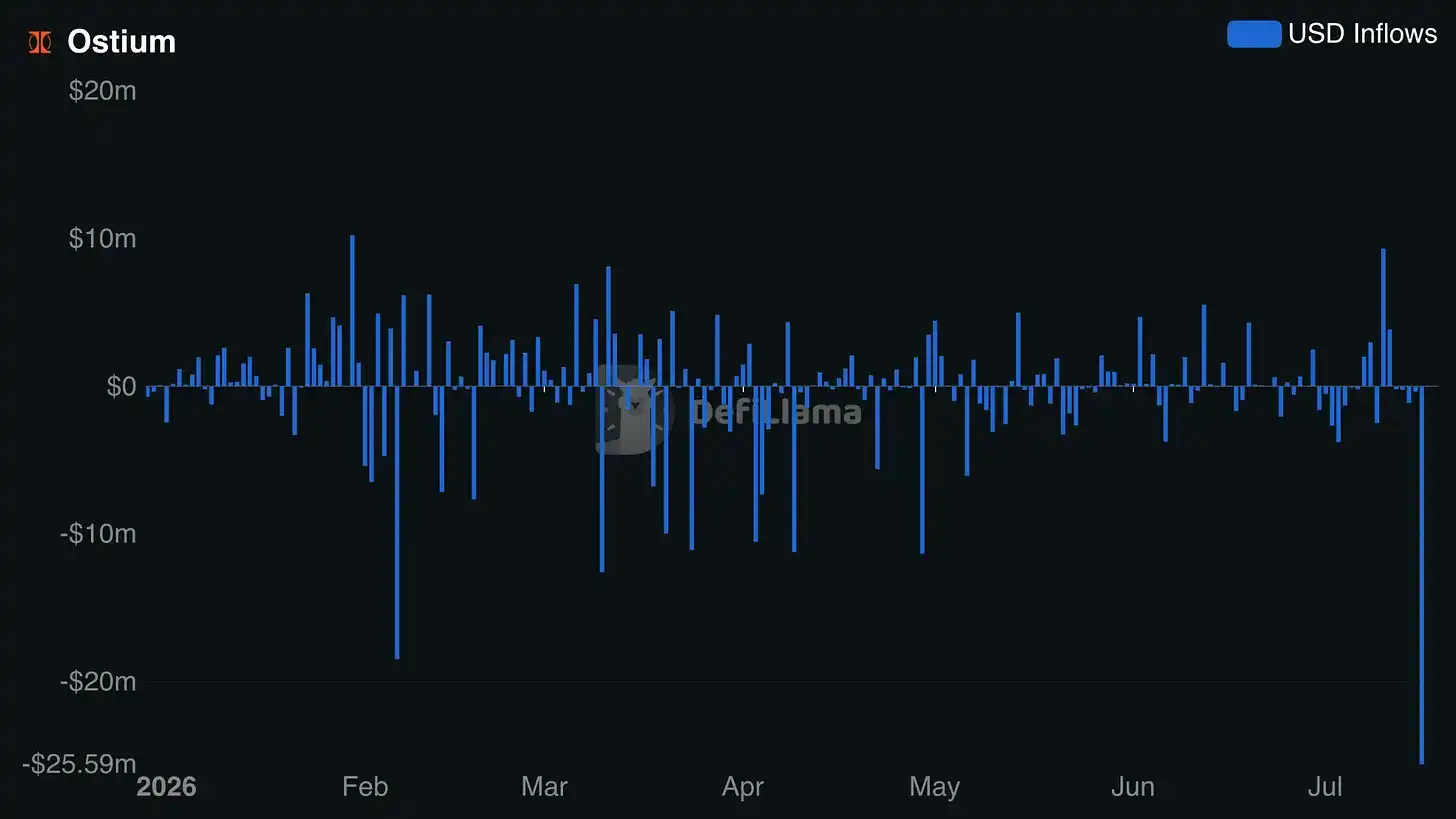
The attacker submitted seemingly valid but illegitimate price reports, then used them to open and immediately close large positions, extracting artificial profits from the vault. Essentially, the attacker found a way to push fake price updates through an approved pathway, making losing trades appear profitable, thereby draining the LP vault.

This is particularly painful for Ostium because its entire product core is bringing off-chain markets on-chain. Stocks, commodities, and forex on Ostium don't have native on-chain prices; the protocol must import them and, more importantly, must trust them.

Contracts on the protocol rely on this trust, as do users, meaning fake prices that pass checks can quickly evolve from bad data to bad execution, bad vault accounting, and real LP losses. For Ostium, oversight of this off-chain to on-chain journey is central to the product.

Ostium stated that trader collateral was isolated and unaffected, and trading contracts were frozen within 60 minutes. That's reasonably fast, but the question is: how much damage should one bad price input be able to cause before the protocol catches it?

Even more frustrating, Ostium was already accepting TradFi trade-offs. Many of the markets it offers aren't truly 24/7 because the underlying assets themselves aren't 24/7. If you've already accepted market trading hours, stale prices, closures, and liquidity gaps, that should make stricter controls around price updates, trade sizes, withdrawals, and timing easier to justify, not harder.

The industry needs to become more comfortable with this, and I think Ostium is leading the way. If authorized pathways can update prices, shouldn't those pathways be tightly controlled and monitored? If new price updates can support large trades or withdrawals, shouldn't there be circuit breakers around size and timing? If an attacker tests the system with small trades first, shouldn't monitoring capture the pattern before the vault is drained?

For protocols bringing off-chain markets on-chain, these controls shouldn't be optional security features; they should be embedded and marketed as part of the product.

Options Need Abstraction

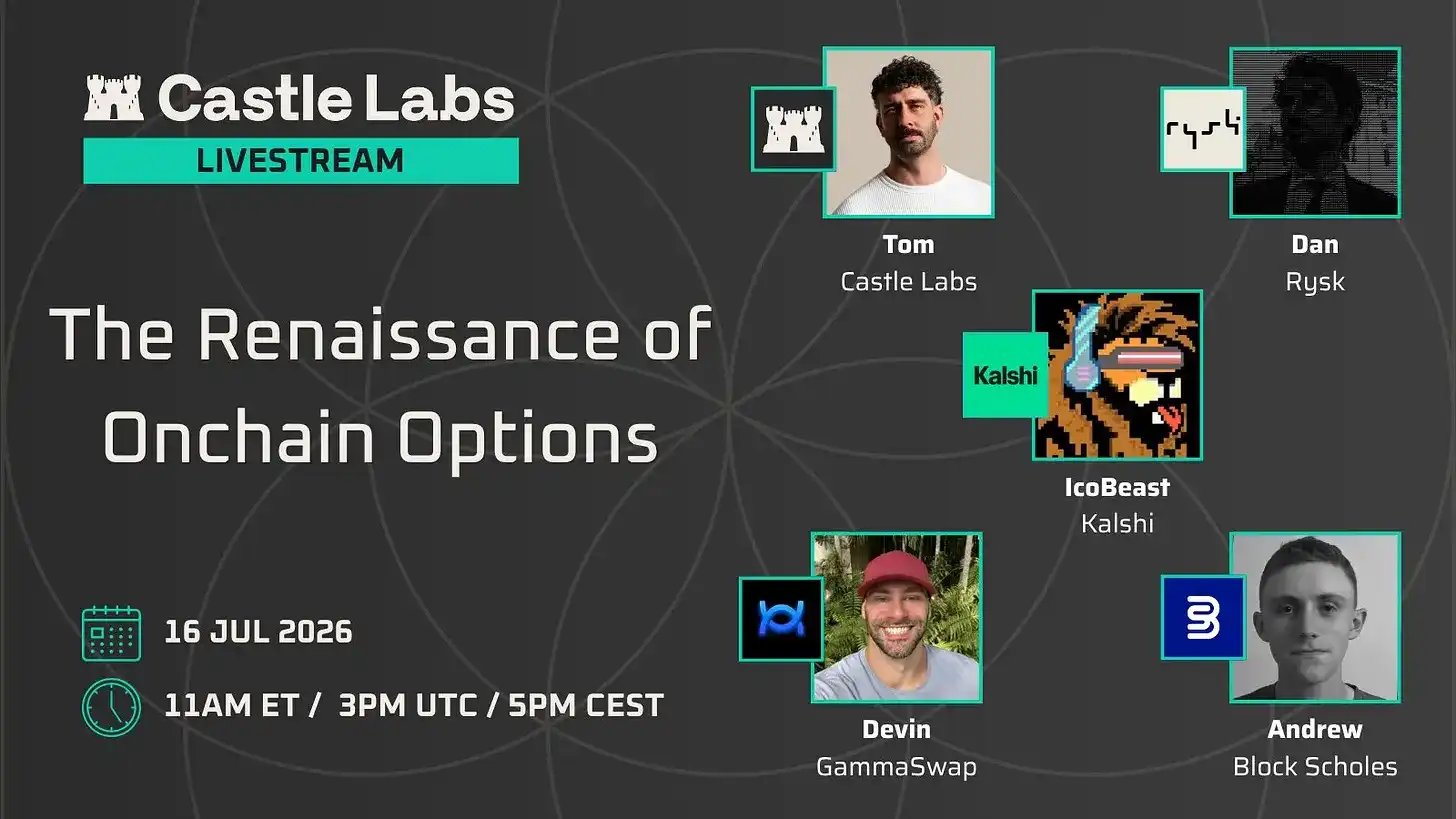
Last week, after publishing our report "The Renaissance of On-Chain Options," we invited Kalshi, Rysk, GammaSwap, and Block Scholes for a live stream. These builders repeatedly mentioned a point: options are powerful, but marketing them as "options" is often the worst sales approach.
Most users don't want to think in Greeks, expiration dates, strike prices, or volatility surfaces; they want yield, leverage, protection, or simple ways to express a view. That's why the products with the most promise in terms of user adoption often aren't vanilla options venues but yield vaults, short-term binary options, structured products, and prediction markets.

Rysk's Dan summarized this almost perfectly: options are not the product; the benefits of options are the product.

Rysk mentioned that its newer products saw over $1 billion in open interest last year, mostly from DeFi-native users seeking asset yield, not from people arriving as options traders. The chart of quarterly notional amounts shows how quickly this product found demand.
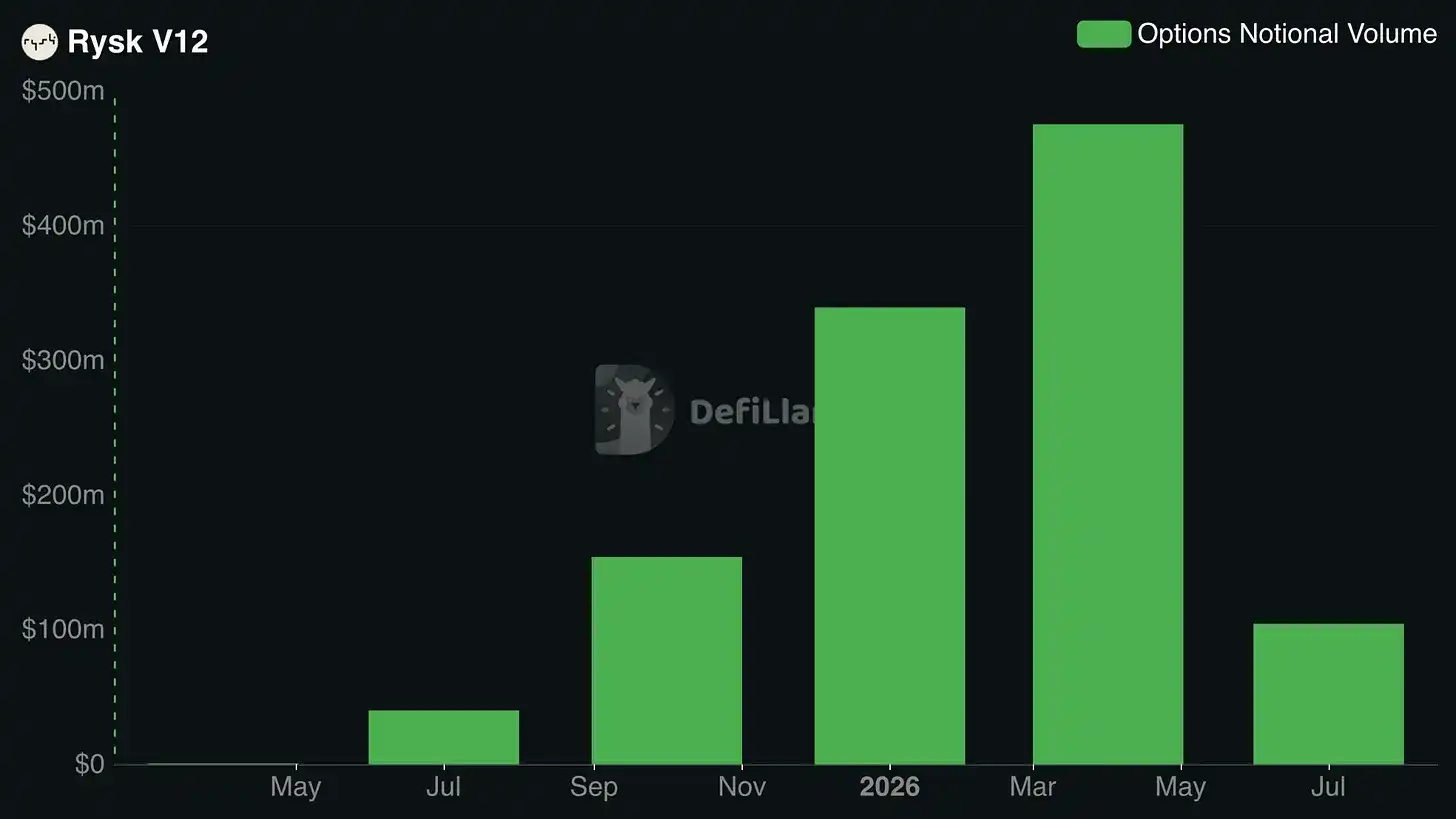
Kalshi stated it now handles 86% of global crypto binary options volume and about 70% of global prediction market volume. The 15-minute market appears to be the optimal time window for crypto binary options because users easily understand the payout, time window, and risk.

GammaSwap is an excellent example of abstracting options away from end-users. Its V1 allowed users to borrow liquidity from AMMs, where AMMs behave much like option sellers, but once Greeks, exotic payoffs, and fragmented liquidity had to become part of every user's journey, the product became capital inefficient and hard to use. V2 is in development, moving toward prediction markets, order books, and known payouts, focusing on presenting a clear question that's easier to sell than another complex options product.

Block Scholes brought perspective from the infrastructure side, as they power about 90% of on-chain options volume through venues like Derive. Traditional options exchanges might retain niche user bases through their native UX, but structured products are how more users will interact with them in the future without even knowing they're interacting with options at all.

For options to grow further on-chain, they need to stop being sold as options. The consensus view is that the next wave will likely come from packaging the payoffs into more easily understandable products.

On Our Radar

Flex, Yearn's Fixed-Rate Lending: Yearn's Flex product is a fixed-rate money market where borrowers choose their own fixed rate. Track new protocols on DefiLlama.

How Base is Bouncing Back: Two announcements from Jesse and Brian sparked widespread community dissatisfaction on X. Jesse acknowledged his failed strategy regarding social and creator tokens and is now handing over the Base App to Cobie, the Crypto Twitter trader and founder of Echo (acquired by Coinbase for $400 million). On the other hand, Brian accepted no responsibility for the memecoin pump-and-dump associated with his avatar last week. Posts like this one from Rune summarize the sentiment well. Cobie taking over Base App is essentially their last lifeline to save face with crypto-native users.

Plether, On-Chain Dollar Index Perpetuals: Plether is building a perpetual DEX for the Dollar Index (DXY), allowing users to go long or short synthetic dollar exposure on-chain. Interestingly, positions have a defined maximum payoff at opening, LPs are split into senior and junior tranches, and the protocol prevents new openings if it cannot enforce solvency.

Starknet's Security Focus: Yesterday, we published a report on two major obstacles for the next phase of institutional on-chain growth: privacy and durability against quantum threats. Starknet is a useful perspective here because its recent work touches both areas: privacy improvements affect what institutions can safely disclose on-chain, and quantum durability asks whether today's infrastructure can survive the next security cycle.


Preguntas relacionadas

QAccording to the article, what is the main revenue-generating activity that public chains can no longer rely on, and what is the alternative direction they must take?

AThe article states that selling block space is no longer a viable business model for public chains. Instead, they must shift their focus towards becoming product studios, application distributors, payment rails, or vertical SaaS stacks, moving away from being neutral infrastructure providers.

QWhat significant financial gap in revenue is highlighted between Arbitrum and Hyperliquid over a 30-day period?

AThe article highlights that over the past 30 days, Arbitrum generated only $430,000 in revenue, whereas Hyperliquid generated approximately $58 million, representing a gap of more than 100 times.

QWhat was the cause of the major security incident involving Ostium, and what was the key weakness exploited?

AThe major security incident at Ostium was caused by an attacker who infiltrated the off-chain infrastructure responsible for feeding price data to the protocol. The key weakness exploited was the trusted, approved pathway for submitting price updates, which allowed the attacker to push through fraudulent price reports.

QWhat is the central argument presented in the article regarding the marketing and adoption of on-chain options?

AThe central argument is that for on-chain options to achieve wider adoption, they should not be marketed as complex 'options' involving Greeks, expiries, and strikes. Instead, they need to be abstracted and packaged as benefits—such as yield, leverage, protection, or simple ways to express a view—through products like yield vaults, short-term binaries, structured products, and prediction markets.

QWhat are the two major obstacles to the next phase of institutional on-chain growth identified in the report mentioned at the end of the article?

AThe two major obstacles identified are privacy (what institutions can safely disclose on-chain) and durability against quantum threats (whether current infrastructure can survive the next security cycle).

Lecturas Relacionadas

human.tech Launches Clean SDK for Privacy-First Web3 Apps

human.tech has launched the Clean SDK, a toolkit enabling developers to build privacy-first Web3 applications with transparent accountability. Released alongside Aztec's version 5, the SDK provides components for integrating zero-knowledge identity verification, sanctions screening, and private transactions, without developers handling sensitive user data or building compliance infrastructure from scratch. It uses zero-knowledge proofs and programmable verification to allow apps to confirm user legitimacy and sanctions compliance while keeping identities confidential. The first application built on the SDK, Shield, a privacy bridge to Aztec, also launched. It allows users to transfer assets privately while proving a unique human is behind each transfer and that funds have passed sanctions checks, as verified by a May 2026 audit. The SDK offers three core verification techniques: Proof of Innocence (sanctions screening against 23 sources), Proof of Personhood (simpler verification via Human Passport), and Proof of Clean Hands (higher-assurance zero-knowledge government ID checks). This allows apps to authenticate users and transactions without exposing personal data. Designed for Aztec builders, the SDK lets developers add programmable privacy to decentralized apps, eliminating the need to create their own verification and ZK infrastructure. Shield demonstrates its practical use for private bridges, but the SDK aims to enable a wider ecosystem of private, accountable financial apps and services. The launch addresses growing demand for infrastructure that balances privacy and accountability. The SDK avoids traditional identity databases, storing encrypted data off-chain, screening at both entry and exit points, and including a gated disclosure mechanism for legal requests. human.tech's products, including the Clean SDK, focus on using zero-knowledge technology to enable verifiable personhood and privacy in digital systems.

TheNewsCryptoHace 28 min(s)

human.tech Launches Clean SDK for Privacy-First Web3 Apps

TheNewsCryptoHace 28 min(s)

Unlocking $100 Million in Liquidity? Pump.fun's New Policy Tests the 5-Minute Pump Technique

Pump.fun, a popular meme coin launchpad, has introduced a new standard mechanism called BOOST. It aims to address a significant capital efficiency issue: when a newly launched token graduates from its initial bonding curve to a liquidity pool (LP), roughly 20% of its liquidity becomes permanently locked as "dead liquidity," estimated to waste over $100 million annually. Instead of locking these funds permanently, BOOST repurposes them. Upon a token's migration, approximately 20% of the settlement funds (e.g., 17.6 SOL or ~$2516 USDC) are used to buy back the token on the open market over a 5-minute period via a Time-Weighted Average Price (TWAP) mechanism. All purchased tokens are immediately burned. This creates a brief, systematic buy pressure immediately after migration, potentially generating a short-term price surge ("pump") while permanently reducing the token's circulating supply. The goal is to enhance the immediate post-launch trading experience, potentially increasing trader retention and sustainable protocol revenue, which funds ongoing token buybacks. However, concerns exist that this artificial 5-minute boost could lower the barrier for launching low-quality tokens and lead to steeper price crashes once the buy pressure stops, if followed by large sell-offs. The feature automatically applies to tokens migrating after July 21, 2024, but not to previously migrated tokens or those launched via the Mayhem AI Agent lab.

marsbitHace 35 min(s)

Unlocking $100 Million in Liquidity? Pump.fun's New Policy Tests the 5-Minute Pump Technique

marsbitHace 35 min(s)

Podcast Notes | Conversation with GSR Asset Management Head: To Determine if This Crypto Rally is Real, Just Watch the Lending Rates on Aave

Podcast Summary: Dialogue with GSR's Head of Asset Management: To Determine if This Crypto Rally is Real, Just Check Lending Rates on Aave Andy Baehr, Managing Director of Asset Management at GSR, discusses the current crypto market, characterizing it as stuck in a state of "ambivalence" with short-lived, unsustainable rallies. He outlines a simple framework: the market moves between "ambivalence" and "conviction" (sustained upward momentum). Currently, every rally resembles a single-stage rocket booster that quickly fizzles out. Baehr identifies three key signals to watch: 1) DeFi lending rates, 2) the potential passage of the CLARITY Act, and 3) the market forming a consensus on the "Fed hawkish peak." He emphasizes that the most immediate indicator for the sustainability of the recent CPI-triggered rally is the USDC borrowing rate on Aave, currently around 3.75%—close to U.S. Treasury yields. The absence of a credit spread indicates low leverage demand and a lack of market energy. He explains that a healthy, sustained rally requires layered buying pressure. Last year's rally progressed from an ETH short squeeze to crypto-native trader influx and finally to ETF inflows. Currently, this structure is missing. Other potential structural buyers like Digital Asset Treasury (DAT) companies are absent, and ETF flows have proven transient. Baehr notes that while small-cap crypto tokens outperformed large caps in Q2—a potential sign of capitation in major assets—capital is also flowing to more exciting opportunities like AI stocks and tech IPOs, leaving crypto sidelined. Regarding DeFi, he highlights that platforms like Aave provide a clear, real-time signal of leverage demand through their supply/demand-driven interest rates. A significant, sustained rate increase would signal genuine market conviction. He also observes the quiet emergence of fixed-income-like products and vaults in DeFi. On regulation, the probability of the CLARITY Act passing before the August 7th deadline has dropped linearly from 75% to below 40% on Polymarket. Baehr suggests its passage would be treated as a bullish surprise, a potent driver for price movement. However, political hurdles, including ethical clause debates and disclosures about the First Family's crypto profits, remain significant obstacles. Ultimately, the market awaits clarity on the Fed's terminal rate under Chair Warsh. Until the "Fed Solstice"—the point where the market collectively understands the peak of hawkish policy—sustained conviction will be difficult to achieve.

marsbitHace 1 hora(s)

Podcast Notes | Conversation with GSR Asset Management Head: To Determine if This Crypto Rally is Real, Just Watch the Lending Rates on Aave

marsbitHace 1 hora(s)

Trading

Spot
活动图片




