Author: Tech Bureau
In the AI payments race, most are watching traditional payment giants like Visa, Mastercard, and Stripe, or AI platforms like OpenAI and Google.
But some data is noteworthy. According to Coinbase's disclosures in their 2026 quarterly earnings calls, over 90% of on-chain Agent transactions occur on the Base chain, 99% of Agent commercial transactions are settled in USDC, and over 97% of on-chain Agent transactions use the x402 protocol. Base chain's stablecoin transaction volume accounts for 62% of the entire industry's stablecoin transaction volume.

In other words, while everyone debates which track—card payments or stablecoins—will win and which protocol will become the standard, a crypto exchange has quietly become the largest operator of Agent payments.
This position belongs not to Visa, Mastercard, or Stripe, but to Coinbase.
What Coinbase Is Building Isn't a Payment Protocol, It's "Giving Agents a Wallet"
On February 11, 2026, Coinbase launched Agentic Wallets through its developer platform, a suite of wallet infrastructure specifically designed for AI Agents.
Before this, Agent payment infrastructure consisted of either APIs for developers or payment gateways for users. The Agent itself didn't have "its own account." To spend money, it either used a human's account to pay on its behalf or indirectly operated through a platform's interface.
What Agentic Wallets does is enable the Agent itself to become an entity capable of holding assets. An Agent can have its own wallet address, autonomously holding funds, initiating transfers, executing transactions, and generating revenue, all within pre-set permissions and risk controls. It no longer requires a human account as an intermediary layer.

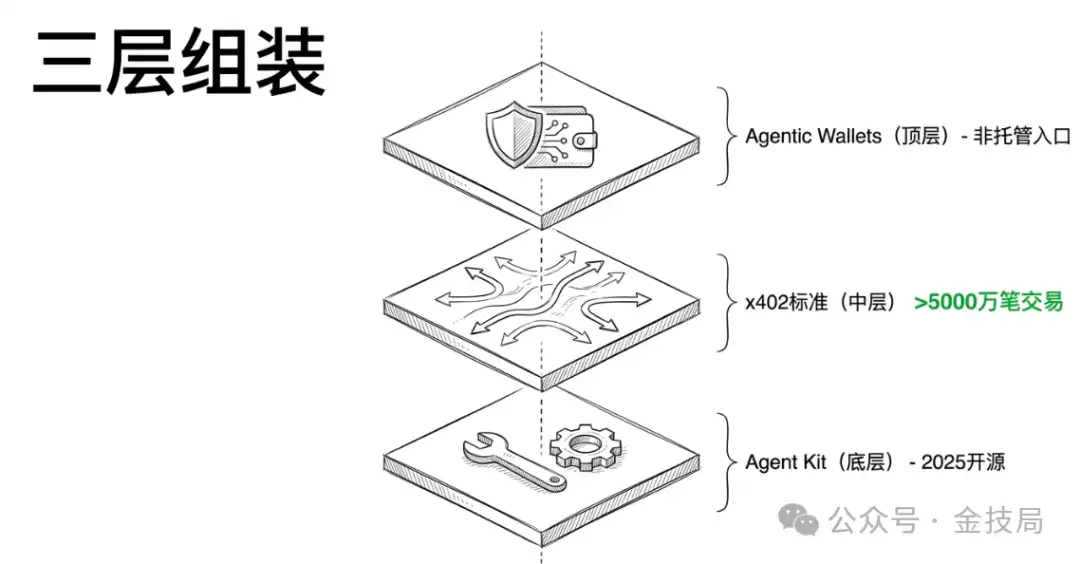
This infrastructure is assembled from several components. The foundation is the Agent Kit, an open-source toolkit launched by Coinbase in 2025 that lets developers integrate wallet functionality into any Agent system. The middle layer is the x402 protocol, the machine-to-machine payment standard activating the HTTP 402 status code, which has processed over 50 million transactions. The top layer consists of non-custodial wallets and security suites, deeply integrated with the Coinbase Developer Platform.
These three components together form a complete "Agent financial account."
This positioning is fundamentally different from what Visa and Stripe are doing. Visa is working to let Agents connect to the existing card payment network, and Stripe is enabling Agents to connect to the existing merchant payment system. Coinbase is giving Agents a brand new, independent financial identity of their own.
Why Does an Agent Need "Its Own Wallet" Instead of Using a Human's Card?
This question is worth exploring. When an Agent buys something for a human, why can't it just use a human's credit card? Why does it need its own wallet?
The answer relates to a fundamental characteristic of Agent payments: many transactions between Agents are micro, high-frequency, and automated machine-to-machine payment flows.
For example, one Agent calling another Agent's API might pay one-thousandth of a cent for a data query. If this payment were made using a human credit card, there are several problems. First, transaction fees: card payment fees are a fixed percentage plus a minimum amount; the fee for a one-thousandth of a cent payment would be orders of magnitude higher than the principal. Second, authorization: a human credit card requires cardholder confirmation for every payment; an Agent cannot ask a human for approval for every micro-payment. Third, attribution: a human's credit card is tied to a human identity; for a payment between Agents, it's difficult to clearly trace whether responsibility lies with which Agent, platform, or person.
Giving an Agent its own wallet alleviates these three problems. The funds in the wallet are stablecoins, with extremely low transfer costs. Spending permissions are controlled by code-level policies, eliminating the need for manual authorization per transaction. The wallet's address is an independent on-chain identity, providing clear attribution and traceability for transactions.
This is why Coinbase's data shows the result "99% of Agent commercial transactions settled in USDC." It's not that USDC is better than credit cards, but rather that stablecoins combined with on-chain wallets are inherently more suitable for Agent-to-Agent payment scenarios based on their technical characteristics.

Coinbase's Complete Closed Loop: Wallet, Chain, and Protocol All Under Its Control
Coinbase's strategy in Agent payments is more comprehensive than it appears on the surface.
It has Base, a self-operated Layer 2 network. It has Agentic Wallets, a suite of wallet infrastructure for Agents. It has x402, a machine-to-machine payment protocol. It also has native wrapped assets like cbBTC and cbETH.
Wallet, chain, protocol, assets—all four components are within Coinbase's own ecosystem. This means an Agent can complete the entire process from holding funds, initiating payments, to finalizing settlements without leaving Coinbase's system.
This closed loop gives Coinbase a unique position in AI payments. Visa has a payment network but no Agent wallets. Stripe has a merchant system but no blockchain layer. Circle has stablecoins but no network layer. Coinbase is one of the few companies that hold multiple components of Agent payments in their own hands.
The risks and advantages of this strategy are clear. The advantage is a seamless, closed-loop experience without cross-system friction. The risk is that if any single component fails, the entire system is affected. Coinbase's net loss of $359 million in the second quarter of 2026 reminds us that the cost of this strategy is not low.
How Did This Dark Horse Position Form?
Coinbase becoming the largest operator of Agent payments has an element of "serendipity" to it.
Coinbase initially built the Base chain not for Agent payments, but to expand its on-chain ecosystem. The x402 protocol was initially proposed as a native Internet machine payment standard, not specifically for Agents. Agentic Wallets wasn't launched until February 2026.
But when the Agent economy began its explosive growth, Coinbase found itself already positioned in multiple key areas. Base happened to be one of the chains with the lowest transaction costs, making it highly suitable for Agents' high-frequency, micro-payment transactions. x402 happened to be the standard suited for machine-to-machine payments. Agentic Wallets happened to fill the gap for Agents needing their own financial identity.
Behind these "coincidences" lies Coinbase's sustained investment in on-chain infrastructure over the past few years. It didn't react hastily when the Agent payments boom began; rather, it started laying the groundwork for wallets, chains, and protocols before the Agent economy even took shape.

This observation offers a general lesson for understanding the AI payments race. When new infrastructure demands emerge, the true beneficiary isn't necessarily the fastest reactor, but the one with the deepest foundational accumulation.
A Final Word
The current narrative in the AI payments race mainly revolves around three things: whose protocol will become the standard, which payment track will prevail, and how card payments and stablecoins will merge.
Coinbase's data offers a different perspective. While the debates over protocols and tracks continue, actual Agent payments are already quietly happening, and they are running on Coinbase's chain.
This phenomenon suggests that the adoption of AI payments may not depend entirely on "whose standard is more reasonable," but on "whose infrastructure is already ready." Protocols can gradually become standardized, but Agent transaction demands won't wait for standards to be finalized. Whoever can provide usable infrastructure when the demand arises will capture the first wave of benefits.

This is the wave Coinbase has captured. It may not be the ultimate winner in AI payments, but for now, it is the one running ahead.