Breaking News: DeepSeek Announces All-Day Off-Peak Pricing on Weekends, Making Weekend Work More Cost-Effective?

marsbitPublicado a 2026-08-23Actualizado a 2026-08-23

Resumen

DeepSeek has announced a significant change to its API pricing model, effective August 23. The new policy removes peak/off-peak distinctions on weekends (Saturdays and Sundays), charging the lower off-peak rate for the entire two-day period. This adjustment has sparked mixed reactions within the developer and professional communities. For developers and businesses heavily reliant on DeepSeek's V4-Flash and V4-Pro APIs, this is welcome news. It allows them to schedule bulk processing tasks on weekends without the higher peak-hour costs, potentially halving their API bills for such workloads. Some users have celebrated the move for making weekend work more cost-effective. However, the announcement has also raised concerns among employees. There is apprehension that companies, particularly in cost-sensitive sectors like AI-powered short drama production, might reorganize work schedules to align with these new cost incentives. Instances are already emerging where teams schedule high-token tasks during cheaper nighttime hours or adjust staff shifts. This has led to worries about a potential shift towards weekend workdays and weekday time-off, prioritizing cost savings over traditional work-life balance. Debate has ensued regarding the practicality of such schedule changes, with questions about increased communication overhead and overall efficiency. Speculation about DeepSeek's motives for the change includes theories that peak pricing correlates with internal model training sc...

Last night, DeepSeek suddenly issued a notice to its API users: starting from 00:00 Beijing Time on August 23rd, the peak/off-peak billing rules will be adjusted. On weekends (Saturday and Sunday), peak and off-peak periods will no longer be distinguished; a uniform off-peak price will be charged throughout the entire day.
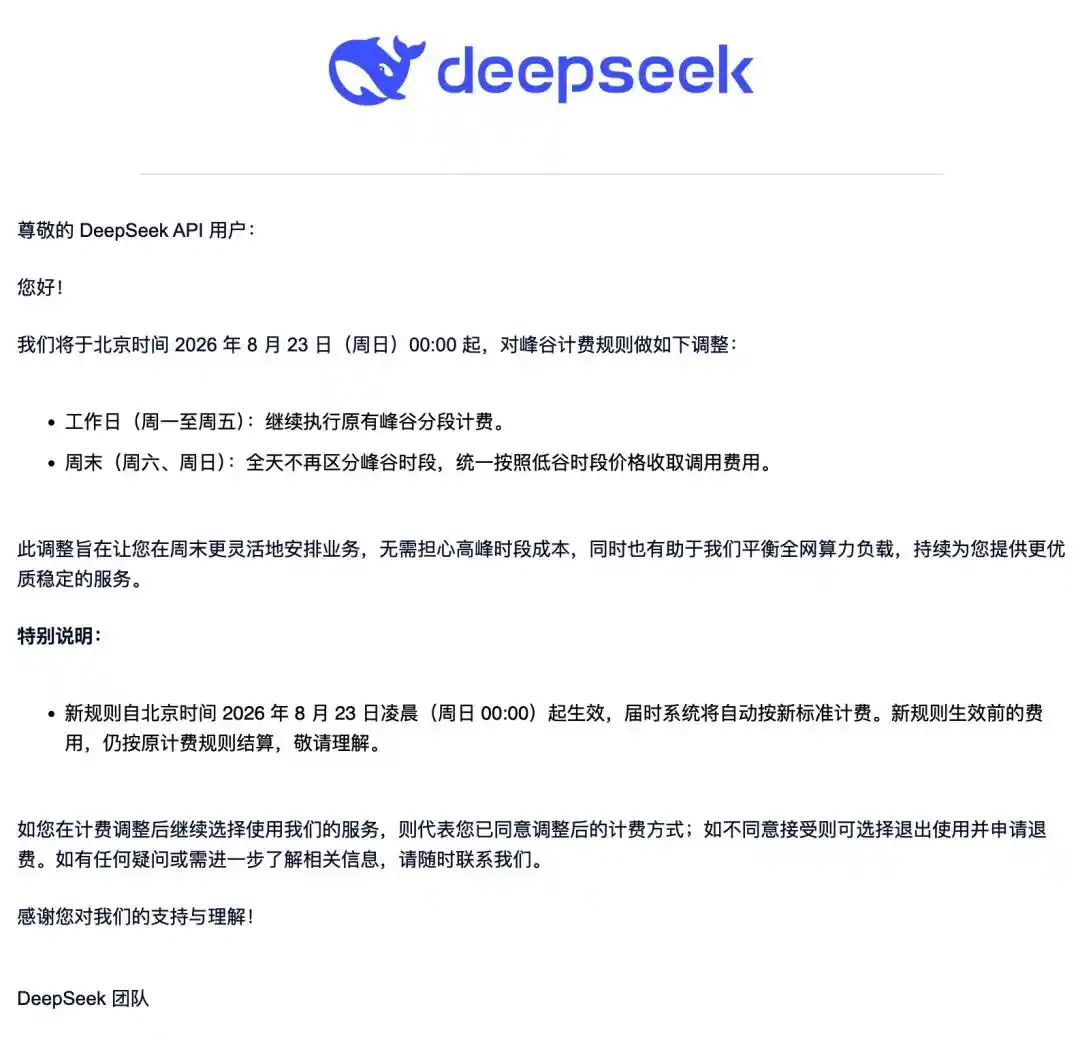
This single announcement stirred up a thousand waves. The notice exploded within the developer community, also causing subtle concerns among white-collar workers.

For the vast developer community, this is undoubtedly good news. Previously, DeepSeek had changed the billing for V4-Flash and V4-Pro APIs to a peak/off-peak model, with peak prices being up to twice the off-peak price. After this price adjustment, developers no longer need to avoid peak windows on weekends; they can confidently schedule batch jobs to run on weekends, which will significantly reduce their bills.

A user on X directly said, "Get a week's work done in two days, the bill is cut in half." However, the actual bill still depends on individual usage patterns.

However, white-collar workers are also starting to worry: will companies rearrange work schedules according to these peak/off-peak periods? Could it really happen that companies require weekend work and weekdays off?

This might sound absurd, but it's indeed happening. The short-drama industry implemented this earlier. Previously, news reported that major platforms successively increased AI computing power prices, causing token costs in the short-drama industry to nearly quadruple in a short period. Under such pressure, many AI short-drama production teams began scheduling high-consumption rendering tasks for late at night, specifically to take advantage of cheaper nighttime computing power.

Soon, this trend spread to the programmer community. Recently, a programmer posted that their company, to save token costs, started implementing a new attendance system requiring work on one weekend day, and even adjusted lunch break times according to token peak/off-peak periods.
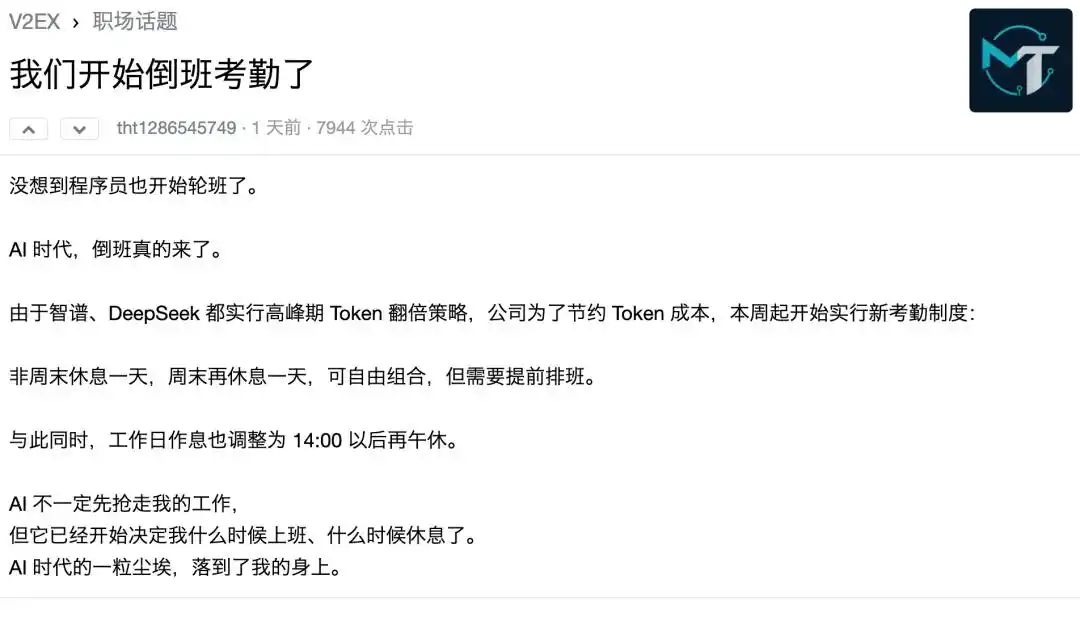
Some lamented, truly each generation has its own script.


However, others question whether such arrangements wouldn't bring additional communication costs. Is it really cost-effective?

Regarding the reason for this price adjustment, there are various speculations. Some say the peak price might correspond to the time when DeepSeek trains its models, so the higher price is to free up computing power for their own employees' training. And on weekends when DeepSeek employees are off work, the price is switched to off-peak.

Regarding this claim, some have raised doubts, believing model training is highly automated and unrelated to whether employees are working.

Currently, this new billing rule is already in effect. This Sunday, have you also started running your batch tasks?

Editor|Zhang Qian

This article is from the WeChat public account "Machine Heart" (ID: almosthuman2014), author: Machine Heart.


Preguntas relacionadas

QWhat major pricing change did DeepSeek announce for its API?

ADeepSeek announced that starting from August 23rd (Beijing Time), it will adjust its peak/off-peak pricing rules. On weekends (Saturday and Sunday), it will no longer distinguish between peak and off-peak hours; the entire weekend will be charged at the off-peak rate.

QHow did the developer community initially react to DeepSeek's pricing announcement?

AThe developer community was very excited about the news, seeing it as a positive change that would allow them to run batch tasks on weekends without worrying about peak-hour prices, potentially significantly reducing their bills.

QWhat concern did the article raise among regular employees (non-developers)?

AThe article raised the concern that companies might rearrange work schedules based on these AI pricing peaks and valleys. Employees worry that companies could start requiring weekend work and offering weekdays off to save on operational AI costs.

QWhich industry was mentioned as an early adopter of shifting work to cheaper off-peak hours for AI costs?

AThe short drama industry was mentioned as an early adopter. Faced with rising AI computing costs, many AI short drama production teams began scheduling high-consumption rendering tasks for late at night to take advantage of cheaper off-peak computing power.

QWhat was one speculated reason in the article for DeepSeek's initial peak pricing on weekdays?

AOne speculation was that the peak pricing on weekdays might correspond to times when DeepSeek uses its own computing resources to train its models, and the higher price is to free up computational power for their internal training needs. Weekends are off-peak because their employees are not working.

Lecturas Relacionadas

Mysterious "Ox Alpha" Large Model Goes Viral with Limited-Time Free Access

A mysterious anonymous AI model named "Ox Alpha," nicknamed "Cow is Coming" by Chinese netizens, has appeared on OpenRouter, sparking widespread speculation. The model offers a 1 million token context, supports text, image, and video inputs, can call tools, and is currently free. Its standout feature is strong coding ability. Initial tests on the DeepSWE benchmark, which evaluates real-world software engineering tasks, showed an 80% pass rate on a subset of tasks, reportedly nearing top-tier code models. However, follow-up tests yielded a 63% score, with variations attributed to different task sets and configurations. The model's true developer is a major topic of debate. The prevailing theory points to Zhipu AI's unreleased GLM-5.3 Flash or its multimodal variant. Evidence cited includes identical visual token consumption patterns with GLM-5V-Turbo for videos, a consistent offset in text token counts compared to GLM-5.3, and similar behavioral traits like refusing audio processing. Zhipu has a precedent of anonymous testing. Simultaneously, another anonymous model, "korrine," appeared on Code Arena, with guesses ranging from Moonshot's Kimi K3.1 to models from Qwen or MiMo, adding to the industry's guessing game. This trend of anonymous "undercover" testing allows for unbiased performance evaluation in platforms like Arena and provides real-world, high-pressure testing through tools like OpenRouter before official release. It also serves as an effective marketing tactic, prolonging discussion through suspense. If Ox Alpha is indeed a "Flash" model, its performance raises expectations for the full-scale version's potential.

marsbitHace 5 min(s)

Mysterious "Ox Alpha" Large Model Goes Viral with Limited-Time Free Access

marsbitHace 5 min(s)

Just Now, The World's First Human vs. Robot Tennis Match Begins, Robot's Desperate Save Leaves Zheng Jie Astonished

Just now, the world's first human vs. robot tennis match began, featuring stunning robotic saves that left tennis star Zheng Jie in awe. This historic event, part of the second World Humanoid Robot Games and broadcast live globally by China Media Group, marked a pivotal moment in Chinese technological innovation and embodied artificial intelligence. The match featured both mixed human-robot doubles and a groundbreaking singles match between Zheng Jie and the "Galaxy Xingzai" humanoid robot developed by Galaxy General. The robot demonstrated impressive skills including serving, forehands, backhands, and strategic court movement, with serves exceeding 100 km/h. It exhibited remarkable adaptability, recovering from a fall to continue play and handling slices and spins. The doubles match highlighted its ability to coordinate dynamically with a human partner. The event's significance extends far beyond a novelty match. Tennis represents an ultimate pressure test for embodied AI, demanding real-time integration of perception, decision-making, full-body motion control, and live博弈 within fractions of a second—a stark contrast to the discrete, contemplative environment of board games like Go mastered by AlphaGo. It directly confronts Moravec's paradox, showcasing AI's move from digital cognition to physical execution. This capability is powered by Galaxy General's proprietary "Galaxy Star Brain" (AstraBrain) model. Its key innovation is a unified architecture that integrates high-level task understanding/tactical decision-making ("brain") and dynamic whole-body motion control ("cerebellum") into a single model, eliminating latency and information loss between separate modules. The model was trained using a two-step process via the "Galaxy Star Workshop" platform. First, it learned foundational movement priors from "imperfect" human motion data (both amateur and professional). Second, it underwent massive-scale evolution in a virtual tennis simulator where multiple AI agents played millions of games against each other. Through this adversarial training, skills like极限救球and recovery from falls emerged autonomously without explicit programming, before being transferred to the physical robot. This "AstraTennis" moment symbolizes a major leap: a decade after AlphaGo conquered the digital world, embodied AI from China has now demonstrated it can operate under the extreme, unpredictable physical pressures of real-world competition.

marsbitHace 49 min(s)

Just Now, The World's First Human vs. Robot Tennis Match Begins, Robot's Desperate Save Leaves Zheng Jie Astonished

marsbitHace 49 min(s)

The Biggest Dark Horse in AI Payments Might Be Coinbase Giving Agents a Wallet

In the AI payments race, while most focus on traditional giants like Visa or AI platforms like OpenAI, Coinbase has quietly emerged as a key player. Data from 2026 shows over 90% of on-chain Agent transactions occur on Coinbase's Base network, with 99% settled in USDC and over 97% using the x402 protocol. Coinbase's pivotal move was launching "Agentic Wallets" in February 2026—a dedicated wallet infrastructure giving AI Agents their own financial identity. Unlike Visa or Stripe, which connect Agents to existing payment rails, Coinbase provides Agents with autonomous wallets to hold assets (like stablecoins), initiate transfers, and execute transactions under predefined rules. This solves core issues for machine-to-machine payments: high credit card fees for micropayments, the need for constant human authorization, and unclear transaction attribution. Coinbase's strength lies in its closed-loop ecosystem: the Base blockchain (low-cost, high-throughput), the x402 payment protocol, Agentic Wallets, and native assets like USDC. This integrated stack, built through years of infrastructure investment, positioned Coinbase to capture early Agent payment demand as the AI economy surged. The key insight is that AI payment adoption may depend less on whose standard wins and more on whose usable infrastructure is ready first. While debates over protocols and payment rails continue, real Agent transactions are already flowing—primarily through Coinbase's ecosystem. It may not be the ultimate winner, but for now, it's the frontrunner by being prepared.

marsbitHace 1 hora(s)

The Biggest Dark Horse in AI Payments Might Be Coinbase Giving Agents a Wallet

marsbitHace 1 hora(s)

Dialogue with Bitwise CIO: Bitcoin May Be Near Bottom, Who Will Drive the Next Rally?

In a recent podcast, Bitwise CIO Matt Hougan analyzed Bitcoin's current market cycle, suggesting it is near a bottom characterized by low volatility and investor indifference. He believes the next major price surge will be driven primarily by wealth management platforms, financial advisors, and family offices, who control trillions in assets and are now gaining access to Bitcoin ETFs. Hougan views Bitcoin as a long-dated, out-of-the-money call option on it becoming a global reserve asset. Its value increases with global monetary system volatility, making it a natural hedge against currency disorder. He outlined Bitcoin's adoption path: first as a global digital store of value (competing with gold), and potentially later as a check against fiat currency abuse by sovereign states. Addressing the muted price action despite institutional ETF inflows, Hougan explained that significant selling by long-term retail holders has offset buying pressure. However, he is optimistic as data shows retail selling has subsided, which, combined with continued institutional inflows, could propel prices higher. Hougan downplayed the future impact of Federal Reserve interest rates and MicroStrategy's actions on Bitcoin's price, arguing they are becoming less relevant. Instead, he pointed to runaway U.S. fiscal deficits and debt as the core long-term drivers. Finally, he discussed the transformative potential of asset tokenization, predicting all traditional assets will eventually trade 24/7 on blockchains. This will merge traditional and crypto markets, increasing efficiency but also introducing crypto-like features such as overnight volatility and easier access to leverage into traditional finance.

marsbitHace 2 hora(s)

Dialogue with Bitwise CIO: Bitcoin May Be Near Bottom, Who Will Drive the Next Rally?

marsbitHace 2 hora(s)

Trading

Spot
活动图片