Betting Big On XRP: Billion-Dollar Asset Manager Confirms What Smart Money Has Been Doing

bitcoinistPublicado a 2025-12-09Actualizado a 2025-12-09

Resumen

A billion-dollar asset manager, WisdomTree, confirms that institutional investors are driving significant capital inflows into XRP globally, far surpassing most other altcoins. In Europe, XRP attracted over $549 million this year—more than triple Ethereum's inflows. Outside the U.S., it drew $252 million. Despite Bitcoin products being much larger, institutions allocated nearly 25 times more new capital to XRP relative to size. A new U.S. synthetic XRP product also garnered $241 million, exceeding Solana and other altcoins. This institutional accumulation, viewed as strategic rather than speculative, positions XRP as a settlement-grade asset for regulated digital finance, even amid recent price declines and market volatility.

Institutional investors are quietly reshaping the narrative around XRP, with the latest analysis report from the billion-dollar asset manager WisdomTree confirming what insiders have long suspected. According to the report, XRP is garnering institutional interest and demand on a global scale. While retail traders debate short-term price movements, smart money capital inflows into XRP are surpassing those of almost every other altcoin.

XRP Dominates Institutional Inflows Across Europe And The Globe

According to an X post by crypto expert Stern Drew, the latest WisdomTree report shows that XRP is the only digital asset attracting consistent institutional demand worldwide. In Europe, XRP has attracted over $549 million in new institutional capital this year, more than three times the inflows into Ethereum. This figure surpasses the total for every altcoin in the market and multi-asset products except Bitcoin.

In a continent traditionally known for conservative investment strategies, these flows into XRP represent a decisive vote of confidence from European institutional investors. Drew has revealed that the demand for XRP has also extended beyond Europe. Outside the United States, XRP has captured roughly $252 million in fresh institutional capital just this year.
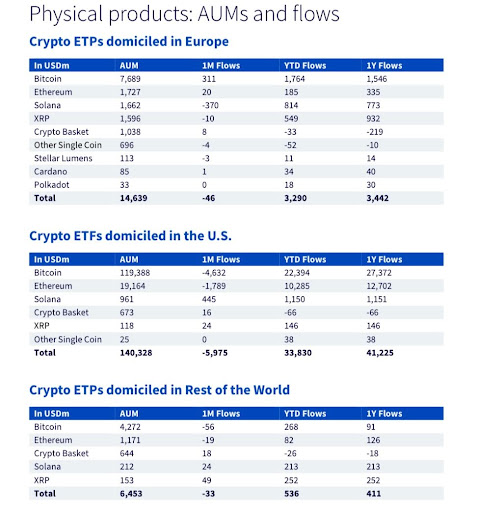
Source: Chart from Stern Drew on X

By comparison, Bitcoin products absorbed only $268 million in smart money capital. Given that BTC products are more than 25 times the size of XRP products, this suggests that institutions have directed nearly 25 times more new capital into XRP than into Bitcoin. Drew has suggested that this increase in flows indicates careful, deliberate positioning rather than short-term speculative activity, which highlights the market’s growing preference for XRP.

US Adoption Signals Broader Shift

In his post, Drew also revealed the growing institutional interest in XRP within the US. This year, a new synthetic XRP product attracted $241 million, surpassing flows into Solana and all other altcoin products in the same category. This surge came at a time when the two largest cryptocurrencies, Bitcoin and Ethereum, collectively saw $6.4 billion exit their ETF structures.

Drew revealed that the dramatic outflows from BTC and ETH signaled that institutional investors were diversifying from established assets while selectively accumulating XRP. The WisdomTree report also showed that, excluding Europe and the US, regions such as Asia and other global markets are increasing their exposure to XRP.

Surprisingly, this surge in global institutional demand is occurring during periods of market stress rather than euphoric rallies. The XRP price is currently down by more than 15% this year and trading at just $2.1. The cryptocurrency has also been experiencing significant choppy action over the past few months, failing to reclaim former highs above $3.

Despite this structural weakness, institutions continue to accumulate XRP in large quantities, indicating a clear bias toward the cryptocurrency. Drew has also revealed that smart money views XRP as a settlement-grade asset, well-suited for integration into the future architecture of regulated digital finance. He highlights that, as global institutional preference increasingly concentrates on XRP, price movements might follow later.

XRP trading at $2.09 on the 1D chart | Source: XRPUSDT on Tradingview.com

Lecturas Relacionadas

Why is the RWA Boom Failing to Benefit DeFi?

The rapid growth of the tokenized real-world assets (RWA) market, now nearing $30 billion on-chain, has largely bypassed the DeFi ecosystem. Only about $2.47 billion is actively locked in DeFi protocols, indicating a penetration rate of just 9%. A major barrier is the "permissioned" architecture of most RWA products, like BlackRock's BUIDL fund, which are designed for institutional compliance. They require whitelisting, off-chain settlement, and strict investor accreditation, making them incompatible with open, permissionless DeFi applications like Aave or Uniswap. This is evident in categories like bonds/money market funds ($16.6B on-chain, $920M in DeFi) and tokenized equities ($2.7B on-chain, $78M in DeFi). Notable exceptions are private credit protocols (e.g., Maple Finance, Centrifuge) and assets like Ondo's USDY, which were designed from inception for DeFi composability, allowing them to be used freely as collateral. Morpho and Aave Horizon also demonstrate successful RWA lending integrations. However, industry reports (IOSCO, ECB) warn that growth may remain confined within traditional financial systems due to fragmented regulations, lack of unified standards, and inherent conflicts between DeFi's open logic and compliance requirements like minimum investments and fixed redemption windows. The RWA sector is effectively split into two markets: a compliant, permissioned on-chain finance market and a smaller DeFi-native market focused on composability. For DeFi penetration to rise significantly, asset issuers must prioritize designs that enable permissionless circulation from the start, moving away from models centered solely on institutional compliance.

marsbitHace 9 min(s)

Why is the RWA Boom Failing to Benefit DeFi?

marsbitHace 9 min(s)

Clarity Act Outlook: No Yield, No Payment

"Clear Act Outlook: No Yield, No Payment" analyzes the evolving U.S. regulatory landscape for stablecoins, focusing on the interplay between the proposed "Clarity Act" and the existing "Genius Act." The article argues that the Genius Act successfully fostered "payment stablecoins" by permitting tokenized assets like U.S. Treasuries as reserves. This created a structured market where stablecoin issuers (like USDC) must hold these reserves, often purchased as Tokenized Money Market Funds (TMMFs) from giants like BlackRock. These TMMFs are primarily B2B products, ensuring user-facing stablecoins remain non-interest-bearing and used primarily for payments. The upcoming Clarity Act is seen as the next phase, aiming to restrict passive yield on stablecoins. Its goal is to dismantle the arbitrage advantage of offshore stablecoins like USDT by redirecting Treasury demand towards compliant, U.S.-sanctioned TMMFs. For on-chain and compliant offshore dollars, this creates new pressure: they must spur adoption and utility to generate yield, as simple Treasury staking may be restricted. This indirectly promotes dollar circulation and sustained Treasury purchases. Ultimately, the analysis posits that U.S. regulation seeks to create a new dollar distribution model. By separating payment function from yield generation and anchoring both to U.S. debt instruments, it aims to embed the dollar and Treasury demand into the global crypto economy, managing yields through sanctioned intermediaries while leaving room for DeFi and cross-border arbitrage.

marsbitHace 37 min(s)

Clarity Act Outlook: No Yield, No Payment

marsbitHace 37 min(s)

Money Has Gone to Bonds and IPOs, Leaving Only HYPE Rising in Crypto

The article "Where Has All the Money Gone? Bonds and IPOs Are Soaring, While Crypto Only Sees HYPE Rising" analyzes the recent underperformance of major cryptocurrencies like Bitcoin and Ethereum compared to traditional financial markets. It identifies three primary factors diverting capital away from crypto: First, surging bond yields, with the 30-year U.S. Treasury hitting a near 20-year high of 5.12%, are attracting capital seeking safe, predictable returns. This is evidenced by Bitcoin spot ETFs experiencing a significant $10.39 billion net outflow in mid-May. Second, a massive $4 trillion IPO pipeline, highlighted by SpaceX's upcoming listing, is absorbing risk capital that might otherwise flow into crypto. Platforms like Hyperliquid are even channeling on-chain crypto liquidity into pre-IPO trading for traditional stocks. Third, uncertainty surrounds new Federal Reserve Chair Warsh's ability to deliver expected interest rate cuts this year due to conflicting political pressures and stubborn inflation expectations, potentially eliminating a hoped-for source of new market liquidity. Consequently, while traditional equities and bonds rally, the crypto market's post-leverage crash recovery is stalled. The notable exception is assets like Hyperliquid (HYPE), which is rising due to its role in facilitating traditional asset trading, underscoring a market divergence where only crypto projects with novel, cross-market narratives are gaining. The article concludes that Bitcoin's next major catalyst may be the August enactment of the CLARITY Act, but warns of a potential retest of the $70,000 support level before then.

marsbitHace 52 min(s)

Money Has Gone to Bonds and IPOs, Leaving Only HYPE Rising in Crypto

marsbitHace 52 min(s)

Trading

Spot
Futuros

Artículos destacados

Qué es XRP 2.0

XRP 2.0: Una Nueva Frontera en el Panorama de las Criptomonedas Introducción a XRP 2.0 En el siempre cambiante ámbito de las criptomonedas, nuevos proyectos surgen continuamente, compitiendo por atención y adopción. Una de estas iniciativas prometedoras es XRP 2.0, un nuevo proyecto de criptomoneda diseñado para aprovechar la tecnología blockchain avanzada y metodologías de encriptación robustas. Aunque el nombre establece paralelismos con el XRP de Ripple, es crucial señalar que XRP 2.0 opera de manera independiente, enfocándose en mejorar la seguridad de las transacciones, la privacidad y la escalabilidad. A medida que el panorama financiero digital abraza cada vez más soluciones descentralizadas, XRP 2.0 busca contribuir de manera significativa a web3 y a la expansión general de los proyectos de criptomonedas. ¿Qué es XRP 2.0? En esencia, XRP 2.0 es un proyecto de criptomoneda que busca crear un ecosistema de moneda digital seguro y descentralizado. Su tecnología fundamental integra principios avanzados de blockchain con técnicas de encriptación de vanguardia. El objetivo principal de XRP 2.0 es establecerse como una plataforma confiable y eficiente que permita la ejecución rápida de transacciones mientras prioriza la protección de la privacidad de sus usuarios. El proyecto se promociona como una solución a muchas limitaciones enfrentadas por las criptomonedas existentes, proponiendo un sistema que puede manejar un mayor volumen de transacciones con mejor velocidad y privacidad. Esta versatilidad posiciona a XRP 2.0 como un competidor significativo en un mercado plagado de diversas monedas digitales. ¿Quién es el Creador de XRP 2.0? La identidad del creador detrás de XRP 2.0 ha sido señalada como 'Wilbur.' Sin embargo, los detalles completos sobre Wilbur o su entidad asociada siguen siendo elusivos. La anonimidad de muchos creadores de criptomonedas no es un fenómeno poco común en la industria, a menudo diseñado para mantener un grado de privacidad y seguridad. ¿Quiénes son los Inversores de XRP 2.0? Hasta ahora, la información específica relacionada con las fundaciones o organizaciones de inversión que apoyan a XRP 2.0 no está disponible públicamente. En el sector de las criptomonedas, el respaldo de inversores respetables puede influir significativamente en la credibilidad y el éxito de un proyecto, sin embargo, la transparencia sobre los patrocinadores financieros de XRP 2.0 no se ha establecido. ¿Cómo Funciona XRP 2.0? XRP 2.0 se destaca al emplear una combinación de tecnología blockchain y algoritmos de encriptación avanzados que aseguran transacciones seguras y descentralizadas. Su estructura innovadora incluye características únicas diseñadas para fomentar el compromiso del usuario y ampliar las funcionalidades más allá de las transacciones convencionales de criptomonedas. Entre estas características, XRP 2.0 incorpora capacidades impulsadas por IA, como funcionalidades de texto a imagen y de texto a voz. Estas adiciones están diseñadas para mejorar la experiencia interactiva de los usuarios, promoviendo una mayor aplicabilidad en diversos sectores. Al unir avances tecnológicos con un diseño centrado en el usuario, XRP 2.0 busca captar la atención de una amplia gama de individuos y empresas que buscan integrar soluciones de criptomonedas en sus marcos operativos. Cronología de XRP 2.0 Entender XRP 2.0 requiere examinar los hitos que han definido su viaje hasta ahora: 23 de julio de 2023: Se presenta XRP 2.0 como un nuevo proyecto de criptomonedas, con el objetivo de revolucionar las capacidades de transacciones seguras y descentralizadas en el ámbito de blockchain. 8 de septiembre de 2023: Se lanza otro proyecto, XRP20, marcando la aparición de un token ERC-20 en la blockchain de Ethereum que no guarda relación con XRP 2.0. 13 de noviembre de 2023: El Libro Mayor de XRP experimenta una actualización significativa con el lanzamiento de la versión 2.0.0 del software del servidor rippled. Es esencial señalar que este desarrollo está desconectado del proyecto de criptomonedas XRP 2.0. Puntos Clave sobre XRP 2.0 Para destilar la esencia de XRP 2.0, surgen varios factores críticos: Características Únicas: La inclusión de características como texto a imagen y texto a voz impulsadas por IA diversifica aún más las aplicaciones potenciales de XRP 2.0. Tecnología Blockchain: El marco utiliza mecanismos avanzados de blockchain y protocolos de encriptación, asegurando un entorno seguro y descentralizado para las transacciones. Escalabilidad y Privacidad: XRP 2.0 prioriza la protección mejorada de la privacidad en los procesos de transacción y la escalabilidad necesaria para acomodar una base de usuarios creciente. No Afiliación con Ripple: Es importante destacar que, a pesar de su nombre, XRP 2.0 no tiene ninguna lealtad ni colaboración con el XRP de Ripple, diferenciando su marco operativo y objetivos dentro del ecosistema de criptomonedas. Conclusión XRP 2.0 representa una ambiciosa aventura en la esfera de las criptomonedas, buscando ofrecer una combinación de seguridad, privacidad y eficiencia en las transacciones digitales. Al integrar tecnologías sofisticadas y características amigables para el usuario, el proyecto se propone ampliar los horizontes de lo que la criptomoneda puede lograr en la economía digital de hoy. Si bien la anonimidad de su creador y la falta de inversores revelados pueden generar cuestionamientos para algunos, el enfoque de XRP 2.0 en funcionalidades avanzadas y descentralización realza su atractivo en un mercado de criptomonedas cada vez más abarrotado. A medida que el paisaje de las criptomonedas sigue evolucionando, XRP 2.0 podría emerger como un jugador crucial en la expansión de soluciones blockchain seguras y escalables.

174 Vistas totalesPublicado en 2024.04.05Actualizado en 2024.12.03

Qué es XRP 2.0

Cómo comprar XRP

¡Bienvenido a HTX.com! Hemos hecho que comprar XRP (XRP) sea simple y conveniente. Sigue nuestra guía paso a paso para iniciar tu viaje de criptos.Paso 1: crea tu cuenta HTXUtiliza tu correo electrónico o número de teléfono para registrarte y obtener una cuenta gratuita en HTX. Experimenta un proceso de registro sin complicaciones y desbloquea todas las funciones.Obtener mi cuentaPaso 2: ve a Comprar cripto y elige tu método de pagoTarjeta de crédito/débito: usa tu Visa o Mastercard para comprar XRP (XRP) al instante.Saldo: utiliza fondos del saldo de tu cuenta HTX para tradear sin problemas.Terceros: hemos agregado métodos de pago populares como Google Pay y Apple Pay para mejorar la comodidad.P2P: tradear directamente con otros usuarios en HTX.Over-the-Counter (OTC): ofrecemos servicios personalizados y tipos de cambio competitivos para los traders.Paso 3: guarda tu XRP (XRP)Después de comprar tu XRP (XRP), guárdalo en tu cuenta HTX. Alternativamente, puedes enviarlo a otro lugar mediante transferencia blockchain o utilizarlo para tradear otras criptomonedas.Paso 4: tradear XRP (XRP)Tradear fácilmente con XRP (XRP) en HTX's mercado spot. Simplemente accede a tu cuenta, selecciona tu par de trading, ejecuta tus trades y monitorea en tiempo real. Ofrecemos una experiencia fácil de usar tanto para principiantes como para traders experimentados.

1.3k Vistas totalesPublicado en 2024.12.10Actualizado en 2025.03.21

Cómo comprar XRP

Discusiones

Bienvenido a la comunidad de HTX. Aquí puedes mantenerte informado sobre los últimos desarrollos de la plataforma y acceder a análisis profesionales del mercado. A continuación se presentan las opiniones de los usuarios sobre el precio de XRP (XRP).

活动图片