USDT moves $156B in small transfers as Tether eyes $500B valuation

ambcryptoPublicado a 2025-12-13Actualizado a 2025-12-13

Resumen

Tether (USDT) is rapidly expanding its influence beyond stablecoins, with $156 billion settled in small transfers under $1,000, indicating growing use for remittances and daily transactions in regions with limited banking access. The company is now targeting capital markets, exploring a stock sale that could value it at $500 billion and raise up to $20 billion, potentially tokenizing its shares for enhanced liquidity. Additionally, Tether is diversifying into acquisitions like a majority stake in Juventus FC, investing €1 billion, and expanding into AI, robotics, and commodity markets, where it became the largest non-central bank gold buyer with 116 tonnes in Q3 2025.

Tether [USDT] is getting bigger!

The company is scaling across payments, capital markets, and even legacy institutions. From a surge in small-dollar transfers to ambitions that stretch far beyond stablecoins, Tether is testing the limits of how big a crypto-native giant can go.

Small transfers, big deal

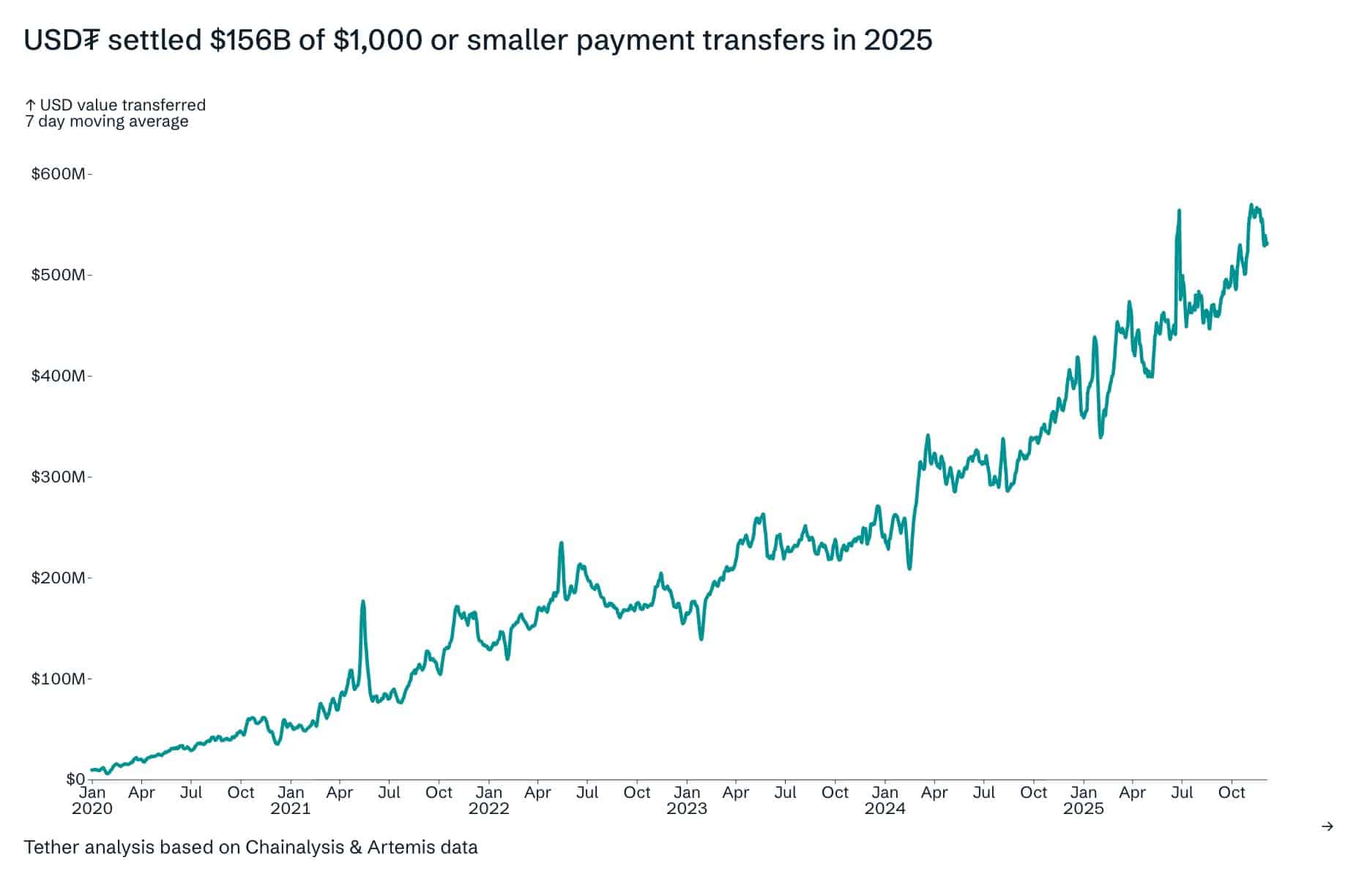
According to data shared by Tether CEO Paolo Ardoino on X, USDT settled $156 billion worth of transfers under $1,000. As the chart shows, small-value transactions have climbed steadily over the past few years, moving through 2024 and into 2025.

Source: X

The seven-day Moving Average is now consistently above $500 million, indicating high-frequency usage.

In regions where traditional banking is expensive or difficult to access, USDT has become a straightforward payment method for remittances and everyday transactions.

From payments to capital markets

That steady rise in small USDT transfers is a precursor for more.

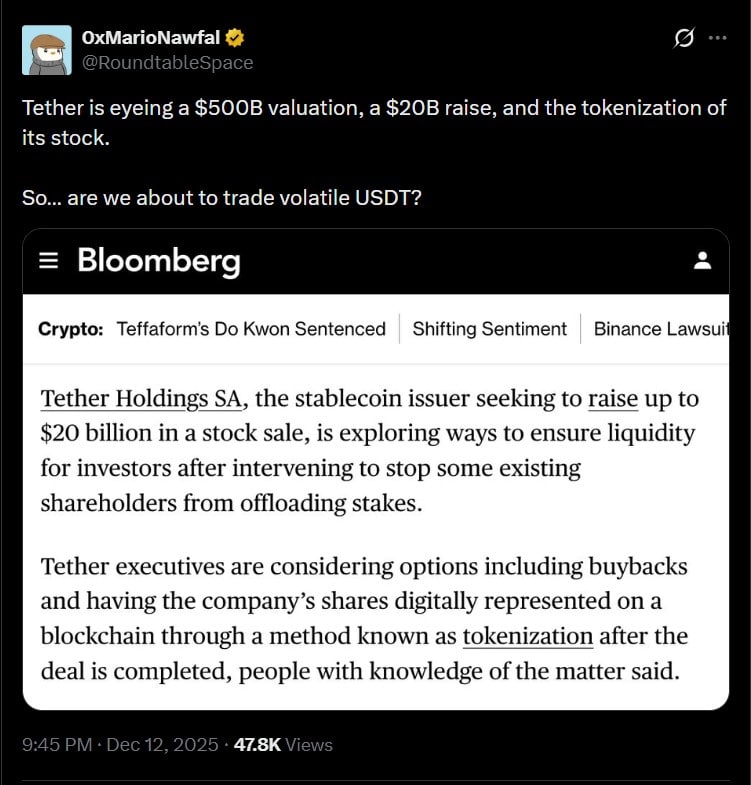
Beyond payments, the company is now eyeing the capital markets. According to a Bloomberg report, Tether is exploring a stock sale that could value the firm at around $500 billion and raise as much as $20 billion.

Executives are also considering tokenizing Tether’s shares on a blockchain to improve liquidity for investors.

Source: X

The move would take Tether from issuing the world’s largest stablecoin to turning itself into a tradeable, on-chain financial asset.

Tether beyond USDT

The company has submitted a binding all-cash proposal to acquire Exor’s 65.4% stake in Italian football giant Juventus FC, with plans to invest €1 billion into the club if the deal closes.

At the same time, Tether is pushing deeper into AI and robotics, backing an Italian humanoid robotics startup and supporting large-scale compute infrastructure for open AI development.

It is also deep in the commodity markets. In Q3 2025, Tether became the largest gold buyer outside central banks, holding 116 tonnes and driving fresh demand for tokenized gold.


Final Thoughts

  • $156 billion in small USDT transfers; Tether is becoming a global payments backbone.
  • A potential $500B valuation shows ambition to rival traditional financial giants.
Next: Analyzing MYX’s price surge – Is $3.45 the next stop?
Share
  • Share
  • Tweet

Lecturas Relacionadas

Los retiros de Bitcoin continúan: 8 años de almacenamiento en una cartera fría Coldcard terminaron en cero

Retirada de bitcoin continúa: 8 años en cartera fría Coldcard terminan en cero La cartera hardware Coldcard ha sido vulnerada, provocando una nueva oleada de retiradas de fondos de dispositivos afectados. Galaxy Research informa que el volumen total robado asciende a 1.367,05 BTC (unos 88,6 millones de dólares) desde 4.585 direcciones, superando ampliamente los 594,5 BTC reportados inicialmente el 30 de julio de 2026. La mayor parte de lo robado permanece inactiva en las direcciones de los atacantes. El problema no reside en el firmware, que ya fue actualizado por Coinkite, sino en las frases semilla (seed phrases) generadas desde marzo de 2021 debido a un error de programación. Estas frases son fácilmente descifrables, y actualizar el firmware no las cambia. Solo transferir los fondos a una nueva dirección con una nueva frase semilla elimina la vulnerabilidad. El fallo se originó al integrar la biblioteca libNgU, lo que hizo que los dispositivos dejaran de usar el generador de números aleatorios por hardware STM32 y pasaran a usar el generador software Yasmarang, inicializado con datos públicamente accesibles como el número de serie del chip. Afecta a frases semilla creadas en dispositivos Mk2/Mk3 (firmware 4.0.1–4.1.9 y hasta 5.0.3), Mk4/Mk5 (hasta v5.6.0) y Q (hasta v1.5.0Q). Se excluyen aquellas creadas con al menos 50 lanzamientos de dados independientes o una passphrase BIP-39 fuerte y única. Los usuarios deben generar una nueva frase semilla en firmware corregido y transferir sus activos. Un caso ilustrativo es el de un inversor de 39 años que perdió 2 BTC (unos 130.000 dólares) en minutos, ahorrados durante ocho años mediante trabajo físico como protección contra la hiperinflación en su país, con el objetivo de una jubilación anticipada a los 50 años. Su estrategia conservadora de "comprar y mantener en frío" se vio truncada, dejándolo devastado y decidido a abandonar las criptomonedas. Este incidente recuerda vulnerabilidades históricas por generadores de números aleatorios débiles, como la de la biblioteca BitcoinJS (2011-2015), que causó grandes pérdidas. Subraya que el almacenamiento offline no garantiza automáticamente seguridad criptográfica, especialmente cuando la entropía se ve comprometida dentro del propio dispositivo "cerrado".

cryptonews.ruHace 1 hora(s)

Los retiros de Bitcoin continúan: 8 años de almacenamiento en una cartera fría Coldcard terminaron en cero

cryptonews.ruHace 1 hora(s)

Trading

Spot
活动图片